Your Hiring Process Might Be Wrong
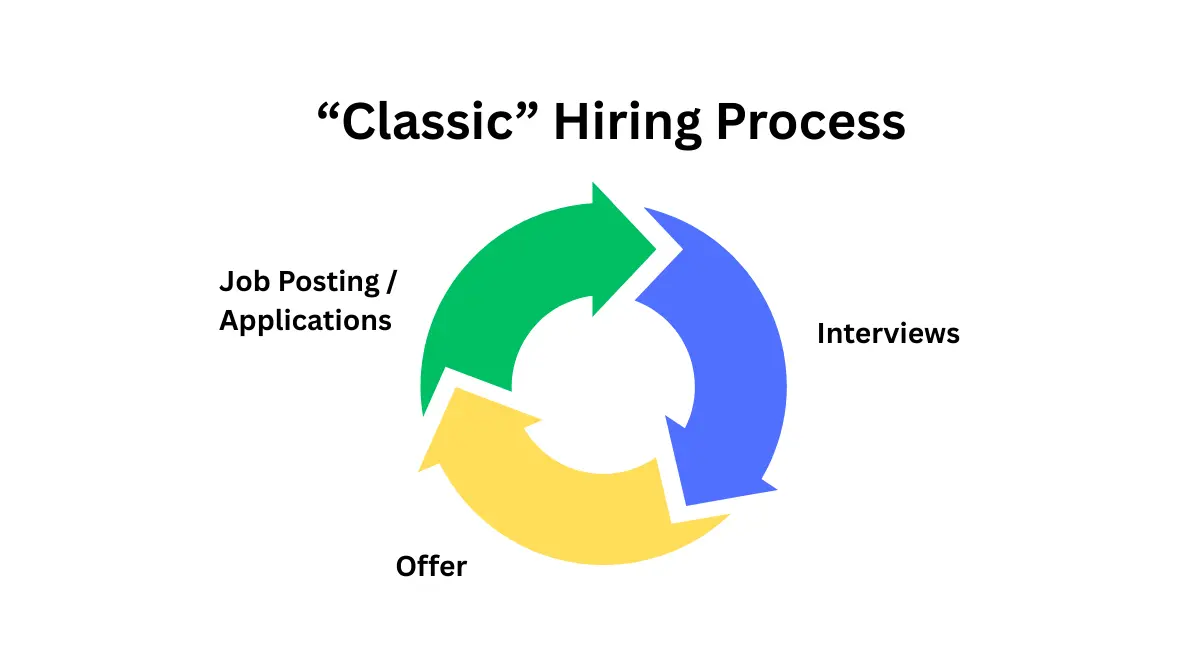
One thing that always shocked me during my career as a recruiter, is that most companies operate in the same way when it comes to hiring. They post a job, wait for applicants and start interviewing as candidates come in.
The problem with this approach is that it supposes that your job posting
alone is powerful enough to generate interest among job seekers and to fill a healthy
candidate pipeline.
In most cases, it is not. For smaller companies, without a widely
known brand, it definitely isn’t.
If you’re a SMB using this strategy, you’re probably dealing with too few
candidates, a long Time-To-Hire and a lack of visibility on
whether you’ll be
able to fill a
role.
This is because there are 2 types of hiring processes, and you’re
using the wrong
one.
Are you a Groupon or a Google?
During the second half of my recruiting career, I worked as an internal recruiter for two tech companies: Groupon (Japan office) and Google (UK, covering the EMEA region). Though both of these positions were similar in title, these jobs were completely different.
Most people want to work for a company like Google, a simple job posting would be enough to attract the best candidates in the industry and beyond. My job was therefore much more that of a filter: identify the absolute best candidates and get them in. FAANG typically has a very complex and sophisticated hiring process, with multiple interviews, using calibrated and pre-approved questions, an extensive feedbacking system and hiring committees. They can afford to apply these multiple filters and have candidates jump through hoops thanks to their huge employer brand.
In my previous position though, at Groupon, the situation was entirely different. Though this also was a known global company, the presence in Japan was limited and the service had encountered a major hiccup in the form of a nationwide delivery issue (osechi scandal). On top of that, smaller Gaishikei (foreign capital companies) without an impeccable brand are less trusted than your average local company in Japan.
As a recruiter, I couldn’t rely on job postings because relevant candidates rarely applied. I couldn’t act as a filter, and instead I became a salesperson. I had to find prospects (candidates), and sell them the opportunity well enough so that they would agree to take part in the hiring process. As you can imagine, this means a different type of hiring process that starts with Lead Generation and Sales, and then becomes a filter again.
If you’re a SMB, you’re a Groupon: you need to adapt your hiring process and
sell
first.
You need to get from this:
To this:
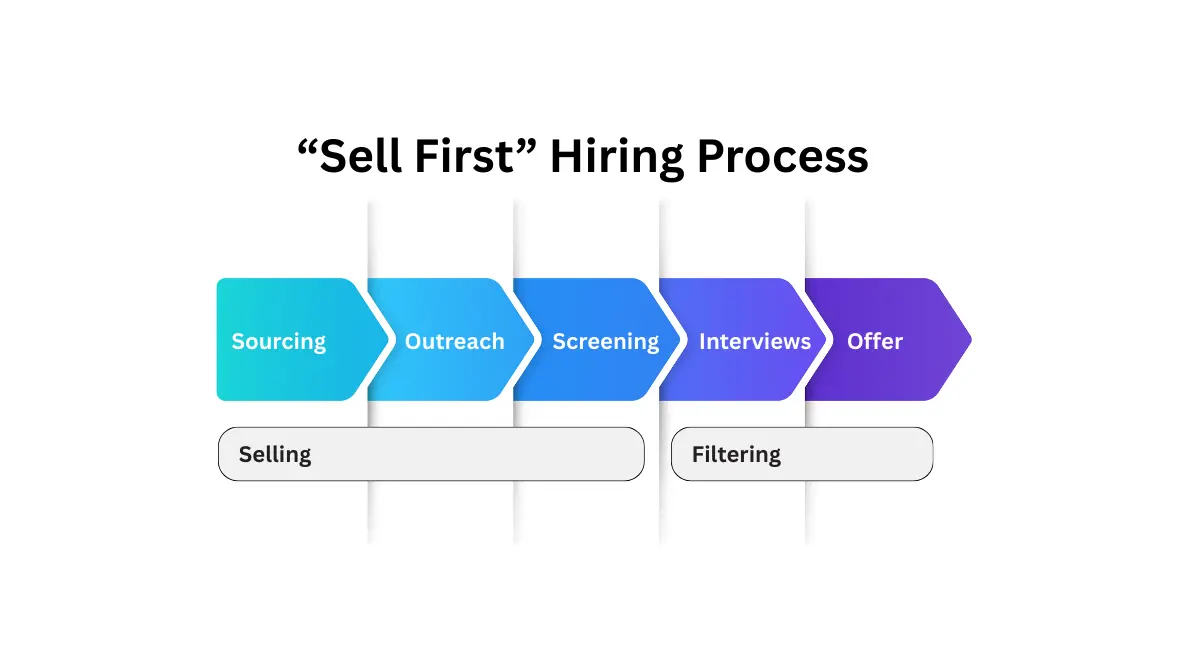
In this article, I’ll explain how my “Sell-first” Hiring Process works, by giving you a clear outline first, before diving deeper into all of its steps: sourcing, outreach, and screening.
Overview of the “Sell-first” Hiring Process
Let me get this out of the way: this type of hiring process is uncomfortable at first.
If
you’re not a salesperson at heart, reaching out to people and pitching them a job feels
harder than it seems. But before even reaching out to them, you’re going to have to
understand how to find them, and that’s a job on its own. I wrote this article as a guide to
follow so that, if you aren’t using a dedicated sourcing service like
SaiyouTeam, you can get through
it efficiently.
This guide focuses on the first 3 steps of what I call the “Sell-first” Hiring Process”, which are:
- Sourcing, which is finding and selecting candidates. In sales terms, that is “identifying prospects”.
- Outreach is getting in touch with them, the same way a salesperson “generates leads”.
- Screening is having a first conversation to assess fit and sell the opportunity to relevant candidates. Sales reps call this “qualifying a lead” before pitching.
Sourcing
In Talent Acquisition lingo, sourcing means finding what we call “passive” candidates. In contrast with candidates that apply to job ads (active candidates), these are people who haven’t expressed interest in your company.
You might think that these aren’t good candidates because they aren’t looking, but that’s not
how it works. Many of these candidates might be looking for new opportunities, or at least
considering them.
They’re just not aware that you exist, so it’s your
job (or your
recruiter’s job) to change that.
There are many platforms that facilitate sourcing (the detail of which is beyond the scope of this article), with the most well known globally being LinkedIn. In Japan, sites like Wantedly also offer similar functionalities, that is searching for candidates and reaching out to them, at the price of an "InMail" or a “Scout Mail”.
This can be a time consuming task if you don’t know how to use these tools to surface exactly the type of candidates that you’re looking for, and this is where a recruiter or sourcer’s expertise is useful.
From a strategic standpoint though, here’s an extremely important piece of advice:
You
should think of sourcing as fishing with a wide net, rather than hunting with a
rifle.
Candidate profile data tends to be incomplete or
updated, and
they
almost never
tell the entire story. Applying strict filters at this stage would eliminate
hundreds of
suitable applicants.
For example, I’ve ended up hiring amazing candidates who
only listed
their job titles on LinkedIn, while people who seemed “perfect on paper” were
disappointing
during interviews.
Again: we’re selling, not filtering, so you give “benefit of the doubt” by default, and list up all candidates that potentially are a fit. Put simply, you should start with a huge list of candidates. Filtering too early is a waste of time: you’d be analyzing every profile in detail, yet 90% of these will not reply to your outreach anyways.
The real focus on the sourcing stage should be to get as close as you can to the entire talent pool, based on your requirements. As a general idea, for a typical Software Engineering role, I like to start outreach when I’ve referenced between 500 and 1,000 candidates.
It’s also better to do all the sourcing work upfront for 2 reasons:
(1) You ideally want all candidates to progress through the different stages of your hiring process within the same timeline, so don’t encounter situations when you’re making a final stage candidate wait while you’re rushing to screen a new candidate you’ve just reached out too.
(2) You’ll make much better hiring decisions when you have all the data. That is at first knowing the extent of your talent pool. For example, if you can’t list 200-500 candidates who fit your requirements, it means your requirements are too strict.
At SaiyouTeam, sourcing candidates is what we specialize in, so reach out to us if you want help!
- You should set the widest possible filters when searching for candidates and start with an extensive list (ideally 500 candidates) to make sure that your future hire is in the mix.
- This also allows you to make better decisions based on more complete profile data and with visibility on the entire talent pool.
Outreach
Next comes the time to make yourself known.
First of all, let’s talk about who should be doing the outreach. You’re not a famous brand, and because you’re reaching out to people who don’t know you. To put your best foot forward, the one doing the outreach should be the person with the most authority and credibility.
For companies of under 30 people, I recommend that the CEO do the
outreach.
If yours is between 30 and 80 people, you can ask the hiring
manager or a
dedicated recruiter.
The reason is simple: candidates will be more responsive to a CEO
who is taking the time to reach out, rather than a rank and file employee. This is
especially true for countries like Japan which place important value on
hierarchy and one’s
role within the group.
Another important point is to tailor your messaging to specific candidates. This shows them
that you’re not just reaching out to anyone, and that you are contacting them
specifically.
Your outreach message should explain why you think they are
relevant to
your opening, and what’s in it for them. This means the USP of the
role, whether it’s the
career advancement opportunity or vacation policy.
I advise you to send a copy of the job description with a salary range. Not only is it standard for compliance in Japan, but because a candidate’s number 1 question is about salary. It should be answered right away. No need to trick them: if the salary on offer is too low, they will tell you and you will both save a lot of time. On top of that, this allows you to conduct actual market research and benchmark your offer directly with your talent pool.
Lastly, your outreach should include an invitation to a 15-20 minutes call within the same week. I’d recommend phrasing it as an “informational” call rather than an interview, so that it doesn’t feel like a test or a commitment that requires preparation on their behalf.
- Ask the most senior person (CEO or hiring manager) to contact candidates and make the outreach message attractive, by listing salary and benefits as well as any other unique selling points.
- Only make a small ask, by offering a 15-20 minutes informative call within the next few days.
Screening
I’ve called this phase “screening”, because this is the industry-standard term to describe a
first introductory call that happens before the formal interview process.
Make no mistake
though, this is more about selling than filtering (hopefully, you’re
starting to see
the pattern here 😉)
It should 2 purposes:
- (1) Assess fit lightly. This means reaching a quick understanding of their background, skills, current situation and interest.
- (2) If the candidate is a potential interviewee, your job is to sell them the opportunity.
Assessing Fit
The only filtering you’ll do here is to understand whether the candidate’s profile is relevant to the role. You are not testing them or asking challenging questions, because they’re still a “cold prospect”. At this stage, you only want to make sure you’re speaking to the right type of candidate. The question in your mind should be “are they worth interviewing?”.
The nuance might be a bit tricky here, so practically speaking you should ask general questions about their journey so far, an outline of their most recent or relevant experience and what they are trying to accomplish next. If that fits your general criteria, then switch to selling the role!
Selling The Opportunity
Keep in mind that you’re the one who reached out first and that the candidate most likely didn’t know you before that. You should therefore make the call about them, explain your business and the role clearly and be prepared to answer their questions. This call should be mostly informational for them.
Emphasize on your strong points, whether it is the career opportunity, benefits, work atmosphere or manager. You should think of the position as an offer, and identify the aspects that might feel attractive to the right candidate.
Book the interview on the spot
Here’s an extremely valuable piece of advice. If you feel like they are interested, try booking an interview on the spot. This is the “strike the iron while it’s warm” principle: the easiest time to get their commitment is during the interview call.
This might feel too “forward” to you, but this is what great salespeople preach, and what recruiters do for a living.
- You should only assess general fit, and spend most of the time selling the opportunity.
- If possible, book the interview during the phone call to maximize results.
Interviewing
Once the screening phase is completed and you’ve booked interviews, candidates have agreed to
be tested properly. This is when you can request a resume, and start conducting
formal
interviews.
This is the “classic” part of the hiring process where you get
to finally
turn the tables and ask difficult questions.
You’ve by now maximized the volume of your
talent pool and generated as many relevant candidacies as possible, which puts you in the
best possible situation to make a great hire.
You’ll have reached a clear
understanding
of your talent pool and the level of human resource you can actually attract,
so that you
can identify the right trade offs. Because you’ve run a hiring process structured in phases,
you also have clarity on the time it will take for you to fill your open
position (also called "Time-To-Hire")
This is in essence what internal recruiters do for top companies, in addition to providing strategic advice to hiring managers, improving candidate experience, optimizing hiring effectiveness and tracking key recruitment metrics (KPIs). Because SMBs like yours don’t have the same resources as Google does, I’ve launched SaiyouTeam to provide the same service, on-demand, and at the fraction of the cost of an agency recruiter. We offer free strategy calls, so don’t hesitate to reach out!