When companies begin hiring engineers in Japan, many quickly run into the same challenges.
They post job openings, yet receive few or no applications.
Recruitment agencies introduce candidates, but:
- They are often the same candidates already being pursued by competing companies.
- Hiring processes drag on for months before a decision is made.
- Internal development capabilities fail to grow, leaving firms dependent on external vendors.
- Even increasing salary offers does little to significantly improve results.
These issues are often explained away as an “IT talent shortage.”
But is it really just a simple shortage of headcount?
In reality, the difficulty of IT hiring in Japan stems from a market structure that differs
from overseas markets.
What is lacking is not merely the number of people, but the specific layer of talent that
companies are seeking.
This article draws on publicly available data and market dynamics to clarify:
- What exactly is in short supply
- Why companies struggle to hire
- What strategic choices organizations should consider
Through this lens, we explore the true nature of Japan’s IT talent shortage.
1–1. Japan’s IT Workforce Is Divided into Three Distinct Layers
Japan’s IT talent shortage is not uniform.
Although it is often described broadly as a lack of “IT talent,” the reality is that the
market is clearly divided into three distinct layers.
| Talent Layer | Market Situation |
|---|---|
| Traditional IT talent (maintenance, operations, legacy) | Available in steady numbers |
| Job-ready practical engineers | In short supply |
| Advanced IT talent (value creation and transformation) | Critically scarce |
First, there is a stable pool of traditional IT professionals who handle maintenance,
operations, and conventional system development.
Many Japanese companies still rely heavily on legacy systems, and the workforce needed to
maintain and operate these systems does exist in the market.
However, engineers who can contribute immediately as practical, hands-on contributors in modern environments are in short supply.
More critically, advanced IT professionals who can leverage cloud and AI technologies, create new business value, and drive organizational transformation are severely lacking.
In other words, Japan has people who can “keep systems running,” but lacks sufficient talent who can “create value and lead transformation.”
The most acute shortages are concentrated in the following areas:
- Cloud
- Cybersecurity
- AI and Machine Learning
- Data utilization and analytics
- Digital transformation leadership (Product Managers and IT consultants)
These fields are directly tied to corporate competitiveness and long-term growth. Demand is high, yet supply in the market remains limited.
1–2. Japan’s IT Talent Shortage and the Supply–Demand Gap: A Data Perspective
Japan’s IT talent shortage is also reflected in official government data.
According to a March 2019 study by the Ministry of Economy, Trade and Industry titled “Survey on IT Human Resource Supply and Demand,” Japan could face a shortage of up to approximately 790,000 IT professionals by 2030.
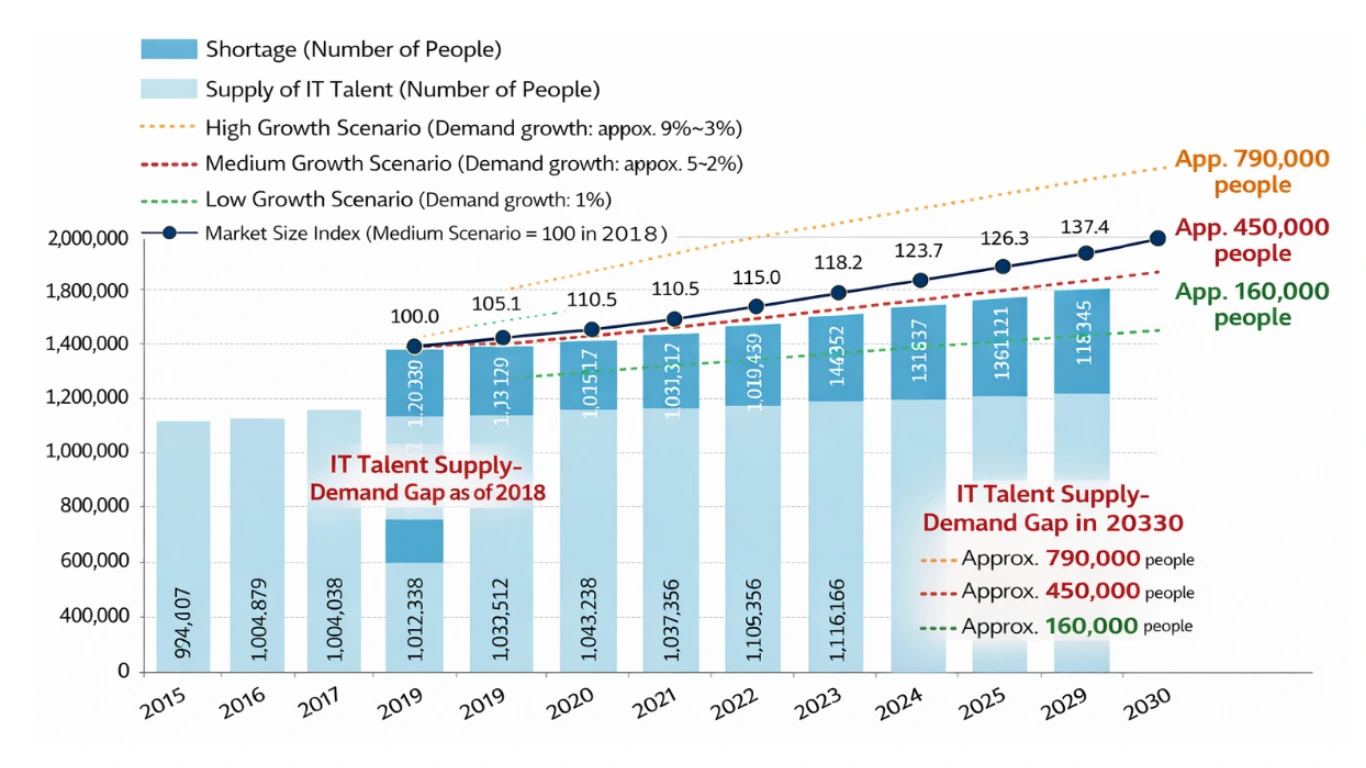
Source: Ministry of Economy, Trade and Industry, “Survey on IT Human Resource Supply and Demand” (March 2019)
At first glance, this figure suggests a broad numerical shortage of IT workers. However, the
shortage does not apply equally across all types of IT talent.
The core gap lies in highly skilled professionals responsible for cloud computing, AI, and
data utilization. Traditional IT personnel focused on maintenance and operations are not
experiencing shortages at the same level.
What the data actually shows is that supply growth is failing to keep pace with rising
demand.
In particular, the gap between supply and demand is widening in advanced IT fields such as
cloud and AI.
In other words, what companies are facing is not simply an overall shortage of headcount,
but a mismatch between the skills they require and the talent currently available in the
market.
1–3. The Rapid Growth of IT Demand Is Driving the Talent Shortage
According to the Ministry of Internal Affairs and Communications’ Information and Communications White Paper, domestic data traffic in Japan has been steadily increasing since 2015.
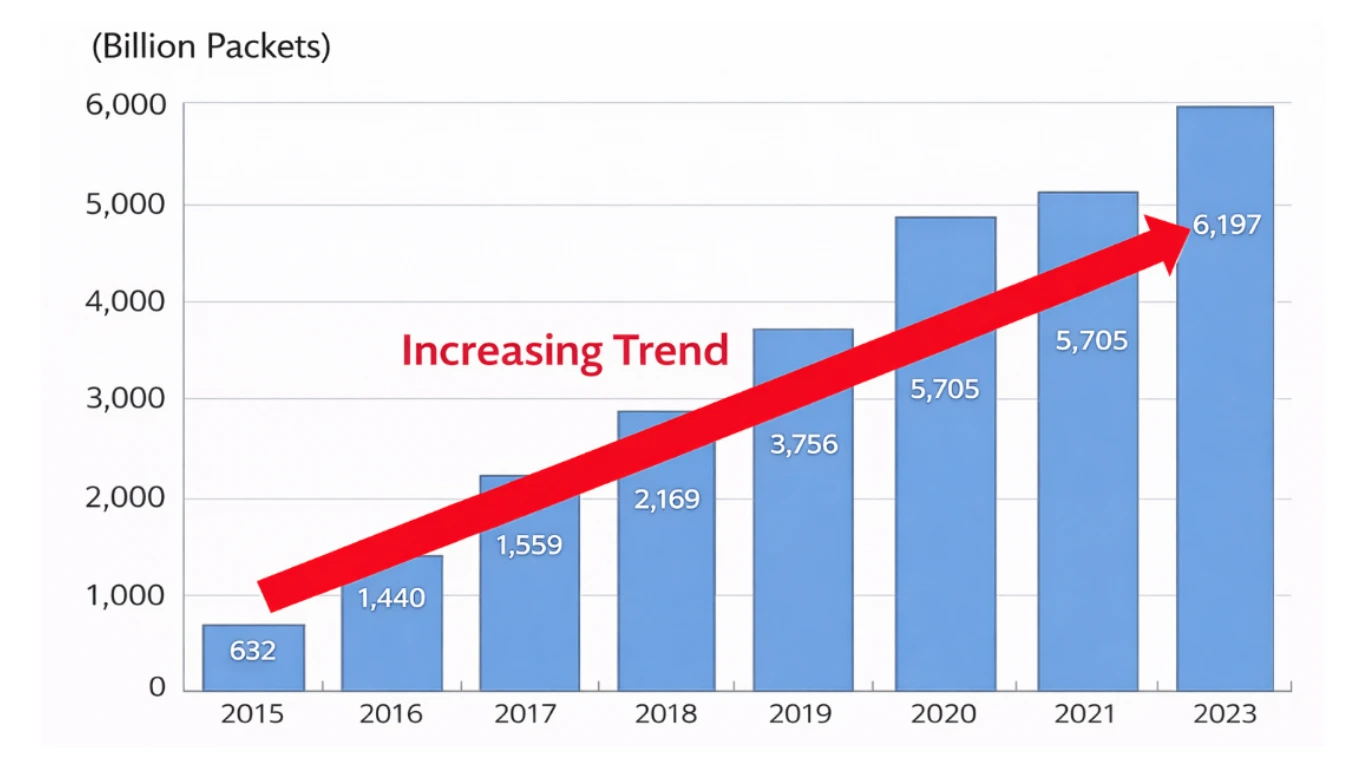
Source: Ministry of Internal Affairs and Communications, 2024 Information and Communications White Paper
An increase in data traffic means that more services and business operations rely on the
exchange of data.
As more work is conducted over the internet and in the cloud, IT is no longer confined to
specialized departments. It has become the infrastructure that supports company-wide
operations.
As a result, demand for professionals who can work with cloud technologies and business
systems has continued to rise.
Furthermore, according to doda’s Job Offer-to-Applicant Ratio Report (October 2025), the
job-to-applicant ratio for IT and telecommunications roles reached 6.70.
This far exceeds the overall average of 2.50, clearly indicating extremely strong employer
demand.
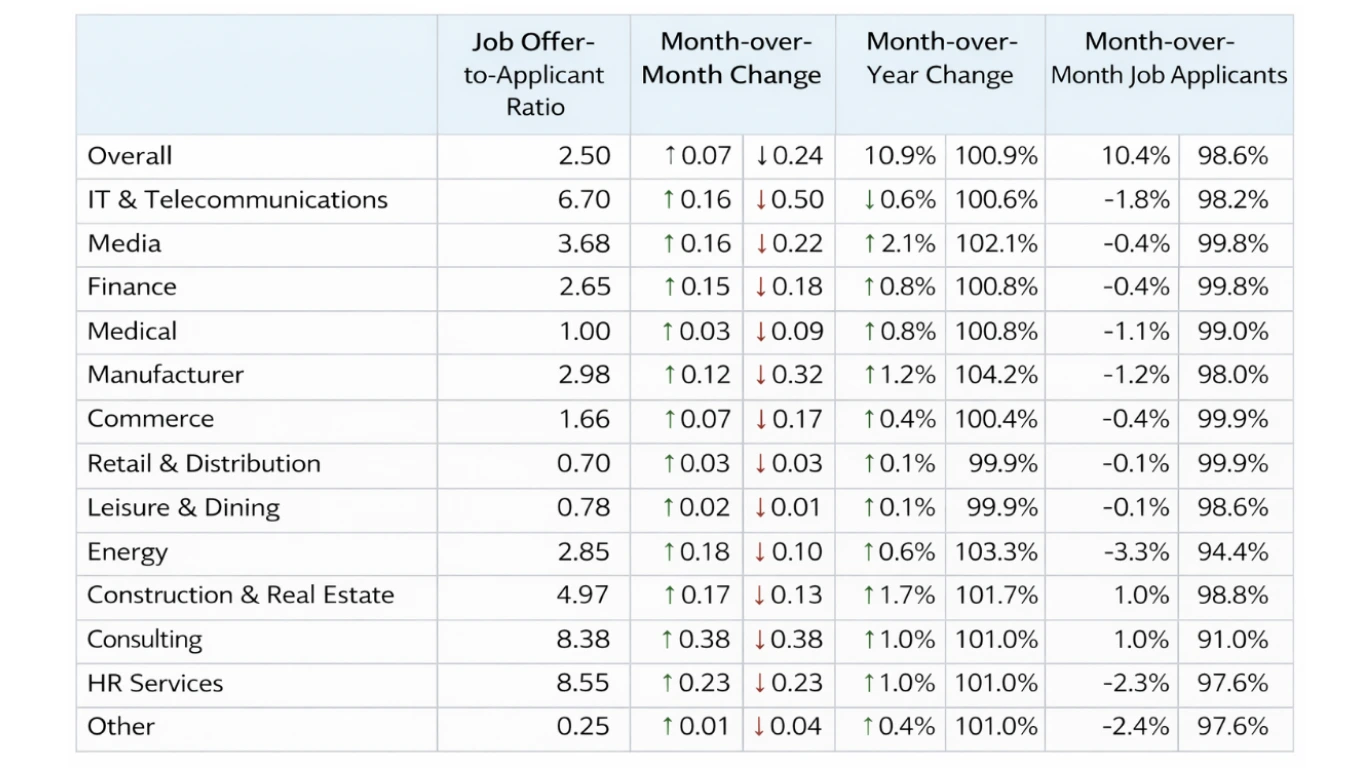
Source: doda, Industry-Specific Job Offer-to-Applicant Ratio Data (October 2025)
Because many companies limit hiring to immediately productive, job-ready candidates,
applicants without direct experience or those requiring training are often screened out
early. As a result, even though there are people who want to work in IT, companies continue
to feel they “cannot hire” due to a mismatch between required skills and available
talent.
In this way, Japan’s difficulty in IT hiring is not simply a matter of insufficient
headcount. It is the result of multiple structural factors overlapping.
So what exactly are those factors?
2. Why Is the IT Talent Shortage Occurring?
Japan’s IT talent shortage is not caused by a single factor. It is the result of multiple structural forces overlapping.
(A) Shrinking Labor Supply
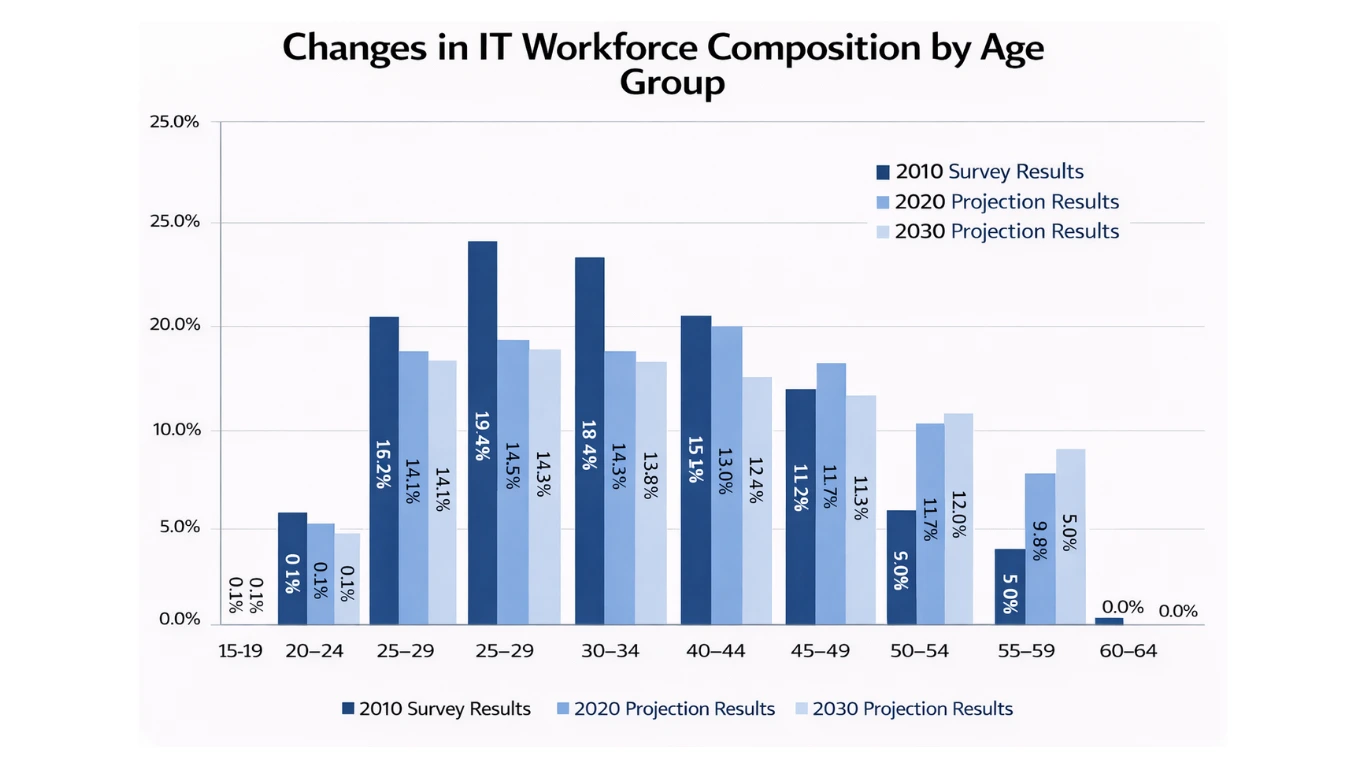
Japan’s declining birthrate and aging population are affecting the IT workforce as well. According to estimates by the Ministry of Economy, Trade and Industry, the supply of IT professionals peaked around 2019 and is projected to enter a downward trend thereafter.
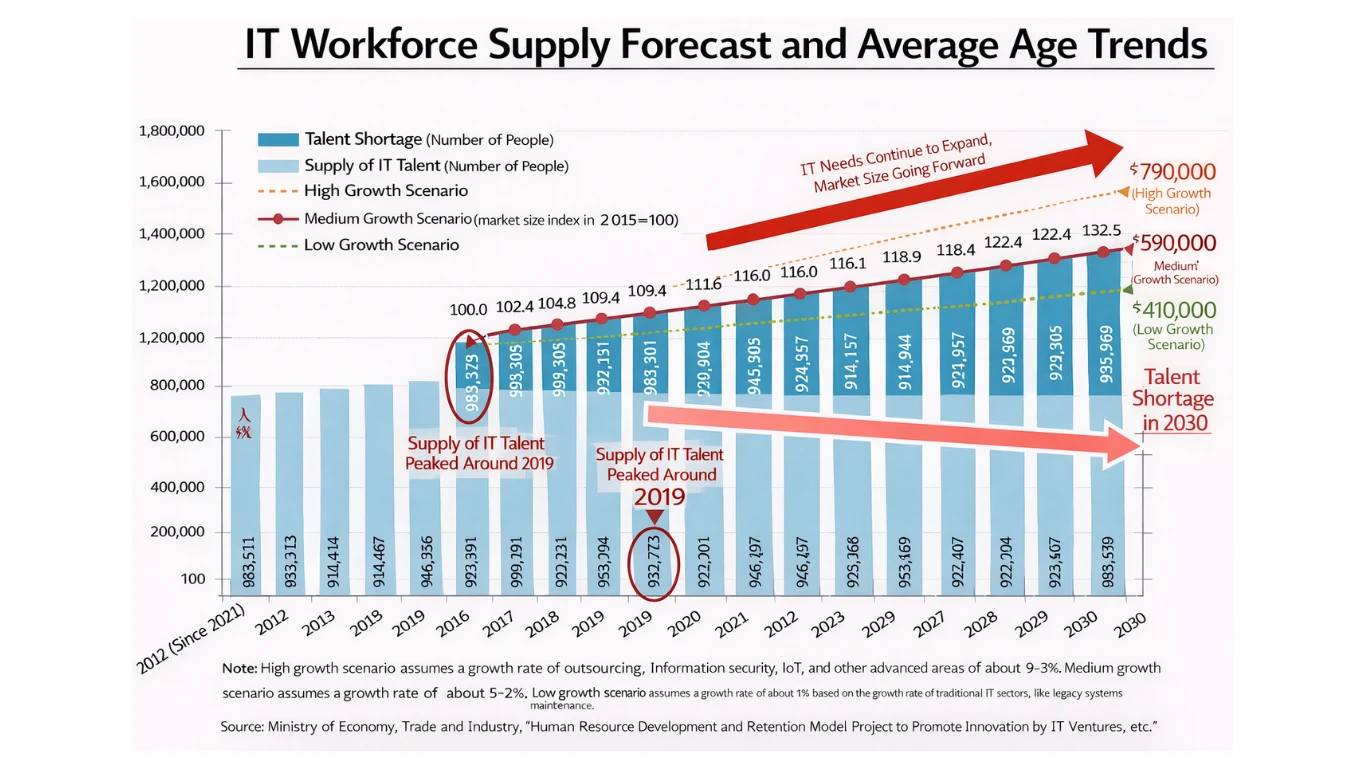
Source: Ministry of Economy, Trade and Industry, Human Resource Development and Retention Model Project to Promote Innovation by IT Ventures, etc.
In addition, the proportion of younger workers is decreasing, while the share of
professionals aged 50 and above is rising. As retirements increase in the coming years, the
overall number of IT professionals may continue to decline.
While demographic change is certainly one contributing factor, it does not fully explain the
difficulty in hiring.
The core issue is not simply the number of people, but the mismatch between the skills the
market demands and the talent currently available.
(B) Changes in the Structure of Demand
In the past, IT was primarily handled by IT companies or internal information systems
departments.
Today, however, companies across all industries rely on IT to operate their business
processes and deliver services.
As a result, IT professionals are no longer needed only within specific sectors. They are
now essential across virtually every industry.
The expansion in demand is driven by initiatives such as:
- Digital transformation (DX)
- Migration to the cloud
- Advanced data utilization
- AI adoption
- Strengthening cybersecurity
These are not temporary investments. They are directly tied to corporate competitiveness and
business continuity.
Consequently, demand for IT talent is rising across manufacturing, retail, finance, and many
other industries.
Although supply has increased to some extent, demand continues to grow at a faster pace.
(C) Talent Concentration in Legacy Systems
In Japan, a significant number of IT professionals are engaged in maintaining and operating
long-standing core systems and business applications.
As a result:
- It is difficult to reallocate talent to emerging fields such as cloud and AI.
- Opportunities to gain hands-on experience with advanced technologies are limited.
- It becomes harder to cultivate highly skilled, next-generation professionals.
Because companies cannot simply shut down their existing systems, many engineers remain
focused on maintenance and operations. This limits their ability to gain meaningful
experience in newer technological domains.
Consequently, the overall growth of advanced IT talent across the market remains
constrained.
(D) An Environment Where Talent Development Is Difficult to Sustain
From the corporate perspective, there are several challenges:
- Employees may leave for other companies even after receiving training.
- It is difficult to fully recover the costs invested in education and skill development.
As a result, companies tend to prioritize hiring job-ready professionals who can deliver
immediate results rather than investing in long-term talent development.
On the other hand, while educational institutions and training providers can teach
foundational knowledge, it is far more difficult to provide the hands-on, practical
experience required in real-world business environments.
Source: Ministry of Economy, Trade and Industry, International Comparative Survey on IT Human Resources (June 2016)
Although the study is somewhat dated, it illustrates a persistent structural trend.
Consequently:
- Companies become increasingly cautious about investing in training.
- Inexperienced candidates struggle to gain opportunities to build practical experience.
This dynamic reinforces dependence on immediately productive talent and further widens the
supply–demand mismatch.
Compounding the issue is the rapid pace of technological change.
(E) The Speed of Technological Change
In fields such as AI, cloud computing, and cybersecurity, the technologies and knowledge
required evolve rapidly. As a result, relying solely on previously acquired skills is no
longer sufficient. Continuous upskilling and reskilling have become essential.
In fact, approximately 43% of companies report that employee skill gaps have already become
apparent, and roughly 80% believe those gaps will widen within the next five years.
If organizational training and hiring practices fail to keep pace with technological change, the shortage of professionals with the necessary skills will continue to deepen.
(F) Industry Structure
In Japan’s IT industry, a multi-layered subcontracting structure is common. A prime
contractor sits at the top, with multiple layers of subcontractors beneath it, while
development and operations are often handled by lower-tier companies.
Under this structure:
- Work tends to be highly fragmented
- Individual responsibilities are narrowly defined
- Experience and know-how often remain dependent on specific individuals
In addition, work processes and design standards are not always unified across organizations,
making it difficult to systematically share knowledge and expertise within teams.
As a result, it is not easy for inexperienced or junior professionals to become fully
productive in a short period of time. Simply increasing headcount does not immediately
translate into higher productivity.
3. What Companies Are Experiencing
According to a survey by Japan’s Ministry of Internal Affairs and Communications, the biggest challenge Japanese companies face in advancing digitalization is “talent shortages,” cited by 67.6% of respondents.
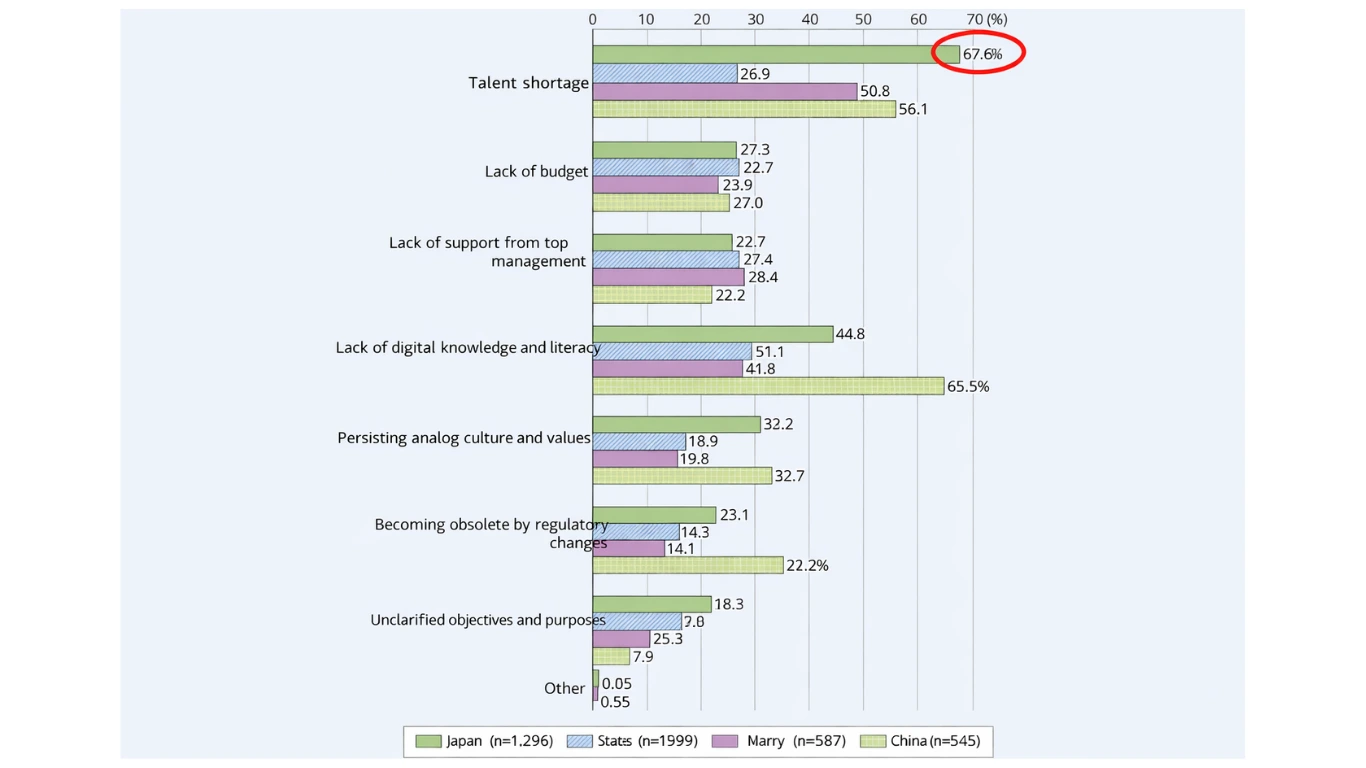
Source: Ministry of Internal Affairs and Communications, Survey on Research and Development Trends in Advanced ICT and Digital Utilization in Japan and Overseas (2022)
Business Impact
- Projects exist but cannot be launched due to lack of personnel
- Internal development does not progress, leading to continued reliance on external vendors
- DX initiatives fail to move forward as planned
Risk Impact
- Security measures are postponed
- Replacement of legacy systems is delayed
Labor Market Impact
- The seller’s market continues
- Dependence on experienced professionals intensifies
- Hiring costs rise
There are inexperienced candidates and job seekers in the market. However, the number of
professionals who possess the specific skills companies require is limited. This mismatch
has led some to question whether the “IT talent shortage” truly exists.
So what is it that companies are actually lacking?
4. The Shortage of IT Engineers and the Shortage of IT Talent Are Different Issues
The shortage of IT engineers and the shortage of IT talent are not the same problem.
What companies are seeking is not only developers, but individuals who can lead organizational change.
| IT Engineer | Primarily a technical implementer responsible for system development and operations. |
| IT Talent | Includes engineers, but also professionals who can lead projects and business and organizational transformation. |
If companies proceed with hiring without clearly understanding this distinction, the desired candidate profile becomes vague, and mismatches are likely to occur repeatedly.
5. How Companies Are Responding in Practice
Companies are taking various measures to address the issue. However, a fundamental challenge
remains: many organizations do not yet have sufficient systems in place to recruit or
develop digital talent.
According to a survey by Japan’s Ministry of Internal Affairs and Communications, roughly
40% of Japanese companies report that they do not have adequate structures for hiring or
developing digital professionals.
1) Developing Talent Internally
- Reskilling initiatives
- In-house training programs
- Transitioning non-IT staff into IT roles
This approach raises the IT skill level of existing employees. However, without a continuous development plan, training often ends as a one-time program rather than a sustained effort.
2) Leveraging External Resources
- Freelancers
- Temporary staffing / SES
- Outsourcing
- Offshoring
Securing talent externally can quickly fill immediate gaps. However, knowledge and expertise
are less likely to accumulate within the organization.
Internal development takes time, while external utilization makes it harder to retain skills
in-house. As a result, relying solely on one approach makes it difficult to resolve the
talent shortage.
6. Putting It All Together
Japan’s IT talent shortage is the result of multiple overlapping factors:
- Shrinking labor supply
- Expanding IT demand
- Concentration of talent in legacy systems
- An environment where talent development is difficult to sustain
- The rapid pace of technological change
In addition, national policy frameworks position the development and retention of digital talent as a priority area.
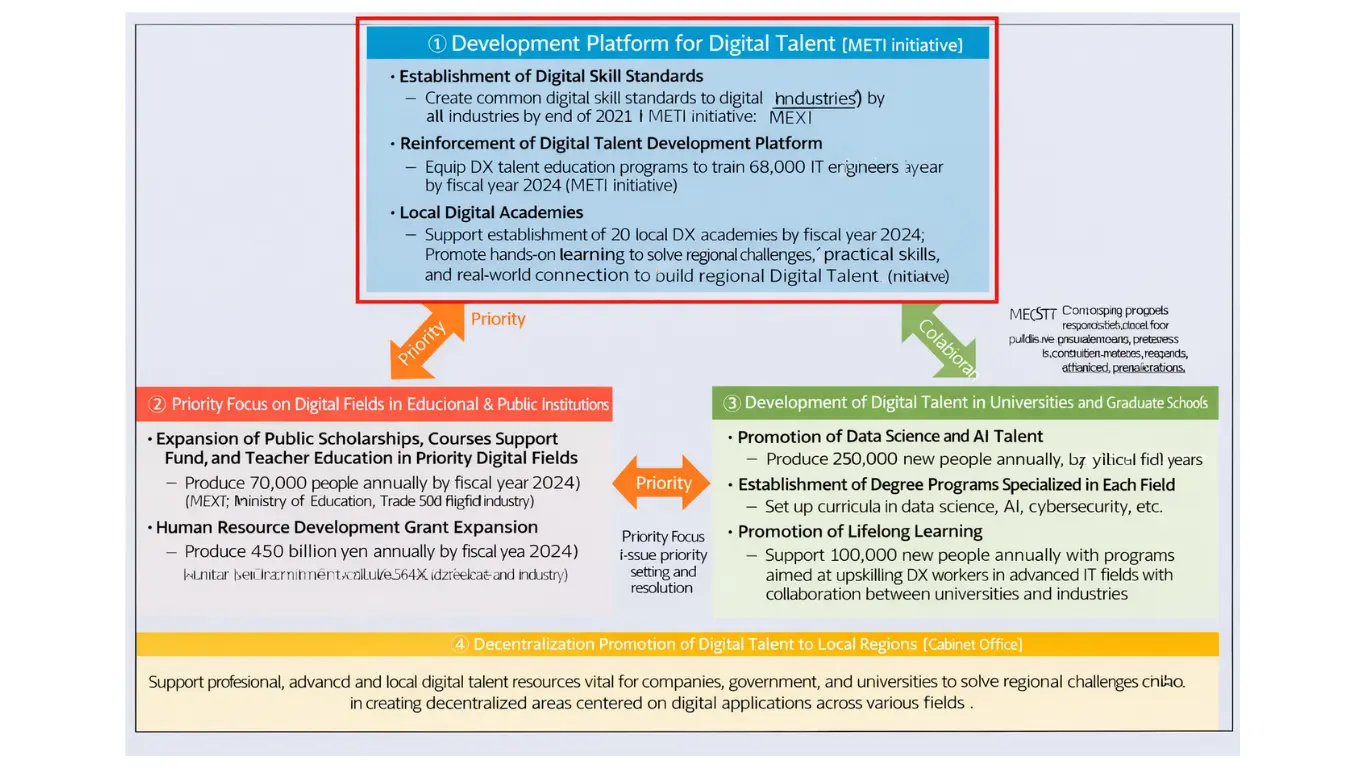
Source: Cabinet Office, Basic Policy for the Digital Garden City Nation Initiative
As these factors progress simultaneously, they create conditions in which professionals with advanced skills are especially likely to become scarce.
The True Nature of Japan’s IT Talent Shortage
Japan’s IT talent shortage is not simply a matter of headcount.
What is lacking are professionals who can create value and drive transformation forward.
Increasing hiring numbers without understanding the underlying structure will not solve the
problem.
By correctly identifying what is actually missing, organizations can take realistic and
balanced actions that combine recruitment, talent development, external partnerships, and
operational efficiency improvements.
The IT talent shortage is neither a rumor nor a misunderstanding. It is a structural
challenge arising from multiple overlapping factors.
What matters most is accurately identifying the specific capabilities that are truly
lacking.