What are the differences between recruitment services?
Many companies may find themselves unsure about which services to use when proceeding with hiring. Because each service operates under a different structure, the way costs are incurred, how they are used, and the points to be mindful of also differ. If used without understanding these differences, you may end up choosing methods that do not suit their needs, incurring higher-than-expected costs, or overlooking contractual terms and legal considerations.
In this article, we categorize recruitment support services in Japan into four types:
- Recruitment agencies
- Job media (job advertisements, job search engines, and job information provision services)
- Recruiting Process Outsourcing (RPO) (like SaiyouTeam)
- Temporary staffing
For each, we’ll detail their structures, costs, strengths, and key considerations.
1. Recruitment Agency (Paid Employment Placement)
A recruitment agency is a service in which the agency acts as an intermediary between a hiring company and a job seeker, conducting matching and coordinating the selection process with the aim of hiring, and facilitating the conclusion of an employment contract. The actual employment contract is not made with the agency, but directly between the company and the job seeker. Under Japanese labor law, a business that carries out such “intermediation” is classified as employment placement.
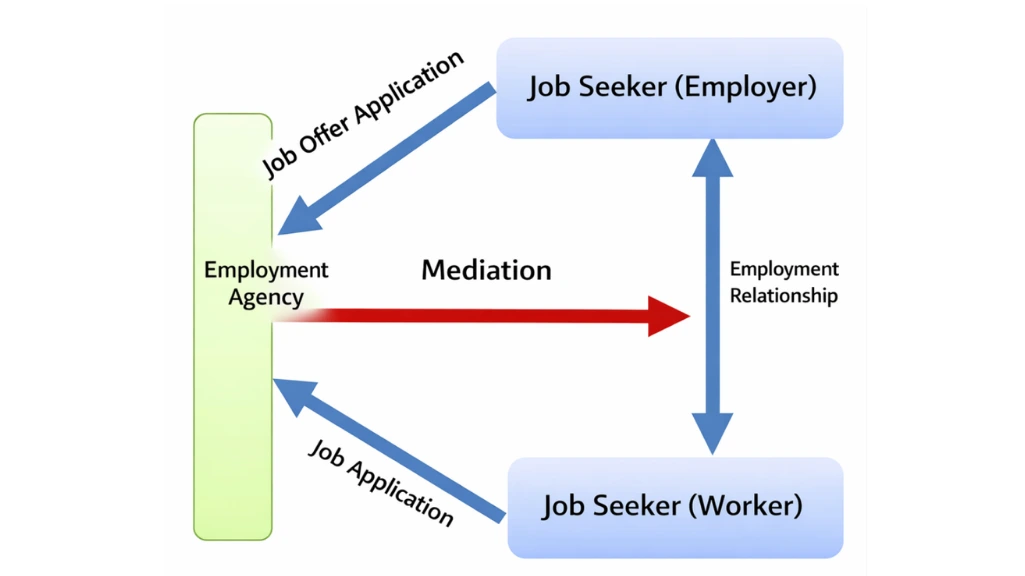
Source: Ministry of Health, Labour and Welfare, “Employment Placement and Worker Dispatch” (July 10, 2023), Material 1-2
When is it used?
Recruitment agencies are more commonly used when companies want to hire candidates with specific experience or skills, rather than to attract a large number of applicants. They are particularly utilized for hard-to-fill positions, specialized roles, managerial positions, or roles that need to be filled urgently.
A key feature is that you can delegate a few steps of the process for which you may not have expertise. That's typically candidate sourcing, recommendations, interview scheduling, and offer negotiations.
Fee Structure
In recruitment agency services, the process typically proceeds through candidate introduction, selection, and hiring. The placement fee is generally incurred only once a hire is successfully made. In many cases, there are no upfront costs at the start of recruitment or at the time of candidate introduction, and refund policies may be in place to account for early resignation after joining.
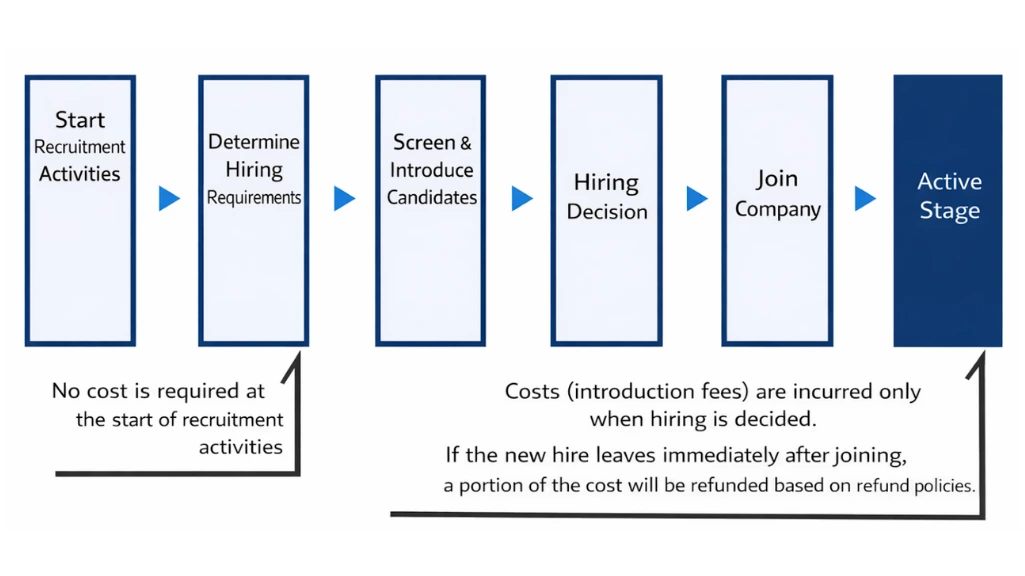
Source: for Agents, Inc., “What is Employment Placement?” (October 22, 2024)
Typical Fees
Placement fees are generally calculated by applying a fixed percentage to the candidate’s expected annual salary, with a typical range of around 30–35%. For example, if the expected annual salary is 5 million yen, the fee would typically be around 1.5 to 1.75 million yen. However, actual rates and terms vary by agency, so it is important to confirm details such as how the expected annual salary is defined, refund conditions, and whether penalty clauses apply when signing the contract. From April 1, 2025, agencies are also required to disclose fee performance data and clearly state any penalty clauses in advance.
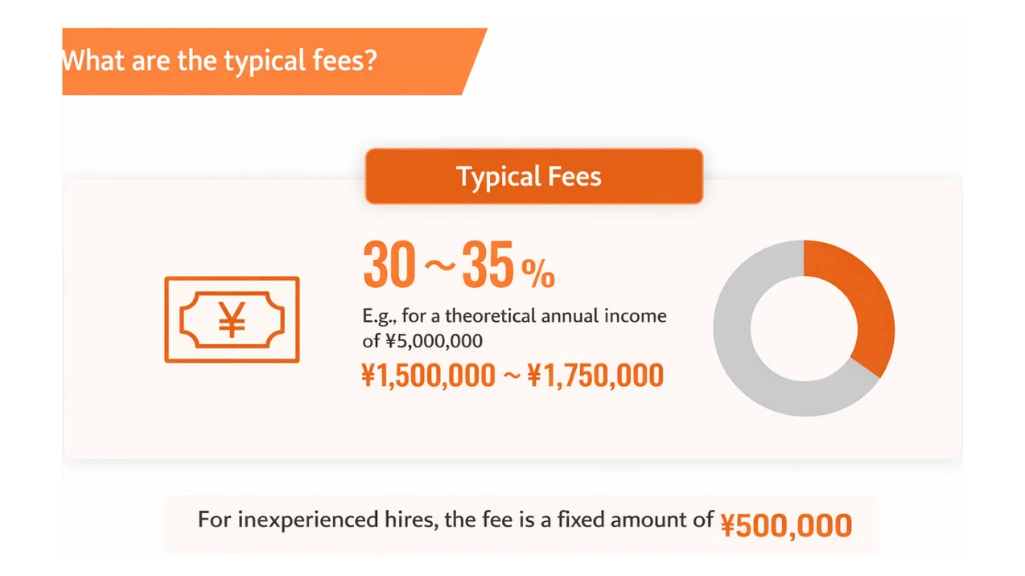
Source: Recruit Marker, “Explaining the Typical Fee Levels for Employment Placement Services” (September 15, 2025)
When Recruitment Agencies Are a Good Fit
- When the number of hires is small but quality is a priority.
- When hiring for difficult-to-fill roles or experienced professionals
- When there are limited in-house recruiting resources and candidate sourcing or coordination needs to be outsourced
- When there are positions that need to be filled urgently
Strengths and Considerations of Recruitment Agencies
Recruitment agencies are strong in that they allow companies to delegate a wide range of tasks, from candidate sourcing to interview coordination and offer negotiation, making them particularly useful for specialized roles or urgent hiring needs. On the other hand, fees tend to be high, and there can be differences in expertise and candidate quality between agencies, so it is important to carefully evaluate which agency to work with. Generally, it is be best option for large companies with established brands, which can handle the costs and will benefit from working with multiple agencies.
Common Mismatches
Common challenges in using recruitment agencies often arise not from the introductions themselves, but from misaligned expectations. For example, if job requirements are too broad, if there is a mismatch between the expectations of the hiring team and management, or if the agency does not fully understand the company’s business or the role, issues may occur. These can include receiving many similar candidates, having a high volume of introductions but low interview pass rates, or feeling that the results do not justify the fees. Another common complaint is the lack of predictability, transparency and professionalism with a number of agencies.
Key takeaway
Recruitment agencies make the most sense when you need targeted hiring support and are willing to pay for introductions that can save time. The trade-off is that the fee is high enough that the service can get expensive very quickly.
2. Job Media (Job Advertisements, Job Search Engines, and Job Information Provision Services)
Job media refers to services that allow companies to post their job information and deliver it to job seekers. This includes job sites, job search engines, and services linked to company recruitment pages.
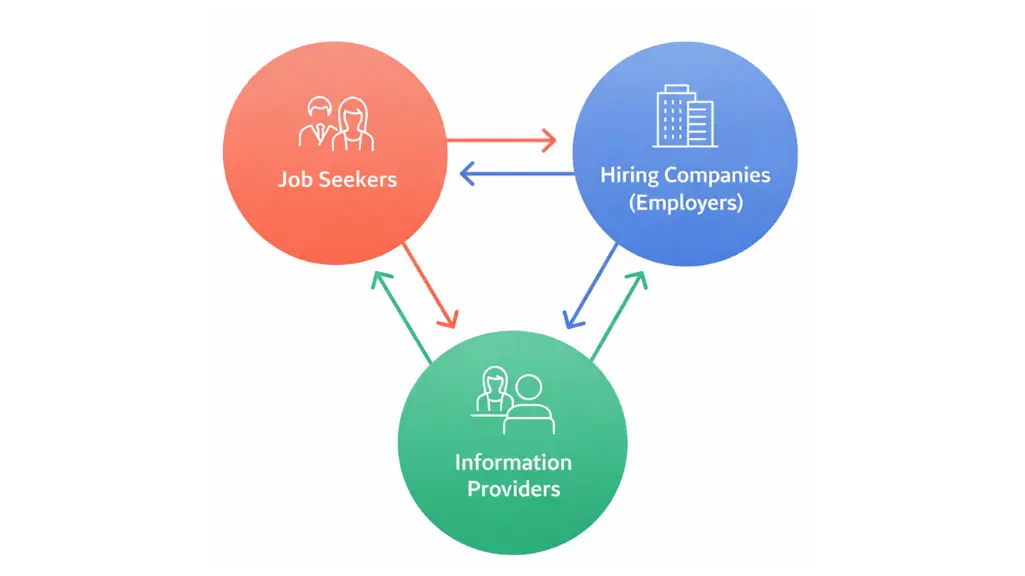
Source: Ministry of Health, Labour and Welfare, “Certification System for Excellent Recruitment Information Provision Service Providers” official website
When is it used?
Job media is commonly used when companies want to publish job postings and attract applicants, rather than having specific candidates sourced individually. It is often utilized when hiring in relatively larger numbers, when the goal is to first gather applications, or when companies want to increase visibility of their job opportunities as part of employer branding and recruitment marketing.
It is particularly well-suited for roles such as sales, administrative positions, retail roles, early-career hiring, and entry-level hiring, where attracting a steady volume of applicants and selecting from them is effective.
Fee Structure
The fee structure for job media varies depending on the platform, but common models include posting-based fees, pay-per-click fees, pay-per-application fees, and pay-per-hire fees. For example, Indeed Sponsored Jobs uses a pay-per-click model, in which charges are incurred when a job posting is clicked, allowing companies to manage campaigns while setting their own budget limits.
There are also platforms that charge a fee for posting a job for a fixed period of time. On the other hand, some services allow companies to start posting jobs for free. Unlike recruitment agencies, where fees are typically incurred only when a hire is made, job media often involves costs tied to job posting visibility or applicant acquisition.
| Service Name | Pricing Model | Posting Fee | Success Fee |
|---|---|---|---|
| Hello Work | Completely Free Model | Free | ー |
| Indeed | Partially Free Model | ¥15〜¥999 per click | ー |
| Jimoty | Partially Free Model | From ¥0 | ー |
| Wantedly | Posting Fee Model | From ¥300,000 | ー |
| Hatarako.net | Posting Fee Model | From ¥88,000 (Greater Tokyo Area / 4 Weeks) | ー |
| Work Gate | Pay-per-Application Model | From ¥3,300 per application | ー |
When Job Media Is a Good Fit
- When you want to first attract a wide range of applicants
- When hiring in relatively larger numbers
- When the goal is to gather applicants over a certain period rather than fill roles urgently
- When you have the internal capacity to handle applications and coordinate interviews
- When you also want to strengthen employer branding and increase awareness
Strengths and Considerations of Job Media
Job media is strong in that it makes it relatively easy to reach a broad audience, and companies can choose platforms based on the type of candidates they want to target. Some services, such as pay-per-click platforms and free posting options, are also easy to start using depending on budget. In addition, because companies can attract candidates directly, it may be easier in some cases to keep cost per hire lower.
On the other hand, even if applications are received, they do not necessarily come from the type of candidates the company is looking for. Results can vary significantly depending on factors such as platform selection, job posting content, frequency of operation, and response speed, so simply posting a job does not guarantee a successful hire. This is especially important to keep in mind when hiring for highly specialized or managerial roles, where job media alone may not generate enough applications from the right candidates.
Common Mismatches
Common problems with job media often arise not from the platform itself, but from posting jobs without clearly defining who the posting is meant to reach and what it is meant to communicate.
For example, if the user base of the platform does not match the target candidates, if the job description does not clearly explain the work or required qualifications, or if compensation and working conditions are out of line with the market, companies may end up with frustrations such as receiving applications that do not lead to interviews, being able to interview candidates but facing frequent withdrawals, or seeing poor results relative to hiring costs.
In addition, with pay-per-click models, increased views do not always lead directly to applications or hires. For that reason, it is important to evaluate performance not only by impressions or clicks, but also by application rate, interview conversion rate, and hiring rate.
Key takeaway
Job media is useful when your goal is reach and applicant generation, not when you expect the platform itself to solve hiring for you. It works best when you already know who you are trying to attract and have the internal capacity to handle the process well.
3. RPO (Recruitment Process Outsourcing)
RPO stands for Recruitment Process Outsourcing, a service in which part or all of a company’s hiring operations are outsourced to an external provider. In Japan, it is often referred to as “recruitment outsourcing.” It involves external support for recruitment-related operations, such as hiring strategy, applicant sourcing activities, candidate communication, interview scheduling, information session management, progress tracking, and reporting. Typical tasks include coordinating interviews and information sessions, managing schedules, running information sessions, and even conducting initial interviews on behalf of the company.
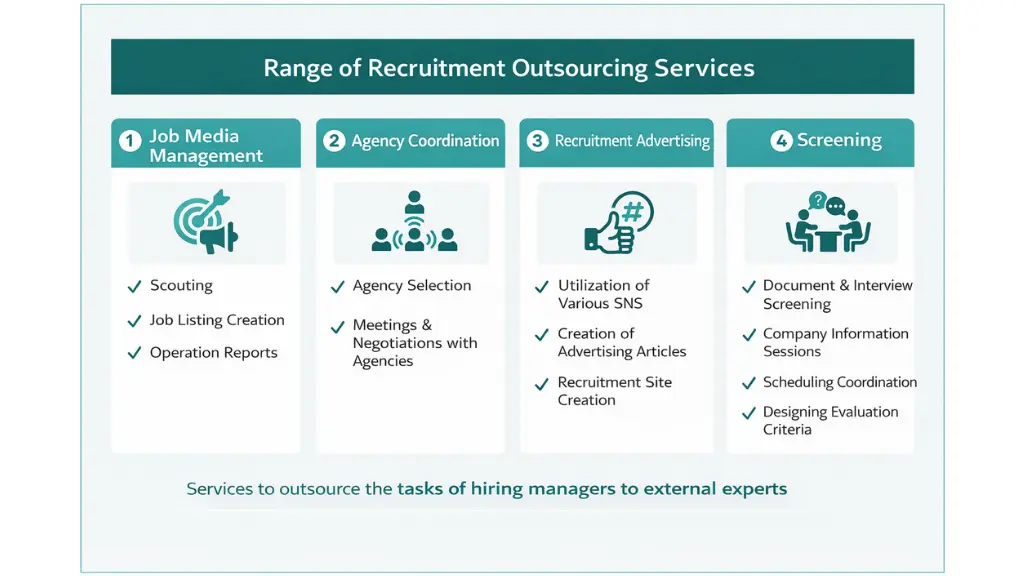
Source: “Complete Fee Guide: 15 Recommended Recruitment Outsourcing Services”
When is it used?
RPO is commonly used when companies want to outsource recruitment operations such as applicant communication and interview scheduling, rather than having candidates introduced to them.
Unlike recruitment agencies, the focus is not on supplying candidates, but on structuring the hiring process and stabilizing its execution. The outsourced scope typically includes operational tasks such as communication with candidates, interview scheduling, and managing information sessions.
Fee Structure
The fee structure for RPO is not primarily success-based like recruitment agencies. Instead, it is generally designed as amonthly fixed model, a pay-as-you-go model, a project-based model, or a combination of these. For example, there may be monthly contracts that cover recruitment operations over a set period, usage-based pricing tied to the number of applicants handled or interviews scheduled, or short-term project-based arrangements for launching hiring initiatives or managing peak hiring periods.
When RPO Is a Good Fit
- When the operational workload of recruitment, such as applicant handling and interview scheduling, is high
- When there are no dedicated recruiters and hiring is managed alongside other responsibilities
- When there is a need to quickly establish a hiring strategy and structure in a short period of time
- When companies want to manage and track application volume and hiring progress in a structured way
Strengths and Considerations of RPO
The commonly advertised strength of RPO is that it allows companies to outsource the practical tasks required for hiring, reducing the internal workload and making recruitment operations easier to run smoothly.
However, the biggest opportunity is strategic. While most RPO firms focus on helping with the operational overload, the ideal RPO partner can provide strategic recommendations on talent acquisition best practices, interviewing and candidate selection, offer negotiation and many other critical areas.
A RPO service like “SaiyouTeam”, for example, was built to provide the sophistication and efficiency of hiring practices of big tech companies for clients, in addition to help with workload. It’s not just outsourcing the process, it’s also defining what the best process is.
Common Mismatches
Common issues with RPO often arise when companies outsource recruitment without clearly defining what they want the provider to handle. For example, a company may expect only applicant handling support, but find that the service is mainly focused on reporting. Conversely, the company may expect operational execution, only to discover that recruitment strategy design is not included. Misalignments like these are common, because offering differs greatly from one RPO firm to the next.
RPO is not a one-size-fits-all service that solves every hiring problem. When selecting a RPO partner, it’s important to request a strategic assessment of your hiring practice, so that service can be tailored to your hiring needs. This is why at SaiyouTeam, we offer a free strategy call to evaluate your recruitment strategy and candidate selection practices versus your hiring goals.
Key takeaway
RPO is first and foremost about execution support, but the best version of it goes further than workload reduction. If the provider cannot clearly define what it will own and improve, you may outsource tasks without actually improving hiring.
4. Temporary Staffing (Worker Dispatch)
Temporary staffing is a system in which a worker employed by a staffing agency (the dispatching company) works under the direction and supervision of another company (the client company). In other words, the employment contract is with the staffing agency, not the client company, while day-to-day work instructions are given by the client company.
Legally, worker dispatch is defined as “having a worker employed by oneself engage in work for another person under that person’s direction and supervision while maintaining the employment relationship.” This differs from recruitment agencies, where a direct employment relationship is established between the company and the job seeker.
Temporary staffing is also different from subcontracting. In subcontracting, the contractor is responsible for delivering the completed work, and the client cannot directly instruct the contractor’s workers. In contrast, under temporary staffing, the client company gives direct instructions to the dispatched worker. This distinction is crucial in practice, as even if they appear similar, the legal classification depends on who gives instructions to the worker.
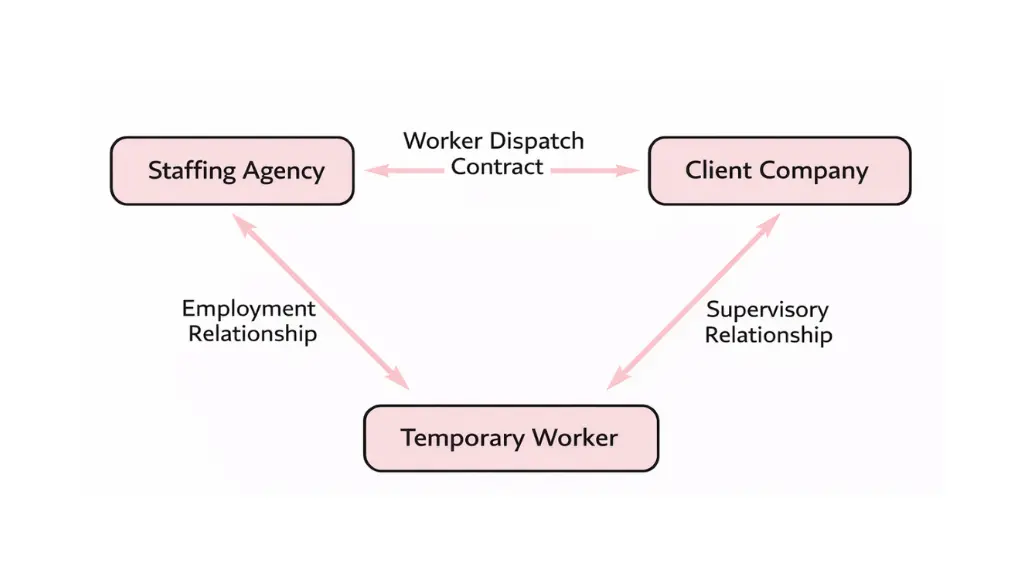
Source: Ministry of Health, Labour and Welfare, “The Need to Distinguish Between Worker Dispatch and Subcontracting”
When is it used?
Temporary staffing is commonly used when companies need to supplement their workforce for a limited period, such as filling vacancies, handling fluctuations in workload, or increasing capacity for routine tasks. Common reasons for using dispatched workers include covering staff shortages, responding to changes in workload, supporting light or auxiliary tasks, and utilizing specialized skills.
In other words, rather than immediately increasing direct hires, temporary staffing is often used when companies want to supplement their workforce with the required number of people for a specific period of time.
Fee Structure
In temporary staffing, companies do not pay a placement fee upon a successful hire. Instead, they pay dispatch fees to the staffing agency. These fees are generally based on working hours or the contract period, and cover various costs such as the worker’s wages, social insurance, training expenses, employee benefits, and the agency’s operating costs.
Dispatch fees therefore include not only the agency’s margin but also elements such as social insurance and training costs. As a result, temporary staffing is not a one-time payment made upon hiring, but a cost that is incurred continuously over the duration of the worker’s assignment.
When Temporary Staffing Is a Good Fit
- When you want to quickly fill vacancies
- When you need to increase headcount only during busy periods
- When you want to assign administrative, support, or operational tasks for a fixed period
- When you want to supplement manpower before committing to direct hiring
- When you want to utilize professionals with specialized skills for a limited time
Strengths and Considerations of Temporary Staffing
A key strength of temporary staffing is that it allows companies to secure workers relatively quickly when needed, while delegating part of the employment-related management to the staffing agency. It is particularly useful for handling sudden vacancies or workplaces with fluctuating workloads.
On the other hand, since the workers are not directly employed by the client company, it is not always well-suited for securing key talent expected to stay long term. In addition, there are several important considerations, such as rules on assignment duration, who is responsible for giving work instructions, and the distinction from subcontracting. Simply viewing it as a way to have external workers perform tasks can lead to misunderstandings.
Common Mismatches
Common issues with temporary staffing often arise from confusing a system designed for short-term workforce supplementation with a long-term hiring solution. For example, if a company aims to secure key talent for the long term but relies on temporary staffing, regulatory limits on assignment periods and contractual constraints may become obstacles.
In addition, even if the intention at the operational level is simply to assign tasks, there can be ambiguity around who is responsible for giving instructions and what scope of work can be assigned, making the distinction from subcontracting unclear.
Furthermore, judging costs based only on the dispatch fee can be misleading. Since these fees include not only wages but also social insurance, training costs, and employee benefits, it is important to review the full cost breakdown rather than assessing price at face value.
Key takeaway
Temporary staffing is a workforce coverage model, not just another way to hire. It can be very practical when you need people quickly for a defined period, but it comes with a different legal structure and should not be confused with direct employment.
Comparison Table of Recruitment Agencies, Job Media, RPO, and Temporary Staffing
| Item | Recruitment Agency (Paid Employment Placement) | Job Media | RPO | Temporary Staffing |
|---|---|---|---|---|
| Service structure | A recruitment agency acts between the company and the job seeker to facilitate hiring | An information service that publishes and distributes job information to attract applicants | An external provider outsources or supports part or all of the hiring process | A staffing agency sends workers it employs to work under the direction and supervision of the client company |
| Who enters into the employment contract | The company and the job seeker | The company and the job seeker | In principle, the company and the job seeker | The staffing agency and the worker |
| What the company receives | Candidate introductions, interview coordination, offer negotiation, etc. | Job posting and applicant acquisition | Support for applicant communication, interview scheduling, progress management, and recruitment operations | A workforce for a fixed period |
| Whether intermediation is involved | Yes | No | It depends. Depending on the level of involvement, it may fall under employment placement | It is not intermediation for direct employment |
| Who gives work instructions | After hiring, the company | After hiring, the company | It depends on the scope of the outsourced work, but work instructions to hired employees are usually given by the company | During the assignment, the client company |
| When costs arise | A success fee is generally incurred when a hire is made | Depends on the platform, such as when posting, when clicked, or when applications are received | Often structured as a monthly fixed fee, usage-based fee, project-based fee, or a combination | Incurred continuously based on working hours or contract period |
| How to think about costs | A substantial fee is incurred each time one person is hired | Relatively easy to start using, but costs vary depending on posting method and operation | A fee for outsourcing recruitment operations | Not a hiring fee, but an ongoing cost for using external personnel |
| Best suited for | Hard-to-fill roles, experienced hires, managerial hires, and urgent hiring | When you want to attract applicants broadly | When you want to reduce the workload of recruitment operations | When filling vacancies, handling busy periods, or needing workers for a limited period |
| Strength | Easy to outsource everything from candidate sourcing to coordination | Can research a broad audience and attract direct applicants | Helps stabilize recruitment operations | Makes it relatively easy to secure workers quickly |
| Points to note | Fees tend to be high | Applications may come in, but not always from the right target candidates | If the scope of work is unclear, expectation gaps and legal classification issues may arise | There are many legal considerations, such as assignment period limits, and special rules |
| Common misunderstandings | People often assume the agency will handle all recruitment operations | People often assume that simply posting will naturally lead to hires | People often assume it includes candidate sourcing as well | People often assume it can be used in place of hiring full-time employees |
How to choose the right service
As we have seen, each recruitment service differs in its role, cost structure, and scope of what can be outsourced. Therefore, if you choose a service without first clarifying whether you need candidate sourcing, applicant generation, support for recruitment operations, or temporary workforce supplementation, you may end up paying for a service that does not fit your needs, lacking the support you expected, or increasing the internal workload.
It is important to first organize what role your company actually needs. Once this is clear, it becomes much easier to determine which service to choose and to proceed with hiring while minimizing unnecessary costs and effort.