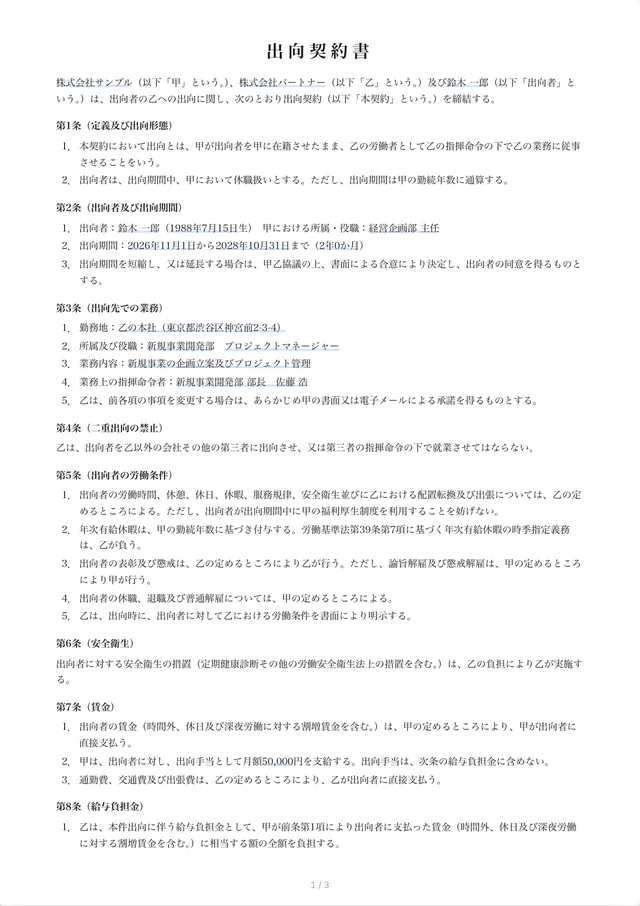
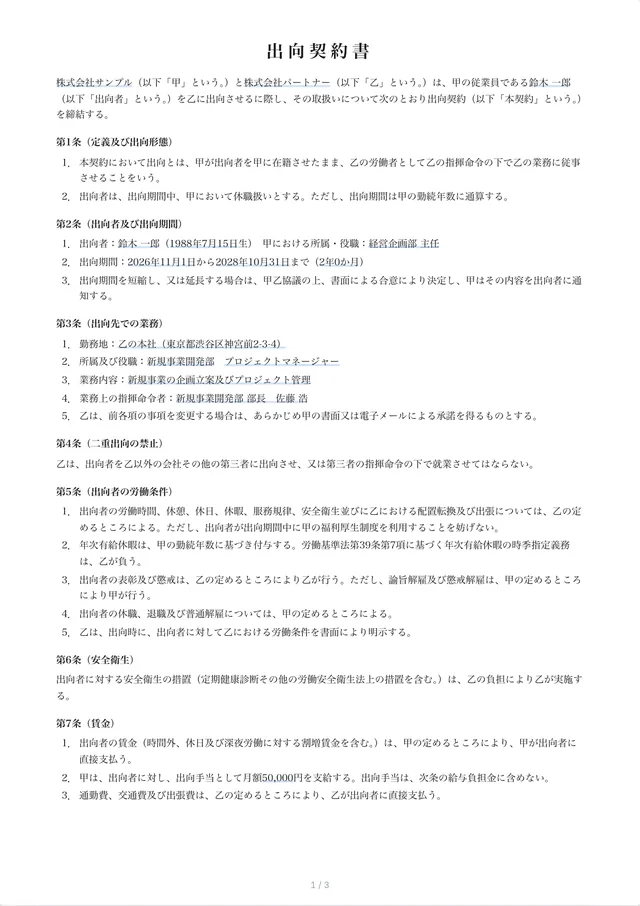
出向契約書
株式会社サンプル(以下「甲」という。)と株式会社パートナー(以下「乙」という。)は、甲の従業員である鈴木 一郎(以下「出向者」という。)を乙に出向させるに際し、その取扱いについて次のとおり出向契約(以下「本契約」という。)を締結する。
株式会社サンプル(以下「甲」という。)、株式会社パートナー(以下「乙」という。)及び鈴木 一郎(以下「出向者」という。)は、出向者の乙への出向に関し、次のとおり出向契約(以下「本契約」という。)を締結する。
定義及び出向形態
- 本契約において出向とは、甲が出向者を甲に在籍させたまま、乙の労働者として乙の指揮命令の下で乙の業務に従事させることをいう。
- 出向者は、出向期間中、甲において休職扱いとする。ただし、出向期間は甲の勤続年数に通算する。
出向者及び出向期間
- 出向者:鈴木 一郎(1988年7月15日生) 甲における所属・役職:経営企画部 主任
- 出向期間:2026年11月1日から2028年10月31日まで(2年0か月)
- 出向期間を短縮し、又は延長する場合は、甲乙協議の上、書面による合意により決定し、甲はその内容を出向者に通知する。出向者の同意を得るものとする。
出向先での業務
- 勤務地:乙の本社(東京都渋谷区神宮前2-3-4)
- 所属及び役職:新規事業開発部 プロジェクトマネージャー
- 業務内容:新規事業の企画立案及びプロジェクト管理
- 業務上の指揮命令者:新規事業開発部 部長 佐藤 浩
- 乙は、前各項の事項を変更する場合は、あらかじめ甲の書面又は電子メールによる承諾を得るものとする。
二重出向の禁止
乙は、出向者を乙以外の会社その他の第三者に出向させ、又は第三者の指揮命令の下で就業させてはならない。
出向者の労働条件
- 出向者の労働時間、休憩、休日、休暇、服務規律、安全衛生並びに乙における配置転換及び出張については、乙の定めるところによる。ただし、出向者が出向期間中に甲の福利厚生制度を利用することを妨げない。
- 出向者の労働時間、休憩、休日、休暇及び服務規律については、甲の定めるところによるものとし、乙はこれに従って出向者を就業させる。安全衛生並びに乙における配置転換及び出張については、乙の定めるところによる。出向者が出向期間中に甲の福利厚生制度を利用することを妨げない。
- 年次有給休暇は、甲の勤続年数に基づき付与する。労働基準法第39条第7項に基づく年次有給休暇の時季指定義務は、乙が負う。
- 出向者の表彰及び懲戒は、乙の定めるところにより乙が行う。ただし、諭旨解雇及び懲戒解雇は、甲の定めるところにより甲が行う。
- 出向者の休職、退職及び普通解雇については、甲の定めるところによる。
- 乙は、出向時に、出向者に対して乙における労働条件を書面により明示する。
- 甲は、甲乙協議の上、乙に代わり、出向時に出向者に対して乙における労働条件を書面により明示する。
安全衛生
出向者に対する安全衛生の措置(定期健康診断その他の労働安全衛生法上の措置を含む。)は、乙の負担により乙が実施する。
賃金
- 出向者の賃金(時間外、休日及び深夜労働に対する割増賃金を含む。)は、甲の定めるところにより、甲が出向者に直接支払う。
- 出向者の賃金(時間外、休日及び深夜労働に対する割増賃金を含む。)は、乙の定めるところにより、乙が出向者に直接支払う。
- 乙の定める賃金が、出向直前に甲で受けていた賃金を下回る場合、甲はその差額の補填として月額400,000円を出向者に支給する。
- 甲は、出向者に対し、出向手当として月額50,000円を支給する。出向手当は、次条の給与負担金に含めない。
- 通勤費、交通費及び出張費は、乙の定めるところにより、乙が出向者に直接支払う。
給与負担金
- 乙は、本件出向に伴う給与負担金として、甲が前条第1項により出向者に支払った賃金(時間外、休日及び深夜労働に対する割増賃金を含む。)に相当する額の全額を負担する。
- 乙は、本件出向に伴う給与負担金として、月額400,000円を負担する。甲が出向者に支払った賃金のうち、これを超える部分は甲が負担する。
- 月の途中に出向が開始し、又は終了した場合の当該月の給与負担金は、日割り計算とする。
- 乙は、前各項の給与負担金を当月末日までに、甲の指定する銀行口座に振り込む。振込手数料は乙の負担とする。
社会保険及び労働保険
- 出向期間中の出向者の健康保険、厚生年金保険、介護保険及び雇用保険は、甲において被保険者資格を継続させ、その事業主負担分の保険料は甲が負担する。
- 出向期間中の出向者の健康保険、厚生年金保険、介護保険及び雇用保険は、乙において被保険者資格を取得させ、その事業主負担分の保険料は乙が負担する。甲は、出向の開始に伴う資格喪失の手続を行う。
- 労働者災害補償保険は、乙において適用し、その保険料は乙が負担する。甲は、乙が保険料を算定するため、甲が出向者に支払った賃金の額を乙に通知する。
勤務状況の報告
乙は、出向者の勤務状況その他甲が指定する事項を、翌月10日までに甲に報告する。
復職
- 出向者が次の各号のいずれかに該当した場合、甲は出向者に対して復職を命じる。
- 出向期間が満了したとき
- 出向の目的を達成し、又は出向の目的が消滅したと甲が判断したとき
- 心身の故障等により乙での労務の提供が困難であると甲が判断したとき
- 甲の休職事由、普通解雇事由又は懲戒事由に該当したと甲が判断したとき
- 出向期間中に甲を退職するとき
- 前各号のほか、復職させるべき理由があると甲が判断したとき
- 復職後の出向者の処遇は、次のとおりとする。出向直前の役職及び等級を基本とし、出向期間中の経験及び成果を考慮して甲が決定する。
機密保持
- 甲及び乙は、本契約の履行により知り得た相手方の業務上の情報その他の機密情報を、相手方の書面による事前の同意なく第三者に開示し、又は漏洩してはならず、本契約の目的以外に使用してはならない。ただし、開示を受けた時点で既に公知であった情報、正当な権限を有する第三者から適法に取得した情報その他これらに準ずる情報を除く。
- 甲及び乙は、出向者に対し、出向期間中及び出向終了後において、甲及び乙の業務上知り得た機密情報を第三者に開示し、又は漏洩しないよう義務付ける。
- 出向者は、出向期間中及び出向終了後においても、甲及び乙の業務上知り得た機密情報を、甲又は乙の書面による事前の承諾なく第三者に開示し、又は漏洩してはならない。
- 本条の規定は、本契約の終了後も有効とする。
知的財産権
出向者が出向期間中に職務上行った発明、考案、創作その他の知的財産に係る権利は、乙に帰属する。ただし、甲の業務に直接関連して生じたものは、甲乙協議の上、その帰属を定める。
出向者が出向期間中に職務上行った発明、考案、創作その他の知的財産に係る権利は、甲に帰属する。ただし、乙の業務に直接関連して生じたものは、甲乙協議の上、その帰属を定める。
個人情報
甲及び乙は、出向者の個人情報を、個人情報の保護に関する法律その他の関係法令及びガイドラインに従い、出向者の雇用管理及び業務に必要な範囲でのみ使用し、その漏洩、滅失又は毀損の防止のために必要かつ適切な措置を講じる。
中途解約
- 甲及び乙は、出向期間の満了前であっても、30日前までに相手方に書面で通知することにより、本契約を解約することができる。この場合、甲は出向者に対して復職を命じる。
- 出向者は、心身の故障、家族の介護その他やむを得ない事由がある場合、甲に申し出て出向の終了を求めることができる。この場合、甲及び乙は誠実に協議する。
損害賠償
甲又は乙は、本契約に違反して相手方に損害を与えた場合、その損害を賠償する。
有効期間
本契約の有効期間は、出向期間が満了するまでとする。出向期間を延長したときは、延長後の出向期間が満了するまでとする。
準拠法及び合意管轄
本契約は日本法に準拠する。本契約に関する一切の紛争については、東京地方裁判所を第一審の専属的合意管轄裁判所とする。
協議事項
- 本契約に定めのない事項及び本契約の解釈について疑義が生じた事項は、甲乙及び出向者が誠意をもって協議の上、解決する。
- 本契約の変更は、甲乙及び出向者の書面による合意によらなければならない。
本契約は日本語を正本とし、英語による訳文は参考のために作成する。本契約締結の証として本書2通を作成し、甲乙記名押印の上、各1通を保有する。本契約締結の証として本書3通を作成し、甲、乙及び出向者が記名押印の上、各1通を保有する。本契約締結の証として本契約を電磁的記録により作成し、甲乙甲、乙及び出向者がそれぞれ電子署名を行った上、各自その電磁的記録を保管する。
2026年10月17日
甲(出向元)
〒100-0005 東京都千代田区丸の内1-1-1
株式会社サンプル
代表取締役 山田 花子 印
乙(出向先)
〒150-0001 東京都渋谷区神宮前2-3-4
株式会社パートナー
代表取締役 田中 太郎 印
出向者
〒160-0023 東京都新宿区西新宿5-6-7
鈴木 一郎 印
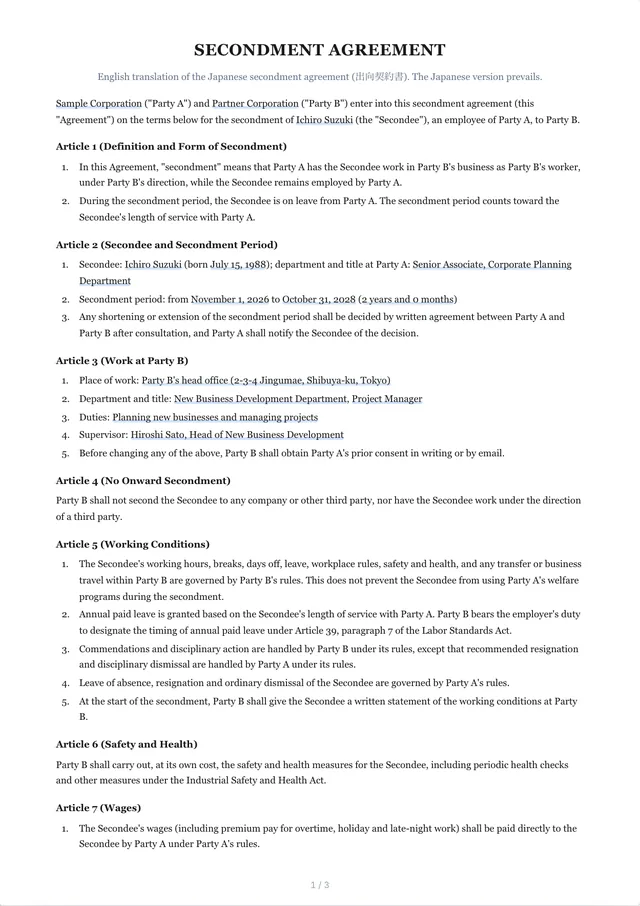
SECONDMENT AGREEMENT
English translation of the Japanese secondment agreement (出向契約書). The Japanese version prevails.
Sample Corporation ("Party A") and Partner Corporation ("Party B") enter into this secondment agreement (this "Agreement") on the terms below for the secondment of Ichiro Suzuki (the "Secondee"), an employee of Party A, to Party B.
Sample Corporation ("Party A"), Partner Corporation ("Party B") and Ichiro Suzuki (the "Secondee") enter into this secondment agreement (this "Agreement") on the terms below for the Secondee's secondment to Party B.
Definition and Form of Secondment
- In this Agreement, "secondment" means that Party A has the Secondee work in Party B's business as Party B's worker, under Party B's direction, while the Secondee remains employed by Party A.
- During the secondment period, the Secondee is on leave from Party A. The secondment period counts toward the Secondee's length of service with Party A.
Secondee and Secondment Period
- Secondee: Ichiro Suzuki (born July 15, 1988); department and title at Party A: Senior Associate, Corporate Planning Department
- Secondment period: from November 1, 2026 to October 31, 2028 (2 years and 0 months)
- Any shortening or extension of the secondment period shall be decided by written agreement between Party A and Party B after consultation, and Party A shall notify the Secondee of the decision.with the Secondee's consent.
Work at Party B
- Place of work: Party B's head office (2-3-4 Jingumae, Shibuya-ku, Tokyo)
- Department and title: New Business Development Department, Project Manager
- Duties: Planning new businesses and managing projects
- Supervisor: Hiroshi Sato, Head of New Business Development
- Before changing any of the above, Party B shall obtain Party A's prior consent in writing or by email.
No Onward Secondment
Party B shall not second the Secondee to any company or other third party, nor have the Secondee work under the direction of a third party.
Working Conditions
- The Secondee's working hours, breaks, days off, leave, workplace rules, safety and health, and any transfer or business travel within Party B are governed by Party B's rules. This does not prevent the Secondee from using Party A's welfare programs during the secondment.
- The Secondee's working hours, breaks, days off, leave and workplace rules are governed by Party A's rules, and Party B shall have the Secondee work accordingly. Safety and health, and any transfer or business travel within Party B, are governed by Party B's rules. This does not prevent the Secondee from using Party A's welfare programs during the secondment.
- Annual paid leave is granted based on the Secondee's length of service with Party A. Party B bears the employer's duty to designate the timing of annual paid leave under Article 39, paragraph 7 of the Labor Standards Act.
- Commendations and disciplinary action are handled by Party B under its rules, except that recommended resignation and disciplinary dismissal are handled by Party A under its rules.
- Leave of absence, resignation and ordinary dismissal of the Secondee are governed by Party A's rules.
- At the start of the secondment, Party B shall give the Secondee a written statement of the working conditions at Party B.
- At the start of the secondment, Party A shall give the Secondee, on Party B's behalf and after consultation with Party B, a written statement of the working conditions at Party B.
Safety and Health
Party B shall carry out, at its own cost, the safety and health measures for the Secondee, including periodic health checks and other measures under the Industrial Safety and Health Act.
Wages
- The Secondee's wages (including premium pay for overtime, holiday and late-night work) shall be paid directly to the Secondee by Party A under Party A's rules.
- The Secondee's wages (including premium pay for overtime, holiday and late-night work) shall be paid directly to the Secondee by Party B under Party B's rules.
- If the wages under Party B's rules are lower than the wages the Secondee received at Party A immediately before the secondment, Party A shall pay the Secondee ¥400,000 a month to make up the difference.
- Party A shall pay the Secondee a secondment allowance of ¥50,000 a month. The secondment allowance is not included in the salary contribution under the next article.
- Commuting, travel and business trip expenses shall be paid directly to the Secondee by Party B under Party B's rules.
Salary Contribution
- As a salary contribution for this secondment, Party B shall bear the full amount of the wages (including premium pay for overtime, holiday and late-night work) paid by Party A to the Secondee under paragraph 1 of the previous article.
- As a salary contribution for this secondment, Party B shall bear ¥400,000 a month. Party A shall bear any part of the wages it pays to the Secondee above this amount.
- For a month in which the secondment starts or ends partway through, the salary contribution is prorated by day.
- Party B shall pay the salary contribution under the preceding paragraphs by the last day of the same month into the bank account designated by Party A, and shall bear the transfer fee.
Social Insurance and Labor Insurance
- During the secondment, the Secondee's health insurance, employees' pension insurance, long-term care insurance and employment insurance continue at Party A, and Party A bears the employer's share of the premiums.
- During the secondment, the Secondee's health insurance, employees' pension insurance, long-term care insurance and employment insurance are enrolled at Party B, and Party B bears the employer's share of the premiums. Party A shall complete the loss-of-coverage procedures for the start of the secondment.
- Workers' accident compensation insurance applies at Party B, and Party B bears its premiums. Party A shall notify Party B of the wages it pays to the Secondee so that Party B can calculate the premiums.
Attendance Reports
Party B shall report the Secondee's attendance and any other matters Party A specifies to Party A by the 10th of the following month.
Return to Party A
- Party A shall order the Secondee to return to Party A in any of the following cases:
- The secondment period ends
- Party A decides that the purpose of the secondment has been achieved or no longer exists
- Party A decides that the Secondee cannot work at Party B because of illness, injury or a similar reason
- Party A decides that a ground for leave of absence, ordinary dismissal or disciplinary action under Party A's rules applies
- The Secondee leaves Party A during the secondment period
- Party A decides, in any other case, that the Secondee should return
- The Secondee's treatment after the return shall be as follows: Party A decides, based on the Secondee's title and grade immediately before the secondment and taking into account the experience and results gained during the secondment.
Confidentiality
- Neither Party A nor Party B shall disclose or leak to a third party, without the other party's prior written consent, any business or other confidential information of the other party obtained in performing this Agreement, nor use it for any purpose other than this Agreement. This does not apply to information that was public when disclosed, information lawfully obtained from a third party with proper authority, or similar information.
- Party A and Party B shall require the Secondee not to disclose or leak to a third party, during or after the secondment, any confidential information of Party A or Party B learned in the course of work.
- During and after the secondment, the Secondee shall not disclose or leak to a third party, without the prior written consent of Party A or Party B, any confidential information of Party A or Party B learned in the course of work.
- This article survives the end of this Agreement.
Intellectual Property
Rights to inventions, devices, works and other intellectual property made by the Secondee in the course of duties during the secondment belong to Party B. Rights arising in direct connection with Party A's business shall be allocated by agreement between Party A and Party B.
Rights to inventions, devices, works and other intellectual property made by the Secondee in the course of duties during the secondment belong to Party A. Rights arising in direct connection with Party B's business shall be allocated by agreement between Party A and Party B.
Personal Information
Party A and Party B shall use the Secondee's personal information only as needed for employment management and the work, in compliance with the Act on the Protection of Personal Information and related laws and guidelines, and shall take necessary and appropriate measures to prevent its leakage, loss or damage.
Early Termination
- Even before the secondment period ends, Party A or Party B may terminate this Agreement by giving the other party written notice at least 30 days in advance. In that case, Party A shall order the Secondee to return.
- If the Secondee has a compelling reason, such as illness, injury or family care, the Secondee may ask Party A to end the secondment, and Party A and Party B shall consult in good faith.
Damages
If Party A or Party B breaches this Agreement and causes damage to the other party, it shall compensate the other party for that damage.
Term of Agreement
This Agreement remains in force until the secondment period ends. If the secondment period is extended, it remains in force until the extended period ends.
Governing Law and Jurisdiction
This Agreement is governed by Japanese law. The Tokyo District Court has exclusive jurisdiction of first instance over any dispute relating to this Agreement.
Consultation
- Any matter not provided for in this Agreement, and any doubt about its interpretation, shall be resolved by good-faith consultation between Party A and Party B, Party B and the Secondee.
- This Agreement may be amended only by written agreement of Party A and Party B, Party B and the Secondee.
In witness whereof, Party A and Party B have executed this Agreement in duplicate, each affixing its name and seal, and each retains one original.In witness whereof, Party A, Party B and the Secondee have executed this Agreement in triplicate, each affixing their name and seal, and each retains one original.In witness whereof, Party A and Party B haveParty A, Party B and the Secondee have executed this Agreement as an electronic record, each applying an electronic signature, and each retains the electronic record.
October 17, 2026
Party A (Seconding Company)
1-1-1 Marunouchi, Chiyoda-ku, Tokyo 100-0005
Sample Corporation
Hanako Yamada, Representative Director (seal)
Party B (Receiving Company)
2-3-4 Jingumae, Shibuya-ku, Tokyo 150-0001
Partner Corporation
Taro Tanaka, Representative Director (seal)
Secondee
5-6-7 Nishi-Shinjuku, Shinjuku-ku, Tokyo 160-0023
Ichiro Suzuki (seal)
October 17, 2026
To: Sample Corporation
Hanako Yamada, Representative Director
CONSENT TO SECONDMENT
English translation of the Japanese consent form (出向同意書). The Japanese version prevails.
I have received an explanation of my secondment to Partner Corporation (the "Receiving Company") on the terms below, while remaining employed by Sample Corporation (the "Company"), and I consent to it.
Terms
-
Receiving Company
Partner Corporation (2-3-4 Jingumae, Shibuya-ku, Tokyo 150-0001)
-
Secondment period
From November 1, 2026 to October 31, 2028
-
Work at the Receiving Company
Project Manager, New Business Development Department. Planning new businesses and managing projects (place of work: Party B's head office (2-3-4 Jingumae, Shibuya-ku, Tokyo))
-
Working hours, days off and leave
Under the Receiving Company's rules.Under the Company's rules.
-
Wages
Paid by the Company under its rules.Paid by the Receiving Company under its rules. The Company also pays a secondment allowance of ¥50,000 a month.
-
Social and labor insurance
Health insurance, employees' pension insurance and employment insurance are with the Companythe Receiving Company; workers' accident compensation insurance applies at the Receiving Company.
-
Status during the secondment
I remain employed by the Company and am on leave from it. The secondment period counts toward my length of service with the Company.
-
Return
I return to the Company when the secondment period ends or in the other cases set out in the agreement between the two companies. Treatment after the return: Party A decides, based on the Secondee's title and grade immediately before the secondment and taking into account the experience and results gained during the secondment.
-
Statement of working conditions
I will receive a written statement of my working conditions at the Receiving Company from the Receiving Companythe Company at the start of the secondment.
End
Address: ________________________
Name: Ichiro Suzuki (seal)




 採用経験14年