
Japan Offer Documents Templates (採用通知関連書類)

The four Japanese documents around the formal job offer. Issue the offer, confirm a hire, withdraw an offer when grounds allow, and acknowledge a declined offer. All bilingual and PDF-exportable.

4 offer templates
Japanese / English preview
PDF export, no signup
Free Templates

Pick the document for this stage of the offer

Each template generates one specific offer-stage document. Fill in the conditions, preview in Japanese or English, edit inline, then export to PDF.

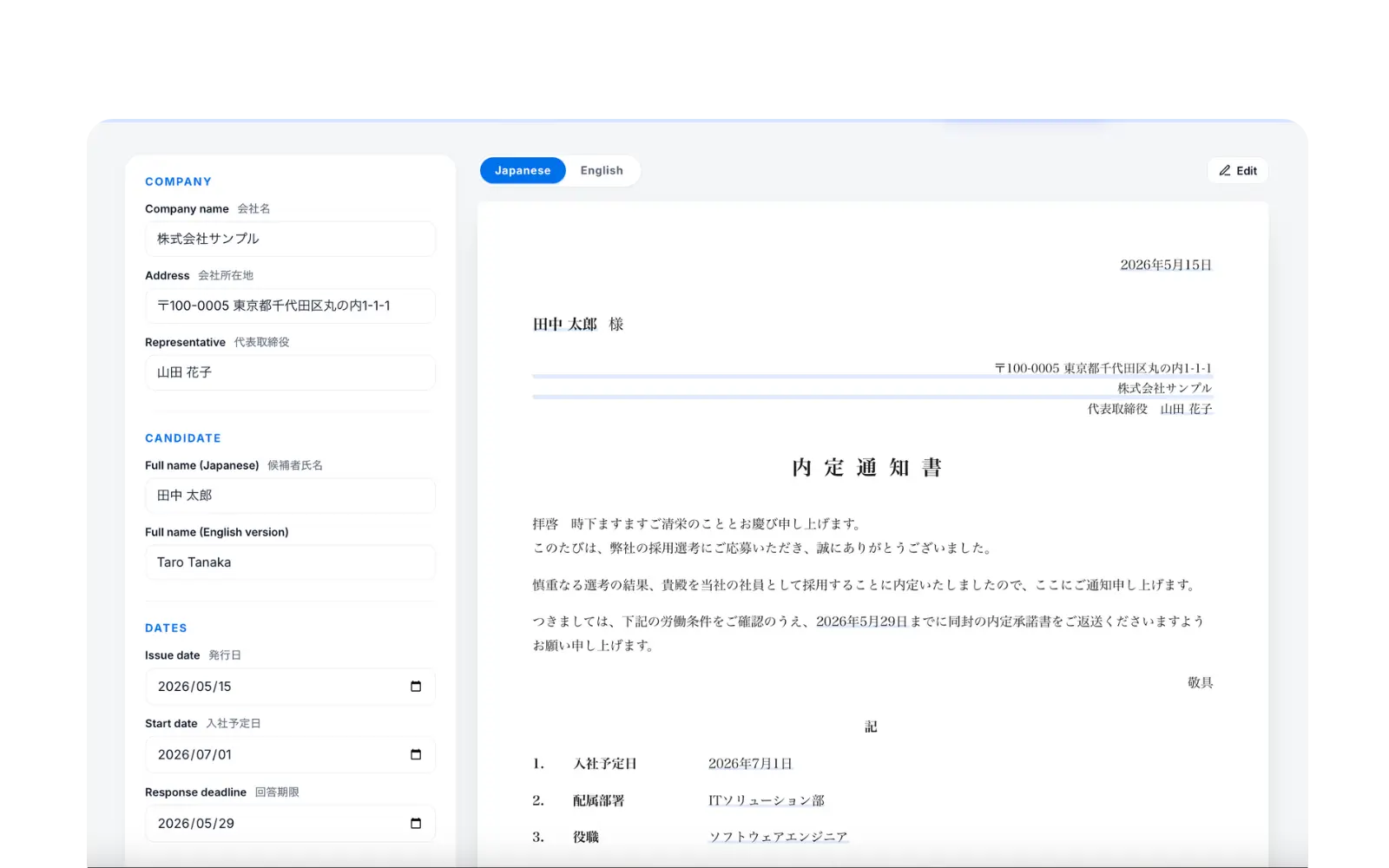
Japan Job Offer Letter (内定通知書) preview
Formal offer

内定通知書

Job Offer Letter

The formal naitei offer letter. Once the candidate accepts, Japanese case law treats it as a labor contract with a deferred start date. Position, compensation, start date, withdrawal grounds, response deadline.


Notice of Hiring (採用通知書) preview
Selection notice

採用通知書

Notice of Hiring

A general selection notice often used for mid-career hires. Confirms the candidate has been chosen and sets the next steps before the labor contract and labor conditions notice.

Notice of Job Offer Withdrawal (内定取消通知書) preview
Withdrawal

内定取消通知書

Notice of Job Offer Withdrawal

Employer-issued notice withdrawing the formal offer. Lawful grounds only: failure to graduate, missing work permit, material misrepresentation, antisocial-forces affiliation, serious health deterioration.

Acknowledgment of Joining Withdrawal (入社辞退受領通知) preview
Decline received

入社辞退受領通知

Acknowledgment of Joining Withdrawal

Brief acknowledgment that the company received the candidate's decision to decline the offer. Formally ends the offer relationship; prevents downstream ambiguity about acceptance.

Decision guide

When to use which

The four documents in this sub-hub cover the offer-stage lifecycle. The right one depends on which way the offer is moving: out (offer made or hire confirmed), back in (offer withdrawn), or closed (candidate declined).

Making the formal offer

Use the Job Offer Letter (内定通知書) for new-graduate hires and any case where you want the stronger naitei commitment. Use the Notice of Hiring (採用通知書) for mid-career and lateral hires where the naitei framing is less natural. Many companies use one or the other; large traditional employers use both at different stages (selection notice early, formal naitei later).

Withdrawing the offer (rare, narrow grounds)

Use the Notice of Job Offer Withdrawal (内定取消通知書) only when you have a defensible legal basis. Standard grounds: failure to graduate, missing work permit, material misrepresentation, antisocial-forces affiliation, serious health deterioration. Withdrawal for business convenience or a change of plans will typically be ruled invalid in Japanese courts.

Acknowledging a decline

Use the Acknowledgment of Joining Withdrawal (入社辞退受領通知) whenever a candidate declines or revokes their acceptance. Closes the offer relationship cleanly and prevents downstream ambiguity about whether the candidate accepted or declined.

The most common mistake

Skipping the acknowledgment when a candidate declines. Even when the candidate communicated by email or phone, a written 入社辞退受領通知 is the convention that formally closes the loop. Without it, an HR file can be ambiguous about whether the company released the slot, which complicates downstream documentation if the candidate later applies for unemployment benefits or refers others.

Frequently asked

Common questions about Japan offer documents

What's the difference between 内定通知書 and 採用通知書?

Both signal selection. 内定通知書 is the formal offer (naitei tsuuchisho) used heavily in the new-graduate cycle; once accepted, Japanese case law treats it as a labor contract with a deferred start date. 採用通知書 is a more general selection notice often used for mid-career hires; legal weight is similar but the document is less formalized as a binding pre-contract.

Can a 内定 be revoked once accepted?

Only on narrow grounds. Permitted reasons: failure to graduate, missing work permit, serious health deterioration, material misrepresentation, or affiliation with antisocial forces. Revocation for business convenience is usually invalid.

Should I send a written response when a candidate declines the offer?

Yes by good business practice. The 入社辞退受領通知 confirms receipt of the decline and formally ends the offer relationship, preventing ambiguity later.

Which document is legally required?

None of these four are strictly required by statute. What is legally required is the 労働条件通知書 (labor conditions notice) under Article 15 of the Labor Standards Act, which must be issued by the start date at the latest.

About the author

Emmanuel Gendre, Founder of SaiyouTeam
Emmanuel Gendre
Founder, SaiyouTeam · TechieCV K.K.

Emmanuel advises small and mid-sized companies (SMBs) on HR and recruiting in Japan. He brings 12 years recruiting in Japan as a Recruitment Consultant placing IT professionals, plus prior experience hiring engineers across EMEA as a Google recruiter. Drafting Japanese offer documents (内定通知書, 採用通知書, withdrawal letters, decline acknowledgments) is something he handles regularly with his SMB clients, so he built these templates as part of that advisory work.

For case-specific offer-stage matters — particularly an 内定取消 — Emmanuel works with licensed Japanese professionals (社会保険労務士 and 弁護士). These templates are planning tools, not a substitute for professional advice.

Need help applying this?

Plan the full offer-to-day-one sequence

SaiyouTeam helps foreign and domestic companies run a clean Japan hiring cycle from offer through onboarding. The naitei withdrawal grounds in particular are subject to strict case law; for any non-standard withdrawal, have the final wording reviewed by a labor and social security attorney (社会保険労務士) or qualified legal counsel.