Hiring Playbook

Japan Job Offer Letter Template (内定通知書)

Generate a clean Japanese Offer Letter (内定通知書) in seconds. Fill in the conditions, preview the letter in Japanese or English, edit inline, then export to PDF.

By Emmanuel Gendre, Founder of SaiyouTeamEmmanuel Gendre Founder, SaiyouTeam · 14 years in talent acquisition Last reviewed: · Aligned with MHLW labor standards guidance and standard sharoshi templates

Offer letter generator

Step 1 of 5

Company

Candidate

Dates

Role

Compensation

Your offer letter is ready

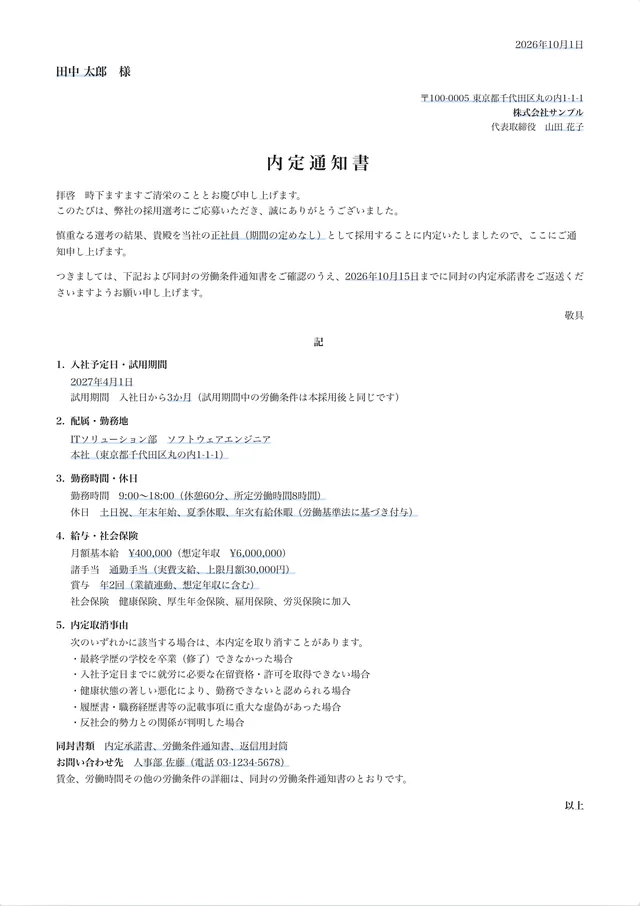
2026年5月15日

田中 太郎 様

〒100-0005 東京都千代田区丸の内1-1-1

株式会社サンプル

代表取締役 山田 花子

内定通知書

拝啓 時下ますますご清栄のこととお慶び申し上げます。
このたびは、弊社の採用選考にご応募いただき、誠にありがとうございました。

慎重なる選考の結果、貴殿を当社の社員として採用することに内定いたしましたので、ここにご通知申し上げます。

つきましては、下記の労働条件をご確認のうえ、2026年5月29日までに同封の内定承諾書をご返送くださいますようお願い申し上げます。

敬具

記

  1. 入社予定日2026年7月1日
  2. 配属部署ITソリューション部
  3. 役職ソフトウェアエンジニア
  4. 勤務地本社(東京都千代田区丸の内1-1-1)
  5. 勤務時間9:00 - 18:00(休憩60分、所定労働時間8時間)
  6. 試用期間入社日から3ヶ月間(労働条件は本採用と同一)
  7. 給与月額基本給 ¥400,000
    想定年収 ¥6,000,000
    諸手当 通勤手当(実費支給、上限月額¥30,000)
    賞与 年2回(業績連動、想定年収に含む)
  8. 休日土日祝、年末年始、夏季休暇、年次有給休暇(労基法準拠)
  9. 社会保険健康保険、厚生年金保険、雇用保険、労災保険に加入
  10. 内定取消事由以下の場合、本内定を取り消すことがあります。
    • 最終学歴の卒業(修了)ができなかった場合
    • 所定の入社日までに就労に必要な在留資格・許可を取得できない場合
    • 健康状態の著しい悪化により勤務できないと認められる場合
    • 履歴書、職務経歴書等に虚偽の記載があった場合
    • 反社会的勢力との関係が判明した場合

賃金、労働時間その他の労働条件の詳細は、同封の労働条件通知書のとおりです。

以 上

  • Ready to send? Download a PDF of the letter you see above. The PDF generates locally in your browser.

How it works

A Japanese Offer Letter (内定通知書) in 60 seconds

An Offer Letter (内定通知書) is the formal letter a Japanese employer issues to confirm a candidate has been selected for employment. Once the candidate accepts, Japanese case law treats it as a labor contract with a deferred start date, so the wording matters. This template generates a defensible structure based on the standard format used by sharoshi (社会保険労務士) and aligned with the Ministry of Health, Labour and Welfare's labor standards guidance.

1. The Japanese letter is the controlling document

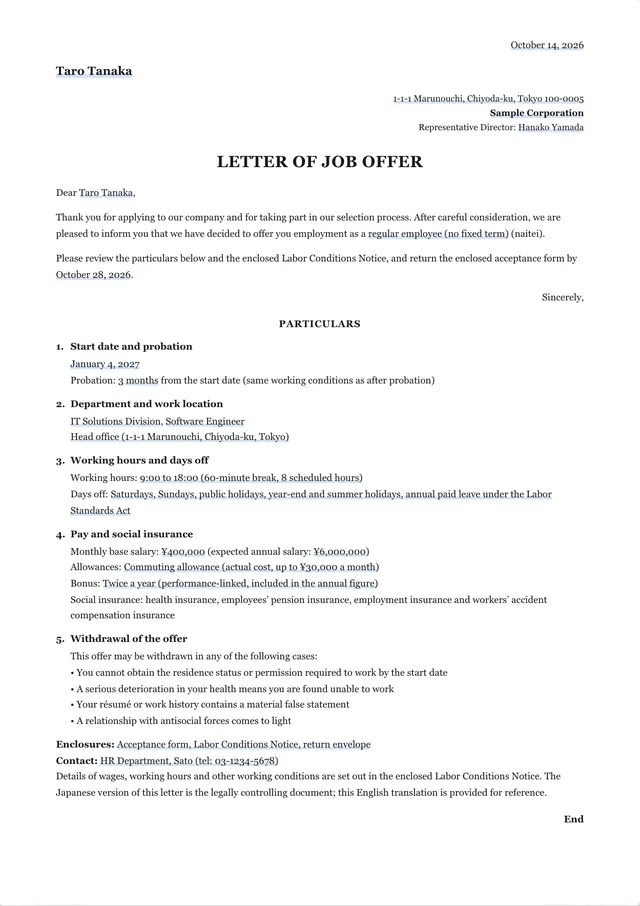
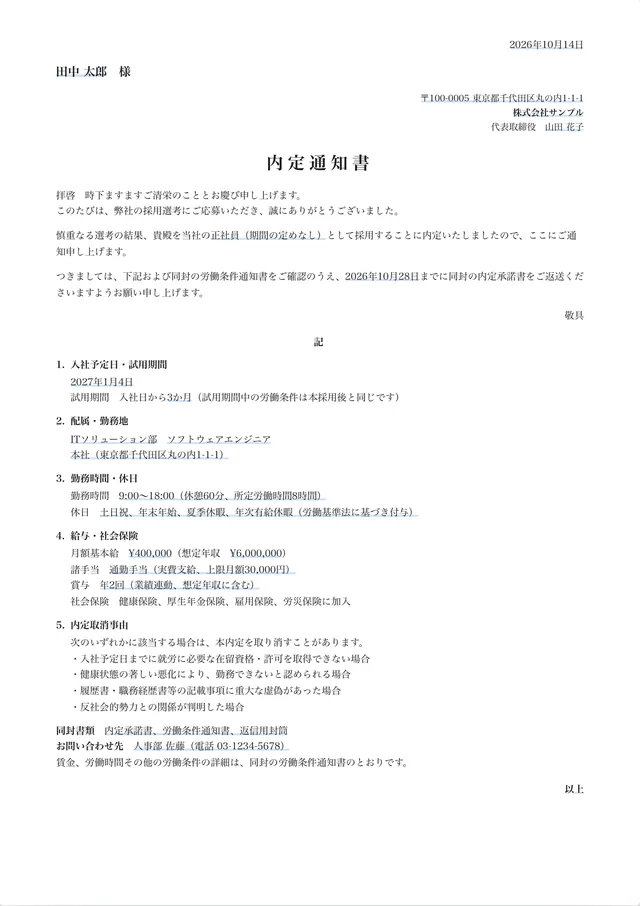
Even when you hire a non-Japanese candidate, the legally binding offer should be in Japanese. Issue the Japanese Offer Letter (内定通知書) and supply an English translation alongside for understanding. This tool lets you toggle the preview between Japanese and English so you can review and download each version separately, with the same structure and data.

2. The template covers the offer essentials

Position, department, work location, working hours, probation, monthly and annual compensation, allowances, bonus structure, days off, social insurance enrollment, and the standard withdrawal clause (内定取消事由). The mandatory written labor conditions under Article 15 of the Labor Standards Act go in a separate labor conditions notice (労働条件通知書). When the accepted offer forms the labor contract, those conditions must be stated at the offer stage, so enclose the notice with the letter; the template says so.

3. Edit anything that doesn't match your case

Click the pencil button at the top right of the preview and the entire letter becomes editable in place. Use this for special-case wording, equity grants, performance reviews, role-specific allowances, fixed-term contracts. When you turn editing off, your changes stay and the form fields keep driving only the highlighted variables.

4. Export to PDF

Click Download as PDF, enter your email, and the file generates locally in your browser. Whatever language is currently visible in the preview is what gets exported.

Edge cases worth knowing

  • Use this template for a formal offer (内定), not an informal pre-offer (内々定).
  • For new graduates, the offer is typically issued at the offer ceremony (内定式) on October 1.
  • Withdrawal grounds are narrow under Japanese law. Do not expand the listed clauses without sharoshi or legal review.
  • If the candidate needs a visa, make obtaining the work permit by the start date an explicit condition.

Reference

What each section means

Offer Letter (内定通知書)
The formal letter confirming the company has selected the candidate and intends to hire them on the stated terms. Once accepted, Japanese case law treats it as a labor contract with a deferred start date.
Labor Conditions Notice (労働条件通知書)
The legally mandated document under Article 15 of the Labor Standards Act listing the full set of working conditions in writing. It is due when the labor contract is formed: when an accepted offer forms the contract, the conditions must be stated at the offer stage, so the notice is usually enclosed with the offer letter.
Probation (試用期間)
A trial period at the start of employment, typically 3 to 6 months, during which dismissal grounds are slightly broader. Working conditions during probation should match those of full employment unless explicitly stated otherwise.
Grounds for withdrawing the offer (内定取消事由)
The narrow list of reasons under which the company reserves the right to revoke the 内定. Standard grounds: failure to graduate, inability to obtain a required visa, serious health deterioration, material misrepresentation, antisocial-forces affiliation.
Antisocial forces (反社会的勢力)
A standard Japanese legal concept covering organized crime and related entities. A clause excluding such affiliation is now boilerplate in offer letters and employment contracts in Japan.
Social insurance (社会保険)
Health insurance, welfare pension, employment insurance, and workers' compensation. Enrollment is mandatory for full-time employees from the start date.

Frequently asked

Common questions about Japanese job offer letters

Is an Offer Letter (内定通知書) legally required in Japan?

An Offer Letter (内定通知書) itself is not strictly required by law, but the moment a candidate accepts a job offer, a labor contract is generally considered formed under Japanese case law. What is mandatory is the labor conditions notice (労働条件通知書) under Article 15 of the Labor Standards Act, which must be issued when the labor contract is formed. When the accepted offer forms the contract, that means at the offer stage, not on the first day of work. Most companies combine both into the offer process: the offer letter sets the headline terms and signals selection, and the labor conditions notice provides the legally mandated detail.

What’s the difference between a formal offer (内定) and an informal pre-offer (内々定)?

An informal pre-offer (内々定, nai-nai-tei) is non-binding and typically used for new graduates ahead of the October 1 offer ceremony (内定式). The formal offer (内定, naitei) is the one that, once accepted, creates a contract that the employer can only revoke for narrow legal reasons. This template generates an Offer Letter (内定通知書), which is the formal version, not a pre-offer notice (内々定通知).

Can a formal offer (内定) be revoked?

Only on narrow grounds. Japanese case law treats an accepted formal offer (内定) as a labor contract with a deferred start date and a reservation of the right to cancel for cause. Permitted reasons typically include: failure to graduate, inability to obtain the required visa, serious health deterioration, material misrepresentation in the application, or affiliation with antisocial forces. Revocation for business convenience or “we changed our minds” will usually be ruled invalid. The withdrawal clause in this template lists the standard grounds; do not expand it without legal review.

Should the offer letter be in Japanese or English?

The legally binding version should be the Japanese one. For foreign hires, it is best practice to issue both: the Japanese Offer Letter (内定通知書) as the controlling document, and an English translation provided for understanding only. This template lets you toggle the preview between Japanese and English so you can review and download each version separately as a PDF.

What conditions are mandatory in the offer?

Under Article 15 of the Labor Standards Act and the related Enforcement Regulation, the items that must be in writing include: the term of the contract (and renewal rules for fixed-term), workplace and assigned duties, working hours and rest, days off and leave, wage calculation and payment, conditions for retirement and dismissal, and (from April 2024) any planned changes to workplace and duties. This template covers the essentials; the full mandatory set goes in a separate labor conditions notice (労働条件通知書), enclosed with the offer letter when the accepted offer forms the labor contract.

Do I need to include resident tax in the salary breakdown?

No. The offer letter typically lists base salary, expected annual figure (including bonus assumptions), and allowances. Resident tax (住民税) is a payroll deduction based on prior-year income, and for first-year hires from overseas it is zero. To estimate net take-home, see the Japan Payroll Calculator linked at the bottom of this page.

Should I attach a labor conditions notice (労働条件通知書) with the offer letter?

Yes. When the accepted offer forms the labor contract, the Ministry of Health, Labour and Welfare says the working conditions must be stated at the offer stage, so the notice belongs with the offer letter. It also removes ambiguity and shows the candidate the full picture before they accept. If the department or duties are not settled yet, state the expected ones in general terms and confirm them once decided. The Ministry of Health, Labour and Welfare publishes a standard labor conditions notice template that is free to use.

How accurate is the auto-translated English version?

The English version is a parallel translation, not a machine output. The two columns are kept structurally identical so the candidate can map every Japanese clause to its English counterpart. That said, the Japanese letter remains the legally binding document. For sensitive cases (executive offers, complex equity, probation carve-outs) have both versions reviewed by your sharoshi or legal counsel.

Can I edit the text directly?

Yes. Click the pencil button at the top right of the preview to make the letter directly editable in your browser. Use this to handle anything the template did not anticipate, extra clauses, special-case wording, role-specific allowances. When you turn editing off, your edits stay; the form fields on the left continue to drive only the highlighted variables.

DIY Hiring Kit

Everything You Need To Hire On Your Own

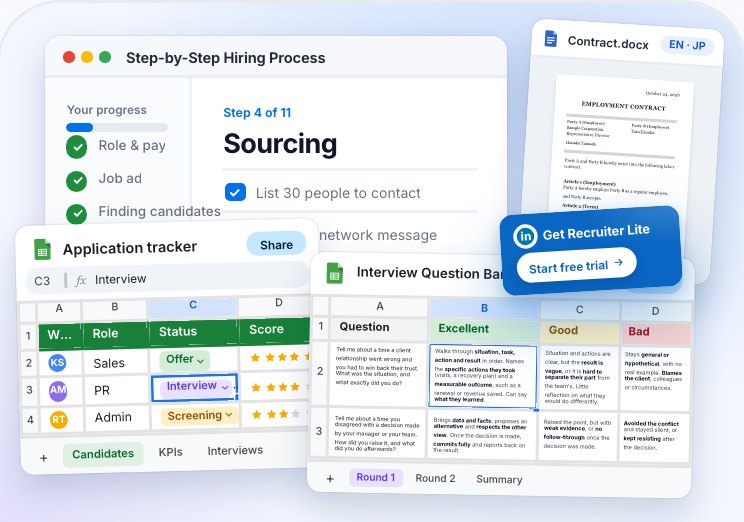
A downloadable hiring framework for small businesses in Japan, with step-by-step guides, spreadsheet ATS, LinkedIn scouting system, interview questions bank, offer letter and employment contracts, and a ton more!

1Dashboard11Checklists8Spreadsheets30Template docs4Weeks of Q&ABilingual

  • Download every file as Word, Google Docs, Excel or Google Sheets

About the author

Emmanuel Gendre, Founder of SaiyouTeam

Emmanuel Gendre

Founder, SaiyouTeam · TechieCV K.K.

Emmanuel advises SMBs on HR and recruiting in Japan. Before founding SaiyouTeam, he spent 14 years in talent acquisition, including as a recruiter at Google. Questions about Japanese offer letters come up often with his clients, so he built this free template.

Official sources

This page is built on the following primary Japanese government sources. Open each link to verify the underlying rule against the issuing authority.

Important. This template provides a generic Offer Letter (内定通知書) structure for general information only and is not a substitute for legal advice. Japanese labor law on accepted offers is unforgiving, withdrawal grounds are narrow, and small wording choices have real consequences. Before issuing an offer to an actual candidate, have the final wording reviewed by a licensed sharoshi (社会保険労務士) or qualified legal counsel.