
Hiring Playbook

Japan offer acceptance letter: how to write it (free template and sample)

An offer acceptance letter (naitei shodakusho) tells the company that you will join. Each field is explained below with a sample, and the free template is ready to download as Word or PDF.

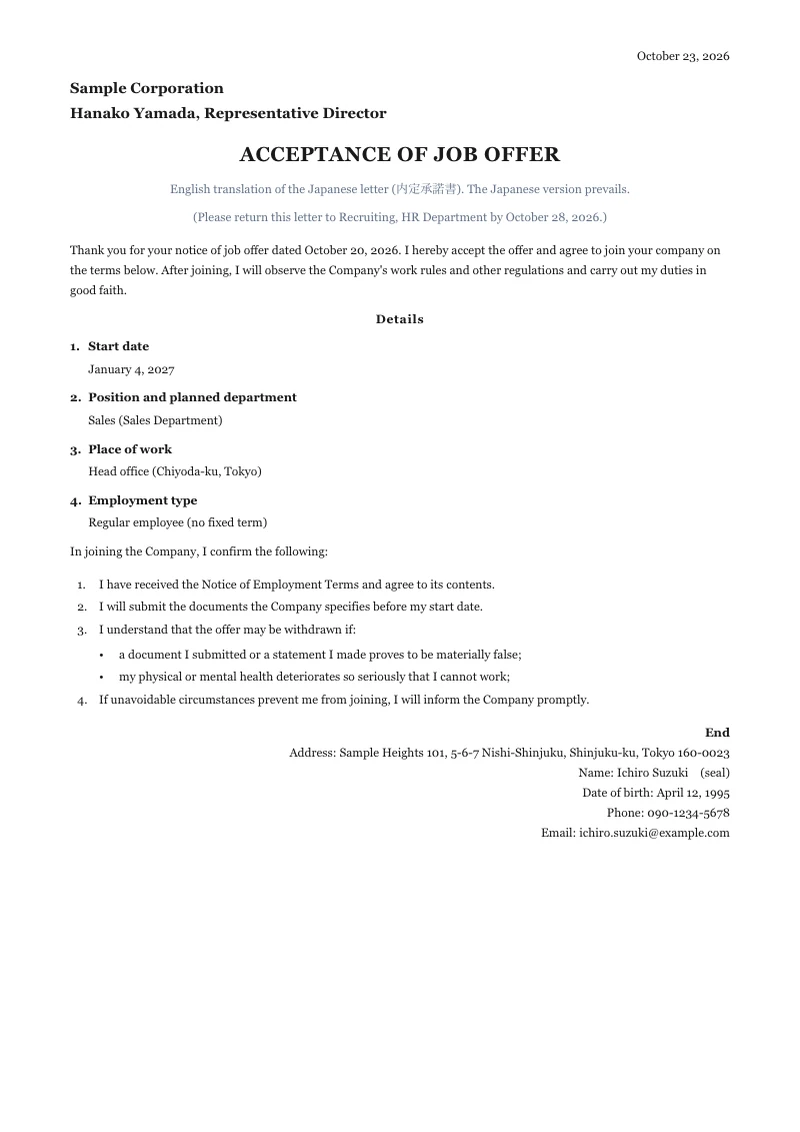
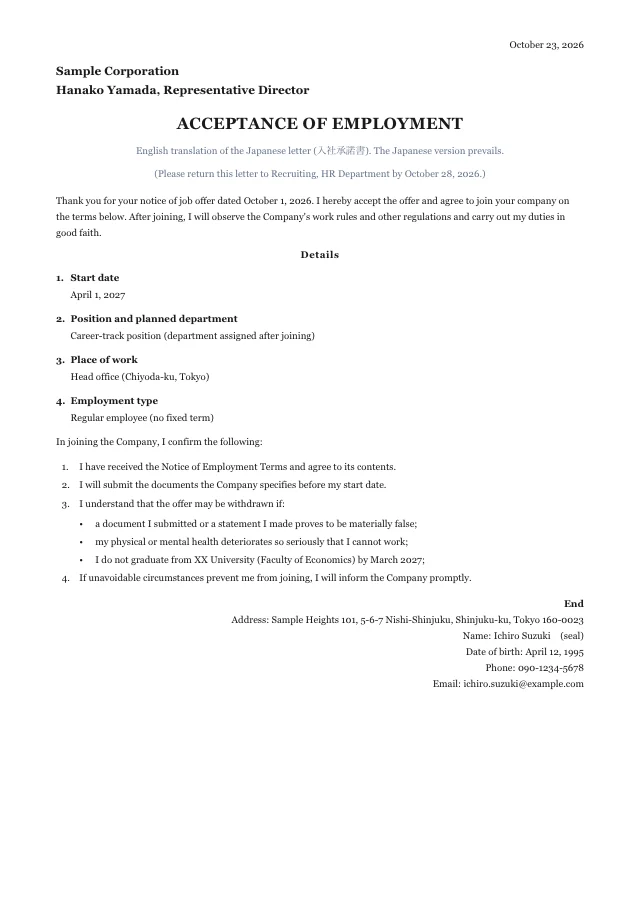
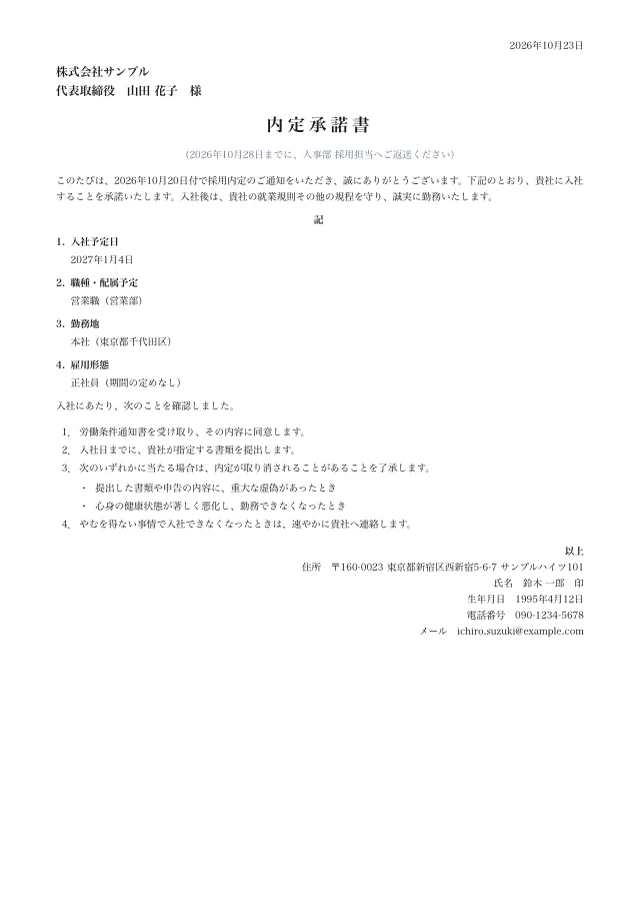
Samples made with this template: the offer acceptance letter in English (mid-career), the Japanese letter, and the new-graduate version titled Acceptance of Employment
Emmanuel Gendre Former Google recruiter, HR and hiring advisor to SMBs Last updated 17 min read

Offer acceptance letter template (free download)

Your inputs update the letter in the preview as you type.

Step 1 of 8

Title and type

The document title, and mid-career or new graduate.

Hire type

No graduation condition

Same content as the nyusha shodakusho

Addressee

The company that receives the letter.

Deadline

The return deadline and address, shown under the title.

8 days to reply

Offer details

The date of the offer and its terms.

Starts 76 days after the offer

Confirmations

What the hire confirms in the letter.

No penalty or pledge to turn down other offers

Offer withdrawal

Grounds on which the offer may be withdrawn.

The hire

Name, address and contact details of the person accepting.

Signature

How the hire signs, and the date written.

Signature

For a paper form returned by post

Your acceptance letter is ready

Your inputs are in the preview. Download it as a PDF, get the blank Word template, or go back to the steps to review.

October 23, 2026

Sample Corporation

Hanako Yamada, Representative Director

ACCEPTANCE OF JOB OFFER

English translation of the Japanese letter (内定承諾書). The Japanese version prevails.

(Please return this letter to Recruiting, HR Department by October 28, 2026.)

Thank you for your notice of job offer dated October 20, 2026. I hereby accept the offer and agree to join your company on the terms below. After joining, I will observe the Company's work rules and other regulations and carry out my duties in good faith.

Details

  1. Start dateJanuary 4, 2027
  2. Position and planned departmentSales (Sales Department)
  3. Place of workHead office (Chiyoda-ku, Tokyo)
  4. Employment typeRegular employee (no fixed term)

In joining the Company, I confirm the following:

  1. I have received the Notice of Employment Terms and agree to its contents.
  2. I will submit the documents the Company specifies before my start date.
  3. I understand that the offer may be withdrawn if:
    • a document I submitted or a statement I made proves to be materially false;
    • my physical or mental health deteriorates so seriously that I cannot work;
  4. If unavoidable circumstances prevent me from joining, I will inform the Company promptly.

End

Address: Sample Heights 101, 5-6-7 Nishi-Shinjuku, Shinjuku-ku, Tokyo 160-0023

Name: Ichiro Suzuki (seal)

Date of birth: April 12, 1995

Phone: 090-1234-5678

Email: ichiro.suzuki@example.com

  • PDF, Word and sample downloads ask for your email address.
  • Your inputs are processed in your browser, and the PDF is made on your device.
  • The confirmations follow what Japan's youth employment guidelines (MHLW) ask employers to state at the offer.

Basics

What is an offer acceptance letter? How it differs from the offer letter

Key points

An offer acceptance letter (naitei shodakusho) is the document in which a person who has received a job offer tells the company, in writing, that they accept the offer and will join. The company prepares the form and encloses it with the offer letter; the candidate writes the date, address and name and returns it. No law requires one.

Some companies call it a nyusha shodakusho (acceptance of employment) or a naitei judakusho; the name differs but the role is the same. The returned letter confirms who will join, and the company starts preparing the assignment and onboarding. Under Japanese case law, the job application counts as the offer to contract and the job offer notice as its acceptance, so the employment contract is formed when the offer is made. The acceptance letter puts the candidate's intent to join in writing (see legal effect).

If you received a letter to fill in and return, see how to write it and how to send it. If you are the company preparing one, see the items to include and the template.

Offer letter, acceptance letter and joining pledge compared

How the job offer letter, offer acceptance letter, notice of employment terms, joining pledge and notice of hiring differ
DocumentFrom whom, whenRole
Job offer letter (naitei tsuchisho)Company to candidate, when selectedConfirms the offer formally and asks for the acceptance letter back
Offer acceptance letter (naitei or nyusha shodakusho)Candidate to company, by the reply deadlineAccepts the offer and states the intent to join
Notice of employment termsCompany to candidate, when the contract is formed (at the offer)States pay, working hours and other terms. A legal duty (Labor Standards Act, Article 15)
Joining pledgeNew hire to company, around the start datePledges to follow the work rules and keep information confidential
Notice of hiring (saiyo tsuchisho)Company to applicant, when selected (mainly mid-career hires)Announces the hiring decision

The naitei shodakusho and the nyusha shodakusho are the same document. In this table, only the notice of employment terms (stating the working conditions) is a legal requirement.

How to write it

How to write an offer acceptance letter: date, address, seal and a sample

Writing an offer acceptance letter mostly means filling in the blanks on the form the company sent. You write the date, address, name and contact details, and stamp your seal if there is a seal box. The acceptance wording is already printed on the form. Follow these five steps.

  1. Check the working conditions

    Check that the start date, position, place of work and pay match what you heard at the interview and what the notice of employment terms says. If anything differs, ask the recruiter before you fill it in.

  2. Write the date

    Write the date you fill it in. If you mail it, fill it in on the day you post it, so the date written and the posting date match. Use the Japanese era or the Western calendar, as the form does.

  3. Write your address, name and contact details

    Write your address in full, from the postal code and prefecture down to the block number, building and room. Write your name clearly, and follow the form for the furigana reading. In the contact field, give a mobile number you can be reached on.

  4. Stamp your seal

    If there is a seal box, stamp it straight with a personal seal (mitome-in) and red ink paste. If the company specifies a type of seal, use that.

  5. Keep a copy and send it back

    Keep a copy or a photo, and send the letter so that it arrives by the reply deadline (see how to send it).

How to fill in each field

How to fill in each field of an offer acceptance letter
FieldWhat to writePoints to watch
DateThe date you write it; match the posting date if you mail itJapanese era or Western calendar, as on the form. Do not leave it blank
AddresseeKeep the printed company and representative namesIf blank, write the full official names
AddressPostal code, then prefecture down to building and room numberNo "same as above" and no abbreviations
NameIn full, written clearlyFollow the form for hiragana or katakana furigana
ContactYour mobile number and an email address you checkDetails the company can use to reach you until you join
SealA personal seal with red ink pasteNo law sets the type of seal; follow the company's instructions
Other fieldsFill in every field on the formIf a field does not apply, follow the form's instructions

Use a black ballpoint or fountain pen, not an erasable pen or a pencil. Do not use correction fluid or tape either: if you make a mistake, ask the company for a new form, or for the file so you can print it again.

If the company asks for an acceptance letter but does not send a form, you can make one with the template above. Any format works as long as it has a title, the date, the addressee, a line accepting the offer ("I accept your offer and will join your company"), the start date, and your address and name; you can reuse the wording of the sample below.

Offer acceptance letter sample and Word template

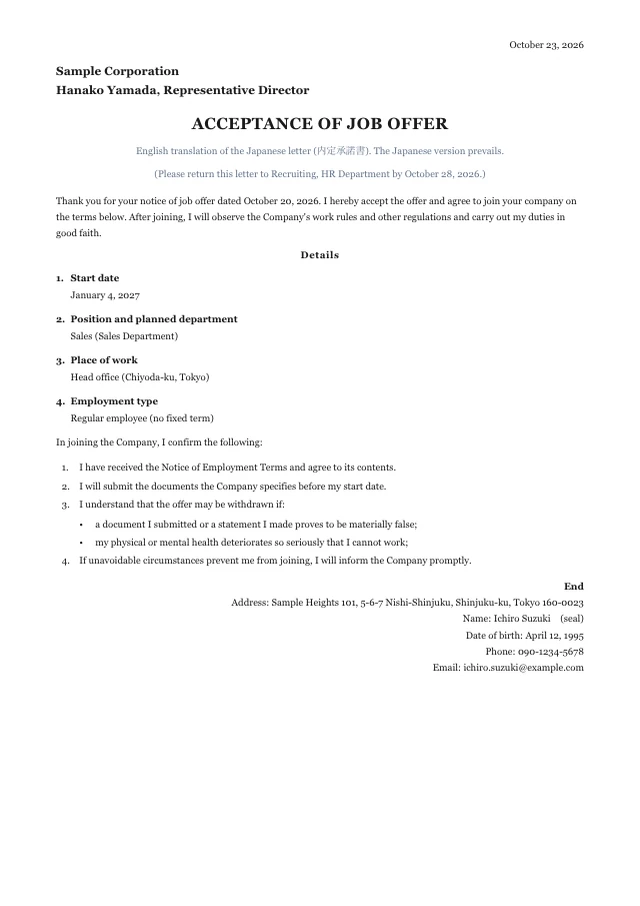
This is a sample (mid-career hire) made with the template above, in English. Every field is filled in, including the date, address, name and contact details. You can download the sample PDF and the Word template (blanks marked [ ]) after entering your email address.

Sample offer acceptance letter in English (mid-career hire, start date January 4, 2027, date, address, name and contact details filled in)
Sample offer acceptance letter: the acceptance line, start date, confirmations, and the hire's address, name, contact details and seal box.

The Word template is the English letter on one page, with every blank marked [ ]. Pick the employment type inside the brackets, and delete the withdrawal grounds for new graduates and foreign nationals if they do not apply. For the Japanese letter, switch the preview to Japanese and download the PDF.

Sending

How to send an offer acceptance letter: mail, cover letter and envelope

Send the letter the way the company asks, so that it arrives by the reply deadline. If there are no instructions, the usual way is to tell the recruiter you accept by phone or email first, then mail the letter.

Mailing it: cover letter and envelope

Use the return envelope if one is enclosed. Strike through the printed 行 or 宛 after the address with a double line, and write 御中 (for a company or department) or 様 (for a named person) instead. Put the documents in a clear file without folding them, in this order from the top: cover letter, acceptance letter, other documents. If the return envelope is a long naga-gata 3, fold the papers in three to fit.

An acceptance letter counts as correspondence (shinsho) under Japanese postal rules, so send it by post (regular mail, express or simple registered mail), not by a parcel delivery service (Ministry of Internal Affairs and Communications, guidelines on correspondence, Japanese). Use express mail if the deadline is close.

A cover letter is not required, but it is usual, because it shows at a glance what is enclosed. You can make one with the cover letter template for returning documents, which also explains how to address and pack the envelope.

Sending it by email or as a PDF

If the company asks for email or a web form, scan the filled-in letter, stamped with your seal, to PDF and send it the way they ask. If the company sends it through an e-signature service, sign it there as instructed. Under Japanese civil law a contract forms by agreement and a seal is not a legal requirement (Cabinet Office, Ministry of Justice and METI, Q&A on seals, Japanese), so the acceptance is valid without one.

Telling the company you accept: phone and email example

On the phone, thank them, say you accept, and say when you will send the letter. Then confirm your acceptance by email too, so there is a record.

Email

Subject: Acceptance of your job offer ([Ichiro Suzuki])

Dear [Ms. Sato],

Thank you very much for your offer of employment. I am pleased to accept it.

I have filled in the acceptance letter and will mail it so that it reaches you by the [October 28] deadline. Please let me know if there is anything else I should do before I join.

I look forward to working with you.

[Ichiro Suzuki]
Phone: [090-1234-5678] Email: [ichiro.suzuki@example.com]

Put the acceptance first and say when you will send the letter, so the company can start preparing your onboarding.

Timing

When does the offer acceptance letter arrive? Deadline, and what to do if it doesn't

The acceptance letter usually comes with the job offer letter. For a mid-career hire, after you hear about the offer by phone or email, it arrives by post or as a PDF, together with the offer letter and the notice of employment terms.

For new graduates, the government's request sets the official offer date at October 1 or later in the final year of study (October 1, 2026 for March 2027 graduates), so the acceptance letter is in principle also handed over from October 1, with the offer letter. Some companies hand it over at the offer ceremony (naiteishiki). The Council on Employment Issues, formed by universities and other schools, asks companies not to request an acceptance letter earlier, at the informal offer (nainaitei) stage, and counts it as owahara (pressure to end job hunting).

Setting the deadline

No law sets the deadline; it is the date written on the offer letter or acceptance letter. I recommend that companies allow about a week, including one weekend. If you are the candidate and cannot decide by the deadline, ask the recruiter for more time before it passes.

Informal offerees asking to delay their acceptance (by company, 2027 graduates)

Mynavi, 2027 Graduates Corporate Recruiting Survey (June 2026, 2,154 companies)

Companies where half or more asked
38.5%
Companies where 20 to 40% asked
23.1%
Companies where 10% or less asked
38.3%

The rate is the number of informal offerees who asked for time to think or to wait for other companies' results, divided by the number of informal offers made. Based on companies that had made informal offers.

Requests to wait are common. For companies, I think answering questions about the working conditions quickly does more to win an acceptance than a short deadline.

If the acceptance letter does not arrive

If nothing has arrived about a week after you heard about the offer, ask the recruiter by email or phone when it will be sent. If another company's reply deadline comes first, explain that too. Some companies do not use an acceptance letter and confirm the acceptance by email reply or e-signature instead. To check what to submit before you join, see the new hire document checklist.

For employers

What to include in an offer acceptance letter: for companies preparing the form

No law sets the format of an offer acceptance letter. Still, the acceptance line, the start date, and the candidate's address and name are essential.

Japan's youth employment guidelines (MHLW) ask employers to state the start date, the terms of employment and the grounds for withdrawing the offer in writing when they make an offer, and to state at that point if graduation is a condition. Repeating these in the acceptance letter makes clear what the candidate accepted. The template above contains the ten items below.

Items in an offer acceptance letter
ItemWhat to writePoint
Title"Naitei shodakusho" or "nyusha shodakusho"Same document either way
Date and addresseeDate written; company and representative namePrint the addressee on the form
Acceptance line"Thank you for your notice of job offer dated [date]. I hereby accept the offer and agree to join your company"Identifies what is accepted
Start dateA specific dateStated at the offer (guidelines)
Position, place of work, type"Sales (Sales Department)", "Head office", "Regular employee", etc.Write the department as "planned"; give details in the notice of employment terms
Working conditionsThat the candidate received and agrees to the notice of employment termsIf the offer forms the contract, the working conditions must be stated at the offer (Labor Standards Act, Article 15)
DocumentsThat the candidate will submit the specified documents before the start dateList them separately (new hire documents)
Withdrawal groundsMaterial false statements, serious health deterioration, failing to graduate (new graduates), no work-eligible status of residence (foreign nationals)State the grounds and any graduation condition at the offer (guidelines)
Notice if unable to joinThat the candidate will tell the company promptly if they cannot joinNo penalty clause (Labor Standards Act, Article 16)
Address, name and sealThe candidate's fields (including contact details)A seal is optional; an e-signature also works

What not to put in the letter

However much you want to secure the hire, leave the following out of the acceptance letter.

Clauses to leave out of an offer acceptance letter, and why
ClauseWhy it is a problemInstead
A penalty or damages for withdrawingArticle 16 of the Labor Standards Act forbids penalties and pre-set damages for breach of an employment contract"If I cannot join for unavoidable reasons, I will tell you promptly"
A pledge to decline all other offersThe guidelines ask employers not to force candidates to stop job hunting in exchange for an offerLeave it out; ask about any hesitation in a meeting
Parental consent as a conditionForcing parental consent to prevent withdrawals (oyakaku) can count as owahara (government request)Leave it out
A guarantor's signature and sealA contract making someone guarantee the candidate's damages is a personal revolving guarantee, void without a maximum amount (Civil Code, Article 465-2)Use a separate personal guarantee letter if needed
"This is not an employment contract"Case law holds that the offer forms the employment contract, so the statement is inaccurateState the working conditions in the notice of employment terms

For a foreign national hire, the template makes an English version (Acceptance of Job Offer) and the Japanese letter together: the preview opens in English, and the "Japanese" button shows the Japanese letter, which has its own fields for names and addresses in Japanese. Keep the Japanese version as the binding text and attach the English one as a translation. If the offer depends on getting a work-eligible status of residence, turn on "Residence status" in the offer withdrawal step.

Law

Legal effect of an offer acceptance letter, and withdrawing after you submit it

An offer acceptance letter has no special legal effect set by statute. In the Dai Nippon Printing case (July 20, 1979), Japan's Supreme Court treated the application as the offer to contract and the job offer notice as its acceptance, and held that an employment contract with a deferred start and a reserved right of cancellation was formed at the offer. The acceptance letter confirms that this contract exists and that the candidate intends to join.

You can still withdraw after submitting the letter

Even if you signed the letter and stamped your seal on it, you are in principle free to withdraw, under the freedom to choose your occupation, and the acceptance letter does not legally bind you (Osaka Prefecture, "Naitei (job offers)", Japanese). For an employment contract with no fixed term, Article 627 of the Civil Code ends the contract two weeks after notice. A withdrawal that seriously breaches good faith may still lead to a damages claim (MHLW, "Check your working conditions", Japanese), so tell the company as soon as you decide.

How to withdraw: email example

First tell the recruiter by phone, then confirm by email or letter. "After careful consideration" is enough as a reason.

Email

Subject: Withdrawal of my acceptance ([Ichiro Suzuki])

Dear [Ms. Sato],

Thank you again for your recent offer of employment.

Although I have already submitted the acceptance letter, after careful consideration I have decided to decline the offer. I sincerely apologize.

I would have preferred to apologize in person, and I hope you will forgive me for writing instead. I wish your company every success.

[Ichiro Suzuki]
Phone: [090-1234-5678] Email: [ichiro.suzuki@example.com]

On the company side, record the withdrawal in writing with an acknowledgment of joining withdrawal.

Acceptance letters and owahara

Asking for an acceptance letter is not itself illegal. The problems are asking for an acceptance letter or pledge at the informal-offer stage and forcing candidates to stop job hunting elsewhere in exchange for an offer. Both count as "owahara": the government's request asks companies not to force candidates to stop job hunting, and the Council on Employment Issues adds not asking for acceptance letters at the informal-offer stage. The MHLW youth employment guidelines likewise ask employers not to force candidates to stop job hunting elsewhere.

Withdrawal of the offer by the company

Once the offer has formed an employment contract, the company can withdraw it, as with a dismissal, only on objectively reasonable grounds that are socially acceptable (Labor Contracts Act, Article 16). Even when a ground written in the acceptance letter applies, each case is judged on its facts. To withdraw an offer to a new graduate, the company must also notify Hello Work and the school (Employment Security Act Enforcement Regulations, Article 35(2)). The document for a withdrawal is the notice of job offer withdrawal.

FAQ

Common questions about offer acceptance letters in Japan

What do I write on an offer acceptance letter?

Fill in the blanks on the company's form: the date, address, name and seal. The acceptance wording is usually printed, so you do not need to add any. If there is no form, a title, the date, the addressee, a line such as "I accept your offer and will join your company", the start date, and your address and name are enough (see how to write it).

Which date do I write on the acceptance letter?

Usually the date you fill it in. If you mail it, fill it in on the day you post it, so the two dates match. If the company specifies a date, use that; the same goes for the date on a joining pledge and other documents.

Can I use any seal on the acceptance letter?

No law sets the type of seal. A contract forms by agreement, and a seal is not required unless a specific rule says so (Cabinet Office, Ministry of Justice and METI, Q&A on seals). Follow the company's instructions; if there are none, a personal seal with red ink paste is the safe choice. Some companies do not accept self-inking stamps (Shachihata).

What is the difference between the offer acceptance letter and the job offer letter?

The job offer letter goes from the company to the candidate; the acceptance letter goes from the candidate to the company. The company makes the offer with the offer letter, and the candidate returns the acceptance letter to say they will join. Neither is required by law; what the law requires is that the working conditions be stated in writing, in the notice of employment terms (see the comparison table).

Do I need a cover letter with the acceptance letter?

It is not required, but it is usual when you mail it. It shows what you enclosed and how many copies, and lets you say thank you. You do not need one if you submit by email or hand it over in person. You can make one with the cover letter template for returning documents.

Is an offer acceptance letter legally binding?

The letter itself has no special legal effect. Under case law, the employment contract (with a deferred start and a reserved right of cancellation) is formed when the offer is made, and the acceptance letter is evidence of the candidate's intent to join. It does not stop the candidate from withdrawing (see legal effect).

Can I withdraw after submitting the acceptance letter?

Yes. You are free to choose your occupation, and for a contract with no fixed term, Article 627 of the Civil Code ends it two weeks after notice. A withdrawal that seriously breaches good faith may lead to a damages claim, so as soon as you decide, call the company and confirm by email.

Is it illegal to accept an offer as a backup?

No. But companies often stop considering other candidates once you accept, so withdrawing afterwards costs them. If you are unsure, ask for more time before the deadline; if you accept and then choose another company, tell them right away.

Is an acceptance letter a form of owahara?

Asking for one after the official offer is not owahara. The government's request and the Council on Employment Issues (formed by universities and other schools) count three things as owahara and ask companies to avoid them: asking for acceptance letters or pledges at the informal-offer stage, forcing candidates to stop job hunting, and forcing parental consent. If you are pressured, you can consult your university's career center or a General Labor Consultation Corner (Japanese).

What is an example email to withdraw after accepting?

Use a subject such as "Withdrawal of my acceptance (your name)", and write thanks, the decision to withdraw, and an apology, in that order. "After careful consideration" is enough as a reason, and you should call before you email (see the withdrawal example).

What is an example message to accept an offer?

"Thank you very much for your offer of employment. I am pleased to accept it. I will mail the acceptance letter so that it reaches you by [date]." is the basic form (see the acceptance example).

When does the acceptance letter arrive, and what if it doesn't?

It usually comes with the job offer letter. New graduates receive it with the official offer, from October 1; mid-career hires receive it by post or email after hearing about the offer. If nothing arrives after about a week, ask the recruiter when it will be sent; if another company's reply deadline is close, explain that too.

Can I submit the acceptance letter by email or as a PDF?

Yes, if the company allows it. You can send a scanned PDF of the letter, filled in and stamped with your seal, or sign through an e-signature service. If you are unsure whether they need the original by post, ask the recruiter.

What if I make a mistake on the acceptance letter?

Do not use correction fluid or tape; ask for a new form and write it again. If you have the file, you can print it again. Whether a double line and a correction seal are acceptable depends on the company, so ask the recruiter.

DIY Hiring Kit

Everything You Need To Hire On Your Own

A downloadable hiring framework for small businesses in Japan, with step-by-step guides, spreadsheet ATS, LinkedIn scouting system, interview questions bank, offer letter and employment contracts, and a ton more!

1Dashboard11Checklists8Spreadsheets30Template docs4Weeks of Q&ABilingual

  • Download every file as Word, Google Docs, Excel or Google Sheets

About the author

Emmanuel Gendre, founder of SaiyouTeam

Emmanuel Gendre

Founder, SaiyouTeam · HR and recruiting advisor to SMBs in Japan

  • Former Google recruiter
  • 14 years in recruiting

Emmanuel advises SMBs on HR and recruiting in Japan. Before founding SaiyouTeam, he spent 14 years in talent acquisition, including as a recruiter at Google. As part of his advice on running the hiring process, he built this free template so the last step of an offer, the candidate's acceptance, goes smoothly.

Official sources

The template and explanations on this page are based on the official sources below, most of them in Japanese (checked October 27, 2026).

Important. This template and guide are general information, not a substitute for professional advice. Laws and official guidance as of October 2026.