Hiring Playbook

Japan Pledge Upon Joining Template (Free, Word/PDF, English and Japanese)

A free template for the pledge you collect from new hires in Japan. Choose clauses such as work rules, confidentiality, social media, side jobs and anti-social forces, and you get a draft with the addressee, date and signature lines in place. Download it as a PDF, or get the blank Word template. Also covered: how to fill it in, sample wording for each clause, and the clauses that are void even when signed.

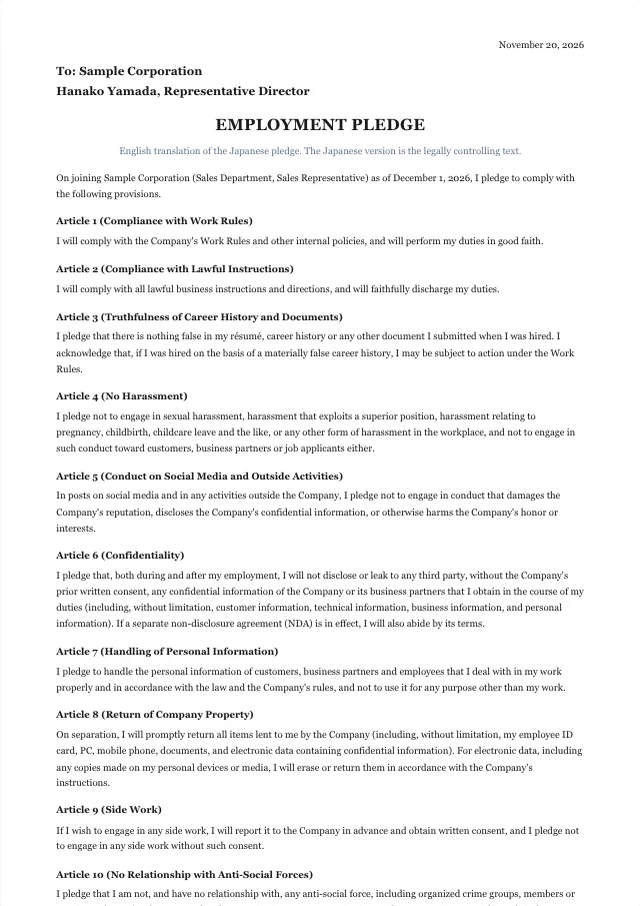
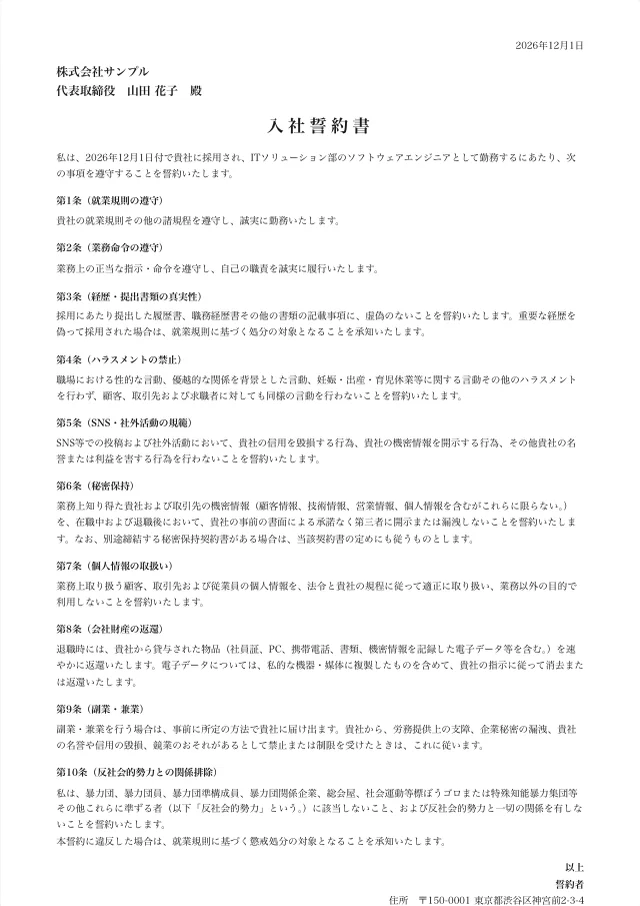
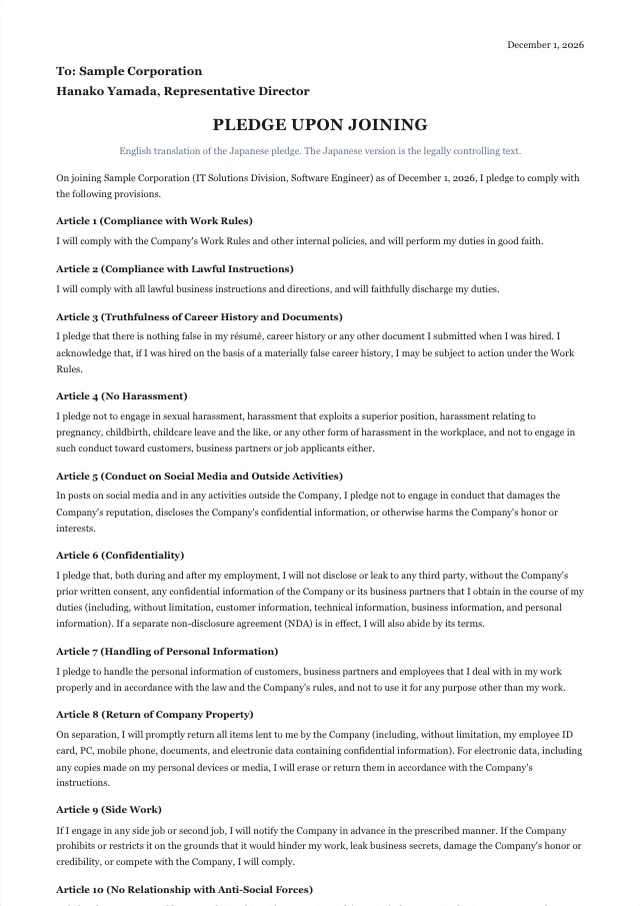
Sample documents made with this template: the pledge upon joining in English, the Japanese original, and an employment pledge
Emmanuel Gendre Former Google recruiter, HR and hiring advisor to SMBs Last updated 20 min read

Pledge Upon Joining generator (free template)

Pick the clauses and fill in the fields: the sample in the preview becomes a pledge you can use as is.

Step 1 of 6

To and title

The pledge’s title and the company it goes to.

Pledge Upon JoiningThe most common title

Pledgor

The new hire’s name, address and placement.

Dates and duties

The dates, and the basic duties.

Handed in on the joining day

Conduct

Clauses on career history, harassment and social media.

Info & property

Information and company property.

Side work & more

Side jobs, and the other clauses.

NotificationAllowed once notified

Your pledge is ready

Your inputs are in the preview. Save it as a PDF or Word file, or go back to the steps to review.

December 1, 2026

To: Sample Corporation

Hanako Yamada, Representative Director

PLEDGE UPON JOINING

English translation of the Japanese pledge. The Japanese version is the legally controlling text.

On joining Sample Corporation (IT Solutions Division, Software Engineer) as of December 1, 2026, I pledge to comply with the following provisions.

Compliance with Work Rules

I will comply with the Company's Work Rules and other internal policies, and will perform my duties in good faith.

Compliance with Lawful Instructions

I will comply with all lawful business instructions and directions, and will faithfully discharge my duties.

Truthfulness of Career History and Documents

I pledge that there is nothing false in my résumé, career history or any other document I submitted when I was hired. I acknowledge that, if I was hired on the basis of a materially false career history, I may be subject to action under the Work Rules.

No Harassment

I pledge not to engage in sexual harassment, harassment that exploits a superior position, harassment relating to pregnancy, childbirth, childcare leave and the like, or any other form of harassment in the workplace, and not to engage in such conduct toward customers, business partners or job applicants either.

Conduct on Social Media and Outside Activities

In posts on social media and in any activities outside the Company, I pledge not to engage in conduct that damages the Company's reputation, discloses the Company's confidential information, or otherwise harms the Company's honor or interests.

Confidentiality

I pledge that, both during and after my employment, I will not disclose or leak to any third party, without the Company's prior written consent, any confidential information of the Company or its business partners that I obtain in the course of my duties (including, without limitation, customer information, technical information, business information, and personal information). If a separate non-disclosure agreement (NDA) is in effect, I will also abide by its terms.

Handling of Personal Information

I pledge to handle the personal information of customers, business partners and employees that I deal with in my work properly and in accordance with the law and the Company's rules, and not to use it for any purpose other than my work.

Return of Company Property

On separation, I will promptly return all items lent to me by the Company (including, without limitation, my employee ID card, PC, mobile phone, documents, and electronic data containing confidential information). For electronic data, including any copies made on my personal devices or media, I will erase or return them in accordance with the Company's instructions.

Treatment of Intellectual Property

Inventions, utility model devices, copyrighted works and other intellectual property created in the course of my duties shall be handled in accordance with the Company's Work Rules and any applicable Employee Invention Rules. Specific assignment terms shall be set out in a separate IP assignment agreement or in the Company's internal regulations.

Side Work

If I engage in any side job or second job, I will notify the Company in advance in the prescribed manner. If the Company prohibits or restricts it on the grounds that it would hinder my work, leak business secrets, damage the Company's honor or credibility, or compete with the Company, I will comply.

Non-Compete (during employment)

During my employment, I pledge not to provide services to any third party that operates a business competing with the Company, without the Company's prior written consent. I understand that any post-employment non-compete obligation will be set out in a separate non-compete agreement.

No Relationship with Anti-Social Forces

I pledge that I am not, and have no relationship with, any anti-social force, including organized crime groups, members or quasi-members of such groups, related enterprises, corporate extortionists, racketeers posing as social or political movements, or organized white-collar crime groups, or any other party of equivalent nature.

Compensation for Damage

I acknowledge that, if I cause damage to the Company intentionally or through gross negligence, I will be liable to compensate the Company for that damage.

I acknowledge that, in the event of any breach of this pledge, I may be subject to disciplinary action under the Company's Work Rules.

End

Pledgor

Address: 2-3-4 Jingumae, Shibuya-ku, Tokyo 150-0001

Name: Taro Tanaka (seal)

  • Downloads ask for your email address.
  • The Japanese version prevails.
  • Based on Japanese law (Nov 2026).

Overview

What a pledge upon joining is, and how it differs from an offer acceptance letter or a guarantee

Key points

A pledge upon joining is a document in which a new hire promises the company that they will follow the work rules, keep information confidential and more. No law requires it, but it records that the company explained its rules and that the employee agreed.

Only the new hire signs it. Unlike a contract, where both sides take on obligations, the employee makes promises: to follow the work rules, keep information confidential, return company property on leaving, and so on. It is not required by law, and it does not replace the employment contract or the work rules. It supplements both.

Companies give it different names in Japanese, and the template’s title setting offers the common ones, including the term used in healthcare and care work. The same document works for new graduates, mid-career hires and part-time staff. Some companies, though, use the same name for the document in which a candidate confirms they will join (an offer acceptance letter). If that commitment to join is what you need, use the offer acceptance letter template. The other documents exchanged at joining are in the hiring and onboarding agreements hub.

The pledge upon joining compared with the offer acceptance letter, the letter of personal guarantee and the employment contract
DocumentWho signsPurposeWhen
Pledge upon joiningEmployeePromise to follow the rules after joiningOnboarding
Offer acceptance letterCandidateConfirm they will joinAfter the offer
Letter of personal guaranteeGuarantorCover damage the employee causesOnboarding
Employment contractCompany and employeeAgree pay, hours and other termsBy the joining date

A personal guarantee lasts 3 years if no period is set, and 5 years at most if one is (Personal Guarantee Act, in Japanese). A guarantee made on or after April 1, 2020 is void without a maximum amount (Civil Code, Article 465-2).

The document a guarantor signs can be made with the letter of personal guarantee template, maximum amount included.

Timing

When to collect the pledge upon joining

You collect the pledge around the joining date, and again when the employee’s role changes.

  1. A pledge sliding out of the joining documents envelope, next to a calendar showing the joining date

    After the offer: collect it before day one

    Collect it during onboarding after the offer, before the joining date (a pre-joining pledge). It works for new graduates and mid-career hires alike. After you send the notice of hiring, enclose it with the joining documents and ask for it back.

  2. A signed pledge with a green check, next to the new hire’s ID card

    Day one: with the employment contract

    If you did not collect it before joining, the usual moment is day one, together with the employment contract and the letter of personal guarantee. The new hire document checklist lists what to enclose, and the cover letter for joining documents goes with them by post.

  3. An employee one step up a staircase, next to a pledge signed again

    Promotion or transfer: sign again

    When a promotion to management or a move to another department changes the employee’s role significantly, have them sign a new pledge, and adjust the confidentiality scope to the information they now handle.

  4. A returned laptop and ID card, and a confidentiality pledge with a shield

    Leaving: close it with another pledge

    On leaving, confirm the return of company property and post-employment confidentiality with a pledge signed on leaving. A signature at that stage cannot be forced, so the pledge collected at joining is your foundation.

Name the pledge in your work rules’ list of documents to submit at hiring

It gives a clear basis for asking, so it is easier to collect.

When it matters most

  1. You want consent to specific rulesWhen you want the employee’s written consent to specific rules in the work rules, such as social media use or harassment prevention
  2. They will handle confidential informationWhen the job involves customer data, internal systems or company assets
  3. Your employment contract is briefWhen the employment contract is a simple form and you want the conduct rules in writing too

Contents

What to include in a pledge upon joining, with sample clauses

A pledge usually sets out these items clause by clause. In the template, every clause except side work can be switched on or off.

What to include in a pledge upon joining
ItemContent
PartiesThe company it is addressed to, and the employee’s name and address
Work rulesPromise to follow the work rules and company policies
InstructionsFollowing lawful work instructions
Career historyNothing false on the résumé or career history
HarassmentPromise not to harass (including customers and applicants)
Social mediaPromise not to damage the company’s reputation online or outside work
ConfidentialityPromise to keep information confidential during and after employment
Personal dataProper handling of customer, partner and employee personal data
Company propertyPromise to return company property (ID card, PC, phone, documents) on leaving
Side workHow side jobs are handled (notification, prior approval)
Anti-social forcesNot being, or having ties to, anti-social forces
DamageLiability for damage caused intentionally or through gross negligence (no amount set)
DisciplineAcknowledging that a breach can lead to disciplinary action (warning, written reprimand, pay cut, suspension, advised resignation, disciplinary dismissal)
SignatureDate and the employee’s signature (seal optional)

Sample clauses

Sample wording for the main clauses. It matches the template (the English translation; the Japanese text prevails), so you can copy it into your own form. The same wording is in the Word format of the pledge.

Pledge upon joining

Compliance with Work Rules

I will comply with the Company's Work Rules and other internal policies, and will perform my duties in good faith.

Confidentiality

I pledge that, both during and after my employment, I will not disclose or leak to any third party, without the Company's prior written consent, any confidential information of the Company or its business partners that I obtain in the course of my duties (including, without limitation, customer information, technical information, business information, and personal information). If a separate non-disclosure agreement (NDA) is in effect, I will also abide by its terms.

No harassment

I pledge not to engage in sexual harassment, harassment that exploits a superior position, harassment relating to pregnancy, childbirth, childcare leave and the like, or any other form of harassment in the workplace, and not to engage in such conduct toward customers, business partners or job applicants either.

Side work (notification)

If I engage in any side job or second job, I will notify the Company in advance in the prescribed manner. If the Company prohibits or restricts it on the grounds that it would hinder my work, leak business secrets, damage the Company's honor or credibility, or compete with the Company, I will comply.

No relationship with anti-social forces

I pledge that I am not, and have no relationship with, any anti-social force, including organized crime groups, members or quasi-members of such groups, related enterprises, corporate extortionists, racketeers posing as social or political movements, or organized white-collar crime groups, or any other party of equivalent nature.

Compensation for damage

I acknowledge that, if I cause damage to the Company intentionally or through gross negligence, I will be liable to compensate the Company for that damage.

The damage clause states no amount: Article 16 of the Labor Standards Act prohibits fixing penalties or damages in advance.

How to write it

How to write a pledge upon joining: date, signature, seal and sample

The company prepares the text, and the employee writes the date and address and signs. On the company side, there are six steps.

  1. Pick clauses that match the work rules

    Choose from what your rules already contain, so the pledge does not create duties the rules lack.

  2. Write the title and addressee

    Title it as a pledge upon joining, and address it to the company and its representative, with the formal honorific after the representative’s name (the template adds it).

  3. Enter the joining date and placement

    Enter the joining date, department and role exactly as in the employment contract.

  4. Date it on the submission day

    The date is the day the employee signs and hands it in. If they hand it in on the joining day, it carries the joining date.

  5. Have the employee sign (and seal)

    The employee writes their address and name by hand. A seal is not a legal requirement; if one is used, a personal seal is enough. An electronic signature is also fine.

  6. Explain it, collect it, keep it

    Explain what each clause means and answer questions before collecting it. Keep the original after the employee leaves, since you may need it to confirm post-employment confidentiality.

Sample pledge upon joining (filled in)

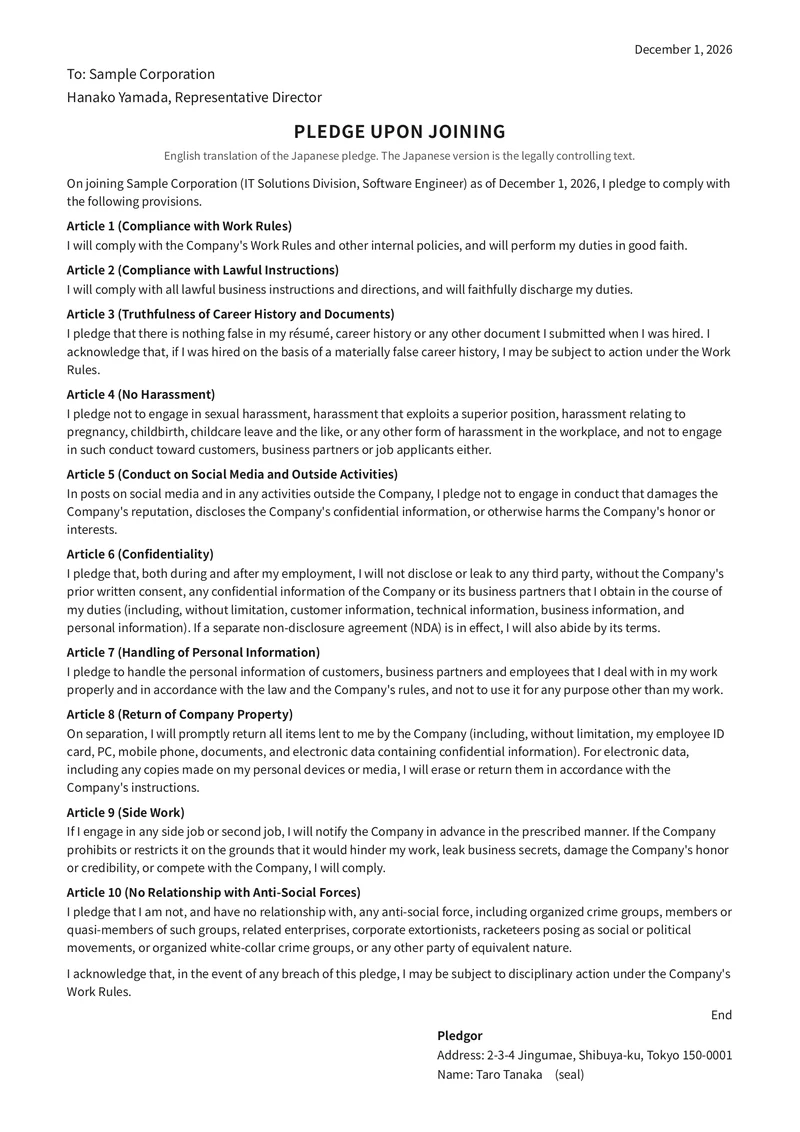
A sample made with the template’s default inputs: a software engineer in the IT Solutions Division who hands it in on the joining day, with side work on notification and the non-compete, intellectual property and damage clauses off. Download the sample PDF and the Word templates with [ ] placeholders (Japanese and English). Downloads ask for your email address.

Sample pledge upon joining in English (addressed to Sample Corporation, handed in on the joining day, Articles 1 to 10 and the signature block)
Sample pledge upon joining (Articles 1 to 10 and the signature block).

The Word version of the pledge is a template with the same wording and [ ] placeholders to replace, so you can add clauses to match your company’s format. To save the pledge with your inputs, use the template’s Download PDF button.

Give employees who do not read Japanese the English version alongside the Japanese one, so they sign knowing what it says. The preview switches between English and Japanese, and both are available as Word files. The Japanese version is the original the employee signs; the English one is a translation.

Legal basis

A pledge records the employee’s own declaration, and it has effect to the extent it complies with the law. That does not mean anything goes. A promise as broad as “I will follow any instruction” may be held void, while a clearly bounded one such as “I will follow the current work rules” is valid. Where the pledge and the employment contract or work rules disagree, the contract or the work rules usually prevail. A post-employment non-compete needs more than a line in the pledge: limits on period and scope, and compensation, have to be worked out separately.

Work rules with reasonable content that have been made known to employees form part of the employment contract even without a pledge (Labor Contract Act, Article 7). The pledge records that the employee has seen those rules. Clauses like the ones below, on the other hand, are void even when signed.

Clauses that are void in a pledge upon joining
Clause to avoidWhyBasis
Penalty or set damages for a breachFixing damages in advance is bannedLabor Standards Act, Art. 16
Repaying training costsMay count as set damagesLabor Standards Act, Art. 16
Saving part of the payForced savings are bannedLabor Standards Act, Art. 18
Limits on resigningOpen-ended employment ends two weeks after noticeCivil Code, Art. 627
Waiving overtime payBelow the legal minimumLabor Standards Act, Arts. 13 and 37
Terms worse than the work rulesVoid where they fall shortLabor Contract Act, Art. 12
Broad post-employment non-competeRestricts the freedom to choose a jobCivil Code, Art. 90

Sources: Labor Standards Act, Labor Contract Act, Civil Code (e-Gov Law Search, in Japanese).

Avoid a blanket ban on side jobs. The model work rules of the Ministry of Health, Labour and Welfare (Article 70) allow side work on notification, and let the employer restrict it only in cases such as hindering work or leaking secrets. The template’s side work clause defaults to notification.

Since October 1, 2026, measures against customer harassment and against sexual harassment of job applicants are also a duty for every employer (Ministry of Health, Labour and Welfare). The template’s harassment clause covers conduct toward customers, business partners and job applicants.

FAQ

Common questions about the pledge upon joining

Can a new hire refuse to sign the pledge upon joining?

You cannot force a signature. No law requires one. Work rules with reasonable content that have been made known to employees still form part of the employment contract without a pledge (Labor Contract Act, Article 7). If someone refuses, explain what each clause is for and ask what concerns them. Withdrawing an offer only because the candidate refused to sign may be held void as lacking an objectively reasonable ground. The documents collected at onboarding are listed in the new hire documents guide.

Is a pledge upon joining a contract?

No. It is a document in which the employee alone makes promises. The rights and duties of both sides are set by the employment contract and the work rules, and the pledge supplements them. A signed pledge is evidence that the employee was told about its content and agreed.

Is a pledge legally binding?

Yes, to the extent it complies with the law. Reasonable content, such as confidentiality or returning company property, is treated as the employee’s agreement. A penalty clause (Labor Standards Act, Article 16) or a promise below a legal minimum is void even when signed.

What if the pledge conflicts with the employment contract?

The employment contract and the work rules usually prevail. The pledge is a supplement. Anything worse for the employee than the work rules is void (Labor Contract Act, Article 12), and a heavy duty that appears only in the pledge is unlikely to hold. Keep the pledge consistent with the contract and the work rules.

Can the pledge include a non-compete clause?

Yes, for the period of employment. While employed, the duty of good faith that comes with the employment contract is understood to mean not competing with the employer. After the employee leaves, validity is judged on the interest being protected, the employee’s position, the area, the period, the activities restricted and any compensation, taken together (Ministry of Economy, Trade and Industry). The safer route for post-employment limits is a separate non-compete pledge at separation.

Does a pledge upon joining expire?

It has no expiry date, but each clause runs for its own period. Following the work rules or instructions ends when the employee leaves. For duties that should continue, such as confidentiality or returning property, write “during and after employment” in the pledge.

What date goes on the pledge? Is it the joining date?

The date the employee signs and hands it in. If you collect it on the joining day, that is the joining date; if you collect it during onboarding beforehand, it is an earlier date. The joining date has its own place in the text, so the two do not need to match.

Does the pledge need a seal? Is an electronic signature acceptable?

A seal is not required, and an electronic signature is fine. The Q&A on seals published by the Cabinet Office, the Ministry of Justice and the Ministry of Economy, Trade and Industry says that, unless a specific rule requires one, the absence of a seal does not affect a contract’s validity. Paper or electronic both work, as long as there is a record of the employee’s agreement.

Do I need both a pledge upon joining and a letter of personal guarantee?

They do different jobs, so collect both if you need both. The pledge is the employee’s own promise to follow the rules; the letter of personal guarantee is a guarantor’s promise to cover damage the employee causes. A guarantee without a maximum amount is void (Civil Code, Article 465-2).

Can a candidate still decline after handing in the pledge?

Yes. Neither the pledge nor an offer acceptance letter can force someone to join, and open-ended employment ends two weeks after notice is given (Civil Code, Article 627). What the company can do is covered in the legal effect of an offer acceptance letter.

Which documents are needed when someone joins?

The notice of employment terms (often combined with the employment contract), the pledge upon joining and the letter of personal guarantee, plus the My Number notification and the dependents’ tax declaration for social insurance and tax. Stating working conditions is a legal duty (Labor Standards Act, Article 15); the pledge and the guarantee are documents the company chooses to ask for. The full list is in the new hire document checklist.

Do part-time staff need a pledge upon joining too?

It is not required, but it works just as it does for full-time staff. Confidentiality and the handling of personal data matter whatever the employment type. For part-timers, some of whom hold more than one job, setting the side work clause to notification fits how they work.

What if a candidate says the pledge feels intimidating?

Explain what each clause is for, and show that it matches the work rules. The pledge confirms the rules that apply after joining, and it cannot contain promises the law voids, such as penalties or limits on resigning. Taking questions before they sign also avoids misunderstandings later.

DIY Hiring Kit

Everything You Need To Hire On Your Own

A downloadable hiring framework for small businesses in Japan, with step-by-step guides, spreadsheet ATS, LinkedIn scouting system, interview questions bank, offer letter and employment contracts, and a ton more!

1Dashboard11Checklists8Spreadsheets30Template docs4Weeks of Q&ABilingual

  • Download every file as Word, Google Docs, Excel or Google Sheets

About the author

Emmanuel Gendre, founder of SaiyouTeam

Emmanuel Gendre

Founder, SaiyouTeam · HR and recruiting advisor to SMBs in Japan

  • Former Google recruiter
  • 14 years in recruiting

Emmanuel advises SMBs on HR and recruiting in Japan. Before founding SaiyouTeam, he spent 14 years in talent acquisition, including as a recruiter at Google. Clients often ask him about onboarding documents such as the pledge upon joining, so he built this free template as part of that advice.

Official sources

The template and explanations on this page are based on the official sources below, all in Japanese (checked November 4, 2026).

Important. This template is general information on how a pledge upon joining is put together. Whether a clause holds depends on its content and how it is used, and anything against the law is void even when signed. Laws as of November 2026.