
What is an AI interview in Japan? How it works, what it costs and how to introduce it
What an AI interview is and how it works, its pros and cons, how many companies use it, what it costs and how to introduce it, for employers in Japan. Get the pre-launch checklist and save it as PDF.

Basics
What is an AI interview? A selection step where AI asks the questions and scores the answers
In short
An AI interview is a selection method where AI asks questions in place of an interviewer, or scores answers that applicants have recorded. Companies that use it hand one step of selection, such as the first-round interview, to AI, and in most cases a person makes the decision. Only 7.2% of companies use AI to assess interview content in new-graduate hiring, and 51.1% of students said being asked to take an AI interview lowers their motivation. Published prices run from ¥700 to ¥5,000 per interview.
There are three main types of AI interview. A study commissioned by the Ministry of Health, Labour and Welfare (MHLW) separates the "conversational AI interview", where AI talks with applicants to assess their qualities, from the "AI assessment of recorded interviews", where AI scores recorded answers (PwC Consulting, "Report on the Frontline of AI and the Metaverse in HR", March 2025). There are also interview support services, where AI records and analyzes interviews run by people.
Conversational
AI asks the questions and follows up based on the answers. Some products use an avatar.
Recorded
Applicants record answers to set questions, and AI scores them.
Interview support
Interviews run by people are recorded and transcribed, and AI helps with scoring.
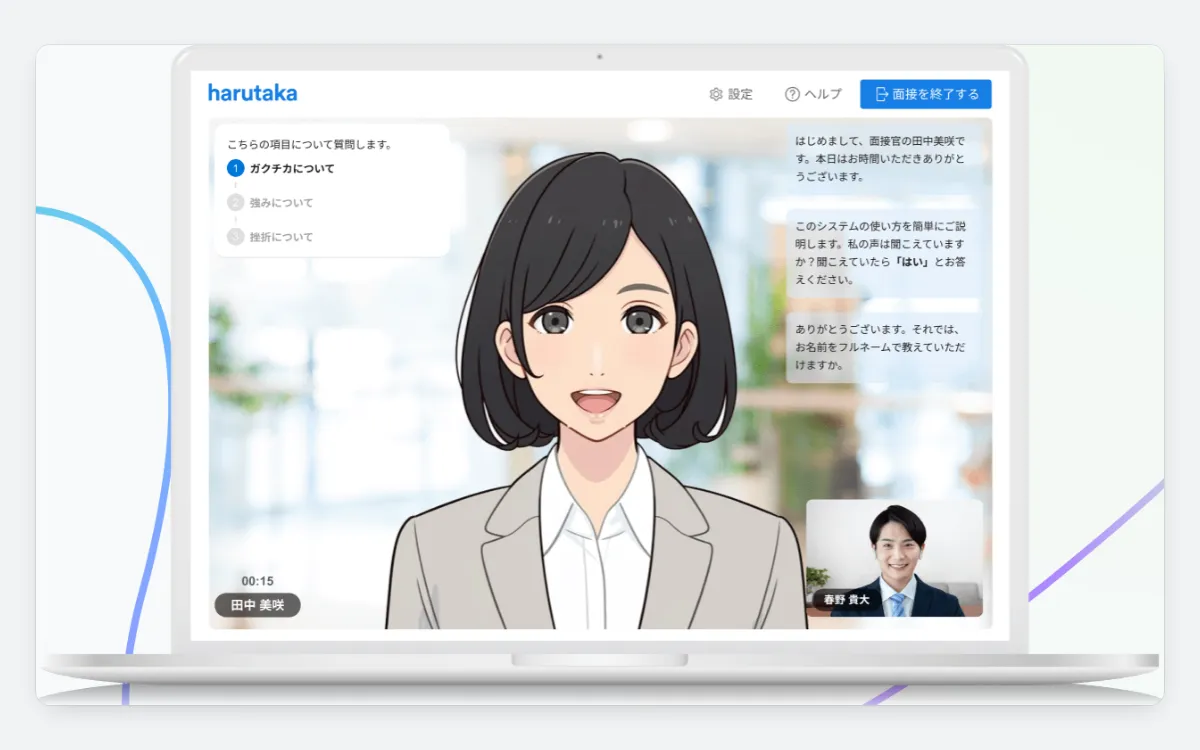
Conversationalharutaka AI Interview
- The AI avatar reads out the question
- List of the questions to come
- Captions of what the AI says
- The applicant's camera feed
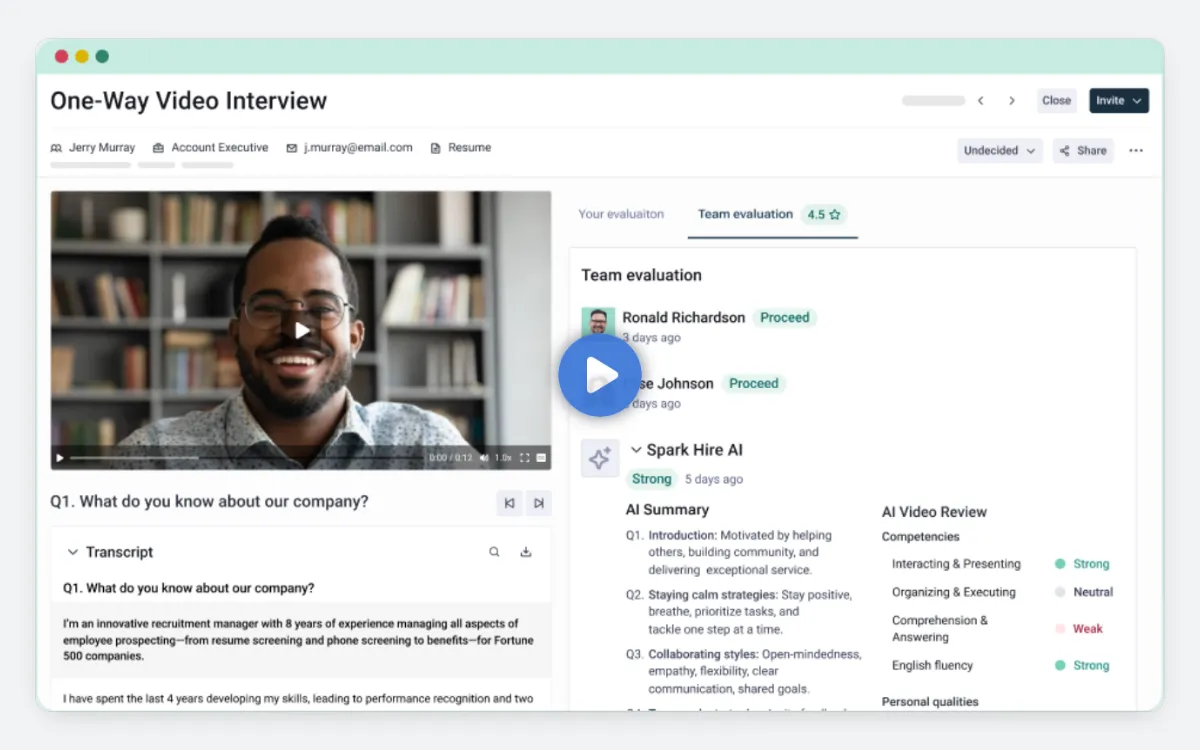
RecordedSpark Hire
- The answer the applicant recorded
- Transcript of questions and answers
- The recruiter's rating
- AI summary and scores
Applicants take an AI interview on a computer or smartphone. Many products let them take it at any time of day within a set period, so no one has to match schedules with an interviewer. The AI mainly scores the content of the answers and how applicants speak. The recorded-interview service that JCB uses rates behavioral traits such as initiative and adaptability on a 5-point scale, based on whether answers fit the question, whether the grammar is correct and whether the answer is clearly structured (Keidanren, "Report on the Use of AI in HR Departments", April 2026).
How it differs from online and recorded interviews
The difference from online or recorded interviews is whether AI or a person does the scoring. Conversational AI interviews also differ from the recorded type because they can change the questions based on the answers.
| Feature | Online interview | Recorded interview | AI interview |
|---|---|---|---|
| A person interviews live | Yes | No | No |
| Can be taken at any time | No | Yes | Yes |
| Follows up on answers | Yes | No | Conversational only |
| Scored by AI | No | No | Yes |
Pros and cons
Pros and cons of AI interviews: less interviewer time, but half of applicants lose motivation
The advantages of AI interviews are less interviewer time and scheduling, and the same questions for everyone. The drawbacks are that applicants' motivation to take part drops, and you lose one chance to show applicants what makes your company attractive.
Pros and cons of AI interviews
What to weigh before deciding
Pros
Time and consistency
- Less interviewer time
- No scheduling, open around the clock
- Same questions and criteria for all
- Recordings and transcripts are kept
Cons
Motivation and judgment
- Some applicants lose motivation
- Fewer chances to sell the company
- Scoring is opaque to applicants
- Scripts and impostors slip by
The time savings are large: JCB cut about 900 hours that employees outside HR had spent on interviews, and moved that time to programs for students that involve alumni (Keidanren). Asking everyone the same questions helps too. In an experiment covering about 70,000 applications for customer service jobs in the Philippines, applicants interviewed by AI were 12% more likely (in relative terms) to get a job offer, and 18% more likely to work for at least a month after joining, than those interviewed by people. The researchers point to the AI asking questions in a set order and wording (Jabarian and Henkel, 2026, preprint). In this experiment too, people made the hiring decisions.
The biggest drawback is how applicants react. When a company asks them to take an AI interview, 51.1% of class of 2027 students said their motivation would drop, and the top reason was "I want to be assessed by a person" (55.2%) (Mynavi, "University Student Career Intentions Survey (April), Class of 2027", April 2026). One student who took one wrote: "It made me question my own worth, wondering if I wasn't even allowed to meet an employee, and I felt a little sad" (the survey's free-text answers). On the other hand, in a survey of 1,000 people aged 15 to 29, 39.5% think AI-based selection leads to fair assessment and 20.0% think it does not, while the largest group, 40.5%, could not say either way (JTUC-Rengo, "Survey on Hiring Discrimination 2026", April 2026).
Motivation when asked to take an AI interview (class of 2027)
- Lower
- 51.1%
- Unchanged
- 42.1%
- Higher
- 6.8%
1,258 university and graduate students. Source: Mynavi
Even when a person makes the final decision, applicants may not see it that way. A recruiter at a company that introduced AI interviews said that although the company had stated a person makes the final decision, posts on social media said applicants had been "rejected by AI" (Toyo Keizai Online, July 2026).
Which companies AI interviews suit, and which they don't
AI interviews suit companies where many people apply for the same role and interviewer time is short. They do not suit companies with few applicants, where each one has to be won over.
Companies AI interviews suit and don't suit
Suits
Many applicants, little time
- Mass graduate hiring with many first rounds
- Year-round part-time hiring across many stores
- Applicants far away who can't easily visit
- Too few interviewers, long waits for interviews
Doesn't suit
Few applicants to win over
- Few applicants and enough interviewers
- Interviews have to sell the company
- Many applicants whose first language isn't Japanese
- Questions and criteria not set yet
For an SMB, the first meeting is both a selection step and the place to show candidates what makes the company and the job attractive. Replacing it with an AI interview takes that away.
Adoption
Companies using AI interviews in hiring: under 10% even in new-graduate hiring, 6.4% under 300 employees
Companies using AI interviews in hiring are still a minority. In new-graduate hiring, 7.2% of companies use AI to assess interview content, more than double the 3.4% of the year before. The rate is 6.4% at companies with fewer than 300 employees and 9.1% at those with 1,000 or more (Mynavi, "Corporate New Graduate Recruitment Survey, Class of 2027", June 2026; prior year, "Corporate New Graduate Recruitment Survey, Class of 2026", June 2025).
Companies using AI to assess interview content (new-graduate hiring)
Share of companies using AI tools to "review interview content". Source: Mynavi
Few plan to start, either. 8.0% of companies said they want to use AI interviews, and 45.6% said they "do not want to use them at all" (same survey). Another survey puts the share of companies that use or plan to use AI interviews in new-graduate hiring at 2.7% (i-plug, 305 companies, November 2026). In a Keidanren survey of 75 mostly large companies (47 with 5,000 or more employees), 25 use AI in hiring, and 13 of those use it to support interviews (Keidanren, April 2026).
Still, on the applicant side, AI interviews are no longer unusual. Among class of 2027 university and graduate students, 28.2% have taken an AI interview, at 2.0 companies on average (Mynavi, "University Student Career Intentions Survey (April), Class of 2027", April 2026). In a survey of 1,000 people aged 15 to 29, 20.6% also said they had taken one (JTUC-Rengo, "Survey on Hiring Discrimination 2026", April 2026).
Students who have taken an AI interview (class of 2027)
- Have taken one
- 28.2%
- Have not
- 71.8%
1,258 university and graduate students. Source: Mynavi
How companies use them: AI handles one step, people decide
In published cases, every company hands only one step of selection to AI, and most state that a person makes the final hiring decision.
New grads, recorded (2020)
SoftBank
About 70%Expected cut in video screening time. HR reviews the videos the AI rejected
New grads, recorded (from class of 2026)
JCB
About 900 hoursInterview time saved for employees outside HR. Recruiters make the decision
New grads, conversational
Ushio
1 stepof selection handed to AI. People review every video and audio file, low scorers included
New grads, conversational
Kirin Holdings
2024 pilotIn October 2024, followed by a decision to roll out fully (vendor announcement)
Part-time, conversational (from 2018)
Yoshinoya
5 to 10 minLength of one interview. Piloted at 74 stores, then extended to Tokyo and its three neighboring prefectures from April 2019
New grads, conversational
Okinawa Cellular Telephone
2028 gradsonward. Recruiters always make the decision and check where human and AI scores differ
Sources: SoftBank (May 2020), Keidanren (April 2026, JCB), MHLW-commissioned study (March 2025, Ushio), VARIETAS (January 2025, Kirin Holdings), Yoshinoya (November 2018, April 2019) and Okinawa Cellular Telephone (June 2026) announcements.
What these cases share: AI interviews are used where many people apply for the same role at the same time. Mass graduate hiring and part-time hiring across many stores are typical. In mid-career hiring too, the taxi company Kokusai Motorcars has used AI interviews for first-round selection since October 2025.
Accuracy
How accurate AI interviews are: close to human ratings, but looks and speech can move the score
AI can score close to human interviewers when it is trained on their ratings, but scores can also shift with looks or speech unrelated to the content of the answer. What decides accuracy is the questions and the scoring criteria, more than the AI.
In interview research, interviews with set questions and scoring criteria (structured interviews) predict job performance after hiring more than twice as accurately as interviews without them (Sackett et al., 2022). The same researchers point out that if you automate running and scoring interviews, validity has to be checked again.
How closely AI scores match human ratings has been examined in vendor announcements and research. In Kirin Holdings' pilot, AI scores and HR's first-round decisions correlated at 0.8 or more (vendor announcement, January 2025). HireVue's scores in the US correlated with human ratings at 0.66 on average, but four of the paper's five authors work for HireVue (Liff et al., 2024). In independent research, AI trained on interviewers' ratings had stronger evidence of validity, while AI trained on applicants' self-ratings had almost no validity (Hickman et al., 2022).
There are also cases where looks moved the score. When the German public broadcaster BR tested a video interview AI, wearing glasses alone lowered the conscientiousness score by about 10 points, a picture frame in the background moved scores by up to 15 points, and a bookshelf moved them even more (BR, February 2021). The experiment used 10 people and one actor, and BR notes the results cannot be generalized. HireVue stopped analyzing video in 2020 (Fortune, January 2021), and since February 2025 the EU has banned AI that infers emotions in the workplace, hiring included.
When choosing a service, pick a product that scores the content of answers against your own criteria, and avoid features that score facial expressions or emotions. The content of answers can be checked against the questions and criteria, but it is hard to tell what an expression score measures. Before introducing it, have the AI and your interviewers rate the same applicants and compare the scores.
Applicants whose first language is not Japanese: watch for transcription errors
AI transcribes what applicants say before scoring it, so transcription errors can affect the score. In a study of English-language interviews, commercial speech recognition made more errors on speech by people speaking English as a second language. Even so, the scoring model built in that study showed no meaningful bias (Hickman et al., 2025). HireVue says its error rate is under 10% for native English speakers but 12 to 22% for non-native speakers (Sheard, 2025). We found no such research for applicants interviewing in Japanese as a second language.
For foreign applicants, set up the AI interview so they can take it in a language they speak comfortably, such as English, or choose a human interview instead. Some products work in English or Vietnamese.
Service comparison
Main AI interview services: 9 Japanese and 6 overseas services compared
AI interview services differ in whether they follow up based on the answers, whether applicants can take them in Japanese and English, and whether pricing is public. The main Japanese services all use a conversational AI, and of the six overseas services, two officially support interviews in Japanese.
All of them can use AI to score answers and compile a report. Services are named for comparison only, not as a recommendation.
Features compared
| Service | Type | Follow-ups | JP | EN | Public pricing |
|---|---|---|---|---|---|
| Services in Japan | |||||
 SHaiNTalent and AssessmentConversational (voice) | Conversational (voice) | Not stated | Yes | Not stated | Yes |
 harutaka AI InterviewZENKIGENConversational (avatar) | Conversational (avatar) | Yes | Yes | Not stated | Not stated |
 AI InterviewerVARIETAS (TA Team)Conversational | Conversational | Yes | Yes | Not stated | Not stated |
 Talent ScouterPreferred NetworksConversational (avatar) | Conversational (avatar) | Yes | Yes | Not stated | Not stated |
 PeopleX AI InterviewPeopleXConversational (avatar) | Conversational (avatar) | Yes | Yes | Yes | Not stated |
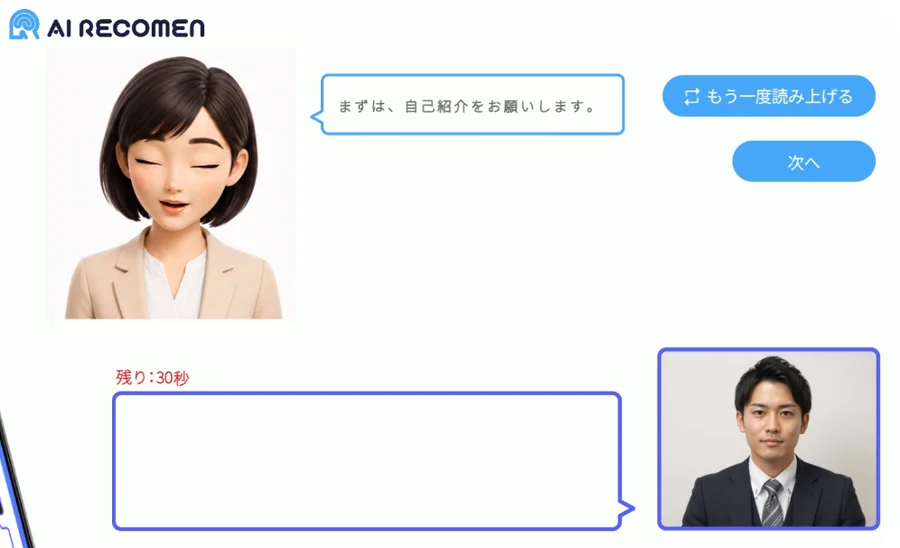
 AI RECOMENi-enterConversational (avatar) | Conversational (avatar) | Yes | Yes | Yes | Yes |
 NALYSYS AI InterviewLeveragesConversational (avatar) | Conversational (avatar) | Yes | Yes | Not stated | Not stated |
 MiAIPropsConversational | Conversational | Yes | Yes | Not stated | Yes |
 HRmaxDYM Human | Conversational | Yes | Yes | Not stated | Yes |
| Overseas services | |||||
 HireVueUSRecorded, voice | Recorded, voice | Yes | Yes | Yes | Not stated |
 Sapia.aiAustraliaChat | Chat | Not stated | Not stated | Yes | Not stated |
 RibbonCanadaVoice, video | Voice, video | Yes | Yes | Yes | Not stated |
 AlexUS (formerly Apriora)Video, voice | Video, voice | Yes | Not stated | Yes | Not stated |
 HeyMiloUSVoice, video | Voice, video | Yes | Not stated | Yes | Not stated |
 Spark HireUSRecorded | Recorded | Not stated | Not stated | Yes | Yes |
Sources: each company's official website and announcements (checked November 9, 2026). A dash means not stated. HRmax offers follow-ups on higher plans only, HireVue's Japanese support covers recorded interviews, Spark Hire's covers transcription only, and PeopleX publishes prices for part-time hiring only.
AI interview services in Japan
-
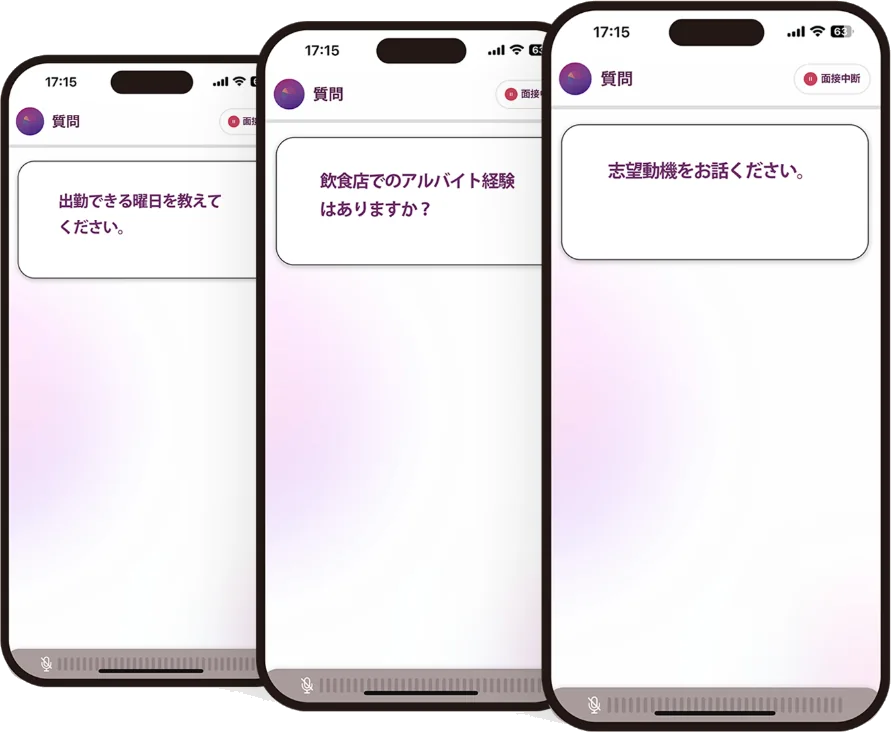
SHaiNTalent and Assessment, Japan
Conversational (voice)Smartphone, 24/7
- Scoring
- 10 items on a 10-point scale
- Record
- Full transcript of every answer
- Price
- ¥5,000 per interview (¥1,000 for part-time roles, excl. tax)
-
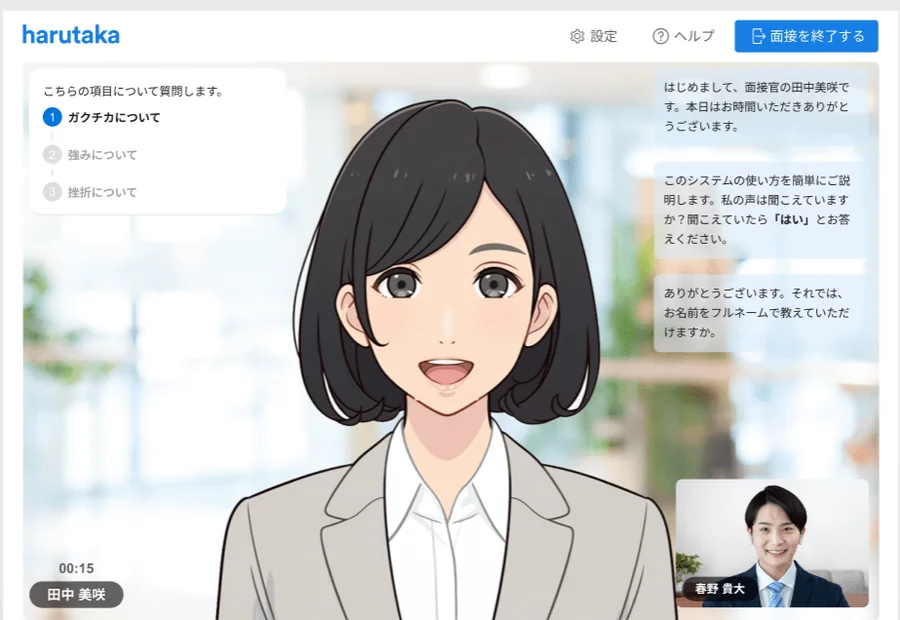
harutaka AI InterviewZENKIGEN, Japan
Conversational (avatar)Up to 5 follow-ups
- Follow-ups
- Up to 5 per question
- Report
- Summary, transcript and points to ask next
- Decision
- Designed for the recruiter to decide
-
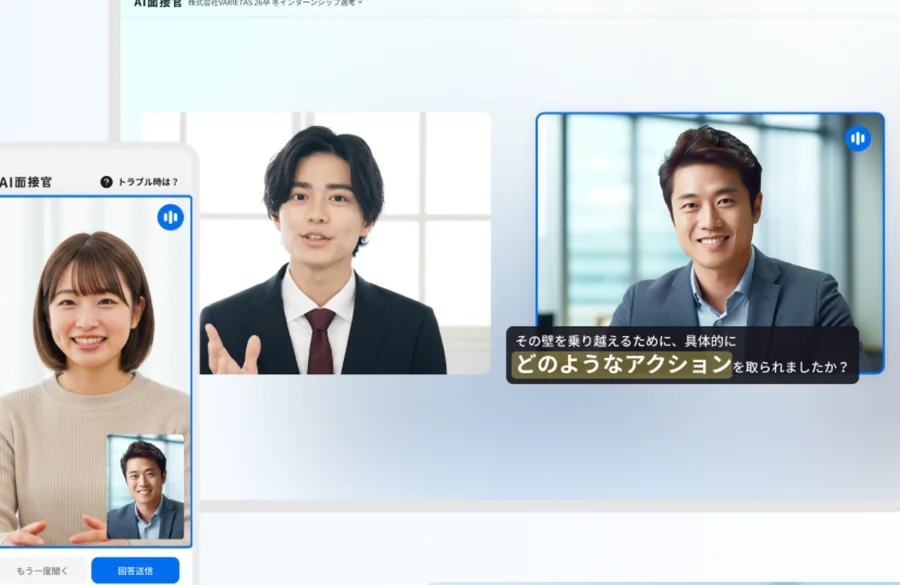
AI InterviewerVARIETAS, Japan
ConversationalReport in about 15 min
- Questions
- A conversation based on the entry sheet
- Scoring
- You set the weight of each criterion
- Name
- Renamed TA Team in June 2026
-
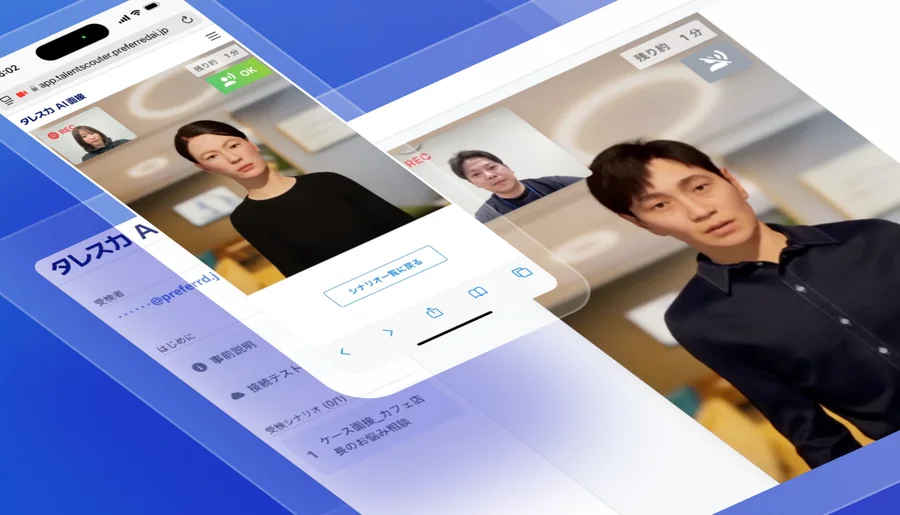
Talent ScouterPreferred Networks, Japan
Conversational (avatar)PC and smartphone, 24/7
- Follow-ups
- Plus counter-questions, based on the answers
- Scoring
- AI comments on the reasons for each score
- Price
- Setup + usage fee + per interview (not public)
-
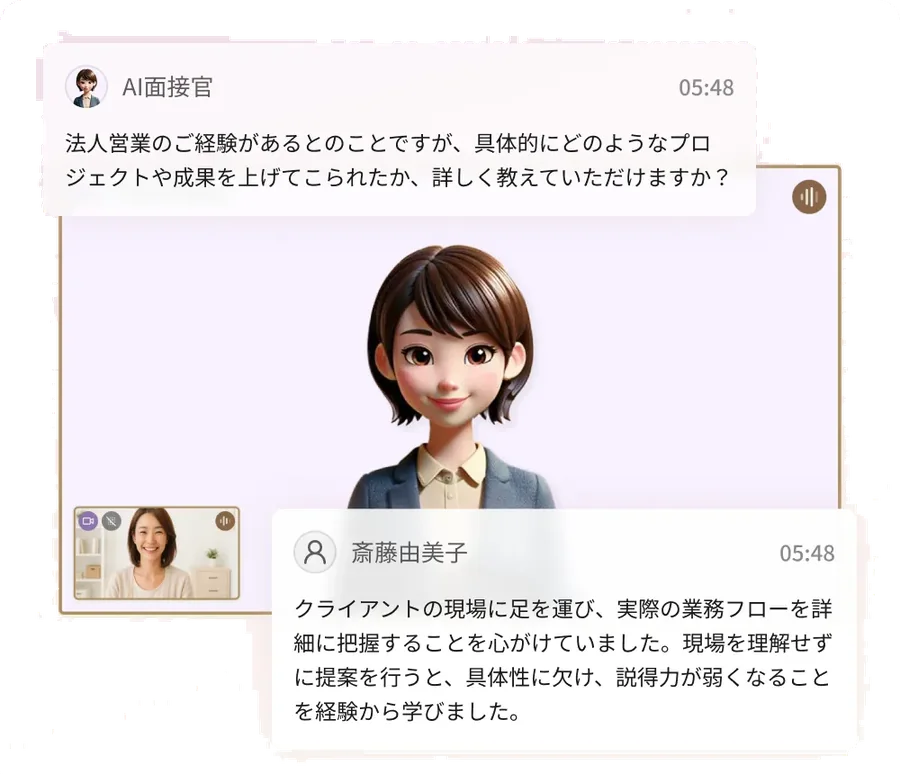
PeopleX AI InterviewPeopleX, Japan
Conversational (avatar)English, Vietnamese
- Follow-ups
- Follows up on set points in real time
- Questions
- Pick from about 150 and weight them
- Note
- Trials and sales talks paused for companies planning fewer than 40 hires
-
AI RECOMENi-enter, Japan
Conversational (avatar)English, Vietnamese
- Questions
- An avatar reads the questions and asks follow-ups
- Record
- Transcript, summary and reasons for scores
- Price
- ¥700 per interview (from ¥35,000 for 50, excl. tax)
-
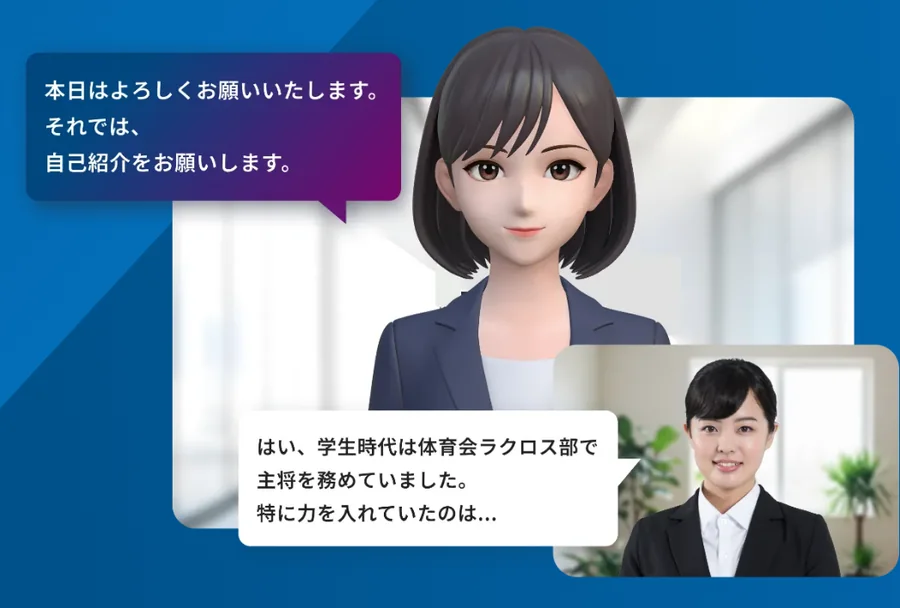
NALYSYS AI InterviewLeverages, Japan
Conversational (avatar)33 criteria
- Follow-ups
- Based on the answers
- Criteria
- Built from 33 assessment items
- For
- New graduates, mid-career, part-time and temp roles
-

MiAIProps, Japan
ConversationalNo app needed
- Follow-ups
- Generative AI writes questions on the spot
- Design
- Over 200 job-specific templates
- Price
- From ¥1,000 per interview
-
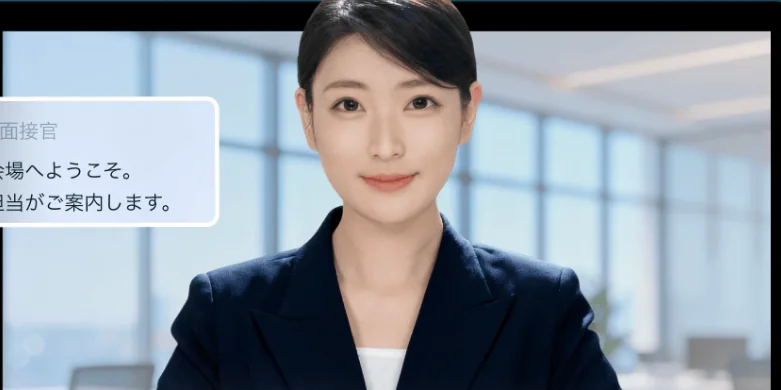
HRmaxDYM HumanReality, Japan
ConversationalCheating detection
- Follow-ups
- On higher plans
- Scoring
- Overall score and comments
- Price
- ¥300,000 setup + ¥70,000 a month + ¥1,000 to ¥5,000 per interview (annual contract, excl. tax)
Overseas AI interview services
For overseas services, check first whether they can interview in Japanese. If you use one in English for applicants whose first language is not Japanese, test whether it scores them on the same criteria.
-
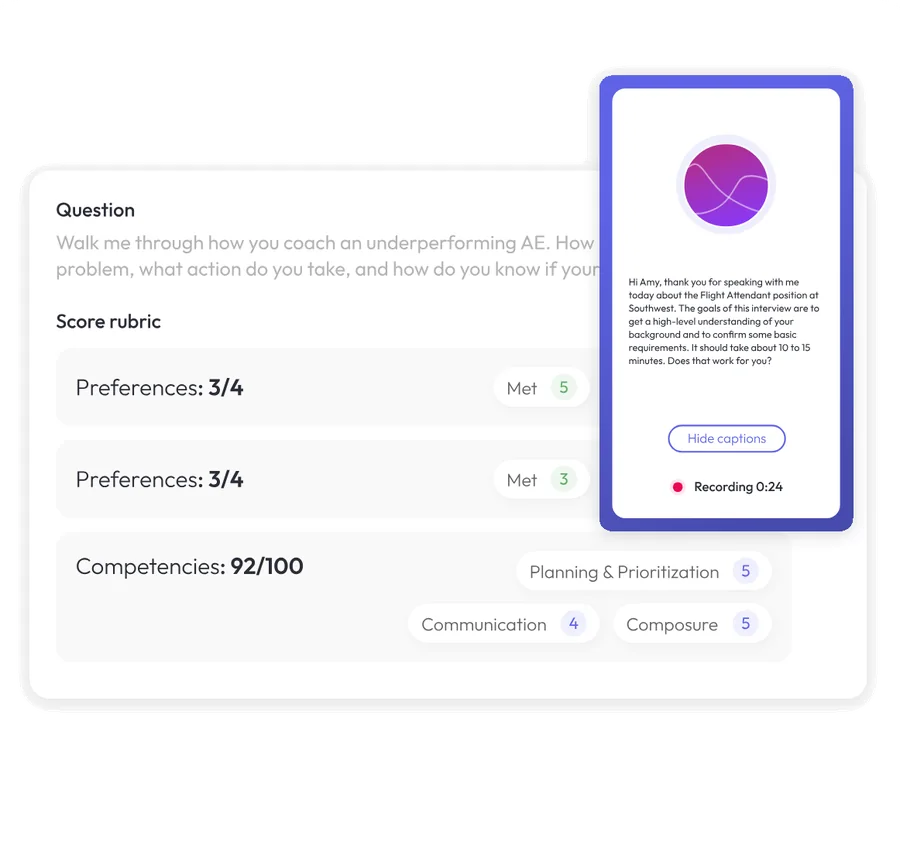
HireVueHireVue, US
Recorded, voicePublishes bias audits
- Scoring
- AI scores recorded interviews against job criteria
- Interviewer
- A voice AI interviewer too (English and others)
- Japan
- Sold by Talenta; recorded interviews work in Japanese
-
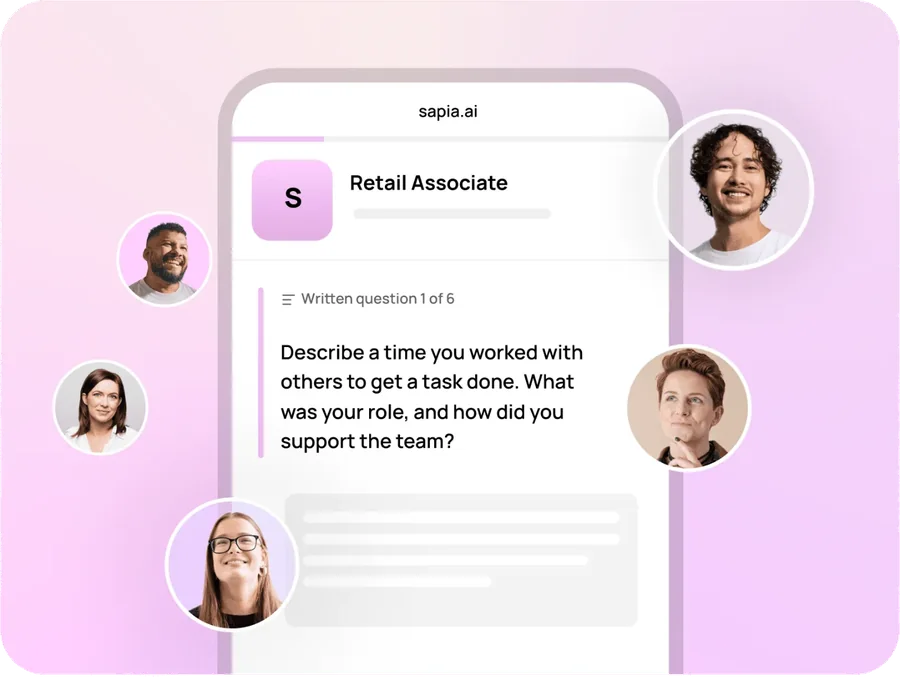
Sapia.aiSapia.ai, Australia
ChatNo Japanese
- Format
- Answer 5 questions by chat
- Scoring
- Scores, rankings and questions for the next interview
- Language
- 9 languages (no Japanese)
-
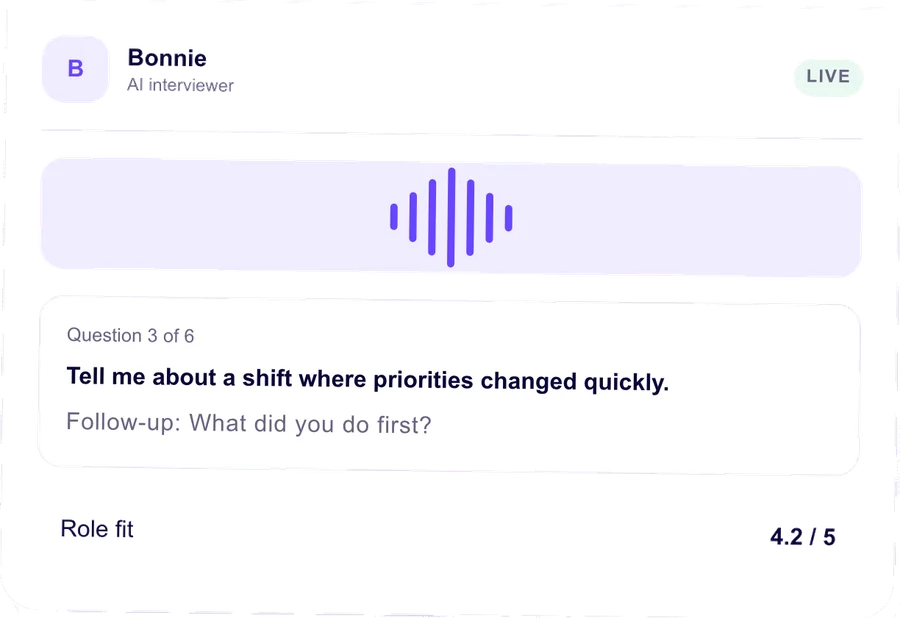
RibbonRibbon AI, Canada
Voice, videoWorks in Japanese
- Follow-ups
- Yes, in interviews run 24/7
- Record
- Recording, transcript, summary and scores
- Company
- Dayforce agreed to acquire it in October 2026
-
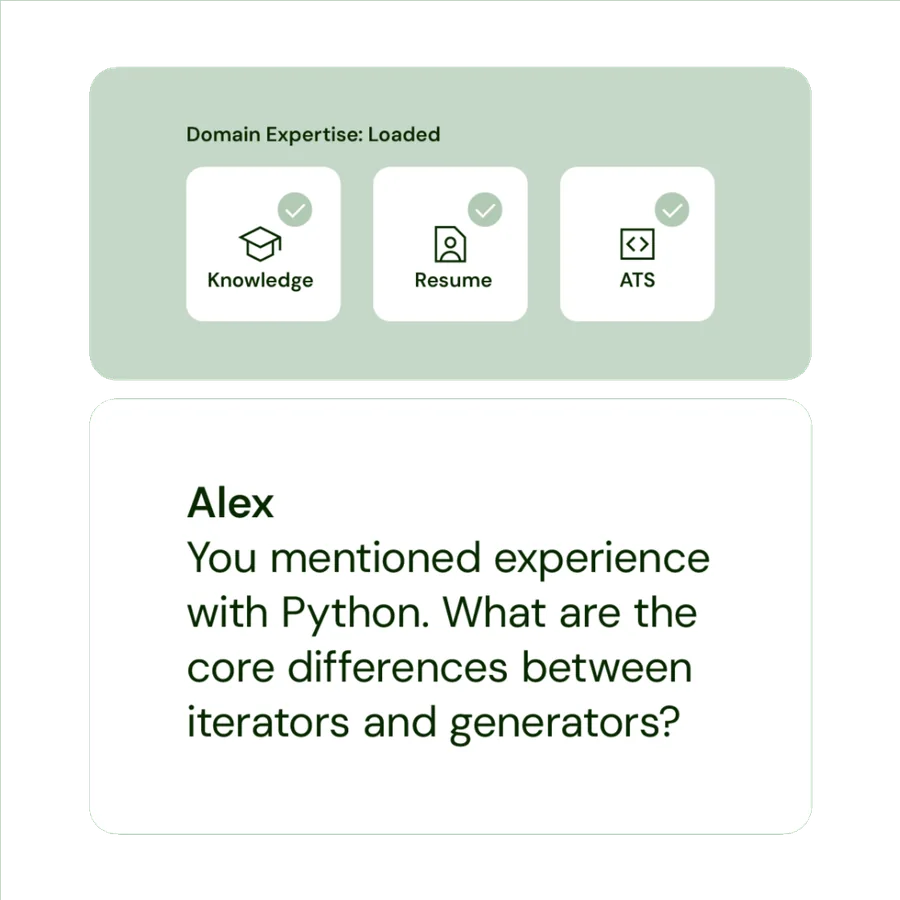
AlexApriora, US
Video, voiceID verification
- Format
- Interviews by video, phone or chat
- Check
- Matches ID and face during the interview
- Language
- 30+ (Japanese not listed)
-
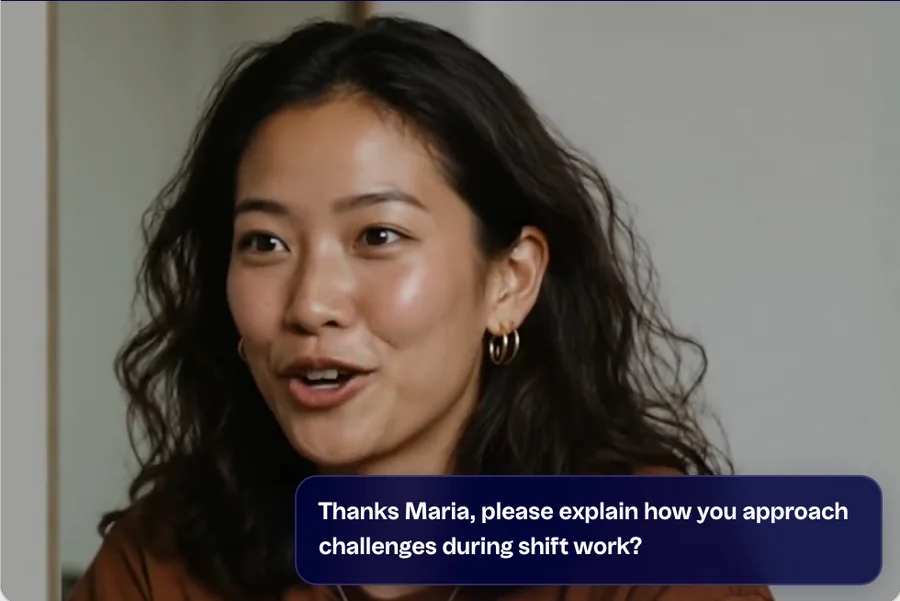
HeyMiloRedsnack Technologies, US
Voice, videoMonthly bias audits
- Follow-ups
- By voice, video and SMS
- Scoring
- Scores each question, with reasons
- Cheating
- Shows a cheating risk score
-
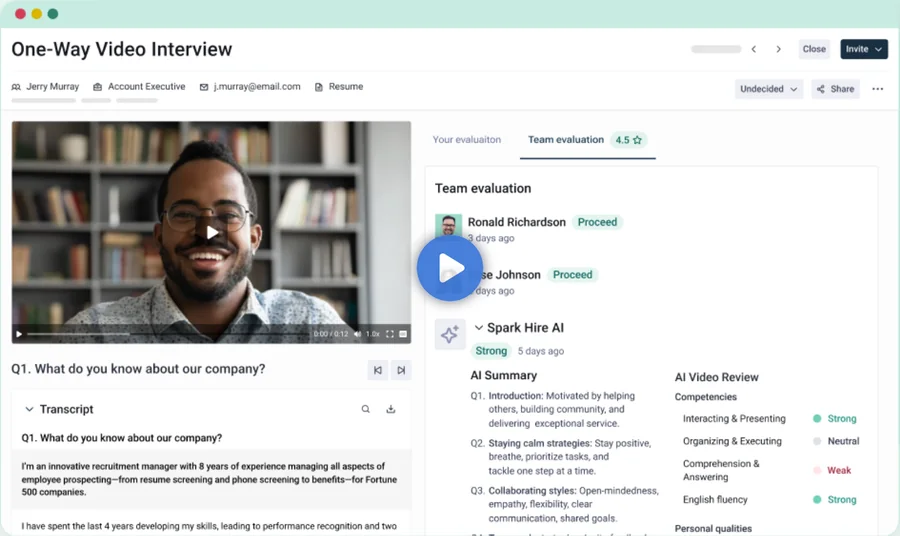
Spark HireSpark Hire, US
RecordedAI scoring optional
- Format
- One-way recorded interviews
- Record
- Transcripts in 50+ languages (Japanese included)
- Price
- From $249 a month (billed yearly, unlimited interviews)
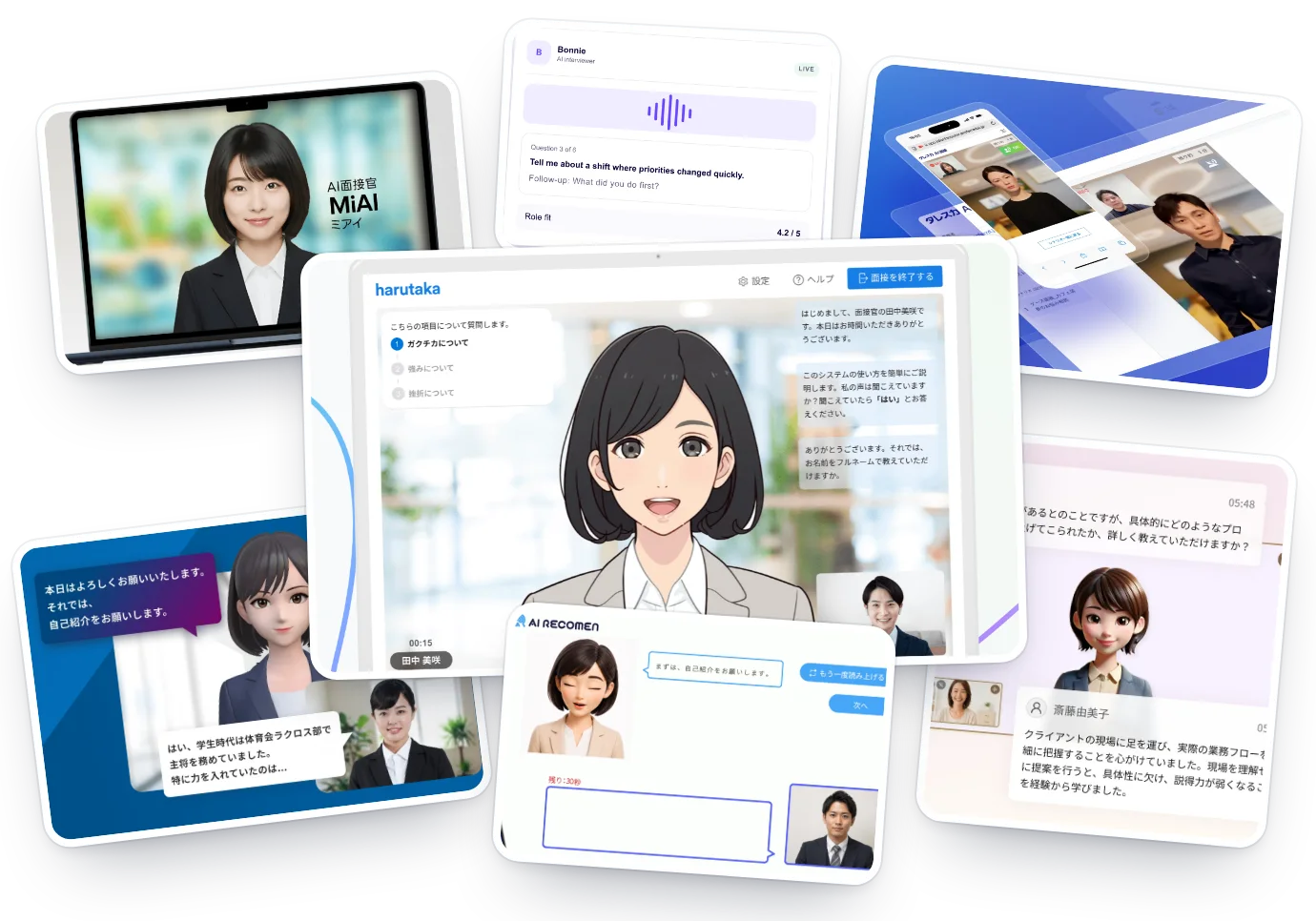
The images at the top of the page and each service's screen are product screens published on each company's official website (all captured November 9, 2026).
Cost
AI interview cost and pricing: ¥700 to ¥5,000 per interview, about 30 minutes of an interviewer's time
Published AI interview prices run from ¥700 to ¥5,000 per interview. Only some services publish prices; most quote a mix of setup fees, monthly fees and per-interview fees.
AI interview pricing compared
| Service | Pricing model | Published price |
|---|---|---|
| SHaiN (standard) | Per interview | ¥5,000 |
| SHaiN (part-time) | Per interview | ¥1,000 |
| MiAI | Per interview | From ¥1,000 |
| AI RECOMEN | Per interview | ¥700 |
| HRmax | Setup + monthly + per interview | ¥1,000 to ¥5,000 |
| PeopleX AI Interview | Setup + monthly + per interview | Not public |
| Talent Scouter | Setup + usage fee + per interview | Not public |
| NALYSYS AI Interview | Setup + monthly + per interview | Not public |
| AI Interviewer | Setup fee + per interview | Not public |
| harutaka AI Interview | Setup + monthly | Not public |
| HireVue | Quote | Not public |
| Spark Hire | Monthly (billed yearly) | From $249 |
Checked on each company's official website (November 9, 2026; AI Interviewer from a press interview). Prices exclude tax. SHaiN starts at 10 interviews a year, and its pay-later plan adds a ¥600,000 annual fee. HRmax is an annual contract with ¥300,000 setup and ¥70,000 a month. AI RECOMEN starts at ¥35,000.
Compared with a person running a first-round interview, the price per interview is the same as or less than 30 minutes of an interviewer's time. First-round interviews last 33.4 minutes on average, according to an old survey (Recruit Career, students graduating in March 2013). If an interviewer's hour costs ¥7,000 (salary plus the employer's social insurance, the default in the cost per hire calculator), a 30-minute interview costs ¥3,500. If HR spends 15 minutes on scheduling (at ¥4,500 an hour), that adds ¥1,125, for ¥4,625 in total. A 60-minute interview, with scheduling, comes to ¥8,125.
First-round interview cost per applicant
Human interviews include 15 minutes of scheduling, at this site's calculator defaults.
The difference shows in volume and scheduling. If people run 100 first-round interviews, interviewer time alone is 50 hours, and applicants wait until a slot fits. AI interviews remove that time, but the time to review results and recordings remains. Some companies, like SoftBank, have people watch only the recordings of applicants the AI rejected.
Compare pricing models: per interview, monthly and minimum spend
Compare quotes on the number of interviews you run in a year. Per-interview pricing suits companies with few interviews, while monthly pricing gets cheaper per interview as volume grows. Also check the minimum spend or minimum volume, such as SHaiN's 10 interviews a year or AI RECOMEN's ¥35,000 (50 interviews).
Setup
Introducing AI interviews: 6 steps to decide before you start
Before you sign up for a service, decide which step to hand over and how answers will be scored. Here are the six steps.
-
Decide which step AI handles
Limit it to one step with many applicants, such as the first-round interview. Also decide whether a person checks before anyone is rejected on the AI's verdict, and who makes the final decision.
-
Set the questions and scoring criteria
Pick the skills to check from the duties in the job posting, then write the questions and the criteria for scoring the answers. Without criteria, you cannot check whether the AI's scores are right.
-
Test it against your own interviewers
In a pilot or free trial, have the AI and your interviewers rate the same applicants, and find the questions where the scores diverge.
-
Decide how applicant data is handled
Decide how to word the purpose of use, how long to keep recordings and scores and how to delete them, and whether the vendor uses applicant data to train its AI, then confirm it in the contract.
-
Tell applicants, and offer a human interview
Before applicants take it, tell them that you use AI, what the AI scores and that a person makes the decision. Offer a human interview to applicants who find it hard to take.
-
Have people check results and review the numbers
Have a person check the AI's verdict before deciding. Each month, review the completion rate, the dropout rate and the gap between AI and interviewer scores, and adjust the questions and criteria.
For how to set the questions and criteria in step 2, see the interview questions guide.
3 rules for applicant data
The recordings and scores collected in AI interviews are applicants' personal data. Decide these three things before you start.
State in the purpose of use that AI analyzes answers
Describe the handling specifically enough for applicants to anticipate it
BasisPPC Guidelines (General Rules) 3-1-1; MHLW guidelines under the Employment Security Act
Do not collect or score anything unrelated to the job
Registered domicile, birthplace, beliefs, union membership and the like
BasisMHLW guidelines under the Employment Security Act, Part 5-1
Supervise the vendor that holds the recordings, and set when to delete them
Confirm retention, deletion and use for AI training in the contract
BasisAct on the Protection of Personal Information (APPI), Article 25
The guidelines of the Personal Information Protection Commission (PPC) require a company that analyzes a person's behavior or interests from information obtained from them to specify the purpose of use clearly enough for that person to anticipate the handling. In 2019, the PPC instructed companies to notify and publish their purpose of use properly after they used a service that estimated applicants' likelihood of declining offers from their browsing history. The MHLW guidelines under the Employment Security Act set out what must not be collected. The questions not to ask in interviews are in the interview questions guide, and the rules for data you hand to vendors are in the ATS guide.
Example notice to applicants
In the notice email or on the job ad, state that you use AI, what the AI scores, who decides, and whom to contact if taking it is difficult. Some services leave it to the employer whether to tell applicants (MHLW-commissioned study). The AI Guidelines for Business (Ministry of Internal Affairs and Communications and Ministry of Economy, Trade and Industry, version 1.2) ask that when AI output informs a human assessment, you tell the person that AI is being used and explain it on request.
Subject: First-round selection (AI interview)
Dear [Name],
Thank you for applying for the [Position] role. The first round of selection will be an AI interview.
•How to take it: at any time before [Deadline], on a computer or smartphone. It takes about [20] minutes.
•What the AI scores: the content of your answers. It does not score facial expressions or appearance.
•How we decide: our recruiter reviews your recording and decides, using the AI's scores as a reference.
•Your recording: we use the recording and scores only for this selection and delete them [6 months] after it ends.
•If taking it is difficult for you: contact [Contact] and we will arrange an interview with a member of our team.
[Name], Recruiting, [Company name]
AI interview pre-launch checklist
Check from top to bottom before you sign a contract and before you send the first notice to applicants. You can save it as PDF with your ticks and use it for internal review.
AI interview
Pre-launch checklist
0 / 10 done
Based on APPI Articles 17 and 25, Employment Security Act Article 5-5 and its guidelines, and the AI Guidelines for Business (version 1.2).
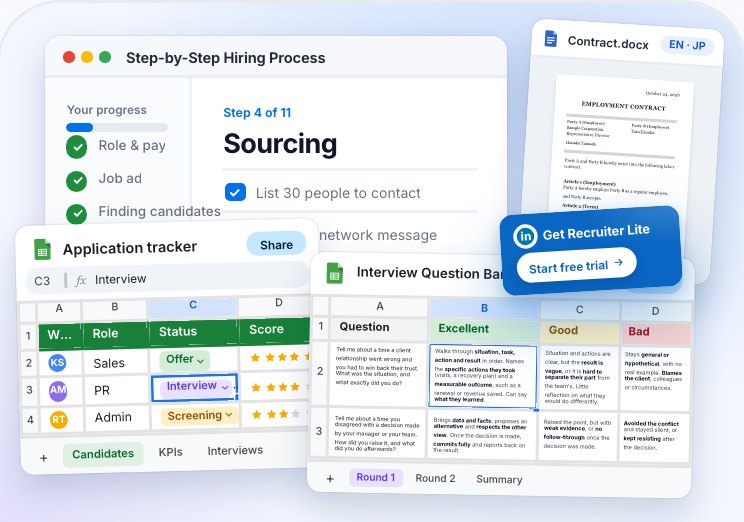
Applicant prep
How applicants prepare for AI interviews: they practice, so tie the questions to your own jobs
Design AI interviews on the assumption that applicants prepare for them. 35.9% of universities said they offer mock AI interview tools or help students use them, or plan to (Mynavi, "Survey on University Career and Job-Hunting Support, FY2026", September 2026). Practice only polishes delivery, so it is not a problem. What needs attention is reading out answers written by generative AI, and impersonation.
Employers have started to respond. Because students use generative AI, 26.0% of companies hiring new graduates adjust their interview questions, for example by asking questions that differ from the entry sheet or adding follow-ups (Mynavi, "Corporate New Graduate Recruitment Survey, Class of 2026", June 2025). Impersonation happens in Japan too: in March 2026, an applicant used AI video to pose as a different, real person in a casual interview for an engineering role (Business Insider Japan). In a Gartner survey, 6% of job candidates admitted to interview fraud, posing as someone else or having someone pose as them (Gartner, 2025).
There are two measures. First, make the AI interview questions ask about the applicant's own experience in concrete terms, and choose a product that asks follow-up questions based on the answers. Second, in the next interview, run by a person, pick one AI interview answer to dig into, and check the applicant's identity.
FAQ
Frequently asked questions about AI interviews
What is an AI interview app?
It is the smartphone app or browser screen that applicants use to take an AI interview. Most services let applicants take it at any time of day within a set period. There are also mock tools for practicing.
Can we make hiring decisions from the AI interview alone?
It is not prohibited by law, but we recommend having a person make the decision. The AI Guidelines for Business ask companies to consider not letting AI decide on its own and to bring in human judgment at the right points. In most published company cases, a person makes the final decision too.
Do we have to tell applicants we use AI interviews?
Yes, you need to tell them. If AI analyzes answers for assessment, you need to state the purpose of use clearly enough for applicants to anticipate that handling (PPC guidelines). In the notice, also state what the AI scores and who decides.
What should we do for applicants who don't want an AI interview?
Offer a human interview. Japan has no rule on this, but New York City law requires employers that use automated employment decision tools to tell applicants in advance that they can request an alternative selection process or an accommodation. Some applicants find it hard to take because of disability or language, so put a contact in the notice.
Can we analyze facial expressions in AI interviews?
We recommend not using features that score facial expressions or emotions. The reasons are in "How accurate AI interviews are". In Japan too, an amended Act on the Protection of Personal Information, which among other things requires telling people how their facial feature data is handled, was promulgated in July 2026 and takes effect by July 2028.
What should we watch for when using AI interviews with applicants overseas?
Check the rules in the applicant's country or region. The EU classes AI used in hiring as high-risk, and the rules apply from December 2027. New York City requires a bias audit within the past year and notice at least 10 business days ahead. Illinois requires consent before AI evaluates a video interview, and deletion within 30 days on request.
DIY Hiring Kit
Everything You Need To Hire On Your Own
A downloadable hiring framework for small businesses in Japan, with step-by-step guides, spreadsheet ATS, LinkedIn scouting system, interview questions bank, offer letter and employment contracts, and a ton more!
1Dashboard11Checklists8Spreadsheets30Template docs4Weeks of Q&ABilingual
- Download every file as Word, Google Docs, Excel or Google Sheets


 14 years in talent acquisition
Related
Related guides and tools
 Guide Interview questions Set the questions and scoring criteria before handing interviews to AI.
 Basics What is an ATS (applicant tracking system)? Keep AI interview results and applicant records in one place.
 Guide How to screen candidates Use the first conversation to show candidates what makes the job attractive.
 Tool Cost per Hire: Averages and Calculator Put a yen figure on the internal time that interviews take.
Official sources
The main sources this guide is based on, most of them in Japanese. Other statistics and documents are linked where they are used.
- MHLWwww.mhlw.go.jp Report on the Frontline of AI and the Metaverse in HR (March 2025) Definitions of AI interview types and interviews with adopting companies (commissioned study).
- Mynavi Career Research Labcareer-research.mynavi.jp Corporate New Graduate Recruitment Survey, Class of 2027 Share of companies using AI to assess interviews, and intent to use AI interviews.
- Mynavi Career Research Labcareer-research.mynavi.jp University Student Career Intentions Survey (April), Class of 2027 Share of students who have taken AI interviews, and the effect on their motivation.
- Personal Information Protection Commissionwww.ppc.go.jp APPI Guidelines (General Rules) Specifying the purpose of use when analyzing data (3-1-1).
- MIC and METIwww.soumu.go.jp AI Guidelines for Business (version 1.2) Notice, explanation and human judgment when AI informs an assessment.
- Keidanrenwww.keidanren.or.jp Report on the Use of AI in HR Departments How member companies use AI in hiring, and the JCB case.