
What is a casual interview in Japan? Vs a job interview, the flow and prep
What a casual interview means in Japan, how it differs from a job interview, the flow and preparation, the recruiting pitch deck, and what not to ask, for employers.


Basics
What is a casual interview? A meeting before any application, with no pass/fail decision
In short
A casual interview is a meeting before any application where the company and the candidate talk without a pass/fail decision and exchange information about the job and the workplace. Unlike a job interview, where the company assesses the candidate, it is a chance for the candidate to decide whether to apply. So the company does not assess, shows the terms and the reality of the job first, and ends by agreeing the next step.
During the second half of my recruiting career, I worked as an internal recruiter at Groupon (Japan office) and Google (UK, covering the EMEA region). At Google, a simple job posting was enough to attract the best candidates, and my job was that of a filter: identify the absolute best candidates and get them in. At Groupon, whose presence in Japan was limited, relevant candidates rarely applied, so I could not act as a filter: I became a salesperson instead and started by selling the opportunity. Yet most companies post a job, wait for applicants and start interviewing as candidates come in. If you are an SMB without a well-known brand, you are a Groupon. That is why the first conversation is for selling, not filtering. I explain this approach in detail in my guide to designing a hiring process for SMBs.
In the hiring process, a casual interview comes after you reach out and before the candidate applies.
-

Reach out: scout, referral, inquiry
The company sends a scout message, an employee refers someone they know, or a candidate who saw the job ad gets in touch. The trigger varies.
-

Casual interview: talk without a pass/fail decision
You exchange information about the job and the workplace and answer the candidate's questions. The company does not assess.
-
Application: the candidate decides
Having heard about the job, the candidate decides whether to apply.
-
Selection: assess through CV screening and interviews
Assessment comes after the application, with set questions and criteria.
More companies are running casual interviews. In a survey of HR staff by Gakujo, a job board operator, the share of companies that said they currently run them for mid-career hiring went from 29.1% in 2023 to 52.7% in 2026 (295 companies answered in 2026). The most common purpose was preventing mismatch, at 79.7%.
Comparison
Casual interview vs job interview: the difference is whether you assess, not the tone
What separates a casual interview from a job interview is not the dress code or the tone but whether the company assesses the candidate. In a job interview, the company assesses the candidate with its own set questions; in a casual interview, the candidate asks the questions and decides whether to apply.
| Item | Casual interview | Job interview |
|---|---|---|
| Held before any application | Yes | No |
| Decides pass or fail | No | Yes |
| Asks for a CV and work history | No | Yes |
| Follows set questions and scoring criteria | No | Yes |
| Shares the salary range | Yes | Yes |
| The candidate decides whether to apply | Yes | No |
Yet many companies assess while saying it is not a selection step. In Mynavi's Mid-Career Hiring Survey 2026, 24.3% to 28.1% of HR staff, roughly 1 in 4, said they judge traits such as initiative or listening skills "during the casual interview", depending on the trait (1,325 to 1,416 respondents who weigh each trait).
Not assessing is not only about being considerate. Interviews without set questions and criteria predict job performance poorly: a 2022 re-analysis of past research found a validity (correlation with job performance) of 0.42 for structured interviews with set questions, against 0.19, less than half, for unstructured ones (Sackett et al., Journal of Applied Psychology). Impressions formed at the start of an interview were also closely tied to the interviewer's ratings (Barrick et al., 2010). Shortlisting on the impression from small talk means judging with a weak method and carrying that impression into the interview.
So in a casual interview, you do not score or rank candidates. The only things you may check are conditions that rule someone out before they apply, such as the work location or a required qualification. Even then, say so at the start, for example: "Before we begin, may I check two things: the work location and this qualification?"
The first conversation I recommend to SMBs follows the same idea. The only filtering is whether the candidate's profile is relevant to the role, in other words "are they worth interviewing?", with no tests and no challenging questions. General questions about their journey so far, their most recent experience and what they want to accomplish next are enough. If that fits your general criteria, switch to selling the role for the rest of the time. In the invitation, calling it "an informational chat" rather than an interview keeps it from feeling like a test. I also cover how to run this first conversation in How to screen candidates.
Do not confuse casual interviews with the "casual job interview fairs" run by Hello Work, Japan's public employment service: these are selection events. The one Hello Work Kobe ran in 2024, for example, let people apply on the day, had no dress code, and gave a hiring decision within three days.
Benefits
Benefits of casual interviews: meet people before they apply, and reduce post-hire mismatch
A casual interview does two things. It lets you meet people who are not yet planning to apply, and by showing the reality of the job, it reduces the number of hires who find the job "not what I expected".
In Mynavi's Job Change Trends Survey 2026, 56.7% of people who changed jobs in 2025 had had a casual interview, and 61.6% named it among the "selection methods that raise motivation to apply". That puts it second only to company visits (64.0%) and ahead of video interviews (58.6%).
Casual interviews, from the job changer's side
1,446 full-time employees who changed jobs in 2025
Has had a casual interview
Named it as raising motivation to apply
Source: Mynavi, Job Change Trends Survey 2026 (December 2025)
On the company side, 33.0% of companies hold a casual interview before hiring to prevent early turnover, and 65.8% of those see an effect, the highest share of any measure listed (Mynavi, Mid-Career Hiring Survey 2025, 1,500 companies).
Companies that hold a casual interview before hiring to prevent early turnover
By company size, 2024
3 to 50 staff269 companies
51 to 300 staff428 companies
301 to 1,000 staff322 companies
1,001 staff or more481 companies
Source: Mynavi, Mid-Career Hiring Survey 2025 (1,500 HR staff)
The smaller the company, the less often it uses this measure: 25.7% at 3 to 50 staff. Yet the less a candidate knows about a company, the more they see the person they meet as the company itself. A study following 41 students found that they read recruiters' behaviour and slow follow-ups as signs of what the whole company is like, and the effect was strongest when they knew little about the company (Rynes et al., 1991). The less a company can compete on name recognition, the more each conversation is worth.
What reduces post-hire mismatch is a meeting that covers the challenges as well as the good points. Telling candidates about the job as it is, bad news included, is called a "realistic job preview" (RJP), and it is known to help retention (Hotta, The Japanese Journal of Labour Studies, 2007). A meta-analysis of 52 studies found that it reduces turnover, if modestly, without lowering the share of candidates who accept offers. The effect comes through the candidate seeing the company as honest, and it was largest when the preview was given orally rather than in writing or on video (Earnest et al., 2011). Previews given after the hiring decision also tended to work better than those given before it, so mention the challenges again with the job offer.
On the other hand, these meetings take staff time and can backfire. In a survey of 934 people who had changed jobs, 65.0% said they had lost interest in a company after a casual interview (uloqo, April 2026, a recruitment process outsourcing firm). In an experiment, interviews that focused only on presenting the company gave candidates more information than interviews combined with selection, but fewer candidates stayed in the process afterwards (Barber et al., 1994). So end every casual interview by agreeing the next step (step 5 of the flow).
Steps
The casual interview flow: split 30 minutes into five parts and end by agreeing the next step
Plan about 30 minutes and go through the five parts below in order. The key is to leave nearly a third of the time for the candidate's questions and use the last three minutes to agree the next step.
-
0 to 3 min
Introductions, and the purpose of the meeting
Say that this is not a selection step and that you will agree the next step together at the end.
-
3 to 8 min
Say why you reached out, and ask what they want to know
Explain specifically why you wanted to meet this person, then ask what they want to learn today and what they want from their next job.
-
8 to 18 min
Talk about the real job and the terms
Cover the work they would take on, the people they would work with, the salary range and working style, and the current challenges, using your recruiting pitch deck.
-
18 to 27 min
Answer their questions
Answer questions about overtime, days off and the like with average figures.
-
27 to 30 min
Agree the next step
Decide whether they will apply, talk again with someone from the team, or take time to think, and put a date on it.
Step 2, why you reached out, is one of the things candidates want to know. In a BizReach survey of 693 members, the information they most hoped to get from a casual meeting was "the work and the role expected of me" (74.3%), followed by "why I was sent a scout message" (48.6%) (March 2023).
In step 3, cover the salary range and working style before you are asked. Candidates find it hard to raise pay or overtime themselves, worried that it may count against them.
For step 4, the advice on answering candidates' questions in interviews applies here too. In step 5, do not stop at "What would you like to do?": with anyone who seems interested, book the next date on the spot (hiring process guide).
No reliable study shows what length works best. 30 minutes is suggested here because it covers the five parts and is short enough for candidates to fit around work. If it is just a first talk after a reply to a scout message, a 15 to 20-minute call is fine.
Preparation
Preparing a casual interview: decide who attends, where, and which terms to send by the day before
Preparing a casual interview means deciding three things by the day before (who attends, where, and what to send in advance) and telling the candidate in the invitation email.
The people who attend are the CEO or the hiring manager for the role. The candidate gets to talk directly with the person they would work under, and the company sends the person who can describe the job and its expectations most concretely. The same goes for reaching out: for companies of under 30 people, I recommend that the CEO do the outreach, and between 30 and 80 people, the hiring manager or a dedicated recruiter. Candidates will be more responsive to a CEO who is taking the time to reach out than to a rank and file employee. This is especially true in Japan, which places important value on hierarchy and one's role within the group.
Candidates also notice who they are talking to. In a survey of members of a women's job site run by Career Design Center, the people they most wanted to talk to in a casual interview were "members of the team I would join" (58.8%) and "my future manager" (53.2%) (October 2025; answered by women who wanted a casual interview). People also give less weight to what they hear when the speaker works in a different role from theirs (Rynes et al., 1991). And among people in their 20s looking to change jobs, the company behaviour that left the best impression was "not making it feel like an interview" (61.8%) (Gakujo, June 2026). Keep it to one or two people on the company side, not a panel facing one candidate.
Hold it online or in your own meeting room, during working hours. Make it a company rule that staff do not meet candidates at restaurants or bars in the evening, or contact them through personal social media accounts.
In the invitation email, give the purpose, the length (30 minutes), the place or link, the attendees' names and titles, and say there is no dress code; attach the job posting and the pitch deck. The job posting should give the salary range, the work and the location.
Casual interview invitation email (example)
Replace the bracketed parts with your own details. If there are conditions you want to check in the meeting, such as the work location or a required qualification, add them.
Subject
An informational chat about the [Role] role at [Company]
Dear [Name],
Thank you for your reply. I'm [Your name] from [Company]. Here are the details of our casual interview.
Purpose: an informational chat about [Company] and the [Role] role. You can decide whether to apply afterwards. This is not a selection step, so there is no need to send a CV or work history.
Date and time: [Day, date], [time] to [time] (30 minutes)
Place: online ([link])
From our side: [Name], [Title], [Department] (head of the team you would join)
Dress code: none
I have attached the job posting and a short deck about the company and the role, including the salary range and working style. Please ask anything you like on the day.
[Name], [Department], [Company]
([email] / [phone])
Casual interview preparation checklist
Go through it from top to bottom by the day before. You can save it as a PDF with your ticks and share it with whoever attends.
Casual interview
Casual interview preparation checklist
0 / 10 done
Set up the meeting
What to send
For the day
Pitch deck
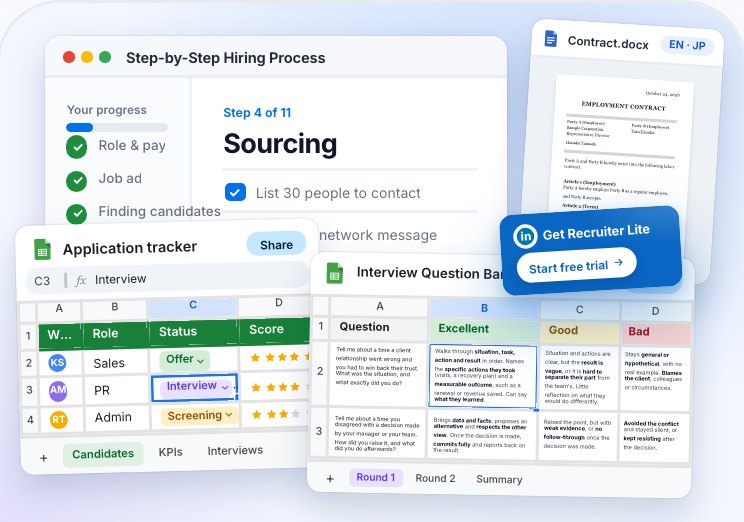
Recruiting pitch deck: the 8 slides to show in a casual interview
A recruiting pitch deck is a short set of slides that introduces the company and the job to candidates. Shown in a casual interview, it makes sure the same facts come across whoever is speaking, and candidates can read it again afterwards.
Put in what candidates want to know. In a Gakujo survey of 186 job seekers in their 20s, the top things they wanted to hear in a casual interview were "the work I would do if I joined" (72.7%), "how easy it is to work there (office, policies, benefits)" (61.7%) and "the personality and atmosphere of the people I would work with" (50.0%) (October 2026). Research also finds that the job itself does the most to decide which company people finally join (Uggerslev et al., 2012), so spend your slides on the work and the working style rather than the company history and philosophy.
What the company does
Who it serves, with what, and how it makes money
Why you are hiring now
Growth or a replacement, and what you expect of this person
The work they would take on
The first three months, and where they will be in a year
The people they will work with
Team size, backgrounds and ways of working
Salary range and working style
Annual salary range, overtime, days off, remote work
Evaluation and growth
When and how people are evaluated, how raises are decided
Current challenges
What is missing, and what is not working yet
The selection process
Number of steps and time from application to offer
Keep slide 7 on the challenges. A study of new-graduate hiring at 15 SMEs and some large companies found that simply handing over information about the workplace could lead candidates to turn down informal job offers, while sharing it with empathy, for example by letting them experience the workplace through employees who joined earlier, worked (Yamamoto, Journal of Japan Society of Human Resource Management, 2017). Put the challenges in the deck, and have whoever runs the meeting talk about them in their own words.
So when you compete with a large company for the same candidate, what should you put forward?
I recommend thinking of the position as an offer and identifying the aspects that might feel attractive to the right candidate: the career opportunity, leave and other benefits, the work atmosphere or the manager, whatever is unique to this position.
In the SMB hiring I have been involved in, three things made the difference against large companies: showing interest in the person as an individual, talking about how they can develop their career, and the CEO sharing their vision directly. When a candidate is about to make a life-changing decision like changing jobs, that makes a huge difference.
Use these 8 slides as the base and keep the deck to 10 slides at most: that is enough to cover in a 30-minute meeting and short enough to read in full when you email it afterwards.
What to avoid
What not to ask in a casual interview: the 14 topics, and selection questions
There are two kinds of questions to avoid in a casual interview: the 14 topics you should not raise in any hiring conversation, and selection questions that turn the meeting into an interview.
The 14 topics are things unrelated to a person's aptitude or ability that you should neither ask about nor look into, such as their registered domicile (the address on the family register), family, religion, political party or favourite books. Even if you ask only to put someone at ease, once you know the answer, it affects how you see them. Casual interviews involve a lot of small talk, so take extra care. Also avoid asking only women about plans to marry or have children. The full list is in the interview questions guide.
What to ask, and what not to ask, in a casual interview
Fine to ask
To choose the information that fits the person
- What they do in their current job
- What they want from their next job
- What they want to learn today
- What got them thinking about a change (as far as they want to say)
- Timing of their other applications (to plan dates)
Do not ask
Assessment questions and the 14 topics
- Why they want to join
- Self-promotion, strengths and weaknesses
- The 14 topics (family, place of origin, religion, political party and so on)
- Plans to marry or have children, asked only of women
As a rule of thumb, ask only what helps you choose the right information for the person or set the next date. Reasons for applying and strengths and weaknesses are assessment questions; there is no use for the answers in this meeting. Ask them in the interview after they apply. If a candidate brings up family circumstances on their own, do not follow up and do not write it down.
Follow-up
After the casual interview: follow up the same day, and count how many lead to an application
After the casual interview, do three things: follow up the same day, keep your notes separate from selection, and count how many meetings lead to an application.
Send your follow-up the same day. In the study mentioned above, students also read slow follow-ups as a sign of what the company is like (Rynes et al., 1991). Along with your thanks, add anything you promised to follow up on and the next step you agreed (how to apply, or the date of the next meeting).
Follow-up email after the meeting (example)
Subject
Thank you for today's casual interview ([Company])
Dear [Name],
Thank you for your time today. As promised, here is more on [the topic you asked about].
([Details])
If you would like to apply, just reply "I'd like to apply" to this email. Once you send your work history, we will propose interview dates by [date].
If you would like some time to think, that is fine too: just let me know. I will check in again around [date].
[Name], [Department], [Company]
If you find that a must-have condition does not match, say so clearly, with the reason, and do not encourage them to apply. That wastes less of their time than leaving them waiting for an answer that never comes.
In your notes, record only what the candidate wanted to know and what you told them, not an assessment. In the interview, assess with your set questions and criteria, not the impression from the casual interview: interviewers tend to run interviews in a way that confirms a good first impression (Dougherty et al., 1994). If you keep the details of people who did not apply in order to contact them later, tell them why (ATS guide).
Finally, track the numbers. Each month, record the number of meetings, how many led to an application, and how many to offers and hires, by channel (scout messages, employee referrals, inquiries). No reliable public survey shows how often casual interviews lead to an application.
In the hiring I have run or advised, about 80% of casual interviews led to an application, the highest success rate of any stage in the process. Most of the rest were cases where the company or the candidate realised it was not a fit. That filter is a good thing: it spares you long selection processes with people who do not fit.
If your own figure is far below this, first check whether step 5 of the flow (agreeing the next step) is being skipped.
FAQ
Casual interview FAQ
What is a casual interview?
A meeting before any application where the company and the candidate talk without a pass/fail decision. It lets the candidate learn about the job and the workplace and decide whether to apply; unlike a job interview, the company does not assess.
What is the usual flow of a casual interview?
Go through five parts in order: introductions and purpose, why you reached out, the job and the terms, answering questions, and the next step. In 30 minutes, allow about 3, 5, 10, 9 and 3 minutes. No reliable study shows what length works best; 30 minutes is suggested because it covers the five parts.
What should you not ask in a casual interview?
Do not raise the 14 topics unrelated to the job, such as registered domicile, family, religion or political party, even in small talk. Also avoid asking only women about plans to marry or have children. Assessment questions, such as reasons for applying or strengths and weaknesses, have no place in a casual interview either.
Should you set a dress code?
Write "no dress code" in the invitation email. The people attending from the company also come in their usual clothes.
Can you ask for a CV or work history?
Not for a casual interview. Asking for application documents makes candidates think it is a selection step. Their profile on the scout platform, or similar information you already have, is enough. If a candidate brings documents anyway, tell them what you will use them for before you take them.
Can you turn down a candidate who does not fit after a casual interview?
A casual interview has no pass or fail. If a condition rules them out before they apply, such as the work location or a required qualification, explain the reason during the meeting. Once they apply, assess them on the same criteria as other applicants.
Can you hold casual interviews with new graduates?
Yes, but do not use meetings before June 1 for selection. Under the job-hunting schedule, selection of new graduates starts on June 1 of their final year of study (they graduate the following March). Before that, do not rank students in these meetings or make attending a condition for the next step. The new-graduate schedule is explained in the direct recruiting guide.
DIY Hiring Kit
Everything You Need To Hire On Your Own
A downloadable hiring framework for small businesses in Japan, with step-by-step guides, spreadsheet ATS, LinkedIn scouting system, interview questions bank, offer letter and employment contracts, and a ton more!
1Dashboard11Checklists8Spreadsheets30Template docs4Weeks of Q&ABilingual
- Download every file as Word, Google Docs, Excel or Google Sheets


 14 years in talent acquisition
Related
Related guides and tools
 Guide
Interview Questions List (for Interviewers)
What to ask, and not ask, in the interviews that follow a casual interview.
 Hiring practices
What is direct recruiting? (vs scouting)
Sending scout messages and turning replies into casual interviews.
 Guide
How to Screen Candidates
The first call before interviews: fit and the must-haves.
 Guide
What is OpenWork? Pricing and scouts
Scout candidates who read your employee reviews.
 Guide
What is Wantedly? Pricing, plans and how to hire with it
The platform where hiring starts with a casual interview.
 Guide
What is Findy? Pricing and reviews
The scouting platform where matched engineers start with a casual interview.
Official sources
The main sources this guide is based on, most of them in Japanese. Other surveys and research are linked where they are used.
- Mynavicareer-research.mynavi.jp Job Change Trends Survey 2026 Job changers who had a casual interview, and the selection methods that raise motivation.
- Mynavicareer-research.mynavi.jp Mid-Career Hiring Survey 2025 Casual interviews as a measure against early turnover, and their effect.
- Mynavicareer-research.mynavi.jp Mid-Career Hiring Survey 2026 Companies that judge candidates "during the casual interview".
- Gakujoprtimes.jp Casual interviews in mid-career hiring (company and job seeker survey) Share of companies running them, their purposes, and what candidates like.
- BizReachwww.bizreach.co.jp Mid-career hiring survey (March 2023) What candidates hope to learn in a casual meeting.
- The Japanese Journal of Labour Studieswww.jil.go.jp Hiring that reduces mismatch at the point of hire (2007) Realistic job previews: telling candidates about the job, bad news included.