What is a candidate persona?How to create one, examples and a free template
What a candidate persona is and how to create one, with mid-career and new graduate examples for SMBs. Fill in the candidate persona sheet with our free template and save it as a PDF, or download the blank Word version.
PDF, Word and example downloads ask for your email address.
Your inputs are processed in your browser, and the PDF is made on your device.
Your team can share the Word version and fill it in.
Basics
What is a candidate persona? The person you want to hire, as one individual
In short
A candidate persona, or recruiting persona, describes the person you want to hire as one realistic individual, down to their current job, why they would change jobs and what they value. It applies the marketing persona to hiring, and you use it to decide what to say, and to whom, in job postings and scout messages.
“Hire anyone good,” you were told, so you posted the job, but the people who apply are not the ones you wanted. Interviewers disagree, and the offers you make get declined. You may have heard of candidate personas without knowing what to write, in how much detail, or how to use one. That may be why you opened this page.
I have worked as a recruiter for more than 14 years. At a recruitment agency in Japan I helped IT engineers change jobs, and at Google I was an in-house recruiter covering Europe, the Middle East and Africa. Today I provide recruitment consulting for SMBs.
Candidate persona vs hiring target and requirements:a group, one person, the pass criteria
A hiring target describes a group; a candidate persona describes one person in it. Hiring requirements play a different role from both: they are the criteria that decide who passes. Side by side, the three look like this.
Hiring target
The group you want to hire from. Example: people in route sales to businesses, in office equipment, telecoms and similar fields
Candidate persona
One person in that group. Example: Sasaki, stuck with the same accounts and looking for proposal work
Hiring requirements
The criteria that decide who passes. Example: 3+ years in B2B sales (must-have)
You don't pick one of the three. Create them in this order: hiring requirements, hiring target, candidate persona. The requirements draw the pass line, the target sets the group you search, and the persona describes one person in that group.
The hiring requirements decide who passes. The age and reasons for moving in a persona are a hypothesis drawn from what is common in that group. Never mark a candidate down only because they differ from the persona. You use the persona to decide what to say in job postings and scout messages.
Why
Why you need a candidate persona:“anyone good” doesn't say who to look for
You have posted the job and set the hiring requirements, so you may wonder whether you still need a persona. You do: requirements set the pass criteria, but they don't say who you want to apply. The trouble without a persona starts before the interview, when you write the job posting.
When a recruiter at an agency takes on a new role to fill, the first thing they ask is: “Why would the right person for this job want to leave their current company?” Once you know why people change jobs, you know which job to present to them, and in what words. A candidate persona lets you do that groundwork in-house. The need for one shows up in three situations.
Each interviewer pictures a different person
If all you decide is “someone with sales experience,” the CEO pictures a future manager and the team lead pictures someone who is easy to train. Each interviewer judges the same candidate by a different yardstick, and the scores split. With one person described in a persona, everyone talks about who you are looking for in the same words.
You can't find the words for job postings and scout messages
A job posting written for a group ends up in words that fit anyone in it. “Family-like workplace” and “rewarding work” could go in any company's posting. Once you know the persona's reasons for moving and worries, you can open with what that person wants to know.
Fewer mismatches after joining
In Japan, 31.2% of university graduates leave their first job within 3 years. The rate is higher at smaller workplaces, reaching 58.2% at those with fewer than 5 employees.
University graduates who leave within 3 years (by workplace size)
People leave for many reasons, and this figure alone doesn't say which. But you can reduce the number who feel “this isn't what I was told” after joining. Write the “honest drawbacks to share” in the persona, and you can raise them during selection, so people who won't fit can decide for themselves.
Those three are the benefits of a candidate persona: your team agrees on who it is looking for, you know what to write in your job posting, and mismatches after joining go down.
Items
Candidate persona sheet items:what to write for each hiring type
What should a persona include? Some examples go as far as age and hobbies, but more items are not better. Leave out any item that would not change the wording of your job posting or scout messages.
The 8 items of a candidate persona sheet
A candidate persona sheet has the following 8 items. Together they are the framework for building a candidate persona.
The role
Role, team, headcount, start date
Current job
Company, industry, responsibilities
Experience and skills
Must-haves and nice-to-haves
Why they want to move
What their current company lacks
What matters to them
Performance reviews, work style, the work itself
Worries about applying
Company size, training, the company's future
How they find jobs
Services they use, who they ask
What we tell them
What appeals, and the drawbacks
The working name, assumed age, commute and location, and time outside work complete the profile.
What changes between mid-career and new graduates
Mid-career and new graduate personas cover different items. In mid-career hiring, the focus is the current job and why they want to move. New graduates have no work history, so you write their major, what they focused on as students, and their job-search priorities.
Items for mid-career and new graduate hiring
Item
Mid-career
New graduate
Current job and work history
Yes
No
Why they want to move
Yes
No
Current salary (estimate)
Yes
No
Major
No
Yes
Main focus as a student
No
Yes
Job-search priorities
No
Yes
What matters to them
Yes
Yes
How they find jobs
Yes
Yes
Who they ask for advice
Yes
Yes
Base the reasons for moving on data
The “why they want to move” field is easy to fill with assumptions. In the MHLW Survey on Employment Trends, the reasons job changers gave for leaving their last company are not only about pay: working hours and relationships at work also come up often.
Why job changers left their previous company
Main work-related reasons (2025)
Men
Women
Working hours, days off and other conditions8.5%12.9%
Relationships at work8.9%11.5%
Pay and other income9.9%8.6%
Worried about the company's future6.9%4.3%
Lost interest in the work5.2%4.6%
Couldn't use their skills or qualifications5.2%3.9%
Among women, working hours, days off and other conditions (12.9%) and relationships at work (11.5%) top the list; among men, pay and other income (9.9%). For men aged 30 to 34, pay (13.4%) and working hours and days off (13.0%) are almost level. In the persona's “why they want to move” field, pick one reason your company can address.
Leave out family, housing, outlook on life, favorite books and people they admire too. The MHLW's Basics of Fair Recruitment Selection says that collecting such matters, which have nothing to do with aptitude or ability, during selection can lead to hiring discrimination. Put circumstances that affect how they work under “outside work,” and keep values to how they like to work.
Examples
Candidate persona examples:mid-career, new graduate and engineer
Without examples, it is hard to know how specific to be. Here are three filled-in examples for a company of about 40 employees. Notice that in every example, the center is not age or background but “why they would choose this job.”
Mid-career, B2B sales
Mid-career persona example: a route salesperson looking for proposal work
Current job6 years in route sales to small businesses at an office equipment dealer with 300 employees. Early 30s, lives in Tokyo.
Why they want to move
Stuck with the same accounts and no chance to propose anything new. Month-end quota pressure is harsh.
How they find jobs
Reads scout messages from job sites on the commute. For companies that catch their interest, checks reviews and the CEO's social media.
Worries about applying
Will a 40-person company offer training? Is its future secure?
What we tell them
They handle deals from proposal to contract on their own. Drawback: few existing accounts to inherit; the job starts with new business development.
The three examples come as a PDF and the blank candidate persona sheet as a Word file, ready to download once you enter your email address.
Steps
How to create a candidate persona:6 steps
Create a candidate persona in the following 6 steps. If HR writes it alone, it drifts from the person the team lead has in mind, so steps 2 and 3 gather input from across the company.
Check the hiring requirements
From the job description or job posting, list the must-have requirements and the nice-to-have ones separately. The must-haves carry over to the persona unchanged.
Find what your top performers have in common
A top performer analysis only takes interviews with 2 or 3 employees doing well in the same job. Ask each of them the same 5 questions and look for answers shared by at least 2.
Example interviews with 3 top performers
Question
Staff A
Staff B
Staff C
Why they joined: talked directly with the CEO
Yes
Yes
No
Why they left their last job: no chance to propose
Yes
Yes
Yes
What matters at work: thanks from clients
Yes
No
No
Worry before joining: whether there is training
Yes
Yes
No
How they found us: applied after a scout message
Yes
No
Yes
In this example, “what matters at work” is not shared by 2 or more, so don't force it: leave it blank to start. For a new role that no one does yet, take your cues from the reasons given by people who reached the final interview or declined your offer in your last search.
Ask the team lead and the leadership
Ask the manager the new hire will work with, and the leadership, who they want to join and who did not fit in the past. Stories of people who did not fit reveal the persona's “honest drawbacks to share.” If their picture differs from the one HR drew, correct it here.
Fill in the sheet and bring it together as one person
Fill in the candidate persona sheet. If words like “proactive” end up in the experience and skills field, rewrite them as past actions. This field comes from the hiring requirements, so an interview should be able to check whether that action happened.
BeforeAfter
InitiativeBefore: Is proactiveAfter: Proposed an improvement before being asked
CommunicationBefore: Strong communication skillsAfter: Brought a divided meeting to a decision
Drive to growBefore: Eager to growAfter: Studies for a certification outside work
If the same role splits into different jobs, such as new business development and account management, make separate personas. Make multiple personas only when you will write a separate job posting and scout message for each.
Check that this person exists in the market
Search job boards and scouting services for people who match the persona. As I wrote in my guide to designing a hiring process, if you can't find around 200 to 500 candidates, your criteria may be too strict. Drop nice-to-haves or review the salary.
Share it with the team and use it in your hiring
Share the sheet with interviewers and with the employees you ask for referrals. Then use it for the job posting, scout messages and what you explain in interviews (how to use it).
How to use a candidate persona:job postings, scouting and interviews
A persona that sits in a shared folder changes nothing about your hiring. You use it in three places, and the first thing it changes is the first line of your job posting.
Decide how your job posting opens
People decide from the first few lines whether to read a job posting. Open with a sentence that answers the persona's reason for moving. The full method is in how to write a job posting.
Written for a groupWritten for the persona
First lineWritten for a group: B2B sales wanted for our family-like workplaceWritten for the persona: From route sales to proposal-led sales
Choose your channels and scout messages
The persona's “how they find jobs” decides where you recruit. For someone who doesn't browse job sites but reads the scout messages they receive on the commute, direct recruiting works better than job ads. In a scout message, make clear in the subject and first two lines what in their background made you reach out.
Explain it in interviews and casual interviews
What you check in interviews is set by the hiring requirements, and your interview questions come from them too. The persona helps with what you explain to candidates. Answer the persona's “worries about applying” early, in a casual interview, and share the “honest drawbacks” before any offer.
Pitfalls
Common candidate persona mistakes:4 when creating and using one
You made a persona, yet neither applications nor interviews changed. If so, something went wrong in how you made it or how you use it. The common mistakes are two when creating a persona and two when using it. The third can also break the law if age is the reason (Act on the Comprehensive Promotion of Labor Policies, Article 9).
Packing in ideals until no such person exists
Stack up must-haves and almost no one in the market meets them all.
How to avoid it
Keep must-haves to the hiring requirements and move the rest to nice-to-haves.
Stopping at “cheerful” and “proactive”
Abstract words fit anyone and can't be checked in an interview.
How to avoid it
Rewrite them as past actions (step 4).
Rejecting people for not matching the persona
Marking people down only because their age or background differs from the persona loses people who meet your criteria, and the selection is no longer fair.
How to avoid it
Decide who passes by the hiring requirements, and use the persona for how you communicate.
HR makes it alone, and the team never uses it
A sheet the team lead had no part in goes unread in interviews and unused in the job posting.
How to avoid it
Write it with the team lead and share it with every interviewer.
Review
Reviewing and updating a candidate persona:fix it with application and decline data
Review the candidate persona each time you start a search, and whenever one of the following happens. You only need to update the fields where your hypothesis was wrong.
You get applications, but few match. Review “how they find jobs” and the opening of your job posting.
You get few applications at all. Check whether your criteria are too strict, and recheck the numbers in the market (step 5).
Candidates decline offers for reasons the persona's worries don't cover. Rewrite the “worries about applying” field.
New hires joined for reasons the persona doesn't list. Update “what will appeal to them” with the reasons you hear in check-ins after they join.
Track applications and the offer acceptance rate every week as recruiting KPIs, and you won't miss the time to review.
FAQ
Frequently asked questions about candidate personas
What does “persona” mean in business?
A portrait of the person you want to use your product or service, drawn as one realistic individual. The word comes from Latin, where it meant the mask an actor wore. A candidate persona applies the idea to hiring, replacing “the person you want as a customer” with “the person you want to hire.”
What is a persona sheet?
A one-page form that brings a persona's items together. A candidate persona sheet lists 8 items: the role, current job, experience and skills, why they want to move, what matters to them, worries about applying, how they find jobs, and what we tell them. Fill it in with the template on this page and save it as a PDF, or download the blank Word version.
How many candidate personas should we make?
One per role you are hiring for is the norm. Make separate ones when the same role splits into different jobs, such as new business development and account management, or when you hire mid-career and new graduates at the same time. With too many, one job posting ends up written for several personas, so keep to the number of job posting and scout message versions you will write.
Can a candidate persona include age, gender or family?
Age can go in as an assumption, but leave out gender and family. In Japan, limiting age in a job posting is not allowed except in specific cases (Act on the Comprehensive Promotion of Labor Policies, Article 9). Recruitment and hiring must give equal opportunity regardless of sex (Equal Employment Opportunity Act, Article 5). The MHLW lists family matters among those that can lead to hiring discrimination if collected during selection. Put circumstances that affect how they work under “outside work.”
Do you create a candidate persona differently for new graduates and mid-career hires?
The steps are the same; the items change. For mid-career hires, the focus is the current job and why they want to move. New graduates have no work history, so you write their major, what they focused on as students and their job-search priorities. The people they ask for advice are usually parents or the university career center.
How do we find what our top performers have in common?
Ask 2 or 3 employees who do well the same 5 questions and look for shared answers. The questions: why they joined, why they left their last job, what matters to them at work, what worried them before joining, and how they found the job. Write the answers shared by at least 2 into the candidate persona (top performer analysis).
DIY Hiring Kit
Everything You Need To Hire On Your Own
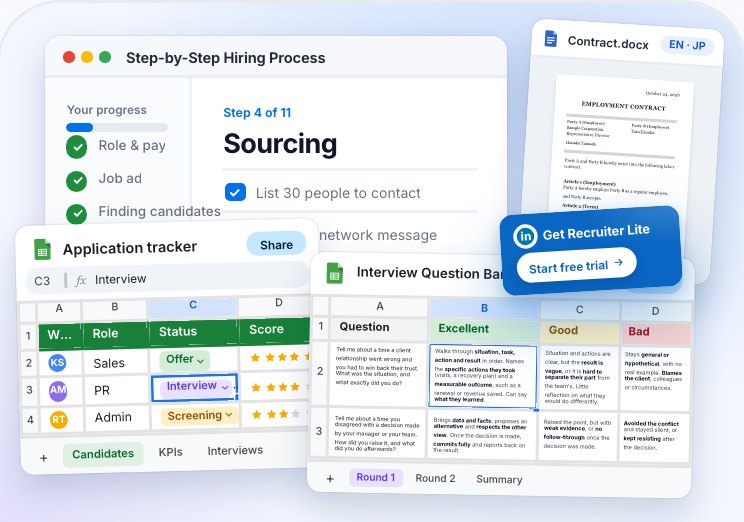
A downloadable hiring framework for small businesses in Japan, with step-by-step guides, spreadsheet ATS, LinkedIn scouting system, interview questions bank, offer letter and employment contracts, and a ton more!
1Dashboard11Checklists8Spreadsheets30Template docs4Weeks of Q&ABilingual
Download every file as Word, Google Docs, Excel or Google Sheets
Founder, SaiyouTeam · HR and recruiting advisor to SMBs in Japan
Former Google recruiter
14 years in talent acquisition
Emmanuel advises SMBs on HR and recruiting in Japan. Before founding SaiyouTeam, he spent 14 years in talent acquisition, including as a recruiter at Google. This guide is part of that advisory work: it brings together how to create a candidate persona and how to use it in job postings and interviews.





 14 years in talent acquisition