
Hiring Playbook

Job descriptions in Japan: how to write one with a free template in English and Japanese

What a job description is for in a Japanese company, how to write one, and examples for six roles from sales to engineering. The free template fills in from the role you pick, in English and Japanese, and downloads as Word, Excel or PDF.

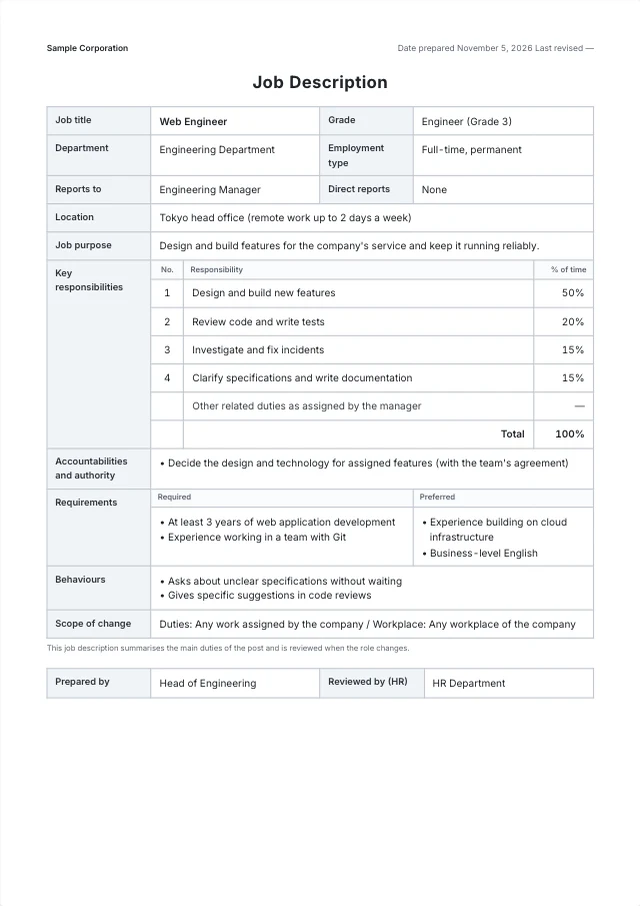
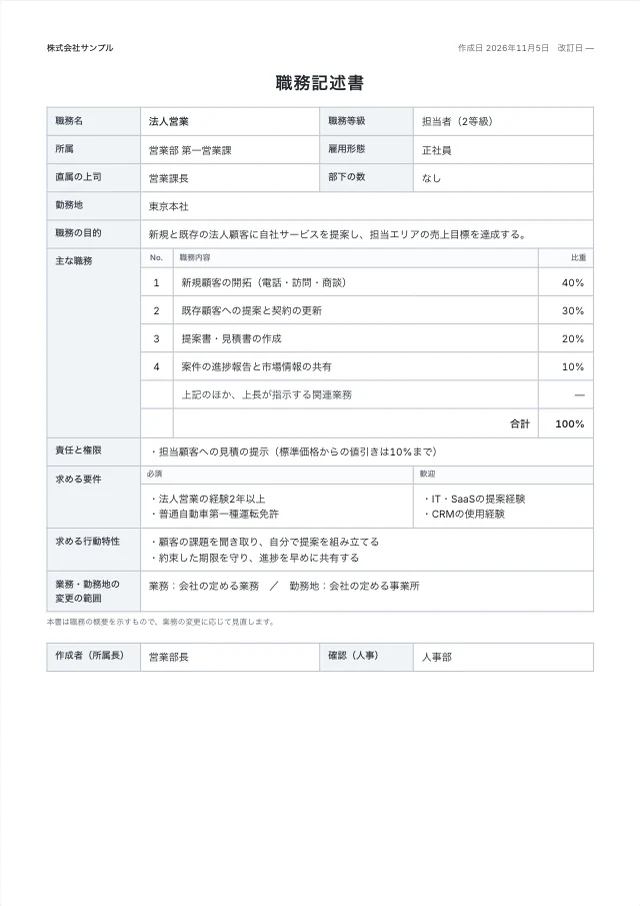
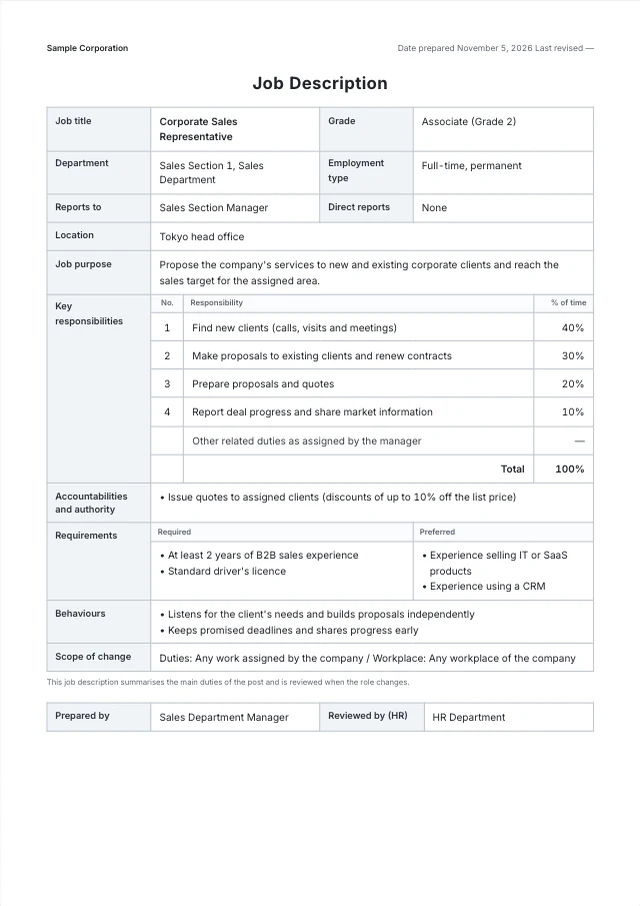
Documents this template makes: an English job description for a sales role, the Japanese version, and one for a web engineer
Emmanuel Gendre Former Google recruiter, HR and hiring advisor to SMBs Last updated 21 min read

Job description template (generator)

Pick a role and fill in the fields; the job description in the preview updates as you type.

Step 1 of 9

Title and role

Pick a title and a role to load an example.

Job descriptionThe most common title

Team and purpose

Where it sits, and why it exists.

Responsibilities

The main duties and the share of time each takes.

%
%
%

More duties

Duties four and five, and the catch-all line.

%
%

The shares add up to 100%

Authority, KPIs

Decision rights and measures.

Requirements

What is required, and what is a plus.

Behaviours

How people who do well in this role work.

Scope and pay

The scope of change, and an optional pay row.

Dates, sign-off

Dates, preparer and reviewer.

Your job description is ready

Everything you entered is on the preview. Save it as PDF, Word or Excel, or go back to a step to change it.

Sample Corporation

Date prepared November 5, 2026 Last revised ―

Job Description
Job titleCorporate Sales RepresentativeGradeAssociate (Grade 2)
DepartmentSales Section 1, Sales DepartmentEmployment typeFull-time, permanent
Reports toSales Section ManagerDirect reportsNone
LocationTokyo head office
Job purposePropose the company's services to new and existing corporate clients and reach the sales target for the assigned area.
Key
responsibilities
No.Responsibility% of time
1Find new clients (calls, visits and meetings)40%
2Make proposals to existing clients and renew contracts30%
3Prepare proposals and quotes20%
4Report deal progress and share market information10%
Other related duties as assigned by the manager―
Total100%
Accountabilities
and authority
  • Issue quotes to assigned clients (discounts of up to 10% off the list price)
RequirementsRequiredPreferred
  • At least 2 years of B2B sales experience
  • Standard driver's licence
  • Experience selling IT or SaaS products
  • Experience using a CRM
Behaviours
  • Listens for the client's needs and builds proposals independently
  • Keeps promised deadlines and shares progress early
Scope of changeDuties: Any work assigned by the company / Workplace: Any workplace of the company

This job description summarises the main duties of the post and is reviewed when the role changes.

Prepared bySales Department ManagerReviewed by (HR)HR Department
  • PDF, Word, Excel and sample downloads ask for your email address.
  • Your inputs are processed in your browser, and the PDF is made on your device.
  • Draws on the Cabinet Secretariat job-based HR guideline and the MHLW job analysis manual.

Basics

What a job description is

Key point

A job description sets out, for one position, the purpose of the job, its main duties and responsibilities, and the skills and experience it needs. Inside the company it sets the hiring requirements, the review criteria and the basis for transfers; outside it, candidates and recruiting agencies receive it as it is.

In Japan the same document goes by several names: the usual Japanese term translates as job description, and some companies call it a job definition or a role profile. A job posting is the advertisement written for applicants; the job description is where the company defines the job itself, and the posting and the interview criteria are written from it.

Job description, job posting and notice of employment terms

The three documents differ in their role and who reads them. All three describe the duties, so using the same wording in each avoids mismatches.

How the job description, the job posting and the notice of employment terms differ
DocumentWho reads itLegal basisWhat it holds
Job descriptionManager, employee, HR, and candidatesNo legal duty to write onePurpose, duties and their weight, authority, requirements
Job postingApplicantsEmployment Security Act, Article 5-3Duties and working conditions
Notice of employment termsThe person hiredLabor Standards Act, Article 15The agreed working conditions

The items each must disclose are set by the Employment Security Act regulations, Article 4-2 for postings, and by the Labor Standards Act regulations, Article 5 for the notice of terms.

The overlap is the duties. Decide them in the job description first, and the "duties" line of the job posting and the "work to be performed" line of the employment contract and notice of terms can use the same words.

Job-based and membership-based employment

Membership-based employment, the traditional Japanese model, hires people first and assigns them work afterwards. Job-based employment defines the job first and then hires or places someone who fits it. In a job-based system the job description is the basis for hiring, reviews and pay.

In August 2024 the government published a job-based HR guideline (Cabinet Secretariat, METI and MHLW), with case studies from 20 companies including Fujitsu, Hitachi, Shiseido and KDDI. In Keidanren's 2025 survey, 26.4% of member companies had introduced job-based employment, counting those planning or considering it.

Companies with job-based employment (including planned or under review)

Keidanren, 2025 Top Management Survey on HR and Labor

Introduced, planned or under review
26.4%
Not introduced
73.6%

Even among Keidanren's members, mostly large companies, that is about one in four. For a small company the easier start is one job description per role you hire for, and one per manager, rather than switching the whole company over.

How it is used

How a job description is used: posting, interviews, reviews and transfers

A job description is written once and reused at four moments, from the first posting to a transfer. It is not only an internal document for reviews and placement: candidates and recruiting agencies get it as it is.

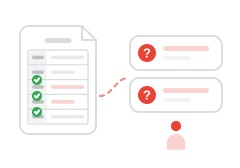
  1. The duty rows of a job description flow into a job posting on a job site, read by two candidates

    When you post the job: copy it into the posting

    The key responsibilities go into the "duties" of the job posting and the required and preferred qualifications into "requirements", word for word. The English version works as is for a LinkedIn job or a recruiting agency. Leave out the compensation row and there is nothing in it you cannot show outside the company.

  2. Ticked requirements on a job description become interview question cards held by an interviewer

    In interviews: turn requirements into questions

    One question per requirement. For "two years of B2B sales", ask how many accounts the candidate handled and how one deal went from first call to close. For a behaviour, ask about a time they actually did it. Every interviewer scores the same items, so candidates can be compared. The interview questions guide shows how to build the questions.

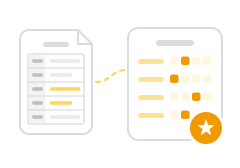
  3. The indicators on a job description line up with the rows of a review form, one rating picked on each

    In performance reviews: the KPIs become the review items

    Copy the job purpose and the indicators into the goals of the performance review form. People are reviewed against the standard they read before joining, which makes the result easier to accept. For roles whose targets change every year, keep the targets on the review form and out of the job description.

  4. An employee moves to the next post, and the job description carries a revision mark

    At a transfer or promotion: check the scope of change, then revise

    Before a transfer, read the job description's scope of change for duties and workplace. If the move stays inside it, a transfer notice is enough. If the role itself changes, revise the job description, date the revision, and hand it over with the promotion notice or transfer notice.

Use the same words in the posting, the interviews, the review form and the notices

Write the duties once and reuse the text, and what you promised before the hire matches what you ask for after it.

How to write it

How to write a job description: from listing the duties to the yearly review

Writing a job description takes five steps. The moments to write one are before a job is posted, when the review system is redesigned, and when a promotion or transfer changes a role.

  1. Pick the position and state its purpose

    Decide which position the job description is for, and write why the job exists in one or two sentences. Once the purpose is clear, choosing the duties and the review criteria stops drifting.

  2. List the duties and weight them

    Ask the current holder and the manager, and write down the work of a typical week and a typical month. The MHLW's job tag occupation database publishes the tasks and skills of more than 500 occupations, which helps spot gaps. Merge similar tasks, keep four or five key responsibilities, and give each a share of time in percent.

  3. Fill in the template

    Pick a role in the template above to load an example, rewrite it in your own words and keep it to one or two pages. Fujitsu built 650 role profiles from templates already used in the market and finished job descriptions for about 15,000 people in two months; it chose not to aim for perfection at first and to refine them in use (job-based HR guideline).

    Even among companies that define jobs in writing, only 4.8% go down to individual tasks (MHLW-commissioned survey). Write each responsibility with a verb that says what is done and to what standard.

    How detailed written job descriptions are

    1. Down to individual tasks4.8%
    2. Fairly detailed32.0%
    3. Not very detailed37.9%
    4. Only in general terms25.1%

    Companies that define jobs in writing. Source: MHLW-commissioned survey, March 2024

  4. Check it with the manager, the employee and the owner

    HR drafts it; the manager and the current holder check it against the real work, and the owner checks it against the company's direction. Written by the manager alone it tilts to the shop floor; written by the owner alone it tilts to strategy.

  5. Publish it and review it once a year

    Give it to the employee and use the same wording in the posting and the review form. Review it once a year, at review time, and date the revision. In Keidanren's survey, 40.7% of companies with job-based employment (including those planning or considering it) do not update their job descriptions on a schedule.

Companies that do not update job descriptions on a schedule

Keidanren members with job-based employment, planned or under review (2025 survey)

No scheduled updates
40.7%
Updated on a schedule (including planned)
59.3%

What to include

What goes in a job description

There is no fixed form for a job description. Most Japanese companies cover the twelve items below. The right-hand column gives the heading used in English versions.

The twelve items of a job description and their English headings
ItemWhat to writeEnglish heading
Job titleThe official title used inside the companyJob Title
Department and managerThe department and the direct managerDepartment / Reports to
Grade or levelAssociate, lead, manager and so onGrade / Level
Employment type and locationPermanent or fixed-term, and the workplaceEmployment Type / Location
Job purposeWhy the job exists, in one or two sentencesJob Purpose
Key responsibilities and share of timeFour or five main duties and the share of time each takesKey Responsibilities
Accountabilities and authorityApproval limits, direct reports, budgetScope and Authority
Key performance indicatorsThe figures or outcomes used in reviewsKey Performance Indicators
Required qualificationsExperience, skills, licencesRequired Qualifications
Preferred qualificationsExperience that is a plusPreferred Qualifications
BehavioursHow people who do well in the role workCompetencies
Scope of change and compensationHow far duties and workplace may change; the pay rangeScope of Change / Compensation

Shiseido's job definitions carry the position name, the job purpose, the responsibilities and the requirements, and are published to the whole company. Hitachi keeps results and KPIs out of individual job descriptions and states only a broad mission, to avoid rewriting them every time conditions change (job-based HR guideline). For roles whose targets change yearly, put the targets on the review form and leave the KPI row off; in the template it stays off until you switch it on.

A Japanese version is what a Japanese-speaking manager, HR team or recruiting agency will expect, and the Japanese sheet is also the one that lines up with the notice of employment terms. Switch the preview to Japanese to check it, and give the Japanese version as the master and the English version as a reference translation to avoid disputes over wording.

Sample, Word and Excel versions

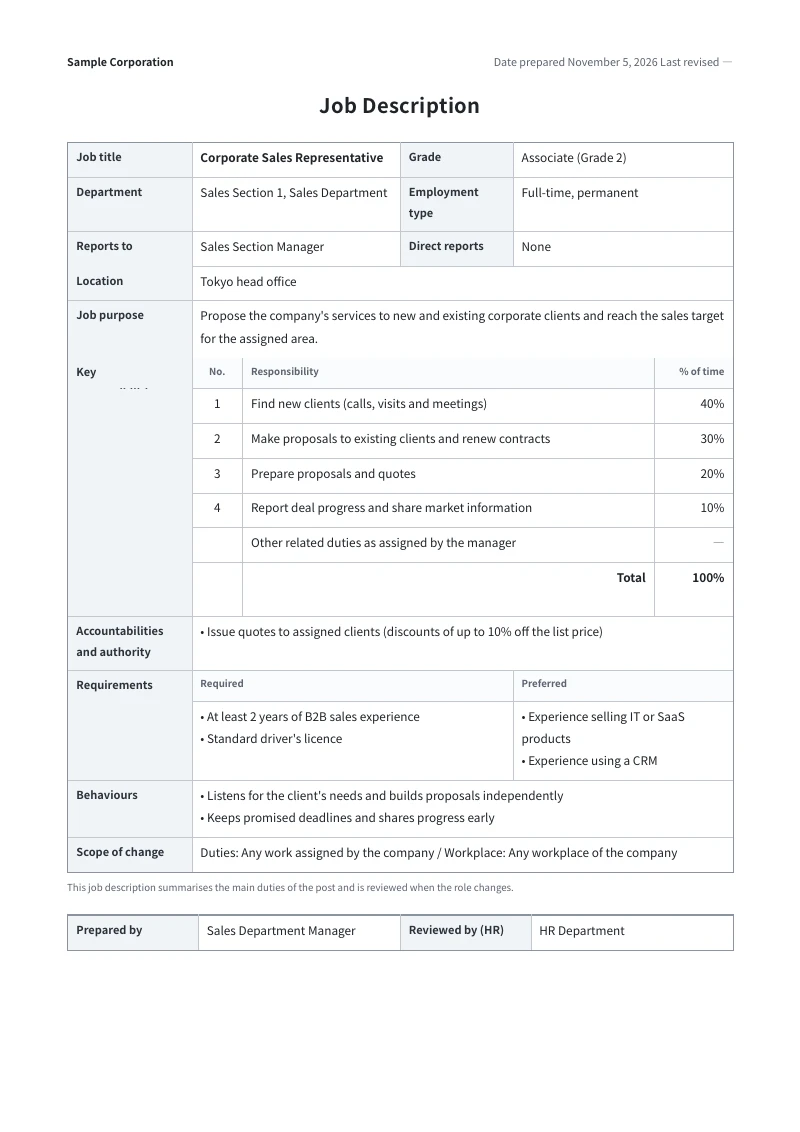
A sample job description for a corporate sales role, made with the template above. The sample PDF and the editable Word and Excel templates are available after you enter your email address.

Sample job description for a corporate sales role: four key responsibilities with their share of time, required and preferred qualifications
A sample made with the template above: purpose, key responsibilities with their share of time, authority, required and preferred qualifications, behaviours and the scope of change.

In the Word and Excel files, replace the bracketed placeholders. Both hold the Japanese sheet followed by the English one. In Excel, duplicate the sheet to keep one job description per role in a single file.

Examples

Job description examples by role: sales, admin, engineering and three more

Six samples, the same ones the template loads. Copy one, rewrite it in your company's words and use it as the starting point. Pick the role in the template and the same example appears in the preview.

Example 1: Corporate sales

Job description (Corporate Sales Representative)

Job purpose

Propose the company's services to new and existing corporate clients and reach the sales target for the assigned area.

Key responsibilities and share of time

Find new clients (calls, visits and meetings) (40%)
Make proposals to existing clients and renew contracts (30%)
Prepare proposals and quotes (20%)
Report deal progress and share market information (10%)

Required

At least 2 years of B2B sales experience
Standard driver's licence

Preferred

Experience selling IT or SaaS products
Experience using a CRM

Key performance indicators

Quarterly sales target achievement
Number of new contracts

For sales roles, revenue and deal counts make natural indicators. State the authority in numbers too, such as the discount limit.

Example 2: Office administration

Job description (Administrative Assistant)

Job purpose

Keep the department's documents and schedules in order so that colleagues can focus on their own work.

Key responsibilities and share of time

Prepare documents and enter data (40%)
Handle calls, visitors and mail (25%)
Manage supplies and process expense claims (20%)
Arrange meetings and business trips (15%)

Required

Can create documents and spreadsheets in Word and Excel
At least 1 year of work experience

Preferred

Office administration experience
Bookkeeping Level 3 (Japan Chamber of Commerce)

Key performance indicators

Share of tasks finished by the deadline
Number of input errors

For office administration, deadlines and accuracy are the indicators. Name the software in the required qualifications.

Example 3: Accounting

Job description (Accountant)

Job purpose

Record daily transactions accurately and close the monthly and annual accounts on time.

Key responsibilities and share of time

Record journal entries and process vouchers (35%)
Manage payments and receipts (25%)
Close the monthly accounts and prepare trial balances (25%)
Provide documents to the tax accountant and support the annual closing (15%)

Required

At least 2 years of accounting experience
Experience with accounting software

Preferred

Bookkeeping Level 2 (Japan Chamber of Commerce)
Experience with the annual closing

Key performance indicators

Monthly closing on schedule
Number of corrected entries

For accounting, closing dates are the core indicator. Split certifications between required and preferred.

Example 4: Web engineer

Job description (Web Engineer)

Job purpose

Design and build features for the company's service and keep it running reliably.

Key responsibilities and share of time

Design and build new features (50%)
Review code and write tests (20%)
Investigate and fix incidents (15%)
Clarify specifications and write documentation (15%)

Required

At least 3 years of web application development
Experience working in a team with Git

Preferred

Experience building on cloud infrastructure
Business-level English

Key performance indicators

Quality of released features
Time to resolve incidents

For engineers, the stack and the way the team works belong in the required qualifications. Remote-work terms go in the location line.

Example 5: Store staff

Job description (Sales Associate)

Job purpose

Help customers find the right products and raise the store's sales and customer satisfaction.

Key responsibilities and share of time

Serve customers and sell products (50%)
Operate the register (20%)
Restock shelves and manage stock (20%)
Clean the sales floor and arrange displays (10%)

Required

Customer service experience (part-time work counts)
Able to work weekends and public holidays

Preferred

At least 1 year in retail sales
Can serve customers in a foreign language

Key performance indicators

Personal sales target achievement
Customer survey scores

For store staff, the days a person can work may be a requirement. Word it so people without experience can apply.

Example 6: HR and recruiting

Job description (HR and Recruiting Specialist)

Job purpose

Hire the people the company needs on plan and support their onboarding and retention.

Key responsibilities and share of time

Plan hiring and write job postings (30%)
Handle applicants and schedule interviews (30%)
Process new hires and social insurance filings (25%)
Support training and the review system (15%)

Required

At least 2 years of HR or recruiting experience
Experience handling personal data

Preferred

Experience with social insurance filings
Experience using an applicant tracking system

Key performance indicators

Hiring plan achievement
Retention 3 months after joining

HR and recruiting staff handle personal data. Put the rules for handling it in the behaviours as well.

Adapting an example to your company

  1. No age or gender in the requirements: write them as the experience and skills the job needs.
  2. Replace abstract words with behaviours: "communication skills" becomes what the person can do, in which situation.
  3. Keep required qualifications to three to five: a long list puts off people who would fit.
  4. Keep the "other duties" line: so that work you did not list can still be assigned.

What a Japanese job posting may not say is covered in the job posting guide.

Legal points

Job descriptions and Japanese law: scope of change and equal pay

No Japanese law requires a job description. Its content, though, touches four rules.

Postings and notices of terms must state the scope of change

Since April 1, 2024, employers must state not only the duties and workplace at hiring but also how far they may change (Labor Standards Act regulations, Article 5; Employment Security Act regulations, Article 4-2). The MHLW describes the scope of change as the range of workplaces and duties that future transfers may bring (MHLW guidance).

Put the scope of change in the job description and the notice of terms and the posting can carry the same wording.

A job limited to one occupation needs consent to transfer

On April 26, 2024 the Supreme Court held that where the parties have agreed to limit the occupation or duties, the employer has no authority to order a transfer outside that agreement without the employee's individual consent (judgment text).

If the job description limits the duties and the notice of terms limits the scope of change to the same duties, a court is more likely to find an occupation-limiting agreement. For roles that may move, write the scope of change as "any work assigned by the company" and announce moves with a transfer notice.

Pay gaps with part-time and fixed-term staff are explained by the job content

The Part-Time and Fixed-Term Workers Act, Article 8 defines "job content" as the duties and the degree of responsibility that comes with them, and bans unreasonable gaps with permanent staff. Under Article 14(2), the employer must explain the gap and its reasons when asked.

The MHLW's job analysis manual says that job information gathered into job descriptions becomes the base data for hiring, training, placement and pay. The key responsibilities and the authority row of the job description are what that explanation rests on.

Job-based does not mean dismissal when the job disappears

Article 16 of the Labor Contracts Act voids a dismissal that lacks objectively reasonable grounds or is not socially acceptable. A job description does not change that test.

FAQ

Job description FAQ

What does "job description" mean in a Japanese company?

A document that sets out the duties of a position and the requirements for it. Some Japanese companies call it a job definition or a role profile instead. For each position it gives the purpose, the main duties, the scope of responsibility and the skills needed.

What is the difference between a job description and a job posting?

The job description defines the job; the job posting advertises a vacancy for it. The job description is also given to candidates, but the posting must carry the working conditions that the Employment Security Act requires. The duties and requirements decided in the job description become the posting's duties and requirements sections.

Who writes the job description?

HR drafts it, and the manager, the current holder and the owner check it. Written by the manager alone it reflects only the shop floor; written by the owner alone it reflects only strategy.

Is a job description required by Japanese law?

No. But the Employment Security Act at hiring and the Labor Standards Act at contract time both require you to state the duties and how far they may change. With a job description, those statements line up.

Is job-based or membership-based employment better?

It depends on the business and on how many specialists you hire from outside, so there is no general answer. In Keidanren's 2025 survey, 50.4% of companies without job-based employment said it does not suit their jobs or business. For a small company, the practical start is a job description for each role you hire for and for managers, used in hiring and reviews.

Where does a job description fit in an HR system?

It is the basis of the three pillars: grades, reviews and pay. The size of the job sets the grade, the purpose and indicators drive the review, and pay follows the job. Companies that are not job-based still use it as the standard for hiring and reviews.

Can I make the job description in Japanese?

Yes. Switch the preview to Japanese and the same content appears as a Japanese sheet you can save as PDF. The Word and Excel files hold both versions. Treat the Japanese version as the master and the English one as a reference translation.

Can I edit the template in Word or Excel?

Yes. The Word and Excel templates download after you enter your email address. Replace the bracketed placeholders. In Excel, duplicate the sheet to keep one job description per role in one file.

Can I assign work that is not in the job description?

Yes, within the employment contract and the work rules. The usual safeguard is an "other related duties as assigned" line at the end of the responsibilities. Where an agreement limits the occupation, a transfer to a different occupation needs the employee's consent (Supreme Court, April 26, 2024).

Should the job description state the pay?

That is the company's choice. Companies that pay by job state a range; others state only the grade. The template has a compensation row you can switch on or off.

How often should a job description be reviewed?

Once a year, at review time. After a reorganisation or a major change in duties, revise it straight away and date the revision.

Does a small company need job descriptions?

Not for everyone, but one for each role you hire for pays off. It keeps the posting, the interview criteria and the review after joining on the same standard.

DIY Hiring Kit

Everything You Need To Hire On Your Own

A downloadable hiring framework for small businesses in Japan, with step-by-step guides, spreadsheet ATS, LinkedIn scouting system, interview questions bank, offer letter and employment contracts, and a ton more!

1Dashboard11Checklists8Spreadsheets30Template docs4Weeks of Q&ABilingual

  • Download every file as Word, Google Docs, Excel or Google Sheets

About the author

Emmanuel Gendre, founder of SaiyouTeam

Emmanuel Gendre

Founder, SaiyouTeam · HR and recruiting advisor to SMBs in Japan

  • Former Google recruiter
  • 14 years in recruiting

Emmanuel advises SMBs on HR and recruiting in Japan. Before founding SaiyouTeam, he spent 14 years in talent acquisition, including as a recruiter at Google. Clients often ask him about job descriptions, so he built this free template.

Official sources

The template and explanations on this page are based on the official sources below, all in Japanese (checked November 5, 2026).

Important. This template and the examples show the general structure of a job description in Japan. The figures and conditions in the examples are illustrations. Laws and survey figures are as of November 2026.