How to write your self-evaluation:examples for performance reviews(by job, free template)
Self-evaluation examples for your performance review, by job: office, sales, care and more. Pick a job and the free template fills in the wording; then save it as a PDF.
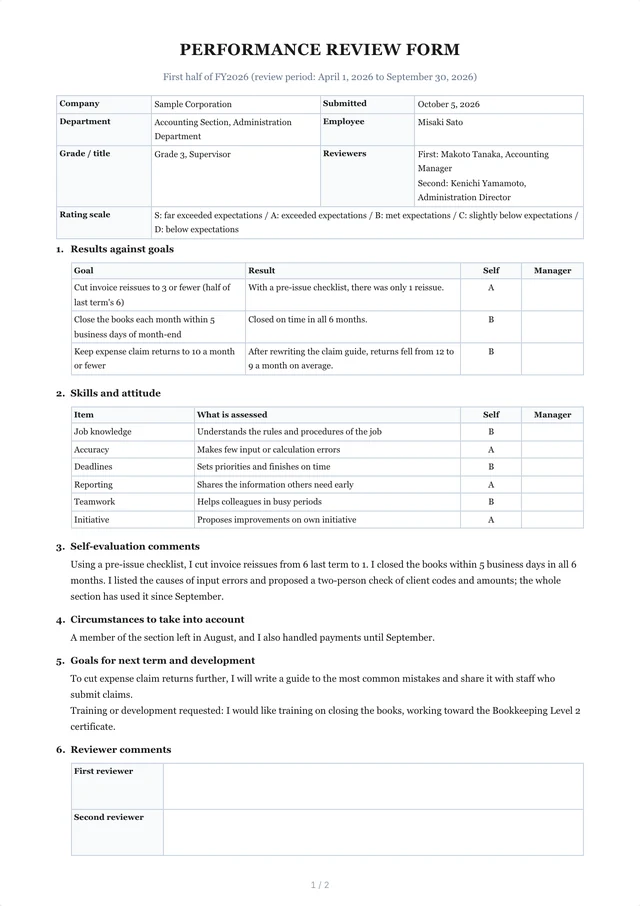
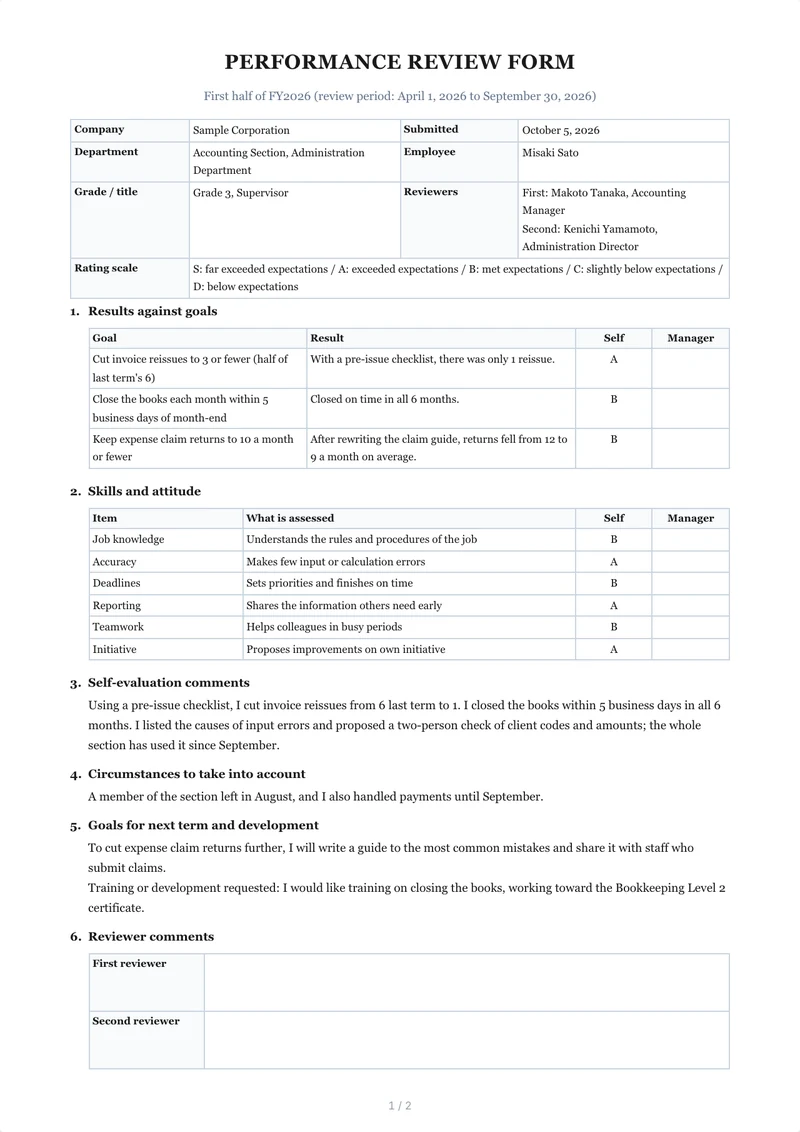
Cut invoice reissues to 3 or fewer (half of last term's 6)
With a pre-issue checklist, there was only 1 reissue.
A
Close the books each month within 5 business days of month-end
Closed on time in all 6 months.
B
Keep expense claim returns to 10 a month or fewer
After rewriting the claim guide, returns fell from 12 to 9 a month on average.
B
Skills and attitude
Item
What is assessed
Self
Manager
Job knowledge
Understands the rules and procedures of the job
B
Accuracy
Makes few input or calculation errors
A
Deadlines
Sets priorities and finishes on time
B
Reporting
Shares the information others need early
A
Teamwork
Helps colleagues in busy periods
B
Initiative
Proposes improvements on own initiative
A
Self-evaluation comments
Using a pre-issue checklist, I cut invoice reissues from 6 last term to 1. I closed the books within 5 business days in all 6 months. I listed the causes of input errors and proposed a two-person check of client codes and amounts; the whole section has used it since September.
Circumstances to take into account
A member of the section left in August, and I also handled payments until September.
Goals for next term and development
To cut expense claim returns further, I will write a guide to the most common mistakes and share it with staff who submit claims.
Training or development requested: I would like training on closing the books, working toward the Bookkeeping Level 2 certificate.
PDF, Word and sample downloads ask for your email address.
Your inputs are processed in your browser, and the PDF is made on your device.
Change the title to use it as a self-evaluation sheet or appraisal form.
Draws on the MHLW job skills evaluation sheets and the national civil service performance evaluation guide.
Examples
Self-evaluation examples: ready-to-use wording by job
Write a self-evaluation in three parts: the result (facts you can show in numbers), what you did (your own actions and ideas), and the next step (what you will do next term). Whatever the job, this order gets your point across to your manager.
Below are seven examples by job, plus examples for rating items, missed goals, next term's goals and reviewer comments. Replace the numbers and tasks with your own and paste them into your review form or HR system. Choose a job in the template above and the same example goes into the form's comment box and next term's goal.
Example 1: Office administration
Self-evaluation (office administration)
Result
Using a pre-issue checklist, I cut invoice reissues from 6 last term to 1. I closed the books within 5 business days in all 6 months.
What I did
I listed the causes of input errors and proposed a two-person check of client codes and amounts; the whole section has used it since September.
Next term
To cut expense claim returns further, I will write a guide to the most common mistakes and share it with staff who submit claims.
Office roles can show results in counts, deadlines and time. "I processed everything accurately" does not say what improved, or by how much.
Example 2: Sales
Self-evaluation (sales)
Result
I won 14 new contracts against a target of 12 (117%). Add-on orders from existing clients reached 6.2 million yen against 8 million yen, so I missed that target.
What I did
I prepared industry-specific proposals before first visits and raised the meeting-to-deal rate from 20% to 28%.
Next term
I will plan quarterly visits for each existing client and reach the add-on order target.
Listing the targets you missed as well as those you met makes the whole self-evaluation more credible.
Example 3: Manufacturing
Self-evaluation (manufacturing)
Result
I lowered my line's defect rate from 1.8% to 1.1%. There were no accidents in my process.
What I did
I rewrote the procedure for the process with the most defects, adding photos, and taught it to 2 new team members. During a pre-shift check I noticed an unusual noise and had a part replaced before the machine stopped.
Next term
To shorten changeovers, I will propose a new layout for where jigs are kept.
In manufacturing, write the self-evaluation with numbers and actions on quality, safety and improvement.
Example 4: Customer service and restaurants
Self-evaluation (customer service and restaurants)
Result
I cut the average lunch serving time from 12 to 9 minutes. The service score in the customer survey rose from 4.1 to 4.4 out of 5.
What I did
I proposed a 5-minute huddle before the rush so the floor and kitchen pass orders the same way, and I taught the basics of service to 2 new staff.
Next term
To reduce food waste, I will make a chart of prep quantities for each day of the week.
Customer service results can be shown through serving times, customer feedback and spend per customer.
Example 5: Care work
Self-evaluation (care work)
Result
I wrote the care records of my 8 residents the same day, every day, and missed no handover.
What I did
After a run of evening falls last term, I proposed at the floor meeting to change where staff are posted to watch residents; falls dropped from 3 last term to 0. I answered families' questions the same day.
Next term
I will take training on supporting people with dementia and share what I learn at the floor meeting.
In care work, write facts about records, accident prevention, and how you responded to residents and their families. Do not name residents.
Example 6: Part-time staff
Self-evaluation (part-time staff)
Result
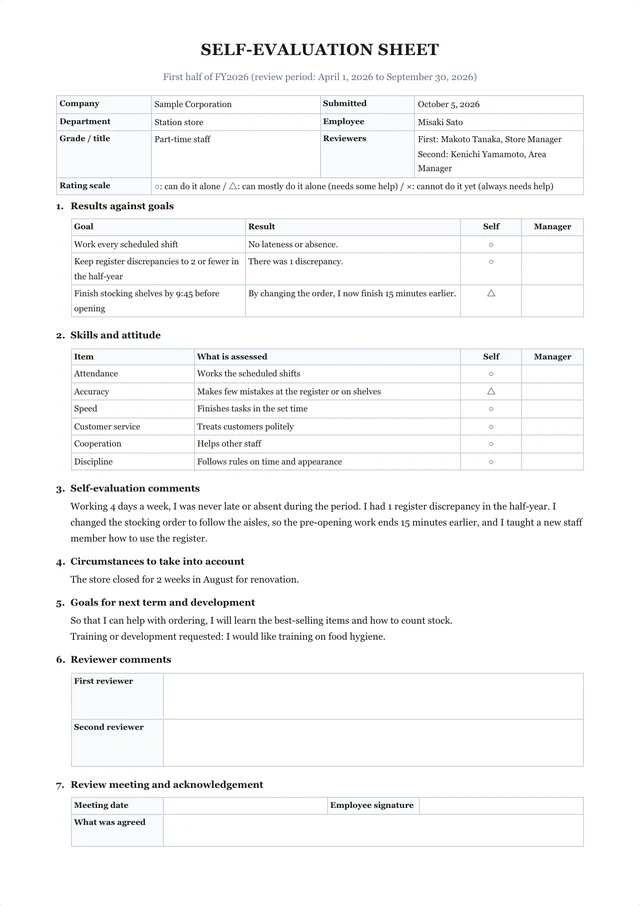
Working 4 days a week, I was never late or absent during the period. I had 1 register discrepancy in the half-year.
What I did
I changed the stocking order to follow the aisles, so the pre-opening work ends 15 minutes earlier, and I taught a new staff member how to use the register.
Next term
So that I can help with ordering, I will learn the best-selling items and how to count stock.
A part-timer's self-evaluation works best with facts on reliable attendance, few mistakes and helping others. Unlike the self-promotion section of a resume, write only what you did at work during the period.
Example 7: Manager
Self-evaluation (manager)
Result
Section sales reached 126 million yen against a target of 120 million yen (105%). 5 of my 6 team members reached their own targets.
What I did
I held a monthly one-on-one with every team member and switched to sharing deal progress weekly.
Next term
I will hand the allocation of deals to one supervisor and plan their development as the next leader.
Managers write their own results plus how they developed their team and what the team achieved.
Examples by item: communication, teamwork, initiative, responsibility
Self-evaluation (by item)
Communication
I gave other departments a reply date first and answered every question by then. I shared the decisions of each meeting in the minutes the same day.
Teamwork
In busy periods I took on data entry outside my role and helped the section meet its closing date.
Initiative
I noticed we were entering the same data twice and, on my own initiative, proposed to my manager a way to enter it only once.
Responsibility
When a project I owned was about to slip, I told my manager and the client three days ahead and set a new date.
For attitude items, write actions that show the attitude, not personality.
Examples for a missed goal or a quiet period
Self-evaluation (missed goal)
Missed goal
My goal was a first reply to every inquiry within 1 business day; I achieved it for 80% of inquiries. Replies slipped when requests piled up at month-end. Next term I will propose a month-end rota and reply to all within 1 business day.
No big results
This term was mostly routine work, but I prepared the payroll transfer data on time every month, with no errors. Next term I will update the procedure so others can cover it when I am away.
Put circumstances outside your control, such as a vacancy or a transfer, in the "circumstances to take into account" box, apart from your comment. The national civil service performance evaluation guide (National Personnel Authority and Cabinet Bureau of Personnel Affairs) also asks civil servants to state such facts in their self-report when a goal was missed for reasons not of their making.
Examples of goals for next term
Goals for next term
Improving work
By the end of March, switch order data entry from manual typing to CSV import and cut input time by 3 hours a week.
Skills
Pass the Nissho Bookkeeping Level 2 exam by December and take over the monthly closing entries on my own.
Developing others
As mentor to one new hire, get them handling calls and data entry on their own within 3 months.
Write what, by when, and to what level for next term's goals, so it is clear at the end of the period whether you reached them. The civil service evaluation guide likewise asks for goals specific enough to judge at the end of the period.
Examples of reviewer (manager) comments
Reviewer comment
Result checked
Cut invoice reissues from 6 to 1, and closed the books on time in all 6 months.
Reason for the rating
Far exceeded the goal of halving reissues and spread the check to the whole section, so the results rating is A.
Expectations
Next term, I look forward to the guide that will cut returned expense claims.
A reviewer's comment refers to the same facts as the self-evaluation and gives the reason for the rating.
What to avoid in a self-evaluation
Ways of writing to avoid in a self-evaluation, and ones that work
To avoid
Example
Works better
Feelings only
I worked really hard
I closed the books on time in all 6 months
Vague strengths
I valued teamwork
I took on data entry outside my role in busy periods
High rating without proof
I achieved more than anyone
I won 14 contracts against a target of 12
Regret only
I made many mistakes and I am sorry
I traced the cause of 2 errors and set up a check
Blaming others
We were short-staffed, so I missed it
A vacancy added to my work; I reached 80% of the goal
Do not write about events outside the review period. Last term's results were covered in last term's review.
Do not name colleagues, and leave out personal information about customers or residents.
Basics
What is a self-evaluation sheet? What goes in the employee's part of a review form
Key point
A self-evaluation sheet is the form on which the employee looks back on how far they reached their goals and how they worked during the review period, and gives ratings and comments. It feeds the manager's rating and is used to talk through differences in the review meeting.
Some companies call the employee's part of the performance review form (jinji koka hyo) the self-evaluation; others use a separate sheet. Either way, the content is the same: results against goals, a self-rating for each item, and the reasons. Describing the use of its job skills evaluation sheets, the Ministry of Health, Labour and Welfare also notes that when the employee and the manager each rate, their views can differ, and that discussing the gap in a meeting helps the employee notice and grow.
Results, skills and attitude ratings
Results, skills and attitude ratings, and what to write in a self-evaluation
Rating
What it looks at
What to write
Results (gyoseki)
Results in the period and how far goals were reached
Results against goals, in numbers
Skills (noryoku)
Knowledge and skills the job needs
What you learned and where you used it
Attitude (joi)
Responsibility, teamwork, initiative and other attitudes
Actions that show the attitude
Rating scales: five levels, or ○△×
Each company defines its five levels. The template uses these words.
The five rating levels and what they mean
Level
Meaning
S
Far exceeded expectations
A
Exceeded expectations
B
Met expectations
C
Slightly below expectations
D
Below expectations
The three-level ○△× scale is the one on the Ministry of Health, Labour and Welfare's job skills evaluation sheets: ○ can do it alone (including being able to teach others), △ can mostly do it alone (needs some help from seniors or colleagues), × cannot do it yet (always needs help). Choose it under "Rating scale" in the template.
Types
Types of evaluation sheets: self-evaluation sheet, performance review form and goal sheet
Evaluation sheets go by different names depending on who fills them in and what they are for.
Types of evaluation sheets, who fills them in, and what they are for
Sheet
Filled in by
Used for
Self-evaluation sheet
The employee
Looking back at the end of the period; input for the rating and the meeting
Performance review form (appraisal form)
The employee and the first and second reviewers
Recording the rating; used for pay rises, bonuses and promotions
Goal sheet (MBO)
The employee and the manager
Setting goals at the start and checking them at the end
The template on this page is a performance review form that puts the employee's self-evaluation and the manager's rating on one sheet. Change the title to use it as a self-evaluation sheet, a performance appraisal form or a goal sheet.
Who makes the evaluation sheet?
The company makes the form, and the employee fills in the self-evaluation part. A common setup has the first reviewer (the direct manager) rate, and the second reviewer (the manager above) check and adjust the first rating. A company with a single reviewer turns off "Second reviewer" in the template's last step.
If writing the rating items from scratch is hard, start from the items on the job skills evaluation sheets the Ministry of Health, Labour and Welfare publishes by job and level. The ministry itself says they work best customized to each company.
How to write it
How to write a self-evaluation: when to write it, in 5 steps
You write the self-evaluation at the end of the period, but collect the material from the start. In a six-month period, set goals at the start, keep records during the period, write the self-evaluation at the end, then move on to the manager's rating and the meeting. A performance appraisal self-evaluation follows the same steps.
Check the goals and rating items at the start
Check the goals set at the start of the period and the form's rating items and scale. If no goals were set, agree on them with your manager, including what counts as reaching each one.
Record facts and numbers during the period
Once a month, note facts you can use: counts, time, deadlines, errors, customer feedback. Written from memory at the end, a self-evaluation leans on the latest events.
Rate each item
Measure each goal and item against the criteria and give it S to D (or ○△×). When unsure, choose the level you can back up.
Write the comment as result, what you did, next step
Give the result in numbers, describe what you did yourself, and state next steps as concrete actions. Put circumstances outside your control (a transfer, a vacancy, a closure) in the "circumstances to take into account" box.
Save it as a PDF, submit it, and discuss it
Click "Download PDF" in the template above to turn the filled-in form into a PDF. After you submit it, discuss the gaps with your manager's rating and next term's goals in the review meeting.
Writing about work that is hard to measure
Even work without sales figures can be measured from five angles: volume, speed, accuracy, deadlines and improvement. For results you cannot count, write the change from before to after.
Angles and examples for putting numbers on work
Angle
Example numbers
Volume
Items processed, requests handled
Speed
Processing time, days to reply
Accuracy
Errors and returned items
Deadlines
Tasks finished on time
Improvement
Time or cost saved
Rating errors reviewers fall into
When a self-evaluation and the manager's rating differ, the cause can be on the reviewer's side too. The national civil service performance evaluation guide (National Personnel Authority and Cabinet Bureau of Personnel Affairs) lists the seven tendencies below and stresses leaving out subjective impressions and rating from a concrete, objective view.
Rating errors reviewers fall into, and how to avoid them
Tendency
What happens
How to avoid it
Halo effect
One impression, or the overall one, colors every item
Use each fact for one item only
Leniency
Ratings are too generous
Check the ratings against the criteria
Severity
Ratings are harsher than the criteria
As with leniency, check against the criteria
Central tendency
Most ratings land on "average"
Gather enough concrete facts before rating
Logical error
Related-looking items get the same rating
Be clear what each item measures
Contrast error
Rating against your own abilities
Rate on objective facts
Working back
Building the rating from the desired pay outcome
Leave pay aside and rate the actions
Source: National Personnel Authority and Cabinet Bureau of Personnel Affairs, performance evaluation guide (procedures for evaluators).
On the employee's side, writing down the facts of the period on the self-evaluation sheet keeps the manager from rating on end-of-period impressions alone.
What to write
What goes on a performance review form
A performance review form contains the ten items below. No law sets the format, but with these in place the employee's review and the manager's rating sit side by side on one sheet. The free template above follows the same order.
This template's field
Items on a performance review form, what to write, and the template field
Item
What to write
This templateTemplate field
Title and review period
Title, review period, submission date
Title and period
Employee
Department, name, grade or title
Employee fields
Reviewers
Titles and names of the first and second reviewers
Reviewer fields
Rating scale
The S to D or ○△× levels and what they mean
Rating scale
Results against goals
Goals set at the start, results, self-rating, manager rating
Results against goals
Skills and attitude
Rating items and what is assessed, self-rating, manager rating
Skills and attitude
Self-evaluation comments
The result, what you did, and the next step
Self-evaluation comments
Circumstances to take into account
Vacancies, transfers, closures and other things outside your control (optional)
Circumstances
Goals for next term
Goals you can judge at the end of the period, and training requested
Next term and development
Reviewer comments and meeting record
The managers' comments, meeting date, employee sign-off
Comments and meeting record
Performance review form sample and Word template
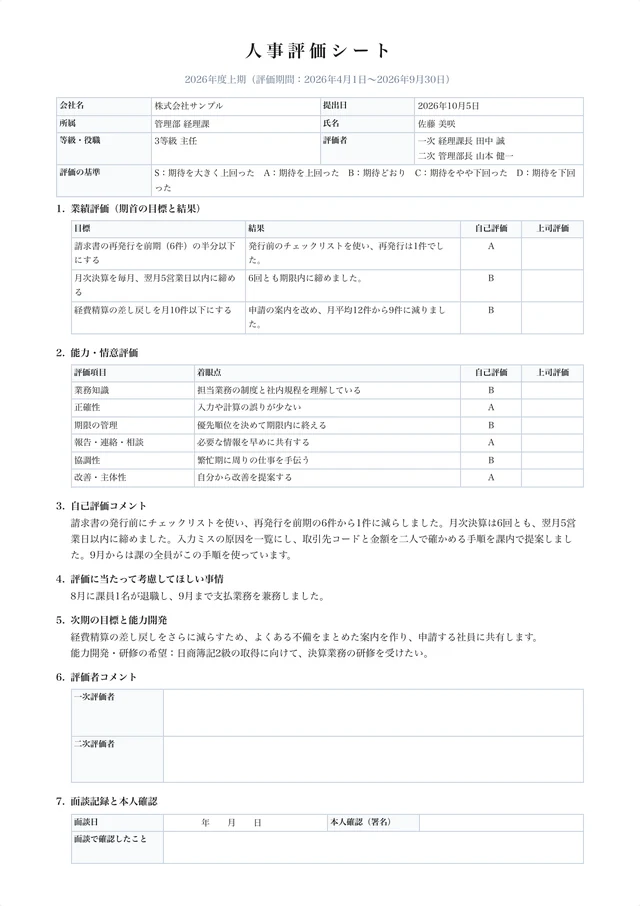
Below is a sample made with the template above (office administration, review period April 1 to September 30, 2026). To edit it in your own format, use the Word version.
A performance review form made with the template above: the self-ratings on results and on skills and attitude, the comments and next term's goals, plus the boxes for reviewer comments and the meeting record.
The Word version is a performance review form in English: replace the [ ] parts. Change the title to use it as a self-evaluation sheet or performance appraisal form. The sample PDF and the Word template ask for your email address.
Legal basis
Legal background and limits
No law requires private companies in Japan to run performance reviews. But there are rules to follow when reviews decide pay rises or bonuses, and when you review part-time and fixed-term staff.
Is evaluation required?National Public Service Act, Art. 70-3; Local Public Service Act, Art. 23-2
Public servants must by law be evaluated regularly, and the evaluation must be conducted fairly (National Public Service Act, Article 70-2; Local Public Service Act, Article 23). No such rule applies to private companies: each company sets its own system.
Rules for pay rises and bonusesLabor Standards Act, Art. 89
A workplace that regularly employs ten or more workers (part-timers included) must set out pay-rise rules in its work rules and file them, and the same goes for bonuses and other irregular wages if it has them. If reviews decide pay rises or bonuses, write that mechanism into the work rules or wage rules. Tell the employee about a raise with a salary increase notice and about a bonus with a bonus payment notice.
Pay of part-time and fixed-term staffPart-Time and Fixed-Term Employment Act, Art. 10
Employers must make efforts to set the pay of part-time and fixed-term staff with regard to their duties, results, motivation, skills or experience. Using an evaluation sheet for part-time staff too gives a record of what was taken into account.
Explaining conditionsSame Act, Art. 14(2) and Art. 6
When part-time or fixed-term staff ask, the employer must explain how their conditions differ from regular employees' and why, and what it took into account in setting them. On hiring, it must state in writing, such as in the employment contract or notice of conditions, whether there are pay rises and bonuses.
Bonuses and contributionEqual pay for equal work guidelines
Where a bonus rewards contribution to company results, part-time and fixed-term staff who contribute as much as regular staff must get the same bonus, and any difference must match the difference in contribution. The revised guidelines apply from October 1, 2026.
Reviews are not disciplineLabor Standards Act, Art. 89(9)
A performance review is not a disciplinary measure. Discipline is limited to the types and degrees set in the work rules. To ask for improvement on a performance problem, use a notice of guidance with targets and a deadline, separate from the review form.
FAQ
Self-evaluation and performance review FAQ
What are some self-evaluation examples for a performance review form?
The examples by job are in "Self-evaluation examples" above. For any job, write the result, what you did, and the next step. In an office role, for example, write the result in counts or deadlines: "I cut invoice reissues from 6 last term to 1."
What should I write on a performance review form?
Your results against the goals set at the start of the period, a self-rating for each item, and the reasons. Depending on the form, there are also boxes for next term's goals, training you would like, and circumstances to take into account. The items are listed in the table "What goes on a performance review form".
What is a performance review form?
A document that rates and records an employee's results, skills and attitude against the company's criteria. In Japan it is called jinji hyoka sheet or jinji koka hyo. A common layout puts the employee's self-evaluation next to the manager's rating, and the results are used for pay rises, bonuses, promotions and development.
What should I write in a performance appraisal?
The term jinji koka (performance appraisal) usually refers to the review that decides pay and promotion, and you write the same things as in a performance review. In your own part, show how far you reached each goal in numbers, then add what you did and your next steps. In the manager's part, write the result you checked, the reason for the rating, and what you expect next.
What are the three principles of performance appraisal?
No law sets out "three principles". Private-sector guides list fairness, objectivity, transparency and the like, and the list varies. The principle that is in law is that a public servant's performance evaluation "must be conducted fairly" (National Public Service Act, Article 70-2; Local Public Service Act, Article 23). In a company too, setting the criteria first, rating on facts, and telling the employee the result and the reasons is what makes it fair.
How do I write the self-evaluation on a performance appraisal form?
Rate each item and give the reason as facts. Write results in counts, deadlines, time or number of errors, what you did as your own actions, and next steps as concrete actions. Follow the five steps in "How to write a self-evaluation".
How do office staff write a performance appraisal?
Office work rarely has numbers like sales figures, so write results in counts, deadlines, time and number of errors. Showing the change in numbers works best: "closed the books on time in all 6 months", "cut returned claims from 4 to 1 a month". The examples are in "Example 1: Office administration".
Should I rate myself high?
Choose the rating you can back up. Too high and the gap with your manager's rating grows; too low and your results do not come across. When unsure, list how far you reached your goals and the facts, then pick the level whose description fits best.
How do I write it when I missed a goal?
Write the result, the cause, and the fix for next term, in that order. Leaving it blank or blaming only others hides what you learned. Circumstances outside your control, such as a vacancy or a transfer, go as facts in the "circumstances to take into account" box.
Why does my performance review feel unfair, and what can I do?
When the criteria and reasons are not shown, a gap with your self-evaluation is hard to accept. In the review meeting, ask which facts were measured against which criteria to reach the rating, and agree with your manager on what would raise it next term. On the company side, show the criteria at the start of the period and write the reasons on the form.
Do part-time staff need a self-evaluation sheet too?
It is not required by law, but it helps explain their pay and conditions. The Part-Time and Fixed-Term Employment Act asks employers to make an effort to set pay with regard to their duties, results, motivation, skills and experience (Article 10). The company must also explain, when the employee asks, what it took into account in setting their conditions (Article 14(2)). Choose "Part-time staff" in the template for part-time items and examples.
How long should a self-evaluation comment be?
There is no rule: write what fits the box. A good guide is three sentences: the result, what you did, and the next step. Check for numbers and actions rather than length.
What is a performance review form called in Japanese? Can foreign employees use it?
The performance review form is "jinji hyoka sheet" (人事評価シート), and the self-evaluation sheet is "jiko hyoka sheet" (自己評価シート). In this template, switch the preview to Japanese for the Japanese form, or keep it in English so foreign employees can fill in the same items.
Is the performance review form free? Is there an Excel version?
The template on this page is free: enter your email address to save the PDF and Word files. For an Excel format, the Ministry of Health, Labour and Welfare publishes free Excel "job skills evaluation sheets" (shokugyo noryoku hyoka sheet) by job and level.
DIY Hiring Kit
Everything You Need To Hire On Your Own
A downloadable hiring framework for small businesses in Japan, with step-by-step guides, spreadsheet ATS, LinkedIn scouting system, interview questions bank, offer letter and employment contracts, and a ton more!
1Dashboard11Checklists8Spreadsheets30Template docs4Weeks of Q&ABilingual
Download every file as Word, Google Docs, Excel or Google Sheets
Founder, SaiyouTeam · HR and recruiting advisor to SMBs in Japan
Former Google recruiter
14 years in recruiting
Emmanuel advises SMBs on HR and recruiting in Japan. Before founding SaiyouTeam, he spent 14 years in talent acquisition, including as a recruiter at Google. Clients often ask him how to run performance reviews, so he built this free template. Pick a job and the examples go in, so employees can start their self-evaluation without a blank page.
Important. This template and the examples show the general structure of a performance review form. Rating items, scales and how reviews feed pay rises and bonuses are set by each company's work rules and wage rules. The numbers in the examples are illustrations. Laws as of November 2026.




 14 years in recruiting