就業規則
株式会社サンプル
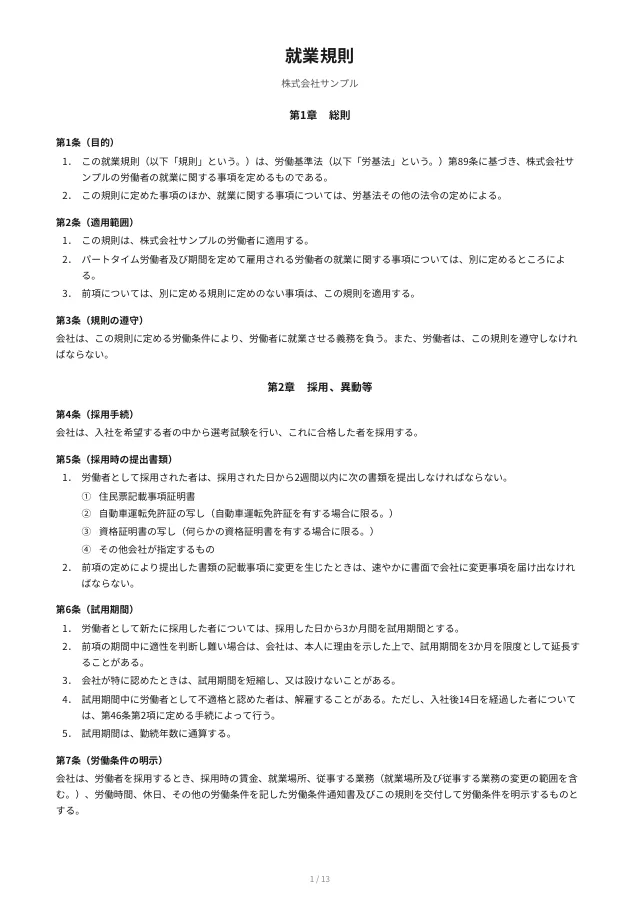
総則
目的
- この就業規則(以下「規則」という。)は、労働基準法(以下「労基法」という。)第89条に基づき、株式会社サンプルの労働者の就業に関する事項を定めるものである。
- この規則に定めた事項のほか、就業に関する事項については、労基法その他の法令の定めによる。
適用範囲
- この規則は、株式会社サンプルの労働者に適用する。
- パートタイム労働者及び期間を定めて雇用される労働者の就業に関する事項については、別に定めるところによる。
- 前項については、別に定める規則に定めのない事項は、この規則を適用する。
規則の遵守
会社は、この規則に定める労働条件により、労働者に就業させる義務を負う。また、労働者は、この規則を遵守しなければならない。
採用、異動等
採用手続
会社は、入社を希望する者の中から選考試験を行い、これに合格した者を採用する。
採用時の提出書類
- 労働者として採用された者は、採用された日から2週間以内に次の書類を提出しなければならない。
- 住民票記載事項証明書
- 自動車運転免許証の写し(自動車運転免許証を有する場合に限る。)
- 資格証明書の写し(何らかの資格証明書を有する場合に限る。)
- その他会社が指定するもの
- 前項の定めにより提出した書類の記載事項に変更を生じたときは、速やかに書面で会社に変更事項を届け出なければならない。
採用
- 会社は、入社を希望する者の中から選考を行い、これに合格した者を採用する。
- 採用された者は、採用された日から2週間以内に、住民票記載事項証明書その他会社が指定する書類を提出しなければならない。提出した書類の記載事項に変更を生じたときは、速やかに会社に届け出なければならない。
試用期間
- 労働者として新たに採用した者については、採用した日から3か月間を試用期間とする。
- 前項の期間中に適性を判断し難い場合は、会社は、本人に理由を示した上で、試用期間を3か月を限度として延長することがある。
- 会社が特に認めたときは、試用期間を短縮し、又は設けないことがある。
- 試用期間中に労働者として不適格と認めた者は、解雇することがある。ただし、入社後14日を経過した者については、第46条第2項に定める手続によって行う。
- 試用期間は、勤続年数に通算する。
労働条件の明示
会社は、労働者を採用するとき、採用時の賃金、就業場所、従事する業務(就業場所及び従事する業務の変更の範囲を含む。)、労働時間、休日、その他の労働条件を記した労働条件通知書及びこの規則を交付して労働条件を明示するものとする。
人事異動
- 会社は、業務上必要がある場合に、労働者に対して就業する場所及び従事する業務の変更を命ずることがある。
- 会社は、業務上必要がある場合に、労働者を在籍のまま関係会社へ出向させることがある。
- 前2項の場合、労働者は正当な理由なくこれを拒むことはできない。
休職
- 労働者が、次のいずれかに該当するときは、所定の期間休職とする。
- 業務外の傷病による欠勤が1か月を超え、なお療養を継続する必要があるため勤務できないとき 6か月以内
- 前号のほか、特別な事情があり休職させることが適当と認められるとき 必要な期間
- 会社は、休職の要否及び復職の可否を判断するため、医師の診断書の提出を求めることがある。
- 休職期間中に休職事由が消滅したときは、原則として元の職務に復帰させる。ただし、元の職務に復帰させることが困難又は不適当な場合には、他の職務に就かせることがある。
- 第1項第1号により休職し、休職期間が満了してもなお傷病が治癒せず就業が困難な場合は、休職期間の満了をもって退職とする。
服務規律
服務
労働者は、職務上の責任を自覚し、誠実に職務を遂行するとともに、会社の指示命令に従い、職務能率の向上及び職場秩序の維持に努めなければならない。
遵守事項
- 労働者は、以下の事項を守らなければならない。
- 許可なく職務以外の目的で会社の施設、物品等を使用しないこと。
- 職務に関連して自己の利益を図り、又は他より不当に金品を借用し、若しくは贈与を受ける等不正な行為を行わないこと。
- 勤務中は職務に専念し、正当な理由なく勤務場所を離れないこと。
- 会社の名誉や信用を損なう行為をしないこと。
- 在職中及び退職後においても、業務上知り得た会社、取引先等の機密を漏洩しないこと。
- 酒気を帯びて就業しないこと。
- その他労働者としてふさわしくない行為をしないこと。
服務規律
- 労働者は、職務上の責任を自覚し、誠実に職務を遂行するとともに、会社の指示命令に従い、職場秩序の維持に努めなければならない。
- 労働者は、次の事項を守らなければならない。
- 許可なく職務以外の目的で会社の施設、物品等を使用しないこと。
- 職務に関連して不当に金品を受けるなど、不正な行為を行わないこと。
- 勤務中は職務に専念し、正当な理由なく勤務場所を離れないこと。
- 在職中及び退職後においても、業務上知り得た会社、取引先等の機密を漏洩しないこと。
- 業務上知り得た個人情報を、業務以外の目的で使用しないこと。
- 会社の名誉や信用を損なう行為をしないこと。
職場のパワーハラスメントの禁止
職務上の地位や人間関係などの職場内の優越的な関係を背景とした、業務上必要かつ相当な範囲を超えた言動により、他の労働者の就業環境を害するようなことをしてはならない。
セクシュアルハラスメントの禁止
- 性的言動により、他の労働者に不利益や不快感を与えたり、就業環境を害するようなことをしてはならない。
- 労働者は、求職者その他の会社の労働者以外の者に対しても、前項の言動をしてはならない。
妊娠・出産・育児休業・介護休業等に関するハラスメントの禁止
妊娠・出産等に関する言動及び妊娠・出産・育児・介護等に関する制度又は措置の利用に関する言動により、他の労働者の就業環境を害するようなことをしてはならない。
その他あらゆるハラスメントの禁止
前3条に規定するもののほか、性的指向・性自認に関する言動によるものなど職場におけるあらゆるハラスメントにより、他の労働者の就業環境を害するようなことをしてはならない。
ハラスメントの禁止
- 労働者は、次の言動により、他の労働者の就業環境を害するようなことをしてはならない。
- 職場内の優越的な関係を背景とした、業務上必要かつ相当な範囲を超えた言動(パワーハラスメント)
- 性的な言動(セクシュアルハラスメント)
- 妊娠・出産等に関する言動及び妊娠・出産・育児・介護等に関する制度又は措置の利用に関する言動
- 性的指向・性自認に関する言動その他職場におけるあらゆるハラスメント
- 労働者は、求職者その他の会社の労働者以外の者に対しても、性的な言動により不利益や不快感を与えてはならない。
顧客等の言動への対応(カスタマーハラスメント)
- 会社は、顧客、取引の相手方、施設の利用者その他の会社の事業に関係を有する者(以下「顧客等」という。)の言動であって、労働者が従事する業務の性質その他の事情に照らして社会通念上許容される範囲を超えたものにより、労働者の就業環境が害されること(以下「カスタマーハラスメント」という。)には毅然とした態度で対応し、労働者を保護する。
- 労働者は、カスタマーハラスメントを受けたときは、速やかに上司その他の管理監督者に報告し、その場の対応について指示を受けるものとする。会社は、可能な限り労働者を一人で対応させないものとし、犯罪に該当し得る言動については警察に通報する。
- 会社は、特に悪質なカスタマーハラスメントについては、法令の範囲内において、当該顧客等に対する商品の販売又はサービスの提供の中止その他必要な措置を講ずる。
- 労働者は、取引先その他の他の事業主が雇用する労働者に対し、業務の性質その他の事情に照らして社会通念上許容される範囲を超えた言動をしてはならない。
ハラスメントの相談
- 第12条から第16条まで前2条に定めるハラスメントに関する相談及び苦情の窓口は、人事部とする。相談窓口の担当者は、相談者のプライバシーを保護し、相談に適切に対応する。
- 会社は、相談を受けた場合には、事実関係を迅速かつ正確に確認し、被害を受けた労働者に対する配慮のための措置及び再発防止のための措置を講ずる。
- 会社は、労働者が相談をしたこと、事実関係の確認に協力したこと、又は都道府県労働局に相談等をしたことを理由として、解雇その他不利益な取扱いをしない。
- ハラスメントに該当する言動を行った労働者に対しては、第59条に基づき、厳正に対処する。
個人情報保護
- 労働者は、会社及び取引先等に関する情報の管理に十分注意を払うとともに、自らの業務に関係のない情報を不当に取得してはならない。
- 労働者は、職場又は職種を異動あるいは退職するに際して、自らが管理していた会社及び取引先等に関するデータ・情報書類等を速やかに返却しなければならない。
始業及び終業時刻の記録
労働者は、始業及び終業の時刻を、勤怠管理システムにより自ら記録しなければならない。
遅刻、早退、欠勤等
- 労働者は遅刻、早退若しくは欠勤をし、又は勤務時間中に私用で事業場から外出する際は、事前に所属長に対し申し出るとともに、承認を受けなければならない。ただし、やむを得ない理由で事前に申し出ることができなかった場合は、事後に速やかに届出をし、承認を得なければならない。
- 前項の場合は、第38条に定めるところにより、原則として不就労分に対応する賃金は控除する。
- 傷病のため継続して4日以上欠勤するときは、医師の診断書を提出しなければならない。
労働時間、休憩及び休日
労働時間及び休憩時間
- 所定労働時間は、1週間については40時間、1日については8時間とする。
- 1週間の所定労働時間は、2026年12月1日を起算日として、2週間ごとに平均して、1週間当たり40時間以内とする。1日の所定労働時間は、8時間とする。
- 始業・終業の時刻及び休憩時間は、次のとおりとする。ただし、業務の都合その他やむを得ない事情により、これらを繰り上げ、又は繰り下げることがある。この場合、前日までに労働者に通知する。
- 始業 午前9時
- 終業 午後6時
- 休憩時間 正午から午後1時まで
- 労働者の始業及び終業の時刻は、労働者の自主的決定に委ねるものとする。ただし、始業時刻につき労働者の自主的決定に委ねる時間帯は午前7時から午前10時まで、終業時刻につき労働者の自主的決定に委ねる時間帯は午後3時から午後7時までとする。
- 午前10時から午後3時までの間(休憩時間を除く。)については、所属長の承認のない限り、所定の労働に従事しなければならない。
- 清算期間は1か月とし、毎月1日を起算日とする。清算期間中に労働すべき総労働時間は、8時間に清算期間中の所定労働日数を乗じて得た時間とする。
- 標準となる1日の労働時間は、8時間とする。休憩時間は、正午から午後1時までとする。
- 前各項に定めるもののほか、フレックスタイム制の運用については、労働者代表と締結する労使協定の定めるところによる。
休日
- 休日は、次のとおりとする。
- 土曜日及び日曜日
- 国民の祝日(日曜日と重なったときは翌日)
- 年末年始(12月29日から1月3日まで)
- 夏季休日(8月13日から8月16日まで)
- その他会社が指定する日
- 休日は、次のとおりとする。
- 日曜日
- 2026年12月1日を起算日とする2週間ごとの第2土曜日
- 国民の祝日(日曜日と重なったときは翌日)
- 年末年始(12月29日から1月3日まで)
- 夏季休日(8月13日から8月16日まで)
- その他会社が指定する日
- 前項の休日のうち、法定休日は日曜日とする。
- 業務の都合により会社が必要と認める場合は、あらかじめ第1項の休日を他の日と振り替えることがある。
時間外及び休日労働等
- 業務の都合により、第21条の所定労働時間を超え、又は第22条の所定休日に労働させることがある。
- 前項の場合、法定労働時間を超える労働又は法定休日における労働については、あらかじめ会社は労働者の過半数代表者と書面による労使協定を締結するとともに、これを所轄の労働基準監督署長に届け出るものとする。
- 妊娠中の女性、産後1年を経過しない女性労働者(以下「妊産婦」という。)であって請求した者及び18歳未満の者については、第2項による時間外労働又は休日若しくは深夜(午後10時から午前5時まで)労働に従事させない。
- 災害その他避けることのできない事由によって臨時の必要がある場合には、第1項から前項までの制限を超えて、所定労働時間外又は休日に労働させることがある。ただし、この場合であっても、請求のあった妊産婦については、所定労働時間外労働又は休日労働に従事させない。
勤務間インターバル
- いかなる場合も、労働者ごとに1日の勤務終了後、次の勤務の開始までに少なくとも、11時間の継続した休息時間を与える。ただし、災害その他避けることができない場合は、この限りではない。
- 前項の休息時間の満了時刻が、次の勤務の所定始業時刻以降に及ぶ場合、当該始業時刻から満了時刻までの時間は労働したものとみなす。
休暇等
年次有給休暇
- 採用日から6か月間継続勤務し、所定労働日の8割以上出勤した労働者に対しては、10日の年次有給休暇を与える。その後1年間継続勤務するごとに、当該1年間において所定労働日の8割以上出勤した労働者に対しては、下の表のとおり勤続期間に応じた日数の年次有給休暇を与える。
| 勤続期間 | 6か月 | 1年6か月 | 2年6か月 | 3年6か月 | 4年6か月 | 5年6か月 | 6年6か月以上 |
|---|
| 付与日数 | 10日 | 11日 | 12日 | 14日 | 16日 | 18日 | 20日 |
|---|
- 前項の規定にかかわらず、週所定労働時間30時間未満であり、かつ、週所定労働日数が4日以下(週以外の期間によって所定労働日数を定める労働者については年間所定労働日数が216日以下)の労働者に対しては、下の表のとおり所定労働日数及び勤続期間に応じた日数の年次有給休暇を与える。
| 週所定労働日数(1年間の所定労働日数) | 6か月 | 1年6か月 | 2年6か月 | 3年6か月 | 4年6か月 | 5年6か月 | 6年6か月以上 |
|---|
| 4日(169日~216日) | 7日 | 8日 | 9日 | 10日 | 12日 | 13日 | 15日 |
|---|
| 3日(121日~168日) | 5日 | 6日 | 6日 | 8日 | 9日 | 10日 | 11日 |
|---|
| 2日(73日~120日) | 3日 | 4日 | 4日 | 5日 | 6日 | 6日 | 7日 |
|---|
| 1日(48日~72日) | 1日 | 2日 | 2日 | 2日 | 3日 | 3日 | 3日 |
|---|
- 週所定労働時間30時間未満であり、かつ、週所定労働日数が4日以下の労働者に対しては、労基法第39条第3項に定める日数の年次有給休暇を与える。
- 年次有給休暇は、労働者があらかじめ請求する時季に取得させる。ただし、労働者が請求した時季に年次有給休暇を取得させることが事業の正常な運営を妨げる場合は、他の時季に取得させることがある。
- 前項の規定にかかわらず、労働者代表との書面による協定により、各労働者の有する年次有給休暇日数のうち5日を超える部分について、あらかじめ時季を指定して取得させることがある。
- 年次有給休暇が10日以上与えられた労働者に対しては、第3項の規定にかかわらず、付与日から1年以内に、当該労働者の有する年次有給休暇日数のうち5日について、会社が労働者の意見を聴取し、その意見を尊重した上で、あらかじめ時季を指定して取得させる。ただし、労働者が自ら請求し、又は前項の規定により年次有給休暇を取得した場合においては、当該取得した日数分を5日から控除するものとする。
- 第1項の出勤率の算定に当たっては、年次有給休暇を取得した期間、産前産後の休業期間、育児・介護休業法に基づく育児休業及び介護休業した期間並びに業務上の負傷又は疾病により療養のために休業した期間は出勤したものとして取り扱う。
- 付与日から1年以内に取得しなかった年次有給休暇は、付与日から2年以内に限り繰り越して取得することができる。繰り越された年次有給休暇とその後付与された年次有給休暇のいずれも取得できる場合には、繰り越された年次有給休暇から取得させる。
- 会社は、毎月の賃金計算締切日における年次有給休暇の残日数を、当該賃金の支払明細書に記載して各労働者に通知する。
年次有給休暇の時間単位での付与
- 労働者代表との書面による協定に基づき、前条の年次有給休暇の日数のうち、1年について5日の範囲で、時間単位の年次有給休暇(以下「時間単位年休」という。)を付与する。
- 時間単位年休を取得する場合の、1日の年次有給休暇に相当する時間数は、8時間とする。時間単位年休は1時間単位で付与する。
- 時間単位年休に支払われる賃金額は、所定労働時間労働した場合に支払われる通常の賃金の1時間当たりの額に、取得した時間単位年休の時間数を乗じた額とする。
- 時間単位年休には、前条第4項及び第5項の規定は適用しない。
産前産後の休業
- 6週間(多胎妊娠の場合は14週間)以内に出産予定の女性労働者から請求があったときは、休業させる。
- 産後8週間を経過していない女性労働者は、就業させない。
- 前項の規定にかかわらず、産後6週間を経過した女性労働者から請求があった場合は、その者について医師が支障ないと認めた業務に就かせることがある。
母性健康管理の措置
- 妊娠中又は出産後1年を経過しない女性労働者から、所定労働時間内に、母子保健法に基づく保健指導又は健康診査を受けるために申出があったときは、次の範囲で時間内通院を認める。
- 産前の場合 妊娠23週までは4週に1回、妊娠24週から35週までは2週に1回、妊娠36週から出産までは1週に1回。ただし、医師又は助産師(以下「医師等」という。)がこれと異なる指示をしたときには、その指示により必要な時間
- 産後(1年以内)の場合 医師等の指示により必要な時間
- 妊娠中又は出産後1年を経過しない女性労働者から、保健指導又は健康診査に基づき勤務時間等について医師等の指導を受けた旨申出があった場合、通勤緩和、休憩時間の延長、作業の軽減、勤務時間の短縮、休業等、医師等の指導事項を遵守するための措置を講ずる。
育児時間及び生理休暇
- 1歳に満たない子を養育する女性労働者から請求があったときは、休憩時間のほか1日について2回、1回について30分の育児時間を与える。
- 生理日の就業が著しく困難な女性労働者から請求があったときは、必要な期間休暇を与える。
母性保護
- 妊娠中又は出産後1年を経過しない女性労働者から申出があったときは、母子保健法に基づく保健指導又は健康診査を受けるための時間を確保し、医師又は助産師の指導事項を守るために必要な措置を講ずる。
- 1歳に満たない子を養育する女性労働者から請求があったときは、休憩時間のほか1日について2回、1回について30分の育児時間を与える。
- 生理日の就業が著しく困難な女性労働者から請求があったときは、必要な期間休暇を与える。
育児・介護休業、子の看護等休暇等
- 労働者のうち必要のある者は、育児・介護休業法に基づく育児休業、出生時育児休業、介護休業、子の看護等休暇、介護休暇、育児・介護のための所定外労働、時間外労働及び深夜業の制限並びに所定労働時間の短縮措置等(以下「育児・介護休業等」という。)の適用を受けることができる。
- 育児・介護休業等の取扱いについては、別に定める「育児・介護休業等に関する規則」による。
不妊治療休暇
- 労働者が不妊治療のための休暇を請求したときは、年5日を限度に休暇を与える。
- 労働者が不妊治療のための休業を請求したときは、休業開始日の属する事業年度(毎年4月1日から翌年3月31日まで)を含む引き続く5事業年度の期間において、最長1年間を限度に休業することができる。
慶弔休暇
- 労働者が申請した場合は、次のとおり慶弔休暇を与える。
- 本人が結婚したとき 5日
- 配偶者が出産したとき 2日
- 配偶者、子又は父母が死亡したとき 5日
- 兄弟姉妹、祖父母、配偶者の父母又は兄弟姉妹が死亡したとき 2日
裁判員等のための休暇等
- 労働者が裁判員若しくは補充裁判員となった場合又は裁判員候補者となった場合には、次のとおり休暇を与える。
- 裁判員又は補充裁判員となった場合 必要な日数
- 裁判員候補者となった場合 必要な時間
- 労働者が国又は地方公共団体の議会の議員の選挙において候補者となった場合には、選挙運動の期間につき、選挙運動のために必要な日数の休暇を与える。
賃金
賃金の構成
- 賃金の構成は、次のとおりとする。
- 基本給
- 手当 通勤手当、役付手当
- 割増賃金 時間外労働割増賃金、休日労働割増賃金、深夜労働割増賃金
基本給
基本給は、本人の職務内容、技能、勤務成績、年齢等を考慮して各人別に決定する。
通勤手当
通勤手当は、月額50,000円までの範囲内において、通勤に要する実費に相当する額を支給する。
役付手当
- 役付手当は、次の職位にある者に対し支給する。
部長 月額50,000円
課長 月額30,000円
係長 月額10,000円
- 昇格によるときは、発令日の属する賃金月から支給する。この場合、当該賃金月においてそれまで属していた役付手当は支給しない。
- 降格によるときは、発令日の属する賃金月の次の賃金月から支給する。
資格手当
資格手当は、次の資格を持ち、その職務に就く者に対し支給する。
衛生管理者 月額10,000円
家族手当
家族手当は、次の家族を扶養している労働者に対し支給する。
18歳未満の子 1人につき月額10,000円
賃金の構成及び手当
- 賃金は、基本給、手当及び割増賃金とする。基本給は、本人の職務内容、技能、勤務成績等を考慮して各人別に決定する。
- 通勤手当は、月額50,000円までの範囲内において、通勤に要する実費に相当する額を支給する。
- 役付手当は、次の職位にある者に対し支給する。
部長 月額50,000円
課長 月額30,000円
係長 月額10,000円
- 資格手当は、次の資格を持ち、その職務に就く者に対し支給する。
衛生管理者 月額10,000円
- 家族手当は、次の家族を扶養している労働者に対し支給する。
18歳未満の子 1人につき月額10,000円
割増賃金
- 時間外労働、休日労働及び深夜労働に対しては、次の割増賃金率により割増賃金を支給する。
- 時間外労働(法定労働時間を超える労働) 1か月60時間以下の部分は25%、1か月60時間を超える部分は50%。この場合の1か月は、賃金計算期間の初日を起算日とする。
- 休日労働(法定休日における労働) 35%
- 深夜労働(午後10時から午前5時までの労働) 25%
- 割増賃金は、次の算式により計算して支給する。
- 時間外労働 (基本給+役付手当)÷1か月の平均所定労働時間数×1.25(1か月60時間を超える部分は1.50)×時間外労働の時間数
- 休日労働 (基本給+役付手当)÷1か月の平均所定労働時間数×1.35×休日労働の時間数
- 深夜労働 (基本給+役付手当)÷1か月の平均所定労働時間数×0.25×深夜労働の時間数
- 前項の1か月の平均所定労働時間数は、次の算式により計算する。(365-年間所定休日日数)×1日の所定労働時間÷12
- 所定労働時間を超え、法定労働時間以内の労働については、通常の労働時間の賃金を支払う。
- フレックスタイム制が適用される労働者については、清算期間における実労働時間のうち、法定労働時間の総枠を超えた時間を時間外労働とする。
休暇等の賃金
- 年次有給休暇の期間は、所定労働時間労働したときに支払われる通常の賃金を支払う。慶弔休暇の期間も同様とする。
- 産前産後の休業、母性健康管理のための休暇、育児時間、生理休暇、育児・介護休業等、不妊治療休暇及び裁判員等のための休暇の期間は、無給とする。
- 第9条に定める休職期間中は、賃金を支給しない。
臨時休業の賃金
会社側の都合により、所定労働日に労働者を休業させた場合は、休業1日につき労基法第12条に規定する平均賃金の6割を支給する。この場合において、1日のうちの一部を休業させた場合にあっては、その日の賃金については労基法第26条に定めるところにより、平均賃金の6割に相当する賃金を保障する。
欠勤等の扱い
- 欠勤、遅刻、早退及び私用外出については、基本給から当該日数又は時間分の賃金を控除する。
- 前項の場合、控除すべき賃金の1時間あたりの金額は、基本給÷1か月平均所定労働時間数とする(1か月平均所定労働時間数は第35条第3項の算式により計算する。)。
賃金の計算期間及び支払日
- 賃金は、毎月末日に締め切って計算し、翌月25日に支払う。ただし、支払日が休日に当たる場合は、その前日に繰り上げて支払う。
- 前項の計算期間の中途で採用された労働者又は退職した労働者については、月額の賃金は当該計算期間の所定労働日数を基準に日割計算して支払う。
賃金の支払と控除
- 賃金は、労働者に対し、通貨で直接その全額を支払う。
- 前項について、労働者が同意した場合は、労働者本人の指定する金融機関の預貯金口座又は証券総合口座へ振込により賃金を支払う。
- 次に掲げるものは、賃金から控除する。
- 源泉所得税
- 住民税
- 健康保険、厚生年金保険及び雇用保険の保険料の被保険者負担分
- 労働者代表との書面による協定により賃金から控除することとしたもの
賃金の非常時払い
- 労働者又はその収入によって生計を維持する者が、次のいずれかの場合に該当し、そのために労働者から請求があったときは、賃金支払日前であっても、既往の労働に対する賃金を支払う。
- やむを得ない事由によって1週間以上帰郷する場合
- 結婚又は死亡の場合
- 出産、疾病又は災害の場合
- 退職又は解雇により離職した場合
昇給
- 昇給は、勤務成績その他が良好な労働者について、毎年4月1日をもって行うものとする。ただし、会社の業績の著しい低下その他やむを得ない事由がある場合は、行わないことがある。
- 顕著な業績が認められた労働者については、前項の規定にかかわらず昇給を行うことがある。
- 昇給額は、労働者の勤務成績等を考慮して各人ごとに決定する。
- 定期の昇給は行わない。基本給の改定は、会社の業績及び労働者の勤務成績等を考慮して、必要に応じて各人ごとに行う。
賞与
- 賞与は、原則として、毎年6月及び12月の支給日に在籍する労働者に対し、会社の業績等を勘案して支給する。ただし、会社の業績の著しい低下その他やむを得ない事由により、支給時期を延期し、又は支給しないことがある。
- 前項の賞与の額は、会社の業績及び労働者の勤務成績などを考慮して各人ごとに決定する。
定年、退職及び解雇
定年等
- 労働者の定年は、満60歳とし、定年に達した日の属する月の末日をもって退職とする。
- 前項の規定にかかわらず、定年後も引き続き雇用されることを希望し、解雇事由又は退職事由に該当しない労働者については、満65歳までこれを継続雇用する。
- 労働者の定年は、満65歳とし、定年に達した日の属する月の末日をもって退職とする。
- 前項の規定にかかわらず、定年後も引き続き雇用されることを希望し、解雇事由又は退職事由に該当しない労働者については、満70歳までこれを継続雇用する。
- 労働者の定年は、満70歳とし、定年に達した日の属する月の末日をもって退職とする。
退職
- 前条に定めるもののほか、労働者が次のいずれかに該当するときは、退職とする。
- 退職を願い出て会社が承認したとき、又は退職届を提出して14日を経過したとき
- 期間を定めて雇用されている場合、その期間を満了したとき
- 第9条に定める休職期間が満了し、なお休職事由が消滅しないとき
- 死亡したとき
- 労働者が自己の都合により退職しようとするときは、業務の引継ぎのため、原則として退職予定日の30日前までに申し出るよう努めなければならない。
- 労働者が退職し、又は解雇された場合、その請求に基づき、使用期間、業務の種類、地位、賃金又は退職の事由を記載した証明書を遅滞なく交付する。
解雇
- 労働者が次のいずれかに該当するときは、解雇することがある。
- 勤務状況が著しく不良で、改善の見込みがなく、労働者としての職責を果たし得ないとき。
- 勤務成績又は業務能率が著しく不良で、向上の見込みがなく、他の職務にも転換できない等就業に適さないとき。
- 業務上の負傷又は疾病による療養の開始後3年を経過しても当該負傷又は疾病が治らない場合であって、労働者が傷病補償年金を受けているとき又は受けることとなったとき(会社が打ち切り補償を支払ったときを含む。)。
- 精神又は身体の障害により業務に耐えられないとき。
- 試用期間における作業能率又は勤務態度が著しく不良で、労働者として不適格であると認められたとき。
- 第59条第2項に定める懲戒解雇事由に該当する事実が認められたとき。
- 事業の運営上又は天災事変その他これに準ずるやむを得ない事由により、事業の縮小又は部門の閉鎖等を行う必要が生じ、かつ他の職務への転換が困難なとき。
- その他前各号に準ずるやむを得ない事由があったとき。
- 前項の規定により労働者を解雇する場合は、少なくとも30日前に予告をする。予告しないときは、平均賃金の30日分以上の手当を解雇予告手当として支払う。ただし、予告の日数については、解雇予告手当を支払った日数だけ短縮することができる。
- 前項の規定は、労働基準監督署長の認定を受けて労働者を第58条第1項第4号に定める懲戒解雇にする場合又は次の各号のいずれかに該当する労働者を解雇する場合は適用しない。
- 日々雇い入れられる労働者(ただし、1か月を超えて引き続き使用されるに至った者を除く。)
- 2か月以内の期間を定めて使用する労働者(ただし、その期間を超えて引き続き使用されるに至った者を除く。)
- 試用期間中の労働者(ただし、14日を超えて引き続き使用されるに至った者を除く。)
- 第1項の規定による労働者の解雇に際して労働者から請求のあった場合は、解雇の理由を記載した証明書を交付する。
退職金
退職金
- 会社は、労働者について、中小企業退職金共済法に基づき、独立行政法人勤労者退職金共済機構との間に退職金共済契約を締結する。ただし、試用期間中の者については、試用期間を経過した後に契約を締結する。
- 退職金は、同機構から労働者(死亡による退職の場合はその遺族)に直接支給する。
- 退職金の額は、中小企業退職金共済法及び同機構の定めるところにより算定した額とする。
退職金の支給
- 労働者が退職し又は解雇されたときは、この章に定めるところにより退職金を支給する。ただし、第59条第2項により懲戒解雇された者には、退職金の全部又は一部を支給しないことがある。
- 継続雇用制度の対象者については、定年時に退職金を支給することとし、その後の再雇用については退職金を支給しない。
退職金の額
- 退職金の額は、退職又は解雇の時の基本給の額に、勤続年数に応じて定めた下表の支給率を乗じた金額とする。
| 勤続年数 | 5年未満 | 5年~10年 | 11年~15年 | 16年~20年 | 21年~25年 | 26年~30年 | 31年~35年 | 36年~40年 | 41年~ |
|---|
| 支給率 | 1.0 | 3.0 | 5.0 | 7.0 | 10.0 | 15.0 | 17.0 | 20.0 | 25.0 |
|---|
- 第9条により休職する期間については、会社の都合による場合を除き、前項の勤続年数に算入しない。
退職金の支払方法及び支払時期
退職金は、支給事由の生じた日から2か月以内に、退職した労働者(死亡による退職の場合はその遺族)に対して支払う。
退職金
退職金の支給の対象となる労働者の範囲、退職金の決定、計算及び支払の方法並びに退職金の支払の時期は、別に定める退職金規程による。
無期労働契約への転換
無期労働契約への転換
- 期間の定めのある労働契約(有期労働契約)で雇用する労働者のうち、通算契約期間が5年を超える労働者は、別に定める様式で申し込むことにより、現在締結している有期労働契約の契約期間の末日の翌日から、期間の定めのない労働契約(無期労働契約)での雇用に転換することができる。
- 前項の通算契約期間は、平成25年4月1日以降に開始する有期労働契約の契約期間を通算するものとする。ただし、契約期間満了に伴う退職等により、労働契約が締結されていない期間が連続して6か月以上ある労働者については、それ以前の契約期間は通算契約期間に含めない。
- この規則に定める労働条件は、第1項の規定により無期労働契約での雇用に転換した後も引き続き適用する。ただし、無期労働契約へ転換した時の年齢が、第44条に規定する定年年齢を超えていた場合は、当該労働者に係る定年は、満65歳とし、定年に達した日の属する月の末日をもって退職とする。
安全衛生及び災害補償
遵守事項
- 会社は、労働者の安全衛生の確保及び改善を図り、快適な職場の形成のために必要な措置を講ずる。
- 労働者は、安全衛生に関する法令及び会社の指示を守り、会社と協力して労働災害の防止に努めなければならない。
- 労働者は安全衛生の確保のため、特に下記の事項を遵守しなければならない。
- 機械設備、工具等の就業前点検を徹底すること。また、異常を認めたときは、速やかに会社に報告し、指示に従うこと。
- 安全装置を取り外したり、その効力を失わせるようなことはしないこと。
- 保護具の着用が必要な作業については、必ず着用すること。
- 20歳未満の者は、喫煙可能な場所には立ち入らないこと。
- 受動喫煙を望まない者を喫煙可能な場所に連れて行かないこと。
- 立入禁止又は通行禁止区域には立ち入らないこと。
- 常に整理整頓に努め、通路、避難口又は消火設備のある所に物品を置かないこと。
- 火災等非常災害の発生を発見したときは、直ちに臨機の措置をとり、所属長に報告し、その指示に従うこと。
健康診断
- 労働者に対しては、採用の際及び毎年1回(深夜労働に従事する者は6か月ごとに1回)、定期に健康診断を行う。
- 前項の健康診断のほか、法令で定められた有害業務に従事する労働者に対しては、特別の項目について、定期に健康診断を行う。
- 第1項及び前項の健康診断の結果必要と認めるときは、一定期間の就業禁止、労働時間の短縮、配置転換その他健康保持上必要な措置を命ずることがある。
安全衛生及び健康診断
- 会社は、労働者の安全衛生の確保及び改善を図るために必要な措置を講ずる。労働者は、安全衛生に関する法令及び会社の指示を守り、会社と協力して労働災害の防止に努めなければならない。
- 労働者に対しては、採用の際及び毎年1回(深夜労働に従事する者は6か月ごとに1回)、定期に健康診断を行う。健康診断の結果必要と認めるときは、労働時間の短縮、配置転換その他健康保持上必要な措置を命ずることがある。
- 会社は、労働者に対し、雇入れの際及び作業内容を変更した場合、その従事する業務に必要な安全及び衛生に関する教育を行う。
- 会社は、労働者の心身の状態に関する情報を適正に取り扱う。
長時間労働者に対する面接指導
- 会社は、労働者の労働時間の状況を把握する。
- 長時間の労働により疲労の蓄積が認められる労働者に対し、その者の申出により医師による面接指導を行う。
- 前項の面接指導の結果必要と認めるときは、一定期間の就業禁止、労働時間の短縮、配置転換その他健康保持上必要な措置を命ずることがある。
ストレスチェック
- 労働者に対しては、毎年1回、定期に、医師、保健師等による心理的な負担の程度を把握するための検査(ストレスチェック)を行う。
- 前項のストレスチェックの結果、ストレスが高く、面接指導が必要であると医師、保健師等が認めた労働者に対し、その者の申出により医師による面接指導を行う。
- 前項の面接指導の結果必要と認めるときは、就業場所の変更、作業の転換、労働時間の短縮、深夜業の回数の減少等、必要な措置を命ずることがある。
労働者の心身の状態に関する情報の適正な取扱い
会社は、労働者の心身の状態に関する情報を適正に取り扱う。
安全衛生教育
- 労働者に対し、雇入れの際及び配置換え等により作業内容を変更した場合、その従事する業務に必要な安全及び衛生に関する教育を行う。
- 労働者は、安全衛生教育を受けた事項を遵守しなければならない。
災害補償
労働者が業務上の事由又は通勤により負傷し、疾病にかかり、又は死亡した場合は、労基法及び労働者災害補償保険法に定めるところにより災害補償を行う。
職業訓練
教育訓練
- 会社は、業務に必要な知識、技能を高め、資質の向上を図るため、労働者に対し、必要な教育訓練を行う。
- 労働者は、会社から教育訓練を受講するよう指示された場合には、特段の事由がない限り教育訓練を受けなければならない。
- 前項の指示は、教育訓練開始日の少なくとも1週間前までに該当労働者に対し文書で通知する。
表彰及び制裁
表彰
- 会社は、労働者が次のいずれかに該当するときは、表彰することがある。
- 業務上有益な発明、考案を行い、会社の業績に貢献したとき。
- 永年にわたって誠実に勤務し、その成績が優秀で他の模範となるとき。
- 永年にわたり無事故で継続勤務したとき。
- 社会的功績があり、会社及び労働者の名誉となったとき。
- 前各号に準ずる善行又は功労のあったとき。
- 表彰は、原則として会社の創立記念日に行う。また、賞状のほか賞金を授与する。
懲戒の種類
- 会社は、労働者が次条のいずれかに該当する場合は、その情状に応じ、次の区分により懲戒を行う。
- けん責 始末書を提出させて将来を戒める。
- 減給 始末書を提出させて減給する。ただし、減給は1回の額が平均賃金の1日分の5割を超えることはなく、また、総額が1賃金支払期における賃金総額の1割を超えることはない。
- 出勤停止 始末書を提出させるほか、7日間を限度として出勤を停止し、その間の賃金は支給しない。
- 懲戒解雇 予告期間を設けることなく即時に解雇する。この場合において、所轄の労働基準監督署長の認定を受けたときは、解雇予告手当(平均賃金の30日分)を支給しない。
懲戒の事由
- 労働者が次のいずれかに該当するときは、情状に応じ、けん責、減給又は出勤停止とする。
- 正当な理由なく無断欠勤が3日以上に及ぶとき。
- 正当な理由なくしばしば欠勤、遅刻、早退をしたとき。
- 過失により会社に損害を与えたとき。
- 素行不良で社内の秩序及び風紀を乱したとき。
- 第11条、第12条から第16条まで第条、第条、第16条第4項に違反したとき。
- その他この規則に違反し又は前各号に準ずる不都合な行為があったとき。
- 労働者が次のいずれかに該当するときは、懲戒解雇とする。ただし、平素の服務態度その他情状によっては、第46条に定める普通解雇、前条に定める減給又は出勤停止とすることがある。
- 重要な経歴を詐称して雇用されたとき。
- 正当な理由なく無断欠勤が14日以上に及び、出勤の督促に応じなかったとき。
- 正当な理由なく無断でしばしば遅刻、早退又は欠勤を繰り返し、3回にわたって注意を受けても改めなかったとき。
- 正当な理由なく、しばしば業務上の指示・命令に従わなかったとき。
- 故意又は重大な過失により会社に重大な損害を与えたとき。
- 会社内において刑法その他刑罰法規の各規定に違反する行為を行い、その犯罪事実が明らかとなったとき(当該行為が軽微な違反である場合を除く。)。
- 素行不良で著しく社内の秩序又は風紀を乱したとき。
- 数回にわたり懲戒を受けたにもかかわらず、なお、勤務態度等に関し、改善の見込みがないとき。
- 第12条から第16条まで第条又は第16条第4項に違反し、その情状が悪質と認められるとき。
- 許可なく職務以外の目的で会社の施設、物品等を使用したとき。
- 職務上の地位を利用して私利を図り、又は取引先等より不当な金品を受け、若しくは求め若しくは供応を受けたとき。
- 私生活上の非違行為や会社に対する正当な理由のない誹謗中傷等であって、会社の名誉信用を損ない、業務に重大な悪影響を及ぼす行為をしたとき。
- 正当な理由なく会社の業務上重要な秘密を外部に漏洩して会社に損害を与え、又は業務の正常な運営を阻害したとき。
- その他前各号に準ずる不適切な行為があったとき。
公益通報者保護
公益通報者の保護
- 会社は、労働者から組織的又は個人的な法令違反行為等に関する相談又は通報があった場合には、別に定めるところにより処理を行う。
- 会社は、前項の相談又は通報をしたことを理由として、労働者に対して解雇その他不利益な取扱いをしない。
副業・兼業
副業・兼業
- 労働者は、勤務時間外において、他の会社等の業務に従事することができる。
- 会社は、労働者からの前項の業務に従事する旨の届出に基づき、当該労働者が当該業務に従事することにより次の各号のいずれかに該当する場合には、これを禁止又は制限することができる。
- 労務提供上の支障がある場合
- 企業秘密が漏洩する場合
- 会社の名誉や信用を損なう行為や、信頼関係を破壊する行為がある場合
- 競業により、企業の利益を害する場合
- 労働者は、勤務時間外において、会社の許可を得て、他の会社等の業務に従事することができる。
- 会社は、労働者が前項の業務に従事することにより次の各号のいずれかに該当する場合には、許可しないことがある。
- 労務提供上の支障がある場合
- 企業秘密が漏洩する場合
- 会社の名誉や信用を損なう行為や、信頼関係を破壊する行為がある場合
- 競業により、企業の利益を害する場合
- 副業・兼業を行う労働者は、副業・兼業先での労働時間その他会社が求める事項を会社に報告しなければならない。
附則
(施行期日)
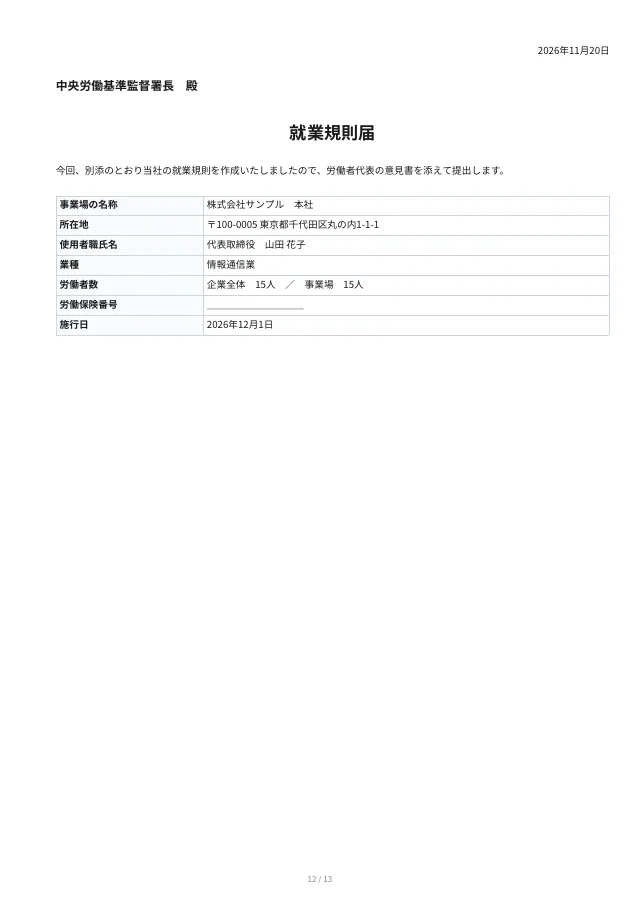
第1条 この規則は、2026年12月1日から施行する。
RULES OF EMPLOYMENT
Sample Corporation: English translation of the Japanese rules of employment (就業規則); the Japanese version prevails.
General Provisions
Purpose
- These rules of employment (the "Rules") set out the matters concerning the work of the workers of Sample Corporation under Article 89 of the Labor Standards Act (the "Act").
- Matters concerning work that are not set out in these Rules are governed by the Act and other laws and regulations.
Scope of Application
- These Rules apply to the workers of Sample Corporation.
- Matters concerning the work of part-time workers and workers employed for a fixed term are set out separately.
- For the workers in the preceding paragraph, these Rules apply to any matter not provided for in the separate rules.
Compliance with the Rules
The Company is obliged to have workers work under the working conditions set out in these Rules. Workers shall comply with these Rules.
Hiring and Transfers
Hiring Procedures
The Company selects applicants through a selection process and hires those who pass it.
Documents to Be Submitted at Hiring
- A person hired as a worker shall submit the following documents within 2 weeks of the hiring date.
- A certificate of the matters in the resident register
- A copy of the driving license (only if the person has one)
- Copies of qualification certificates (only if the person has any)
- Any other documents the Company specifies
- If any matter in the documents submitted under the preceding paragraph changes, the worker shall promptly notify the Company of the change in writing.
Hiring
- The Company selects applicants and hires those who pass the selection.
- A person hired shall submit a certificate of the matters in the resident register and any other documents the Company specifies within 2 weeks of the hiring date, and shall promptly notify the Company of any change in them.
Probationary Period
- A newly hired worker serves a probationary period of 3 months from the hiring date.
- If the worker's suitability cannot be judged within that period, the Company may, after explaining the reason to the worker, extend the probationary period by up to 3 months.
- The Company may shorten or waive the probationary period where it sees fit.
- A worker found unsuitable during the probationary period may be dismissed. For a worker who has been employed for more than 14 days, the procedure in Article 46, paragraph 2 applies.
- The probationary period counts toward the length of service.
Statement of Working Conditions
When hiring a worker, the Company states the working conditions by giving the worker a written statement of working conditions, covering wages at hiring, the place of work, the duties (including the scope of possible changes to the place of work and duties), working hours, days off and other conditions, together with these Rules.
Personnel Transfers
- The Company may order a worker to change the place of work or duties when business needs require it.
- The Company may second a worker to an affiliated company, while the worker remains employed by the Company, when business needs require it.
- In the cases of the preceding two paragraphs, a worker may not refuse without a justifiable reason.
Leave of Absence
- A worker who falls under either of the following is placed on leave of absence for the period stated.
- Absence due to a non-work-related injury or illness has exceeded 1 month(s), and the worker cannot work because further treatment is needed: up to 6 months
- Any other special circumstance in which leave of absence is found appropriate: the period needed
- The Company may require a medical certificate to decide whether leave of absence is needed and whether the worker can return.
- When the reason for leave ends during the leave period, the worker returns to the original duties in principle. If that is difficult or inappropriate, the worker may be assigned to other duties.
- If a worker on leave under paragraph 1, item 1 has not recovered and cannot work when the leave period ends, the worker retires at the end of the leave period.
Responsibilities
Responsibilities
Workers shall be aware of their responsibilities, perform their duties in good faith, follow the Company's instructions and orders, and strive to improve work efficiency and maintain order in the workplace.
Compliance Provisions
- Workers shall comply with the following.
- Not to use the Company's facilities or goods for purposes other than work without permission.
- Not to seek personal gain in connection with their duties, or to borrow or accept money or goods improperly from others, or commit any other dishonest act.
- To devote themselves to their duties during working hours and not to leave the place of work without a justifiable reason.
- Not to act in a way that damages the Company's reputation or credibility.
- Not to disclose, during or after employment, any confidential information of the Company or its business partners learned in the course of work.
- Not to work under the influence of alcohol.
- Not to commit any other act unbecoming of a worker.
Responsibilities and Compliance
- Workers shall be aware of their responsibilities, perform their duties in good faith, follow the Company's instructions and orders, and strive to maintain order in the workplace.
- Workers shall comply with the following.
- Not to use the Company's facilities or goods for purposes other than work without permission.
- Not to accept money or goods improperly in connection with their duties, or commit any other dishonest act.
- To devote themselves to their duties during working hours and not to leave the place of work without a justifiable reason.
- Not to disclose, during or after employment, any confidential information of the Company or its business partners.
- Not to use personal information learned in the course of work for any other purpose.
- Not to act in a way that damages the Company's reputation or credibility.
Prohibition of Power Harassment at the Workplace
Workers shall not harm the working environment of other workers through words or conduct that exceed what is necessary and appropriate for work, taking advantage of a superior position in the workplace such as job title or personal relationships.
Prohibition of Sexual Harassment
- Workers shall not cause other workers disadvantage or discomfort, or harm their working environment, through sexual words or conduct.
- Workers shall not engage in the conduct in the preceding paragraph toward job applicants or any other persons who are not workers of the Company.
Prohibition of Harassment Related to Pregnancy, Childbirth, Childcare Leave and Family Care Leave
Workers shall not harm the working environment of other workers through words or conduct concerning pregnancy or childbirth, or the use of systems or measures for pregnancy, childbirth, childcare or family care.
Prohibition of All Other Harassment
In addition to the preceding three articles, workers shall not harm the working environment of other workers through any other harassment in the workplace, including words or conduct concerning sexual orientation or gender identity.
Prohibition of Harassment
- Workers shall not harm the working environment of other workers through any of the following.
- Words or conduct that exceed what is necessary and appropriate for work, taking advantage of a superior position in the workplace (power harassment)
- Sexual words or conduct (sexual harassment)
- Words or conduct concerning pregnancy or childbirth, or the use of systems for pregnancy, childbirth, childcare or family care
- Words or conduct concerning sexual orientation or gender identity, and any other harassment in the workplace
- Workers shall not cause job applicants or other persons who are not workers of the Company disadvantage or discomfort through sexual words or conduct.
Response to Customer Harassment
- The Company responds firmly to, and protects workers from, words or conduct of customers, business partners, facility users or any other persons connected with the Company's business ("Customers") that exceed what is socially acceptable in light of the nature of the worker's duties and other circumstances and harm the worker's working environment ("Customer Harassment").
- A worker who experiences Customer Harassment shall promptly report it to a supervisor or other manager and follow their instructions on how to respond. The Company does not, as far as possible, have a worker respond alone, and reports words or conduct that may constitute a crime to the police.
- For especially serious Customer Harassment, the Company takes the necessary measures within the limits of the law, including ceasing to sell goods or provide services to the Customers concerned.
- Workers shall not engage in words or conduct toward workers employed by business partners or other employers that exceed what is socially acceptable in light of the nature of the work and other circumstances.
Consultation on Harassment
- The point of contact for consultations and complaints concerning the harassment set out in Articles 12 to 16the preceding two articles is the Human Resources Department. The staff in charge protect the privacy of the person consulting and handle the consultation appropriately.
- On receiving a consultation, the Company promptly and accurately confirms the facts and takes measures to support the affected worker and to prevent recurrence.
- The Company does not dismiss or otherwise treat a worker disadvantageously because the worker consulted, cooperated in confirming the facts, or consulted a Prefectural Labor Bureau.
- A worker who engages in words or conduct constituting harassment is dealt with strictly under Article 59.
Protection of Personal Information
- Workers shall take due care in managing information concerning the Company and its business partners and shall not improperly obtain information unrelated to their own work.
- When transferring to another workplace or job, or leaving the Company, workers shall promptly return all data and documents concerning the Company and its business partners that they managed.
Recording the Start and End Times of Work
Workers shall record their own start and end times of work using the attendance management system.
Late Arrival, Leaving Early and Absence
- A worker who arrives late, leaves early, is absent, or leaves the workplace for private reasons during working hours shall notify the head of their department in advance and obtain approval. If advance notice is impossible for an unavoidable reason, the worker shall notify the department head promptly afterwards and obtain approval.
- In the cases of the preceding paragraph, wages for the time not worked are deducted in principle as set out in Article 38.
- A worker absent for 4 or more consecutive days due to injury or illness shall submit a medical certificate.
Working Hours, Rest Periods and Days Off
Working Hours and Break Times
- Scheduled working hours are 40 hours a week and 8 hours a day.
- Scheduled weekly working hours average no more than 40 hours a week over each two-week period counted from December 1, 2026. Scheduled daily working hours are 8 hours.
- The start and end times of work and the break time are as follows. They may be moved earlier or later for business reasons or other unavoidable circumstances, in which case workers are notified by the previous day.
- Start of work: 9:00 a.m.
- End of work: 6:00 p.m.
- Break time: 12:00 noon to 1:00 p.m.
- The start and end times of work are left to each worker's own decision. The worker may choose the start time between 7:00 a.m. and 10:00 a.m. and the end time between 3:00 p.m. and 7:00 p.m. each day.
- Between 10:00 a.m. and 3:00 p.m. (excluding the break time), workers shall work unless the head of their department approves otherwise.
- The settlement period is one month, starting on the 1st of each month. The total working hours for the settlement period are 8 hours multiplied by the number of scheduled working days in the period.
- The standard working hours for one day are 8 hours. The break time runs from 12:00 noon to 1:00 p.m. each day.
- Other matters concerning the flextime system are governed by the labor-management agreement concluded with the workers' representative.
Days Off
- Days off are as follows.
- Saturdays and Sundays
- National holidays (the following day when a holiday falls on a Sunday)
- Year-end and New Year holidays (December 29 to January 3)
- Summer holidays (August 13 to August 16)
- Other days the Company designates
- Days off are as follows.
- Sundays
- The second Saturday of each two-week period counted from December 1, 2026
- National holidays (the following day when a holiday falls on a Sunday)
- Year-end and New Year holidays (December 29 to January 3)
- Summer holidays (August 13 to August 16)
- Other days the Company designates
- Of the days off in the preceding paragraph, Sunday is the statutory day off.
- When the Company finds it necessary for business reasons, it may, in advance, swap a day off in paragraph 1 for another day.
Overtime and Work on Days Off
- For business reasons, the Company may have workers work beyond the scheduled working hours in Article 21 or on the days off in Article 22.
- For work beyond the statutory working hours or on the statutory day off, the Company concludes in advance a written labor-management agreement with the representative of the majority of workers and files it with the competent Labor Standards Inspection Office.
- Pregnant women and women within one year after childbirth ("expectant and nursing mothers") who so request, and workers under 18, are not required to work overtime, on days off or late at night (10:00 p.m. to 5:00 a.m.) under paragraph 2.
- When there is a temporary need due to a disaster or other unavoidable cause, the Company may have workers work outside scheduled hours or on days off beyond the limits in paragraphs 1 to 3. Even then, expectant and nursing mothers who so request are not required to work overtime or on days off.
Work Interval
- In every case, each worker is given a continuous rest period of at least 11 hours between the end of one day's work and the start of the next, except in a disaster or other unavoidable case.
- If the rest period in the preceding paragraph ends after the scheduled start time of the next day's work, the time from that start time to the end of the rest period is deemed to have been worked.
Leave
Annual Paid Leave
- A worker who has worked continuously for six months from the hiring date and attended at least 80% of the scheduled working days is granted 10 days of annual paid leave. For each further year of continuous service in which the worker attends at least 80% of the scheduled working days, the worker is granted the number of days below according to length of service.
| Length of service | 6 mo. | 1 yr 6 mo. | 2 yr 6 mo. | 3 yr 6 mo. | 4 yr 6 mo. | 5 yr 6 mo. | 6 yr 6 mo. + |
|---|
| Days granted | 10 | 11 | 12 | 14 | 16 | 18 | 20 |
|---|
- Notwithstanding the preceding paragraph, a worker whose scheduled weekly working hours are under 30 and who is scheduled to work four days a week or less (216 days a year or less where working days are set other than by the week) is granted the number of days below according to scheduled working days and length of service.
| Days per week (days per year) | 6 mo. | 1 yr 6 mo. | 2 yr 6 mo. | 3 yr 6 mo. | 4 yr 6 mo. | 5 yr 6 mo. | 6 yr 6 mo. + |
|---|
| 4 (169 to 216) | 7 | 8 | 9 | 10 | 12 | 13 | 15 |
|---|
| 3 (121 to 168) | 5 | 6 | 6 | 8 | 9 | 10 | 11 |
|---|
| 2 (73 to 120) | 3 | 4 | 4 | 5 | 6 | 6 | 7 |
|---|
| 1 (48 to 72) | 1 | 2 | 2 | 2 | 3 | 3 | 3 |
|---|
- A worker whose scheduled weekly working hours are under 30 and who is scheduled to work four days a week or less is granted the number of days of annual paid leave set by Article 39, paragraph 3 of the Act.
- Annual paid leave is taken at the time the worker requests in advance. If leave at that time would disrupt the normal operation of the business, the Company may have the worker take it at another time.
- Notwithstanding the preceding paragraph, by written agreement with the workers' representative, the Company may designate in advance the timing of the leave days each worker holds beyond five days.
- For a worker granted 10 or more days of annual paid leave, the Company, after hearing and respecting the worker's views, designates in advance the timing of five of those days, to be taken within one year of the grant date. Days the worker has taken on request or under the preceding paragraph are deducted from the five days.
- In calculating the attendance rate in paragraph 1, periods of annual paid leave, maternity leave, childcare and family care leave under the Child Care and Family Care Leave Act, and leave for treatment of a work-related injury or illness are treated as days attended.
- Annual paid leave not taken within one year of the grant date may be carried over and taken until two years after the grant date. Where both carried-over and newly granted leave are available, the carried-over leave is used first.
- The Company notifies each worker of the remaining days of annual paid leave as of each wage closing date on the pay statement.
Granting Annual Paid Leave by the Hour
- Under a written agreement with the workers' representative, up to five days a year of the annual paid leave in the preceding article may be granted by the hour ("hourly leave").
- For hourly leave, one day of annual paid leave equals 8 hours. Hourly leave is granted in units of one hour.
- Wages for hourly leave are the hourly amount of the normal wages paid for working the scheduled hours, multiplied by the hours of leave taken.
- Paragraphs 4 and 5 of the preceding article do not apply to hourly leave.
Maternity Leave
- A female worker due to give birth within six weeks (14 weeks for a multiple pregnancy) is granted leave on request.
- A female worker within eight weeks after childbirth is not permitted to work.
- Notwithstanding the preceding paragraph, a female worker more than six weeks after childbirth may, on request, be assigned to work that a doctor finds will not harm her.
Measures to Maintain Mothers' Health
- When a female worker who is pregnant or within one year after childbirth applies to receive health guidance or a health examination under the Maternal and Child Health Act during scheduled working hours, the Company allows hospital visits during working hours as follows.
- Before childbirth: once every four weeks up to week 23 of pregnancy, once every two weeks from week 24 to 35, and once a week from week 36 until childbirth; if a doctor or midwife ("doctor") instructs otherwise, the time needed under that instruction
- After childbirth (within one year): the time needed under the doctor's instruction
- When such a female worker reports that a doctor has given guidance on her working hours or other matters based on health guidance or an examination, the Company takes measures to follow that guidance, such as easing commuting, extending breaks, reducing work, shortening working hours or granting leave.
Childcare Time and Menstrual Leave
- A female worker raising a child under one year old is granted, on request, childcare time of 30 minutes twice a day in addition to break time.
- A female worker for whom work on days of menstruation is extremely difficult is granted leave for the period needed on request.
Maternity Protection
- On application by a female worker who is pregnant or within one year after childbirth, the Company secures time for health guidance or examinations under the Maternal and Child Health Act and takes the measures needed to follow the instructions of a doctor or midwife.
- A female worker raising a child under one year old is granted, on request, childcare time of 30 minutes twice a day in addition to break time.
- A female worker for whom work on days of menstruation is extremely difficult is granted leave for the period needed on request.
Childcare and Family Care Leave
- Workers who need them may use childcare leave, postnatal paternity leave, family care leave, sick/school-event leave for children, family care days off, limits on non-scheduled work, overtime and late-night work for childcare and family care, reduced working hours and other measures under the Child Care and Family Care Leave Act ("childcare and family care leave").
- Childcare and family care leave is governed by the separate "Rules on Childcare and Family Care Leave".
Fertility Treatment Leave
- A worker who requests leave for fertility treatment is granted up to 5 days of leave a year.
- A worker who requests time off for fertility treatment may take up to one year of leave within the five consecutive business years (April 1 to March 31) that include the business year in which the leave begins.
Congratulatory and Condolence Leave
- On application, workers are granted congratulatory and condolence leave as follows.
- The worker's own marriage: 5 days
- Childbirth by the worker's spouse: 2 days
- Death of the worker's spouse, child or parent: 5 days
- Death of the worker's sibling or grandparent, or the spouse's parent or sibling: 2 days
Leave for Jury Duty and Election Candidacy
- A worker who becomes a lay judge or substitute lay judge, or a lay judge candidate, is granted leave as follows.
- As a lay judge or substitute lay judge: the days needed
- As a lay judge candidate: the time needed
- A worker who becomes a candidate in an election for the national Diet or a local assembly is granted the days of leave needed for campaigning during the election campaign period.
Wages
Components of Wages
- Wages consist of the following.
- Base salary
- Allowances: commuting allowance and position allowance
- Premium wages: premium wages for overtime work, work on days off and late-night work
Base Salary
Base salary is decided individually, taking into account the worker's duties, skills, performance, age and other factors.
Commuting Allowance
A commuting allowance equal to the actual cost of commuting is paid, up to ¥50,000 a month.
Position Allowance
- A position allowance is paid to workers in the following positions:
General manager: ¥50,000 a month
Manager: ¥30,000 a month
Supervisor: ¥10,000 a month
- On promotion, the allowance is paid from the wage month that includes the date of appointment, and the previous position allowance is not paid for that month.
- On demotion, the new allowance is paid from the wage month after the one that includes the date of appointment.
Qualification Allowance
A qualification allowance is paid to workers who hold the following qualifications and perform the related duties:
Health officer: ¥10,000 a month
Family Allowance
A family allowance is paid to workers who support the following family members:
Each child under 18: ¥10,000 a month
Components of Wages and Allowances
- Wages consist of base salary, allowances and premium wages. Base salary is decided individually, taking into account the worker's duties, skills, performance and other factors.
- A commuting allowance equal to the actual cost of commuting is paid, up to ¥50,000 a month.
- A position allowance is paid to workers in the following positions:
General manager: ¥50,000 a month
Manager: ¥30,000 a month
Supervisor: ¥10,000 a month
- A qualification allowance is paid to workers who hold the following qualifications and perform the related duties:
Health officer: ¥10,000 a month
- A family allowance is paid to workers who support the following family members:
Each child under 18: ¥10,000 a month
Premium Wages
- Premium wages are paid for overtime work, work on days off and late-night work at the following rates.
- Overtime work (work beyond the statutory working hours): 25% for up to 60 hours a month and 50% for hours beyond 60 a month; the month starts on the first day of each wage calculation period
- Work on the statutory day off: 35%
- Late-night work (10:00 p.m. to 5:00 a.m.): 25%
- Premium wages are calculated as follows.
- Overtime: (base salary + position allowance) ÷ average scheduled working hours per month × 1.25 (1.50 for hours beyond 60 a month) × hours of overtime
- Work on the statutory day off: (base salary + position allowance) ÷ average scheduled working hours per month × 1.35 × hours worked
- Late-night work: (base salary + position allowance) ÷ average scheduled working hours per month × 0.25 × hours of late-night work
- The average scheduled working hours per month in the preceding paragraph are calculated as: (365 − annual scheduled days off) × scheduled daily working hours ÷ 12.
- Work beyond the scheduled working hours but within the statutory working hours is paid at the normal hourly wage.
- For workers under the flextime system, hours actually worked in a settlement period beyond the total statutory working hours for the period are treated as overtime.
Wages for Leave
- For annual paid leave, the normal wages paid for working the scheduled hours are paid. The same applies to congratulatory and condolence leave.
- Maternity leave, leave for maternal health care, childcare time, menstrual leave, childcare and family care leave, fertility treatment leave and leave for jury duty and election candidacy are unpaid.
- No wages are paid during leave of absence under Article 9.
Wages during Temporary Closure
If the Company has a worker stay off work on a scheduled working day for reasons attributable to the Company, it pays 60% of the average wage under Article 12 of the Act for each day. If the worker is kept off for part of a day, wages of at least 60% of the average wage are guaranteed for that day under Article 26 of the Act.
Deductions for Absence
- For absence, late arrival, leaving early and private outings, wages for the days or hours concerned are deducted from base salary.
- The hourly amount to be deducted is base salary ÷ average scheduled working hours per month (calculated by the formula in Article 35, paragraph 3).
Wage Calculation Period and Payday
- Wages are calculated up to the last day of each month and paid on the 25th of the following month. If payday falls on a day off, wages are paid on the preceding day.
- For a worker who joins or leaves partway through a calculation period, monthly wages are prorated by the scheduled working days in that period.
Payment and Deductions of Wages
- Wages are paid directly to the worker, in currency and in full.
- With the worker's consent, wages are paid by transfer to a savings account or securities account at a financial institution the worker designates.
- The following are deducted from wages.
- Withholding income tax
- Resident tax
- The insured person's share of health insurance, employees' pension insurance and employment insurance premiums
- Items agreed to be deducted from wages in a written agreement with the workers' representative
Emergency Payment of Wages
- If the worker or a person supported by the worker's income falls under any of the following and the worker requests it for that reason, wages for work already done are paid even before payday.
- Returning home for one week or more for an unavoidable reason
- Marriage or death
- Childbirth, illness or disaster
- Leaving employment by resignation or dismissal
Wage Increase
- Wage increases are given on April 1 each year to workers with good performance and conduct. They may not be given if the Company's results decline significantly or for other unavoidable reasons.
- A worker with outstanding results may receive a wage increase notwithstanding the preceding paragraph.
- The amount of each increase is decided individually, taking into account the worker's performance and other factors.
- There is no regular wage increase. Base salary is revised individually as needed, taking into account the Company's results and the worker's performance.
Bonus
- Bonuses are paid in principle each year in June and December to workers employed on the payment date, taking into account the Company's results. Payment may be postponed or withheld if the Company's results decline significantly or for other unavoidable reasons.
- The amount of each bonus is decided individually, taking into account the Company's results and the worker's performance.
Retirement Age, Resignation and Dismissal
Retirement Age
- The retirement age is 60. A worker retires at the end of the month in which the worker reaches that age.
- Notwithstanding the preceding paragraph, a worker who wishes to continue working after the retirement age and does not fall under any ground for dismissal or retirement is kept in continued employment until age 65.
- The retirement age is 65. A worker retires at the end of the month in which the worker reaches that age.
- Notwithstanding the preceding paragraph, a worker who wishes to continue working after the retirement age and does not fall under any ground for dismissal or retirement is kept in continued employment until age 70.
- The retirement age is 70. A worker retires at the end of the month in which the worker reaches that age.
Resignation and Retirement
- In addition to the preceding article, a worker retires in any of the following cases.
- The worker applies to resign and the Company approves, or 14 days have passed since the worker submitted a notice of resignation
- For a fixed-term worker, the term expires
- The leave period under Article 9 ends and the reason for leave remains
- The worker dies
- A worker who intends to resign for personal reasons shall endeavor, in principle, to give notice at least 30 days before the intended date, so that work can be handed over.
- When a worker leaves or is dismissed, the Company issues without delay, on request, a certificate stating the period of employment, type of work, position, wages or reason for leaving.
Dismissal
- A worker may be dismissed in any of the following cases.
- The worker's attendance and conduct are extremely poor, with no prospect of improvement, and the worker cannot fulfil the responsibilities of a worker.
- The worker's performance or efficiency is extremely poor, with no prospect of improvement, and the worker is unfit for work, for example because a transfer to other duties is not possible.
- A work-related injury or illness has not healed three years after treatment began, and the worker receives or becomes entitled to an injury and disease compensation pension (including where the Company has paid a lump-sum compensation).
- The worker cannot perform the work because of a mental or physical disability.
- The worker's efficiency or attitude during the probationary period is extremely poor and the worker is found unsuitable.
- Facts falling under the grounds for disciplinary dismissal in Article 59, paragraph 2 are found.
- The business must be reduced or a department closed for operational reasons, a natural disaster or a similar unavoidable cause, and a transfer to other duties is difficult.
- Any other unavoidable reason equivalent to the above.
- When dismissing a worker under the preceding paragraph, the Company gives at least 30 days' notice, or pays at least 30 days' average wages as an allowance in lieu of notice. The notice period may be shortened by the number of days for which the allowance is paid.
- The preceding paragraph does not apply to a disciplinary dismissal under Article 58, paragraph 1, item 4 approved by the Labor Standards Inspection Office, or to the dismissal of any of the following.
- Workers hired on a daily basis (except those employed continuously for more than one month)
- Workers employed for a fixed term of two months or less (except those employed beyond that term)
- Workers on probation (except those employed for more than 14 days)
- When a worker dismissed under paragraph 1 requests it, the Company issues a certificate stating the reason for dismissal.
Severance Pay
Severance Pay
- The Company concludes a retirement allowance mutual aid contract for workers with the Organization for Workers' Retirement Allowance Mutual Aid under the Smaller Enterprise Retirement Allowance Mutual Aid Act. For workers on probation, the contract is concluded after the probationary period.
- Severance pay is paid directly by the Organization to the worker (or to the bereaved family on retirement by death).
- The amount of severance pay is calculated under the Act and the rules of the Organization.
Terms for Severance Pay
- When a worker leaves or is dismissed, severance pay is paid under this chapter. All or part of it may be withheld from a worker dismissed for disciplinary reasons under Article 59, paragraph 2.
- For workers in continued employment, severance pay is paid at the retirement age, and none is paid for the subsequent re-employment.
Amount of Severance Pay
- Severance pay is the base salary at the time of leaving or dismissal multiplied by the rate below for the length of service.
| Years of service | Under 5 | 5 to 10 | 11 to 15 | 16 to 20 | 21 to 25 | 26 to 30 | 31 to 35 | 36 to 40 | 41 + |
|---|
| Rate | 1.0 | 3.0 | 5.0 | 7.0 | 10.0 | 15.0 | 17.0 | 20.0 | 25.0 |
|---|
- Periods of leave of absence under Article 9 are not counted in the length of service, except where the leave is for the Company's reasons.
Method and Time of Payment
Severance pay is paid to the worker (or to the bereaved family on retirement by death) within two months of the day the reason for payment arises.
Severance Pay
The workers eligible for severance pay, how it is decided, calculated and paid, and when it is paid are set out in the separate Severance Pay Rules.
Conversion to an Indefinite-Term Contract
Conversion to an Indefinite-Term Contract
- A worker on a fixed-term contract whose total contract period exceeds five years may, by applying in the form the Company specifies, convert to an indefinite-term contract from the day after the current contract ends.
- The total contract period counts fixed-term contracts starting on or after April 1, 2013. If there has been a gap of six months or more with no contract, for example after a contract expired, earlier contract periods are not counted.
- The working conditions in these Rules continue to apply after the conversion. If the worker is older than the retirement age in Article 44 at conversion, the worker's retirement age is 65, and the worker retires at the end of the month in which that age is reached.
Safety, Health and Accident Compensation
Safety Rules
- The Company takes the measures needed to secure and improve workers' safety and health and to create a comfortable workplace.
- Workers shall follow safety and health laws and the Company's instructions and work with the Company to prevent industrial accidents.
- In particular, workers shall comply with the following.
- To check machinery, equipment and tools before work, and to report any problem promptly to the Company and follow its instructions.
- Not to remove or disable safety devices.
- To wear protective equipment for work that requires it.
- For persons under 20, not to enter areas where smoking is allowed.
- Not to take anyone who does not wish to be exposed to second-hand smoke into a smoking area.
- Not to enter restricted areas.
- To keep the workplace tidy and not to place objects in passageways, emergency exits or near fire-fighting equipment.
- On discovering a fire or other emergency, to take immediate action, report to the head of their department and follow instructions.
Health Examinations
- Workers receive a health examination at hiring and once a year (every six months for those engaged in late-night work).
- Workers engaged in hazardous work specified by law also receive regular examinations on special items.
- When the results of the examinations make it necessary, the Company may order measures needed to protect health, such as a temporary ban on work, shorter working hours or a change of assignment.
Safety, Health and Health Examinations
- The Company takes the measures needed to secure and improve workers' safety and health. Workers shall follow safety and health laws and the Company's instructions and work with the Company to prevent industrial accidents.
- Workers receive a health examination at hiring and once a year (every six months for those engaged in late-night work). When the results make it necessary, the Company may order measures needed to protect health, such as shorter working hours or a change of assignment.
- The Company gives workers the safety and health training needed for their work at hiring and when their work changes.
- The Company handles information on workers' physical and mental condition appropriately.
Face-to-Face Guidance for Persons Working Long Hours
- The Company keeps track of workers' working hours.
- A worker found to have accumulated fatigue from long working hours receives, on application, face-to-face guidance by a doctor.
- When the guidance makes it necessary, the Company may order measures needed to protect health, such as a temporary ban on work, shorter working hours or a change of assignment.
Stress Check
- Workers receive a test by a doctor, public health nurse or similar professional once a year to assess psychological stress (stress check).
- A worker found by the professional to be under high stress and in need of guidance receives, on application, face-to-face guidance by a doctor.
- When the guidance makes it necessary, the Company may order measures such as a change of workplace or work, shorter working hours or fewer late-night shifts.
Appropriate Handling of Information on Workers' Health
The Company handles information on workers' physical and mental condition appropriately.
Safety and Health Training
- Workers receive the safety and health training needed for their work at hiring and when their work changes, for example on reassignment.
- Workers shall comply with what they learn in safety and health training.
Accident Compensation
If a worker is injured, falls ill or dies for work-related reasons or while commuting, accident compensation is provided under the Act and the Industrial Accident Compensation Insurance Act.
Vocational Training
Training
- The Company provides workers with the training needed to improve the knowledge and skills required for their work.
- A worker instructed by the Company to attend training shall attend unless there is a special reason.
- The instruction is given to the worker in writing at least one week before the training starts.
Commendations and Sanctions
Commendations
- The Company may commend a worker in any of the following cases.
- The worker has made a useful invention or idea that contributed to the Company's results.
- The worker has worked faithfully for many years with excellent results, setting an example for others.
- The worker has worked continuously for many years without accidents.
- The worker has made a social contribution that brings honor to the Company and its workers.
- Any other good deed or meritorious service equivalent to the above.
- Commendations are presented, in principle, on the Company's founding anniversary, with a certificate and a cash award.
Types of Disciplinary Action
- If a worker falls under any item of the next article, the Company takes disciplinary action of the following types according to the circumstances.
- Reprimand: the worker submits a written apology and is warned for the future.
- Pay reduction: the worker submits a written apology and pay is reduced. A single reduction does not exceed half of one day's average wage, and the total does not exceed one tenth of the total wages for one pay period.
- Suspension: the worker submits a written apology and is suspended from work for up to 7 days without pay.
- Disciplinary dismissal: the worker is dismissed immediately without notice. If the competent Labor Standards Inspection Office approves, the allowance in lieu of notice (30 days' average wages) is not paid.
Grounds for Disciplinary Action
- A worker who falls under any of the following receives a reprimand, pay reduction or suspension according to the circumstances.
- Unauthorized absence of three days or more without a justifiable reason.
- Frequent absence, late arrival or leaving early without a justifiable reason.
- Causing damage to the Company through negligence.
- Disturbing order and discipline in the Company through misconduct.
- Violating Article 11 or Articles 12 to 16Article , Article or Article 16, paragraph 4.
- Any other violation of these Rules or improper conduct equivalent to the above.
- A worker who falls under any of the following is dismissed for disciplinary reasons. Depending on the worker's usual conduct and other circumstances, ordinary dismissal under Article 46, or a pay reduction or suspension under the preceding article, may be chosen instead.
- Being hired by falsifying important parts of one's background.
- Unauthorized absence of 14 days or more without a justifiable reason, without responding to demands to return to work.
- Repeated unauthorized late arrival, leaving early or absence without a justifiable reason, not corrected after three warnings.
- Frequently disobeying work instructions or orders without a justifiable reason.
- Causing serious damage to the Company intentionally or through gross negligence.
- Committing, on Company premises, an act that violates the Penal Code or other criminal laws, where the criminal facts are clear (except minor violations).
- Seriously disturbing order or discipline in the Company through misconduct.
- Showing no prospect of improvement in attitude despite several disciplinary actions.
- Violating Articles 12 to 16Article or Article 16, paragraph 4 in a way found to be malicious.
- Using the Company's facilities or goods for purposes other than work without permission.
- Using one's position for personal gain, or improperly receiving or demanding money, goods or entertainment from business partners.
- Misconduct in private life, or unjustified defamation of the Company, that damages its reputation and seriously harms its business.
- Disclosing important business secrets of the Company without a justifiable reason, causing damage or obstructing normal operations.
- Any other improper conduct equivalent to the above.
Protection of Whistleblowers
Protection of Whistleblowers
- When a worker consults or reports on organizational or individual violations of law, the Company handles the matter as set out separately.
- The Company does not dismiss or otherwise treat a worker disadvantageously because the worker made such a consultation or report.
Side Jobs and Concurrent Employment
Side Jobs and Concurrent Employment
- Workers may engage in work for other companies outside their working hours.
- Based on the worker's notification that they will engage in such work, the Company may prohibit or restrict it if any of the following applies.
- It interferes with the worker's work for the Company
- Company secrets would be disclosed
- It involves conduct that damages the Company's reputation or destroys trust
- It competes with and harms the Company's interests
- Workers may engage in work for other companies outside their working hours with the Company's permission.
- The Company may refuse permission if any of the following applies.
- It interferes with the worker's work for the Company
- Company secrets would be disclosed
- It involves conduct that damages the Company's reputation or destroys trust
- It competes with and harms the Company's interests
- A worker with a side job shall report to the Company the working hours at the other employer and any other matters the Company requests.
Supplementary Provisions
(Effective date)
Article 1: These Rules take effect on December 1, 2026.

 12 years in talent acquisition
 LinkedIn