
What Is Findy?Pricing, Reviews and Hiring Engineers With It
A guide for companies weighing Findy to hire software engineers in Japan. It explains Likes and the skill score, the pricing and success fee, what companies say about it, and how employers use it.

Basics
What is Findy?
In short
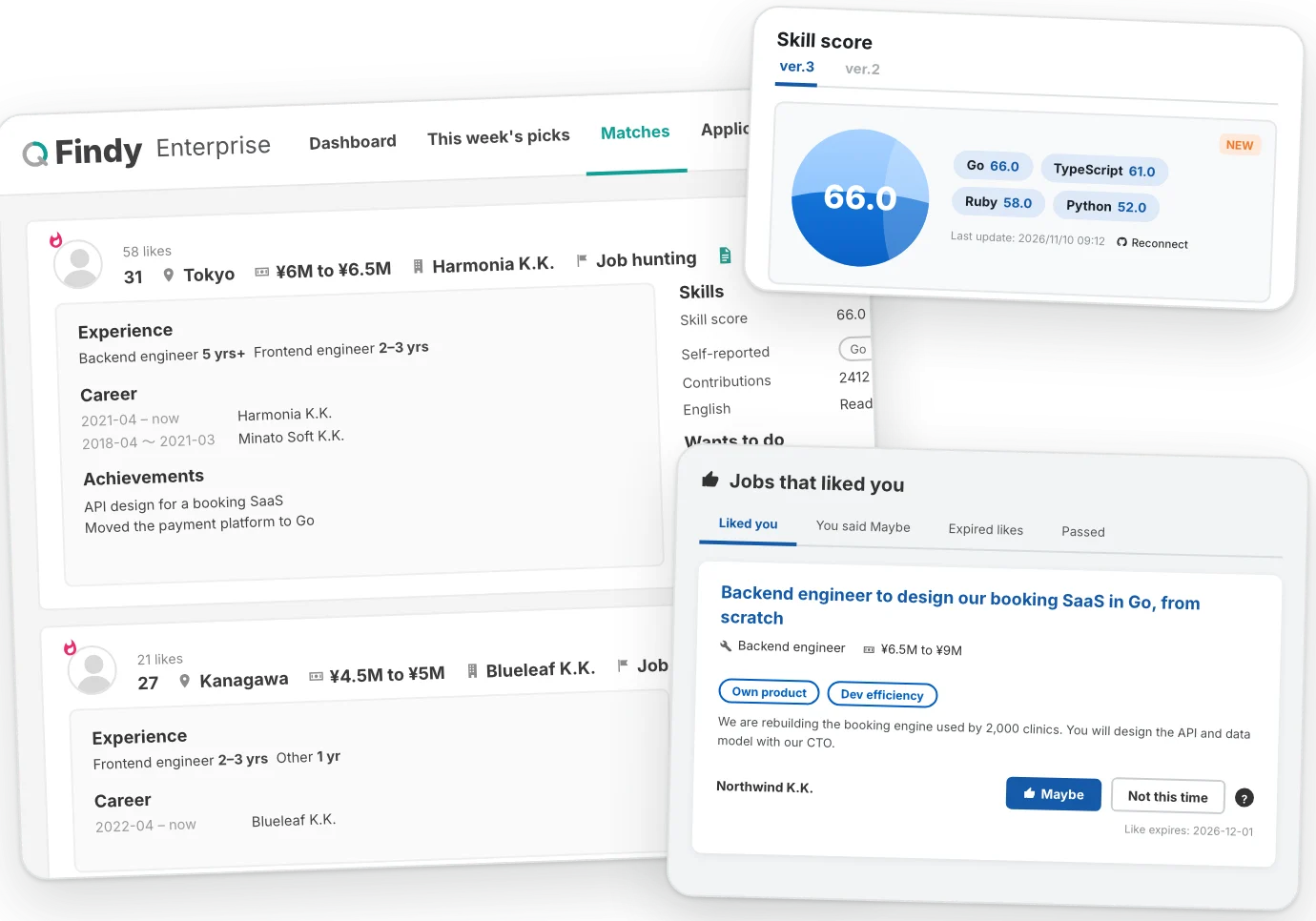
Findy is a scouting service in Japan built for hiring software engineers. A company sends a Like to engineers it's interested in. If the engineer answers with Maybe, it's a match, and the company can send a scout. Each engineer's level shows as a skill score, computed from public GitHub code.
Your engineering job ad has been up for a month, and applicants are few. An agency would send profiles, but the fee is about 35% of salary, and a resume won't show you how someone codes. That's when Findy comes up, the platform that scores engineers from their GitHub code. But its prices aren't public, and contracts last six or twelve months. So you want two answers: what will a hire cost, and will engineers answer a company like yours?
My recruiting career spans over 14 years, with roles at Google, Persol Career and other companies. Today, I advise small and mid-size businesses through my recruitment consulting services. Engineering roles are the hiring problem my clients raise most, and Findy comes up whenever we compare scouting platforms. For this guide, I read Findy's employer site and its terms for member companies, revised in June 2026. Then I checked them against Findy's case studies and the prices recruiting firms have published. I wrote it for our hiring playbook.
- First, how Findy works: Likes, matches and the skill score.
- Then the pricing: two plans, the success fee, and the terms to read before you sign.
- Next, the engineers on Findy, its pros and cons, and what companies say.
- After that, Findy side by side with its rivals, and how it can sit within your hiring strategy.
- Last, getting started, with the match and reply rates worth aiming at.
How it works
How Findy works: Likes and the skill score
Findy is a scouting platform where both sides show interest before anyone writes. You send a Like to an engineer you're interested in. If the engineer answers with Maybe, it's a match. Findy tells engineers that scouts only come from companies they matched with. So on Findy, no scout message reaches an engineer without their consent.
A Findy contract gets you five things:
- Job posts: only posts that pass Findy's review go live. If Findy asks for changes, you have 7 days.
- Search and Likes: search members by role, skills, age or salary, check their skill score, and send a Like.
- Scouts and messages: write to the people you match with.
- GitHub access: after a match, you can see the person's GitHub account.
- Customer success: a manager helps with everything from your hiring strategy to your job posts.
Findy vs other scouting platforms
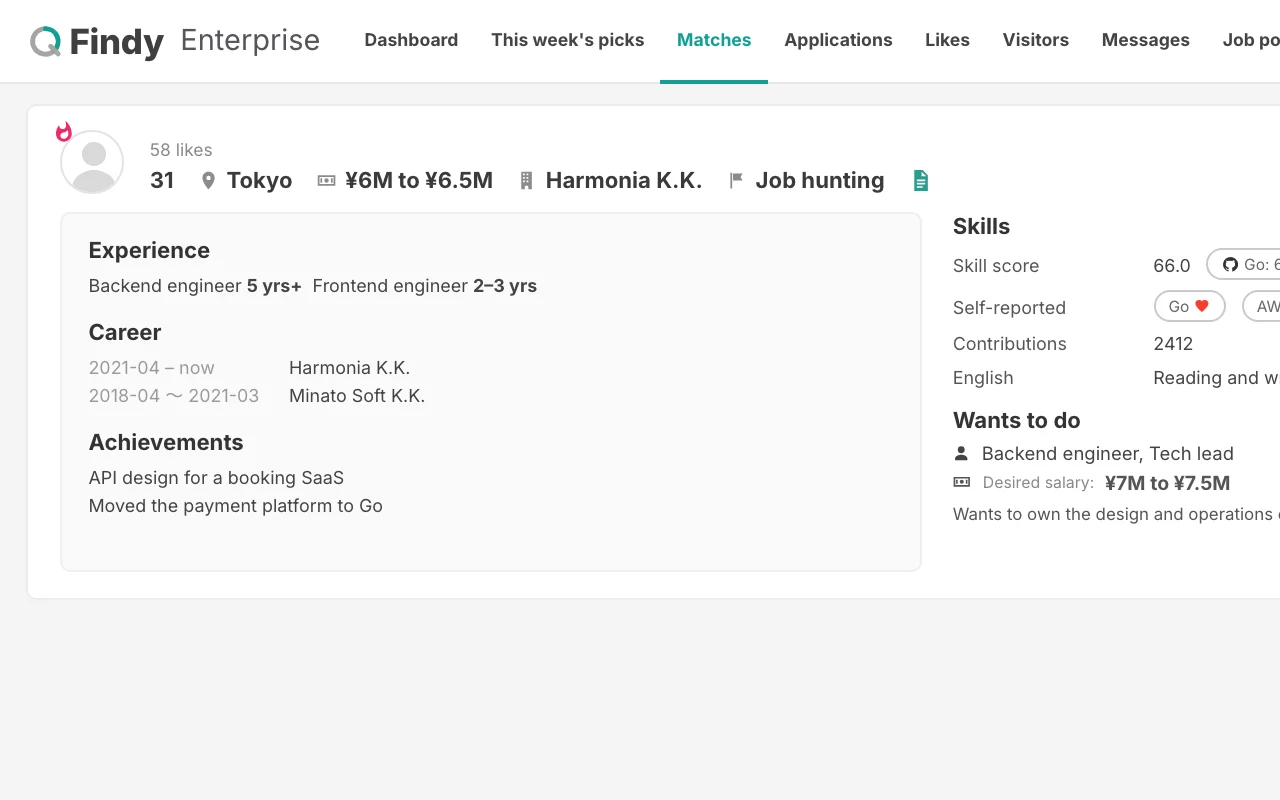
Here's how matched candidates appear in the console:
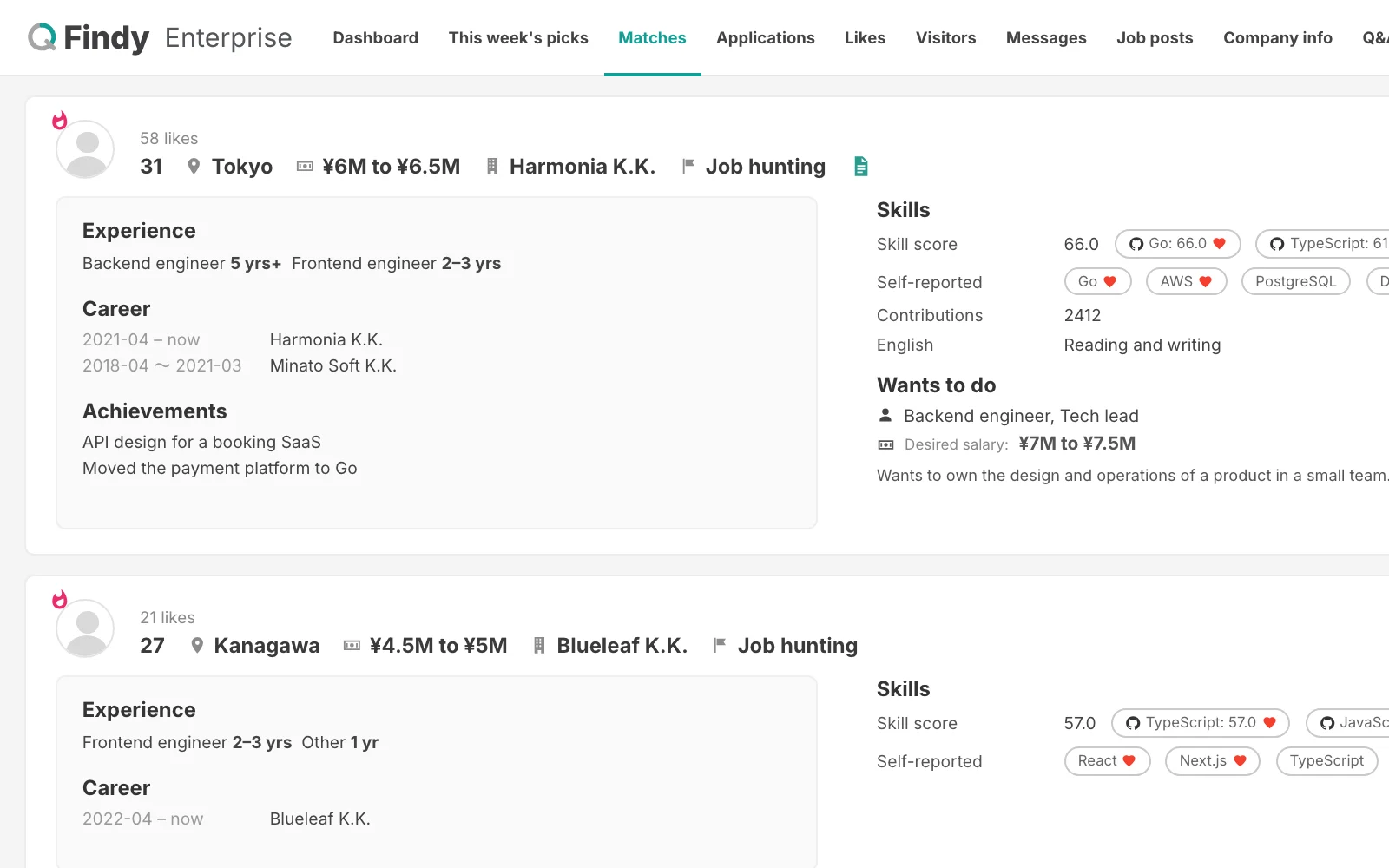
A matched candidate on Findy (mock-up)
- Job hunting: looking for a move now
- Skill score: per language, from GitHub
- Career: past jobs and projects
- Wants to do: target role and salary
Findy's screens are in Japanese, so the English labels here are our own translations. At first sight, it looks like any scouting database. Yet 3 differences change how you'll use it:
- Difference 1A mutual Like comes before the scout. The first thing an engineer gets is a one-click Like, not a message. Only once they answer Maybe can you send a written scout. That order is where the high reply rates come from.
- Difference 2Skills show as a number. The skill score comes from Findy's analysis of public GitHub code. You choose people from the code they actually wrote, not from a self-reported resume.
- Difference 3Likes are capped. Findy's own materials say 70 a week, and recruiting firms report 35 a week per account. You can't send them in bulk, so you pick your targets.
You can see the effect of that order in the numbers. After a match, 56.9% of scouts get a reply in one agency's data, far above other platforms. But before that, only about 12 to 14% of the Likes engineers read become a match. On Findy, the match rate decides your results more than the reply rate.
Findy suits companies that want their own engineers to pick candidates by reading their code. It's a weaker fit for non-engineering roles, and for engineers whose code isn't public.
Likes, Maybes and Premium Scouts
You can approach engineers on Findy in three ways. They differ in who you reach, how many, and on which plan.
| Approach | Like | Scout | Premium Scout |
|---|---|---|---|
| Message | None | Free text | Free text |
| Sent to | Members who fit a job | People you matched with | People you haven't matched with |
| How many | 35 to 70a week | Unlimited | Not public |
| Plans | Both | Both | Premium only |
Sources: Findy for employers, Findy's service materials, and recruiting firms' research (Direct Sourcing, Marugoto).
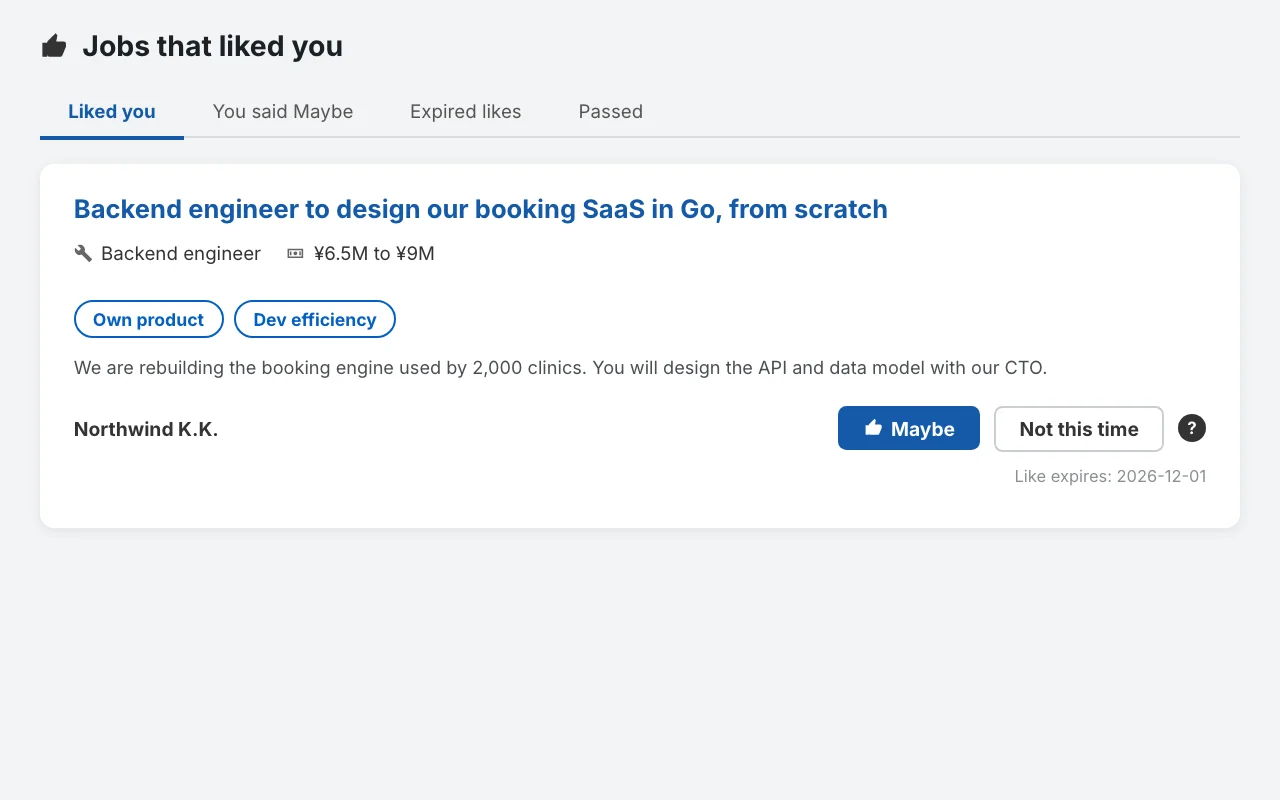
Likes are the way in. You check a candidate's skill score and profile, choose the job, and click Like. Each one takes 10 to 15 seconds. The engineer receives your job with two buttons, Maybe and Not this time, and each Like has an expiry date. A Maybe makes it a match, and their GitHub opens to you.
Scouts are written messages to the people you matched with. They've already shown interest, so skip the boilerplate. Say what caught your eye in their GitHub or career, and the job you have in mind.
Premium Scouts go straight to people you haven't matched with. Recruiting firms report they come with the Premium plan only, along with full candidate search. Premium is the one route to engineers with the highest skill scores.
Engineers can make the first move too. When one asks a question or applies to your job, Findy's terms expect a reply through Findy's messages within about a week.
What the skill score is: technical skill measured from GitHub
The skill score is a measure Findy builds from its own analysis of public GitHub repositories. It looks at how much code a person writes, what they add to other projects, and how much support their code and account get from other developers. Since a December 2024 update, Findy scores six languages one by one (Ruby, Python, Go, PHP, JavaScript and TypeScript), then derives an overall score.
For employers, it's a first filter. The head of engineering at Yourmystar, a home-services platform, put it this way: a score of 50 or more makes them go and read the GitHub. You narrow down with the number, then decide by reading the code.
Some skills don't show in the score, though. Work code is often private, and some engineers barely use GitHub. And engineers can join Findy without GitHub. So don't rule people out just because their score is low or missing.
Findy also says it uses its own AI to match engineers' skills with job posts. Recruiting firms report you can sort results by recommendation, by skill, or by how much code people write.
How much of a candidate you see, before and after a match
Before a match, you see the skill score and a profile summary: favorite languages, past jobs, what they want to do, the environment they're after, and a short pitch. After a match, you can open their GitHub account and resume. So the full picture only opens once they answer Maybe.
Which companies use Findy
Findy's employer site shows two numbers: over 1,200 client companies, and over 3,000 since launch. Its case studies range from Cybozu, with over 1,000 staff, to CONOC, with about 20. What they share is that they build their own web products or business software.
Pricing
Findy pricing: a term fee, plus a share of each hire's salary
Now the cost. Findy charges two things: a term fee for six or twelve months, and a success fee each time someone joins. The price list sits in a brochure behind a form, not on the web. Findy's own listing on jinjibu.jp, an HR services directory, reads "from ¥45,000 a month, plus a success fee on joining".
Basic and Premium: the two Findy plans
Several recruiting firms report the same prices for Findy. There are two plans, Basic and Premium, each with a 6-month or a 12-month term.
Findy price list (recruiting firms' research)
| Item | Basic | Premium |
|---|---|---|
| 6-month term | ¥360,000¥60,000 a month | ¥600,000¥100,000 a month |
| 12-month term | ¥540,000¥45,000 a month | ¥900,000¥75,000 a month |
| Success fee | 30% of annual pay | 35% of annual pay |
| Who you can reach | Skill scores up to the mid-60s | Every registered engineer |
| Condition | None | Job post minimum salary of ¥6M+ |
Before tax. Sources: Direct Sourcing (updated December 2025), AchieveHR (research as of April 2026), VOLLECT. Findy doesn't publish its prices.
The plans differ in who you can reach. On Basic, you can send Likes to people with skill scores up to the mid-60s. Recruiting firms say that's about 85% of members, with target salaries of ¥4 to 7 million. You reach the top 15% only on Premium, which also adds Premium Scouts and full candidate search.
Members you can reach on Basic
Share of members by skill score, as reported by recruiting firms
- Reachable on Basic (scores to the mid-60s)
- 85%
- Premium only
- 15%
Sources: VOLLECT, TECH HIRE, core scout (third-party research)
If you're unsure, choose by the salary you'll pay. For engineers paid up to ¥7 million, seniors included, Basic is enough. For tech leads or engineering managers at ¥8 million or more, take Premium. Recruiting firms also list an optional interview article about your company, at ¥400,000 each.
Findy success fee: 30 to 35% of annual pay, ¥700,000 minimum
Most of the bill is the success fee. The rate is the one in your contract on the day you sent the Like. It applies to annual pay: twelve months of monthly pay (base pay, allowances other than commuting, and fixed overtime pay), plus expected bonuses and incentives. Findy's terms set a minimum fee of ¥700,000 before tax.
| Hire's annual pay | Basic (30%) | Premium (35%) |
|---|---|---|
| ¥5 million | ¥1.5M | ¥1.75M |
| ¥6 million | ¥1.8M | ¥2.1M |
| ¥8 million | ¥2.4M | ¥2.8M |
| ¥10 million | ¥3M | ¥3.5M |
Before tax, per hire. Rates as reported by recruiting firms. Premium requires at least one job post with a minimum salary of ¥6 million or more.
Both rates match what agencies usually charge, 30 to 35% of salary. On the success fee alone, Findy isn't much cheaper than an agency. Before you sign, also read 5 rules in Findy's terms:
- Every contract type: employee, fixed-term, part-time or contractor, each one triggers the fee. If a contractor becomes an employee, or their pay goes up, Findy bills the difference.
- One year after the last contact: if you agree to hire someone within a year of your last contact on Findy, the fee is due, even after your contract ends.
- A 50% refund for early leavers: if the hire quits for personal reasons in their first 30 days, you get half back. You must report it in writing within 5 business days, and there's no refund when the company caused it.
- No cancelling mid-term: a company can't cancel during its term. The 6 or 12-month fee stays the same even if you hire early.
- Penalties for going around Findy: contacting someone you found on Findy outside it costs ¥500,000. Signing them on top of that adds ¥3.6 million or three times the fee, whichever is higher.
Findy invoices the success fee on the hire's first working day, payable by the end of the following month. Late payment carries 14.6% a year in interest.
Findy cost per hire, and when it pays off
A cost per hire on Findy adds two parts: the term fee divided by your hires, and the success fee. First, how many Likes does one hire take? Put the published numbers together, and a month of Likes looks roughly like this:
150 Likes read, one hire
If engineers read 150 of your Likes in a month: the matches, replies and hire to expect.
- 150Likes read
- 20Matches13%match
- 11Replies57%reply
- 1Hire1 in 11joins
Sources: Direct Sourcing (12 to 14% of read Likes match, 56.9% reply rate), Knock On The Door case study (3 hires in 3 months). Our estimate.
That pace, about one hire a month, matches Findy's case studies. Now the money. Say you hire an engineer at ¥6 million a year on a 12-month Basic plan. The success fee is 30%, so ¥1.8 million. Add the ¥540,000 term fee, shared across your hires:
What one hire costs on Findy, from 1 to 4 hires
12-month Basic, engineers paid ¥6 million, against a 35% agency fee
Agency fee, 1 hire
Findy, 1 hire
Findy, 2 hires
Findy, 3 hires
Findy, 4 hires
Before tax. SaiyouTeam estimate from recruiting firms' Findy prices and a standard agency fee.
For a single hire, an agency costs less. Two hires come out even, and three save about 6%. But with 30% against 35%, the gap never goes past about 14%, however many you hire. Premium charges 35%, like an agency, so it costs more by the term fee. So Findy isn't a way to save money. Its real value: you meet people you picked from their code, once they've said they're interested.
It also takes less of your time than most scouting platforms. Findy's service materials put a Like at 10 to 15 seconds and a scout after a match at 2 to 3 minutes. So 150 Likes and 20 scouts a month take under two hours in total. Most of your time goes into reading GitHub and meeting people. Three questions tell you whether Findy fits:
- Are you hiring web engineers? Most members work in backend, frontend or mobile. It won't help you hire salespeople or factory engineers.
- Can someone on staff read code? The skill score is only a start; someone has to read the GitHub. A CTO or lead with 15 minutes a day is enough.
- Will you hire two or more a year? For one hire, an agency or a flat-fee platform with no success fee costs less.
Members
Who you'll find on Findy: 165,000 users, 140,000+ engineers
The price only makes sense if the engineers you need are on Findy. Here's who they are, from Findy's own figures.
Findy's site for engineers counts 165,000 registered users, as of September 2026. Its employer site counts over 140,000 engineers registered since launch. Product and project managers can now sign up as well.
Engineers on Findy, by role
Registered engineers by role, as listed on Findy's employer site (each "or more")
Backend
Data, infrastructure, QA, PM and others
Frontend
Mobile
Source: Findy for employers
Backend engineers are the largest group, working in Python, Java, PHP, Ruby, Go and more. Frontend means JavaScript and TypeScript; mobile means Swift, Kotlin and Dart. Findy doesn't publish a split by age or years of experience.
It doesn't publish active users either. Instead, it says it runs over 450 events a year for engineers, and invites viewers to log in when they watch. It also tells engineers that 79.8% of users who changed jobs got a raise (January to June 2026), so expect candidates to look for more than they earn now.
The roles Findy fills best
Match the role figures with the case studies, and three profiles stand out.
Experienced web engineers
Backend and frontend make up more than half of members, and you reach most of them on the Basic plan, aimed at salaries of ¥4 to 7 million. Knock On The Door, a 35-person company, had 3 people join or accept an offer in 3 months.
Tech leads and CTOs
Senior people are fewer, and you reach them on Premium. Schoo, an online learning service, hired a CTO about 4 months in. Optimind, which builds delivery-route software, hired an engineering manager.
Side-job and contract engineers
Findy isn't only for full-time roles: you can also hire engineers on contract. CONOC, with about 20 staff, hired two employees and one side-job engineer. White Healthcare had one person run Findy and hired three employees and two contractors. As covered above, contract hires carry the success fee too.
Pros and cons
Findy pros and cons: little effort, but not cheap
Findy's main strength is that you meet engineers whose skills you can see, for little effort. Its weaknesses: a cost close to an agency's, and a contract you can't leave early.
Little effort, and candidates who are already interested
A Like takes 10 to 15 seconds, and you only write scouts to people you matched with. Several companies in the case studies run Findy with a single recruiter. Yourmystar hired three people in a year with one person running it. Loglass, which makes business planning software, says running it takes very little work.
Customer success is part of the deal. Recruiting firms report two months of onboarding from the day your account opens, with advice on Likes, job posts and scout wording. UPSIDER, a corporate card company, followed its customer success manager's advice and reached an offer acceptance rate above 80% through Findy.
What companies say about Findy
Public reviews from employers are rare. ITreview, a review site for business software, lists a single review, from March 2024, and no score. BOXIL, another review site, has none. So I took companies' views from that review and from the case studies.
On the plus side:
- Sending Likes is quick, so it saves a lot of work.
- Skills are shown in detail, which makes screening easier.
- A high share of casual interviews lead to selection: 40 to 45% at ROUTE06.
- A high offer acceptance rate through Findy: over 80% at UPSIDER.
On the minus side:
- You can't filter by last login date.
- People who haven't logged in for two weeks rarely react.
- Engineers with high skill scores get approached by many companies, so competition is tough.
Watch out: a binding contract, and a score tied to GitHub
The first thing to watch is the contract. You can't cancel a 6 or 12-month term, and anyone you met on Findy stays billable for a year after your last contact. If you end up hiring just one person, it costs more than an agency.
The second is that the score leans on GitHub. It can only be computed from public code, so engineers whose work is private score low. Recruiting firms' articles agree on another point too: Findy is weak for juniors and career changers.
The table sums up Findy's strengths and limits.
| Topic | Pros | Cons |
|---|---|---|
| Cost | Slightly cheaper than an agency from 3 hires | Costs more than an agency for one hire |
| Reach | Over 140,000 registered engineers | Basic reaches about 85% of them |
| Candidates | Skills visible through the score and GitHub | People with private code score low |
| Success fee | Rate locked on the day of the Like | 30 to 35% of annual pay, ¥700,000 minimum |
| Workload | 10 to 15 seconds a Like, one person can run it | No cancelling during the term |
| Scouts | 50 to 65% reply after a match | Likes capped at 35 to 70 a week |
Comparison
Findy vs other hiring platforms: success fees and terms
Findy is rarely the only platform on an engineering hiring shortlist. This table sets it beside the ones employers in Japan weigh most, from engineer-only sites to large generalists.
| Sort by | ||||
|---|---|---|---|---|
 dodaJob board, agency and scouts (Persol) | 10.99MJune 2026 | Not public | Not public | Not public |
 Rikunabi NEXTJob board (Recruit) | 10M+Unofficial estimate | Not public | Not public | Not public |
 LinkedIn Recruiter CorporateAll professions | 5M | ¥1,700,00012 months | 150¥944 per scout | None |
| LinkedIn Recruiter LiteAll professions | 5M | ¥16,0001 month | 30¥533 per scout | None |
 Wantedly StandardMid-career, new grads | 4.57M | ¥900,0006 months | 25¥6,000 per scout | None |
| Wantedly PremiumMid-career, new grads | 4.57M | ¥1,320,0006 months | 50¥4,400 per scout | None |
 BizReachExecutives, high income | 3.53M | ¥850,0006 months | 67¥2,125 per scout | 15%of salary |
 OpenWorkMid-career, new grads | 1.83M | ¥1,200,00012 months | 833¥120 per scout | ¥300K–800K |
 GreenIT and web | 1.63M | ¥600,000One-off | 1,000Included | 20%of salary |
 YOUTRUSTMid-career | 500K | ¥2,400,00012 months | 20¥10,000 per scout | None |
 doda XExecutives | 400K | ¥1,050,0008 weeks | 217¥2,625 per scout | None |
 FindyIT engineers | 165K | ¥360,0006 months | 35–70 a weekLikes | 30–35%of salary |
 LAPRASIT engineers | 40K | ¥945,0006 months | Unlimited | None |
Source: SaiyouTeam research, platforms' published figures (November 2026). Findy's prices are recruiting firms' research; Likes are the signal sent before a scout. Click a column to sort.
In the table, Findy has the highest success-fee rate. Green charges 20% of annual pay for applicants from 2027, BizReach 15%, and Wantedly and LinkedIn charge none. Its member base is also among the smallest, just above LAPRAS (40,000), another platform for IT engineers. In return, because scouts go out after a match, its reply rate is the highest of any platform Direct Sourcing measures.
Platforms that hire engineers don't all price the same way. Green gives you 1,000 scouts a month after a single entry payment, and also covers sales and other non-IT roles. BizReach charges ¥850,000 for six months plus 15% of salary, and reaches high earners in every field. Findy isn't about volume. You choose who to approach, and talk once they've shown interest.
The kit's recruiting platforms sheet lists each platform with its main features and its cost, so you can weigh them for your own roles.
Strategy
Using Findy in your hiring strategy
Findy does best at companies where someone who reads code picks the candidates, alongside other channels. On its own, it won't cover every role and salary band.
Three hiring cases show how to use it.
-
Scenario 1
3 backend engineers to hire this year, at a 40-person SaaS company
Candidate personaRuby or Go engineers with 3 to 7 years of experience, earning ¥5.5 to 7 million.
Strategy
- Findy
- Employee referrals
Findy leads: the CTO reads skill scores and GitHub and sends Likes every day, and HR handles scouts and scheduling. Referrals on the side.
Plan
Basic, 12 months, ¥540,000With three hires paid ¥6 million, each one comes to about ¥1.98 million, slightly under an agency's ¥2.1 million, and you've read everyone's code first.
-
Scenario 2
8 engineers a year, tech leads and EMs included, at a 300-person IT company
Candidate personaTech leads and engineering managers with 7+ years of experience, earning ¥8 to 10 million.
Strategy
- Findy
- BizReach
Findy's candidate search and Premium Scouts reach top-scoring engineers directly. Managers who code less score lower, so BizReach, searchable by career history, runs alongside.
Plan
Premium, 12 months, ¥900,000Only Premium reaches the top 15%. With job posts starting at ¥6 million or more, the condition is met.
-
Scenario 3
4 engineers, employees and contractors, at a 50-person healthcare company with no recruiter
Candidate personaFrontend and mobile engineers: two employees and two contractors.
Strategy
- Findy
- Careers site
The head of development spends 15 minutes a day on Findy Likes and scouts. Customer success helps fix the job posts, and the careers site hosts articles about the team, linked from each scout.
Plan
Basic, 6 months, ¥360,000Four hires in six months put the term fee at ¥90,000 each. Contract hires carry the success fee too, so check the rate before signing.
Run Findy in-house, or hand it to an agency?
Running Findy means two jobs: choosing who gets a Like, then scouting and meeting the people you match with. Choosing takes someone who can read code.
- In-house: in many case studies, a CTO or engineer judges the code and picks the Likes, while HR handles scouts and scheduling. You can start with 15 minutes a day.
- A scouting agency: some agencies run Findy for clients. Their fee comes on top of what you pay Findy.
- Findy's own agency service: under a separate contract, Findy runs Findy User Success, an agency service with a minimum fee of ¥1.2 million.
Whoever runs it, keep every exchange inside Findy. Contacting someone you found there by email or social media costs a ¥500,000 penalty.
Getting started
Getting started with Findy
Setup comes first, from the first call to a live job post. After that comes the routine, from Likes to interviews.
Setup: from a free consultation to a live job post
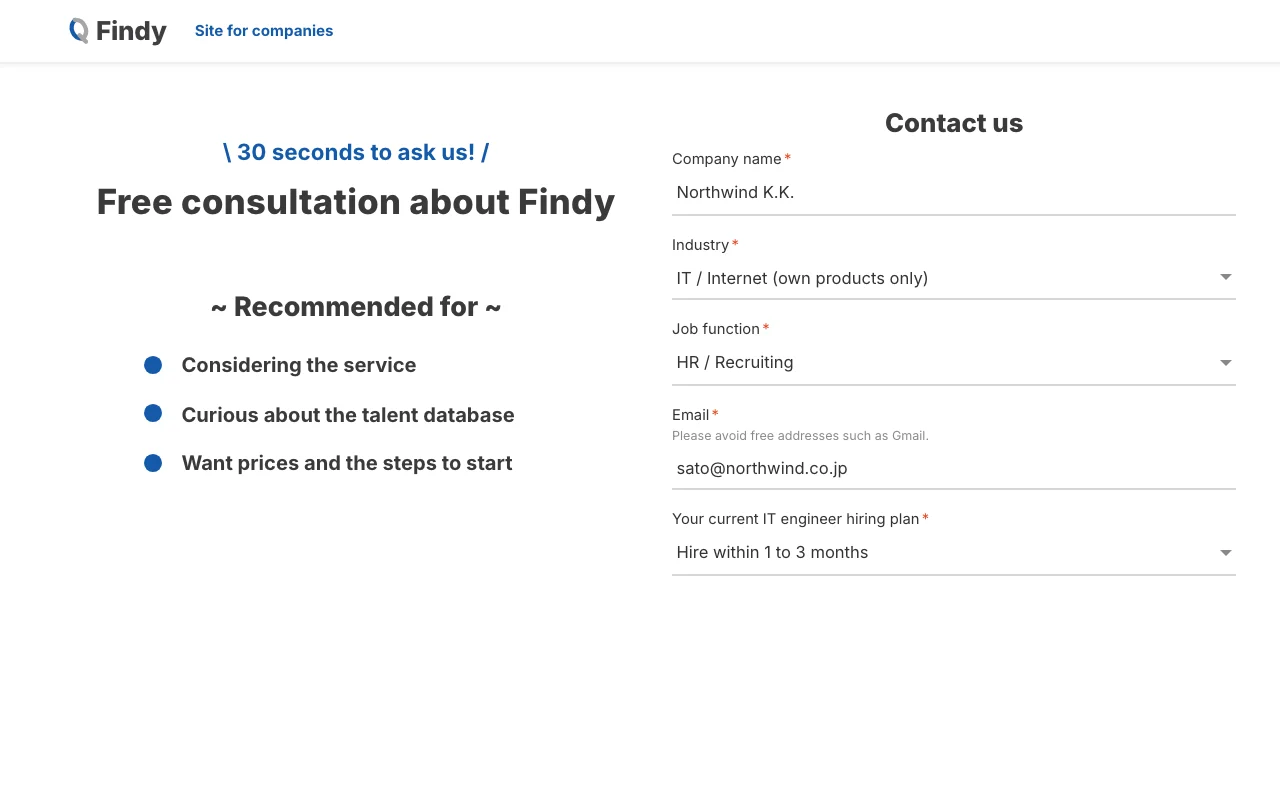
Ask for a free consultation
Fill in the form on Findy's employer site, with your hiring plan and contract types. Findy only serves companies hiring for themselves, and won't accept free email addresses.
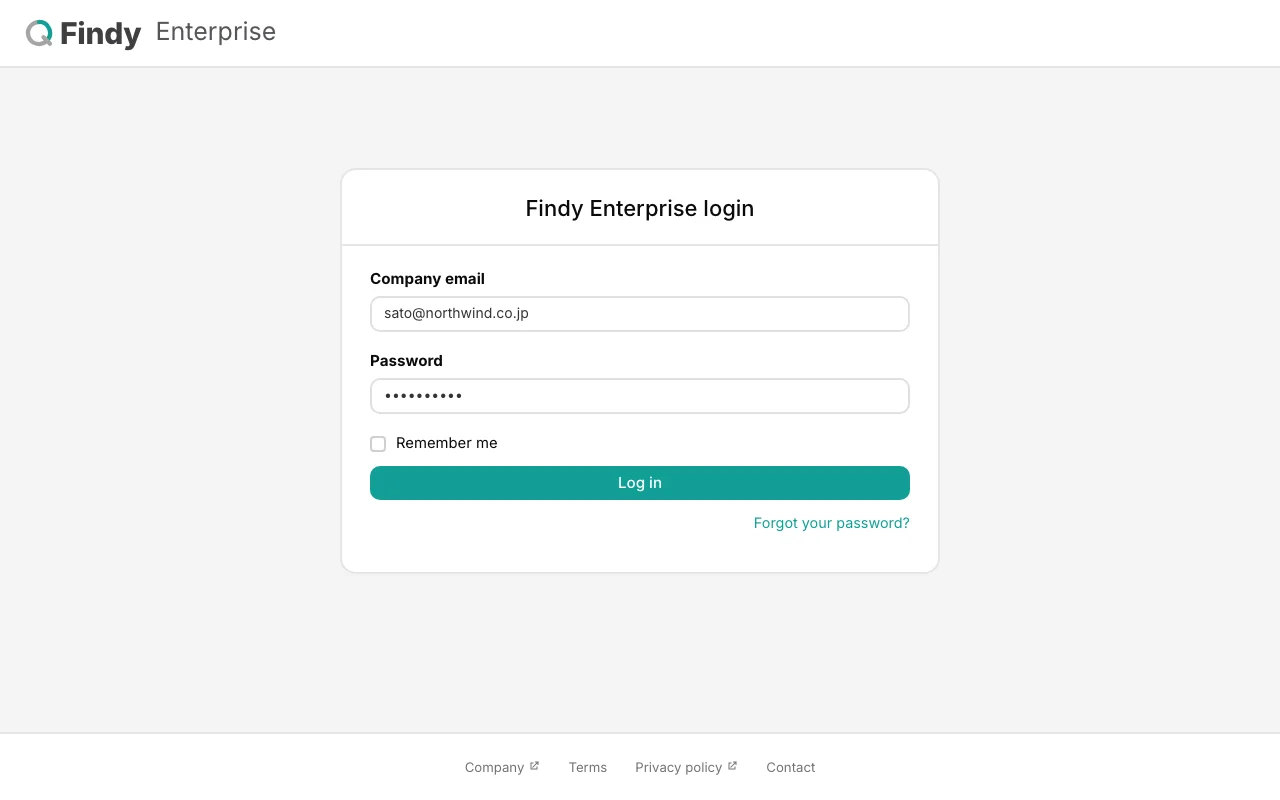
See the console in a demo, then sign
The sales meeting includes a live search demo. Pick a plan and sign the application form; your account is ready when the login arrives. The console is called Findy Enterprise.
Write your job post and pass review
Only posts that pass Findy's review go live. Engineers then see the role, salary, tech stack and preferences. Findy advises deciding who it's for, what to say and how, before you write.
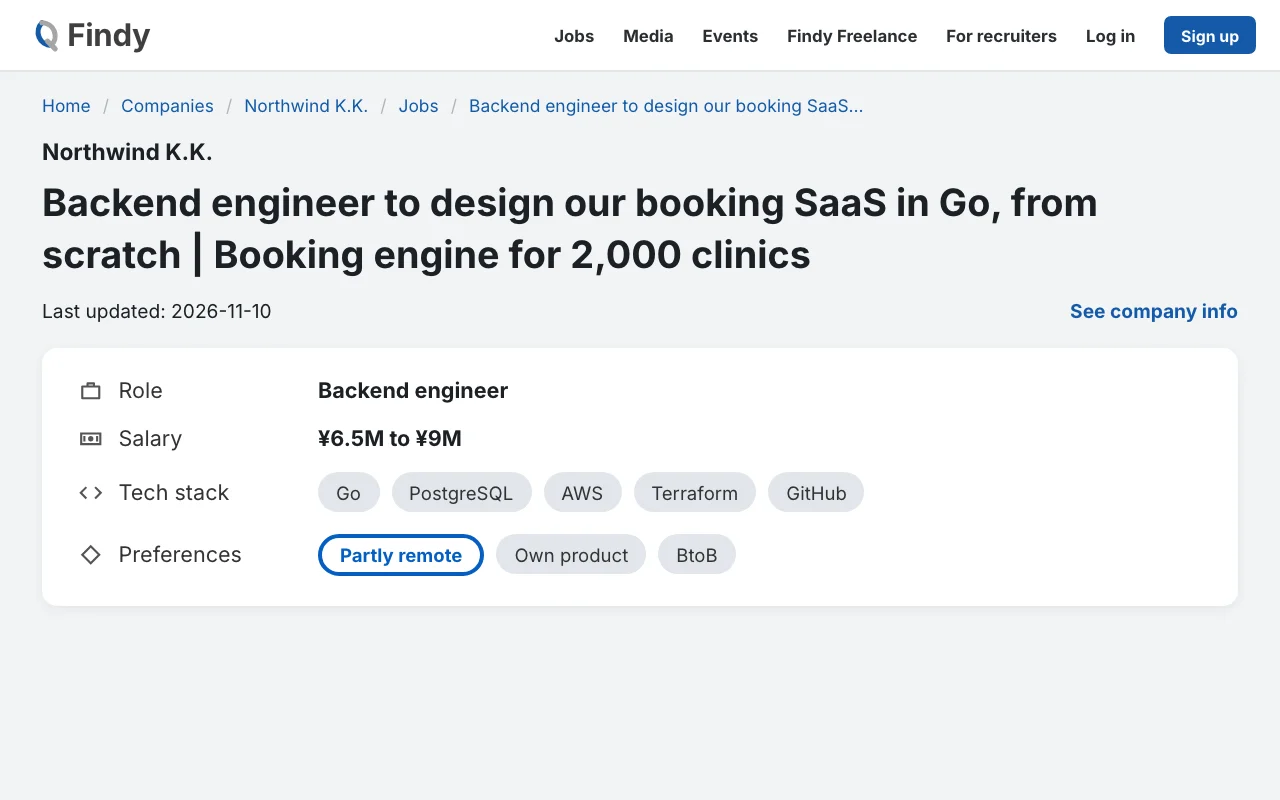
Daily work: from Likes to interviews
Search and send Likes
Search by role, skills and salary, check each skill score and profile, and send a Like. The engineer receives your job with a Maybe button.
Scout the people you match with
Engineers who answer Maybe appear in your matches. Read their GitHub and career, then say what caught your eye and the job you have in mind.
Start with a casual interview
Offer a casual interview first, with an engineer from the team. Answer messages within about a week.
Review your numbers
Once or twice a month, go over your match and reply rates with your customer success manager.
Results
Measuring results on Findy, and improving them
Once you're live, two questions follow: how soon the first hire arrives, and whether your numbers look normal.
Time to hire on Findy
Findy doesn't say how many days setup takes. Between the meeting, the contract, the account and the job review, allow a few weeks. After that, Findy's case studies show a first hire within 2 to 4 months. Knock On The Door made its first hire 2 months in, and Cybozu had 10 people agree to join in about six months.
Once a candidate enters selection, it runs at its normal pace: Knock On The Door wrapped it up within about three weeks. Our hiring process guide covers the steps after a reply.
Hiring through Findy, week by week
First hires 2 to 4 months in, in Findy's case studies
- Weeks 1 to 2Consultation, meeting, contract
- Weeks 3 to 4Account, job post review
- Weeks 5 to 12Likes and interviews
What good match and reply rates look like on Findy
Track three numbers on Findy: the share of read Likes that become a match, the reply rate to scouts after a match, and the share of casual interviews that lead to selection. In Direct Sourcing's data, the match rate is 12 to 14% and the reply rate above 60%. At ROUTE06, 40 to 45% of casual interviews moved on to selection.
Line up scout reply rates by platform, and Findy looks far ahead of the rest. Direct Sourcing, an agency that sends scouts on clients' behalf, published these figures from over 800,000 scouts:
Reply rate to scouts, by platform (Findy: after a match)
Scouts sent by Direct Sourcing for its clients, September 2025
Findy
Wantedly
YOUTRUST
LinkedIn
BizReach
OpenWork
Green
Source: Direct Sourcing. Figures from a single agency, not platform-wide averages.
But Findy's figure counts replies from people who already matched. A fairer comparison with other platforms' scouts is the 12 to 14% of read Likes that become a match. It only counts Likes engineers opened, but it still beats Green's 2.2% and BizReach's 6.3%.
How to raise your Findy match and reply rates
The term fee is fixed, so more matches mean more hires for the same fee, and a lower cost per hire. These habits help most:
- Send Likes every day, but not on Friday: a few at a time. One recruiting firm notes that on Fridays, every company spends its remaining Likes, so yours get buried.
- Favor recent logins: people who haven't logged in for two weeks rarely react. You can sort results by activity.
- Fix the job post: engineers read it before they answer Maybe. Findy's hiring guides suggest framing why you're hiring as the ideal, the current state and the gap.
- Cite their GitHub in the scout: name the repository and what caught your eye. ROUTE06 writes its scouts like love letters.
- Bring an engineer to the casual interview: in a 2022 Findy survey, engineers most want to meet future teammates (71.4%).
FAQ
Frequently asked questions about Findy
What is Findy?
Findy is a scouting service in Japan built for hiring software engineers, run by Findy Inc. since 2017. A company sends a Like, the engineer answers with Maybe, and the match lets the company send a scout. A skill score, computed from public GitHub code, shows each engineer's level.
How much does Findy cost for employers?
A fee for a six or twelve-month term, then a share of salary for each hire. Findy doesn't publish prices. Several recruiting firms report ¥360,000 for 6 months or ¥540,000 for 12 months on the Basic plan, and ¥600,000 or ¥900,000 on Premium, before tax.
What is the Findy success fee?
It's 30 to 35% of the hire's annual pay. Recruiting firms report 30% on Basic and 35% on Premium. Findy's terms set a minimum fee of ¥700,000, and the rate is the one in your contract on the day you sent the Like.
Like vs Maybe on Findy: what's the difference?
A Like is the signal a company sends to an engineer; Maybe is the engineer's answer. When both are there, it's a match, and the company can send a scout message. Findy's own materials cap Likes at 70 a week; recruiting firms report 35 a week per account.
What is a Premium Scout on Findy?
It's a scout you can send to an engineer you haven't matched with. Recruiting firms say it comes with the Premium plan only, together with full candidate search, so you can reach every engineer, top skill scores included. Premium reportedly requires a job post with a minimum salary of ¥6 million or more.
What is the Findy skill score?
It's a measure of technical skill that Findy computes from public GitHub repositories. It counts how much code a person writes, what they add to other projects, and how much support their code and account get from other developers. Since December 2024, it's computed per language for six languages. Engineers can join Findy without a GitHub account.
How many people use Findy?
165,000 registered users, as of September 2026. Findy's employer site counts over 140,000 engineers registered since launch. By role, it lists at least 39,000 in backend, 33,000 in frontend, 5,700 in mobile and 36,000 in data, infrastructure, QA and product roles.
What is a typical reply rate on Findy?
After a match, about 50 to 65%. Direct Sourcing, an outsourced scouting firm, recorded 56.9% in September 2025, and Findy puts its own average at about 65%. But before that, only about 12 to 14% of the Likes engineers read turn into a match.
How long until a first hire on Findy?
Findy's case studies show a first hire 2 to 4 months in. Knock On The Door, a 35-person company, made its first hire 2 months after starting, and had 3 people join or accept an offer within 3 months.
Is the fee refunded if a hire quits early?
Half of it. If the hire quits for personal reasons in their first 30 days, Findy returns half the success fee. Death and illness don't count, and you must report it in writing within 5 business days. There's no refund when the company causes the departure.
Can I cancel Findy mid-contract?
No. Findy's terms don't let a company cancel during its contract term. And if you hire someone you met on Findy within a year of your last contact, the success fee is due, even after your contract has ended.
Can a small company hire with Findy?
Yes, if you hire two or more web engineers a year and someone on staff can read their code. Many of Findy's case studies are companies with 20 to 50 people. But for a single hire, the term fee plus a 30% success fee can cost more than an agency.
Can I hire contractors or side-job engineers on Findy?
Yes. Findy's terms count contractor agreements as hires, so the success fee applies. If a contractor later becomes an employee, Findy bills the difference. Freelance projects are handled by a separate service, Findy Freelance.
Findy, Findy Freelance and Findy Team+: how do they differ?
This guide covers Findy, the scouting platform for hiring engineers, mostly for full-time roles. Findy Freelance matches freelance and side-job engineers with contract projects. Findy Team+ is a tool that measures a development team's productivity. Each has its own contract.
Can I use Findy in English?
Only in Japanese, as far as we can see. Findy's employer site and the login page of its console, Findy Enterprise, have no English version or language switch. Roles that use English are still listed: engineers can search for jobs where their English is an asset.
How is Findy different from Green and BizReach?
Findy charges a 6 or 12-month fee plus 30 to 35% of annual pay, and you scout after a match. Green bills a one-off entry fee plus a success fee (20% of annual pay for applicants from 12 January 2027), with 1,000 scouts a month. BizReach combines a ¥850,000 plan for six months with 15% of salary, and its strength is higher earners in every field.
DIY Hiring Kit
Everything You Need To Hire On Your Own
A downloadable hiring framework for small businesses in Japan, with step-by-step guides, spreadsheet ATS, LinkedIn scouting system, interview questions bank, offer letter and employment contracts, and a ton more!
1Dashboard11Checklists8Spreadsheets30Template docs4Weeks of Q&ABilingual
- Download every file as Word, Google Docs, Excel or Google Sheets


 14 years in talent acquisition
Related
Related guides and tools
 Guide
What is Green? Pricing and success fees
The IT and web platform with a one-off entry fee.
 Guide
What is BizReach? Pricing, scouts and how to hire with it
The scouting platform for experienced, higher-income candidates.
 Hiring practices
What is direct recruiting? Scouting vs agencies
The method behind Findy's Likes and scouts.
 Hiring practices
What is a casual interview?
How to run the first meeting after a match.
 Guide
What is LAPRAS? LAPRAS SCOUT pricing and scores
The flat-fee platform that scores engineers from their public work.
 Template
How to write a job description
Write the post engineers read before they answer Maybe.
Official sources
The main sources for this guide. Other references are linked where they are used in the text.
- Findy Inc.recruiting.findy-code.io Findy terms of use for member companies The minimum fee, annual pay, refunds, cancellation and penalties (revised 1 June 2026).
- Findy Inc.recruiting.findy-code.io Findy for employers Matching through Likes, registered engineers by role, and client companies.
- Findy Inc.findy-code.io Findy for engineers 165,000 registered users (September 2026), and scouts only from companies you matched with.
- Findy Inc.prtimes.jp Skill score update (December 2024) How the skill score is computed, and the per-language scores.
- Direct Sourcingdirectsourcing-lab.com Findy plans and how to use them Basic and Premium prices, the Like limit and match rates (updated December 2025).
- Direct Sourcingdirectsourcing-lab.com Scout reply rates by platform Reply rates measured on over 800,000 scouts, Findy included (September 2025).