
What Is Green?Pricing, Success Fees and How to Hire With It
A practical guide to Green for companies hiring IT and web professionals in Japan. It covers the Interested button and scouts, pricing and the new success fee, and the steps to start hiring with it.

Basics
What is Green?
In short
Green is a Japanese job site for hiring experienced IT and web professionals. Companies post jobs for a one-off entry fee, approach members with free Interested clicks and up to 1,000 scouts a month, and pay a success fee only when someone joins.
Say you need two engineers this year. An agency would take about a third of each salary, and your job ads bring applicants who have never shipped code. You keep hearing about Green, a job site where IT people browse and where companies make the first move. Its pricing sounds friendly: one entry fee, then a fee per hire. But the fee changes in January 2027, and fewer members have logged in each year since 2023. So the questions are concrete: what will a hire cost you, and will anyone answer?
Recruiting has been my job for 14 years, with roles at Google and Persol Career, and I now advise small and mid-size companies on hiring in Japan. Engineers are the hardest roles my clients bring me, and Green comes up in nearly every one of those conversations. To write this guide, I read Green's employer help center from end to end, its parent company's results for the year to September 2026, and the case studies Green publishes. It belongs to our hiring playbook, a series of guides for employers in Japan.
- First, how Green works: job posts, Interested clicks, Want to meet and scouts.
- Then the pricing: the entry fee, the success fee, and what changes in January 2027.
- Next, the people on Green, followed by its pros and cons.
- After that, how Green compares with other platforms, and the role it can play next to your other channels.
- Last, the practical part: setup, the daily routine and the numbers to track.
How it works
How Green works: job posts, clicks and scouts
Job site or scouting platform? Green is a bit of both. You post jobs, members search them and apply, as on any job site. But Green tells candidates that more than 90% of its successful job changers applied after a company approached them. On Green, the first move usually comes from you.
How Green differs from job ads and agencies
A Green contract gives you five things:
- Job posts without a limit: as many jobs as you like, with no posting period. Green reviews each one before it goes live.
- A company page: Green interviews you and takes photos, then you complete your company, PR and interview pages.
- Candidate search: the member database, with each person's career but not their name.
- Three ways to approach: Interested clicks, scouts, and Want to meet.
- Analytics: views and reply rates for each job, next to the average of jobs that hired.
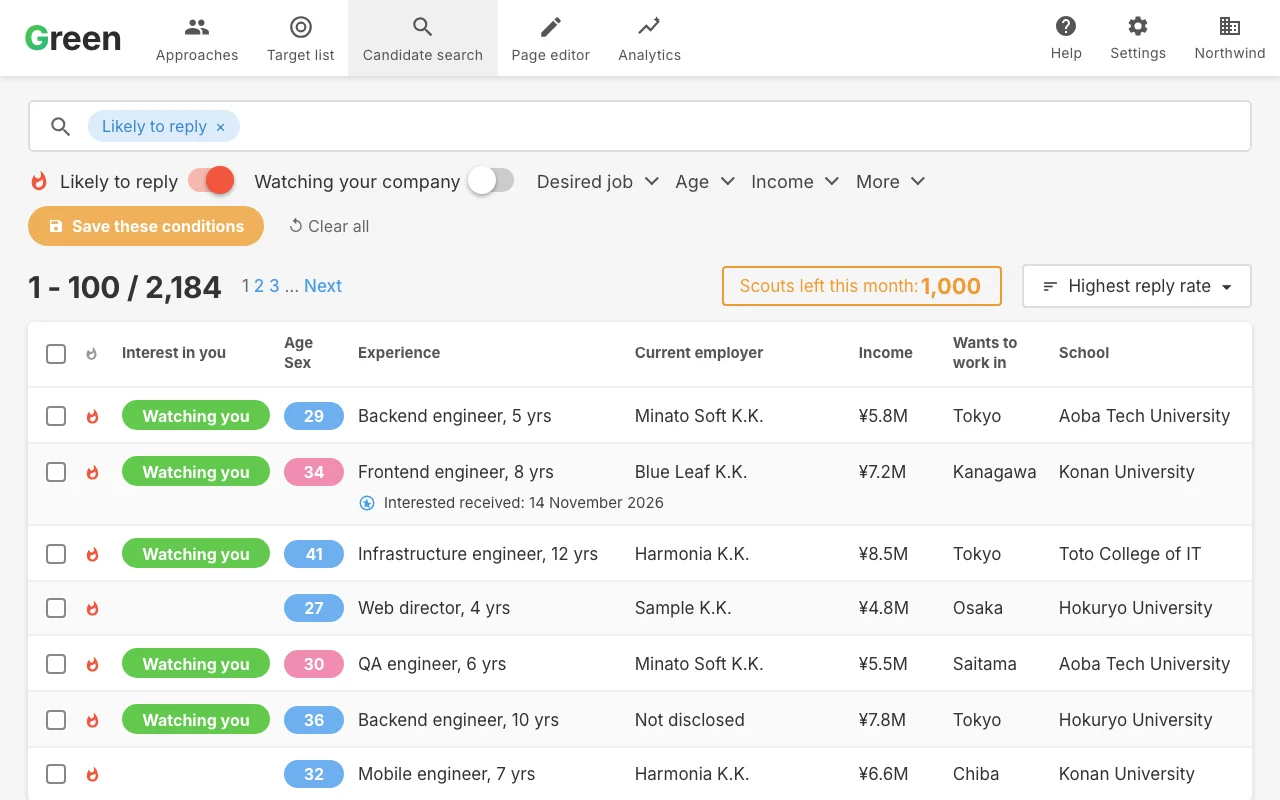
Candidate search looks like this:
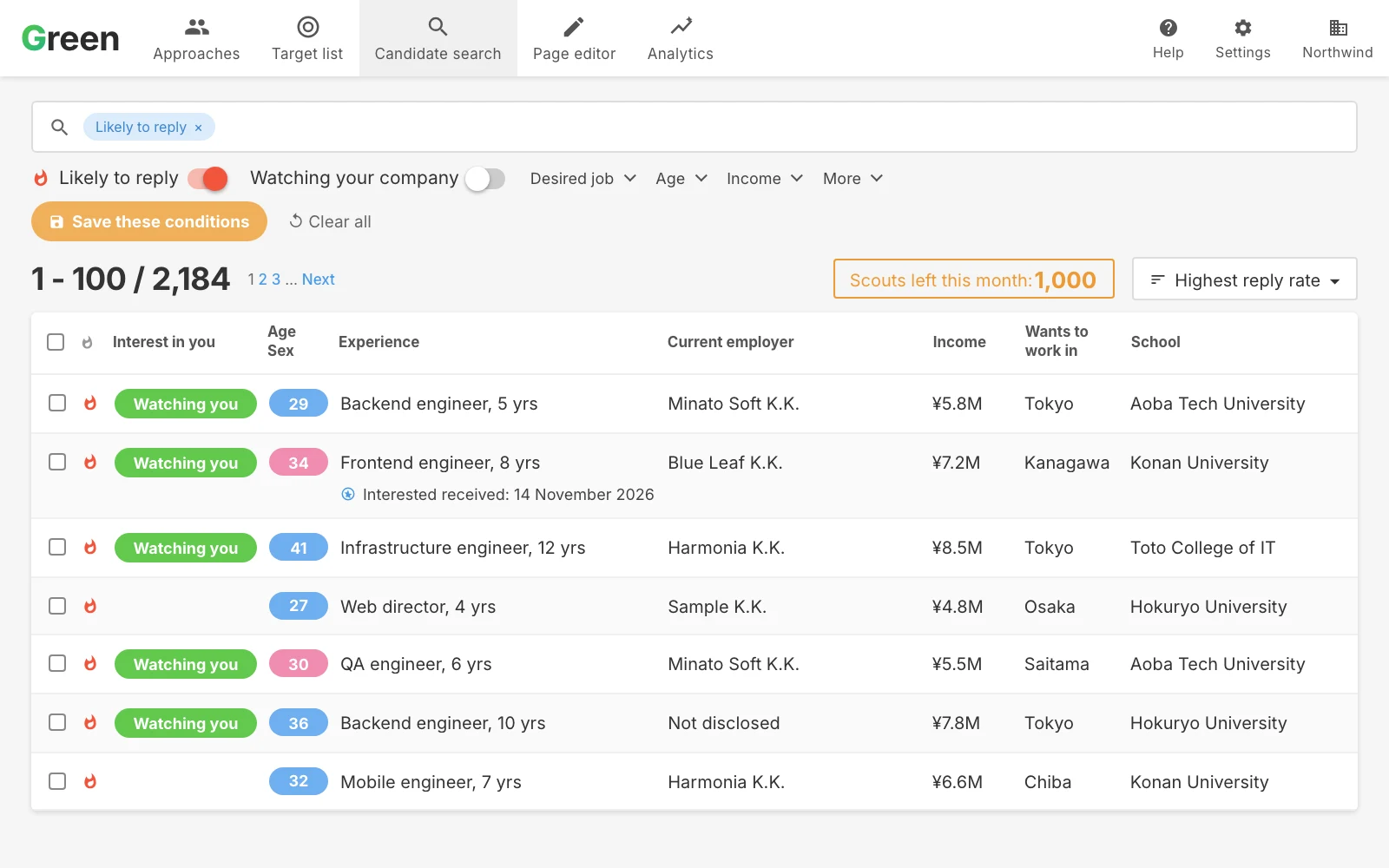
Candidate search on Green (mock-up)
- Likely to reply: red and yellow flames only
- Watching you: saw your pages or similar jobs
- Scouts left: 1,000 a month
- No names: age, career and income
Green has no English interface: the labels in these mock-ups are our translations. So far, it looks like any job site with a database. But 3 differences decide how you'll work with it:
- Difference 1You pay once to join, then per hire. No monthly fee and no posting period: the entry fee is paid once, and the success fee is billed on each hire's start date. A quiet month costs nothing.
- Difference 2The cheapest approach is a click. Interested sends no message and costs nothing, with no limit. You can send it to 100 members at once, and the member answers with one click if your job appeals. Scouts, with a message, come on top: 1,000 a month.
- Difference 3Members approach you too. A member can press Interested on your job. You answer with Want to meet, a meeting offer, and Green says about half of those get a reply.
Those three set the pace. Green doesn't publish an overall reply rate, but its analytics page compares each job with the average of jobs that led to a hire. In a screenshot from its help center, that average is 3.6% for scouts and 47.5% for Want to meet. A cold scout rarely works on its own. Replies come from people who already showed some interest.
Green is worth it for one kind of company: one with an in-house recruiting team that hires engineers at scale. For one or two hires, other platforms cost less. With volume but no recruiter, nobody runs the daily routine that Green's replies depend on.
Interested, Want to meet and scouts
These are the three ways to reach a member. They differ in cost, in effort, and in what the member is asked to do next.
| Approach | Interested | Want to meet | Scout |
|---|---|---|---|
| Message | None | A meeting offer | Free text |
| How many | Unlimited, 100 at once | Unlimited | 1,000a month |
| Sent to | Any member | Members who pressed Interested on your job | Any member |
| The member then | Asks to hear more, or applies | Replies to set a meeting | Applies through the form |
Sources: Green help center, Interested and scouts and Want to meet.
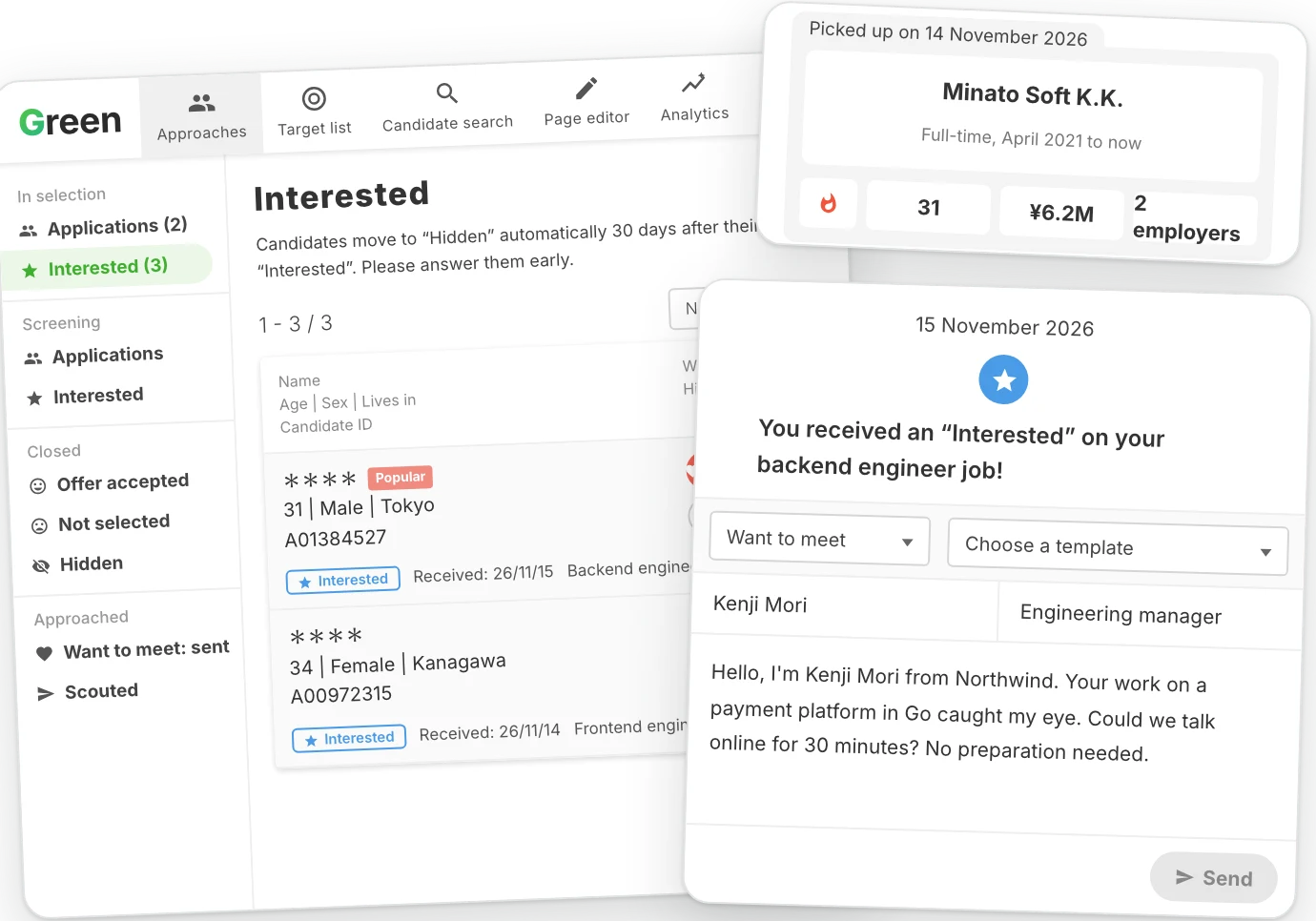
Interested is Green's signature. Tick members in the search results, pick a job, and send. The job lands in the member's list of interested companies. If they ask to hear more, it counts as an application, and Green asks you to offer a casual meeting, not an interview.
Scouts carry your message, and the member answers by applying. Green expects you to meet whoever replies, so only write to people you'd actually meet. The 1,000 scouts reset on the first of each month and don't carry over. You can scout the same person again after 14 days, and send Interested again after 6 months.
Want to meet works the other way round. When a member presses Interested on your job, they land in your Interested folder with their full resume, minus the name and contact details. Send Want to meet with a short note to the ones you like. Answer within 30 days: after that, they move to a hidden folder on their own.
What you see of a candidate, and when
In the search results, you see a member's age, experience, current employer, income, preferred location and school. When a member presses Interested on your job or applies, the whole resume opens, except the name, address, phone number and email. Those appear once the person passes your screening, at the point where you schedule the meeting.
Members, on their side, see your company and job before they answer anything. They can also block companies from seeing their profile, which is how people hide from their current employer.
Green's AI tools: the target list and two labels
Green has three machine-learning tools that help you choose whom to approach:
- Target list: for each job, you describe the target, the must-haves and the exclusions in plain words. Green picks matching members three times a day and learns from the ones you hide. Its console promises over 10 times the reply rate of a normal scout.
- Flame mark: red, yellow or grey, it shows how likely a member is to open and answer. Green recommends filtering on it rather than on the last login date.
- Watching you: the label marks members who viewed your jobs or PR pages in the past 6 months, or jobs like yours. Scouts to them get 2.91 times the usual reply rate, by Green's own count.
Which companies use Green
11,277 companies have registered on Green since 2006, according to Atrae's results presentation. Green describes itself as a job site for IT, web and startup hiring. In a June 2024 survey of HR staff at startups by the recruiting outsourcer Marugoto, Green was among the three platforms most used, with BizReach and Wantedly.
Pricing
Green pricing: a one-off entry fee, then a fee per hire
That's how Green works. Next comes the bill, in two parts: an entry fee, paid once when you join, and a success fee per hire. There's no monthly fee, the number of jobs is unlimited, and the 1,000 scouts a month are included.
Green plans: what the entry fee buys
Green doesn't publish its prices: the price list is a download behind a form. Its help center only gives a range, ¥450,000 to ¥1.2 million depending on the plan. A reseller, Neo Career, lists four plans from Green's November 2026 materials:
| Plan | Entry fee | Branding pages included |
|---|---|---|
| Light | ¥600,000one-off | Core features only |
| Basic | ¥750,000one-off | A PR page or an interview page |
| Standard | ¥900,000one-off | A PR page and an interview page |
| Premium | ¥1.2Mone-off | Both pages, 3 search boosts, 2 newsletters |
Before tax. Source: Neo Career, a Green reseller, citing Green's materials (November 2026).
Every plan shares the core: candidate search, 1,000 scouts a month, unlimited Interested clicks and unlimited jobs. The plans differ by the branding pages Green writes for you and by promotion. Options are sold on top: 200 extra scouts for ¥400,000, a top spot in job search for ¥400,000 (2 weeks, 3 jobs), or a newsletter feature for ¥100,000.
Green success fee: what each hire costs
The success fee is what you'll mostly pay. It's set by the job category you choose when you post the job, and it is locked on the day the person applies. That matters now, because the formula changes for people who apply from 12 January 2027.
Green success fee, before and after January 2027
| Job category | Applied until 11 Jan 2027 | Applied from 12 Jan 2027 |
|---|---|---|
| Engineers (systems, network), executives | ¥1.2M | 20%at least ¥1.2M |
| Sales, marketing, back office, creative, specialists | ¥900,000 | 20%at least ¥900,000 |
| Assistants, service, construction | ¥600,000 | 20%at least ¥600,000 |
| Pay of ¥3 million or less | ¥300,000 off | No discount |
| Upper limit | None | ¥2 million |
Before tax, per hire. 20% of annual pay: monthly pay × 12, allowances except commuting, and bonuses. Sources: Green help center, until January 2027 and from January 2027.
In practice, the new formula costs more in two cases: above a certain salary, and for hires at ¥3 million or less, who lose the ¥300,000 discount. For an engineer, the 20% passes the ¥1.2 million minimum at ¥6 million a year. For a sales or marketing hire, the line is ¥4.5 million. Green's own examples:
| Hire | 20% of annual pay | Success fee |
|---|---|---|
| Assistant at ¥2.8 million | ¥560,000 | ¥600,000the minimum |
| Engineer at ¥5 million | ¥1 million | ¥1.2Mthe minimum |
| Engineer at ¥8 million | ¥1.6 million | ¥1.6M |
| Executive at ¥12 million | ¥2.4 million | ¥2Mthe cap |
Source: Green help center. Before tax.
Before you sign, note 4 rules from Green's help center and terms:
- Any contract counts: full-time, contract, part-time or freelance, the fee is due if the person starts working for you.
- Billing on day one: you report the offer and the start date in the console, and Green invoices on the start date. For applicants from 12 January 2027, you also report the hire's annual pay within 14 days of the decision. Without it, the fee is ¥2 million.
- Half back if they leave fast: Green refunds 50% of the fee if the person leaves within 30 days of starting. You must have reported the start date in advance and tell Green within 7 days.
- No hiring around Green: hiring a candidate you met on Green without reporting it costs 3 times the fee, up to ¥4.5 million.
Clients have until 8 January 2027 to accept the new pricing in the console. Jobs of clients who haven't accepted it are closed, and reopening one counts as acceptance. The contract renews itself each year at no cost, and you can cancel at any time. But the entry fee isn't refunded, and coming back means paying it again, so Green suggests closing your jobs between hiring rounds instead.
How Green fits within your budget
Two fees make a cost per hire in two layers: the entry fee, spread over every hire you ever make, and the success fee on each one. First, how much work one hire takes. Green's figures give a rough path from a month of scouts to a hire:
From 1,000 scouts to a hire
One month of scouts at Green's benchmarks, with the read and reply rates, and the applicants behind each hire.
- 1,000Scouts sent
- 453Read45%read
- 36Replies3.6%reply
- 1Hire1 in 29applicants
Sources: Green help center (benchmark of jobs that hired), Atrae results presentation (21,411 applicants and 747 hires in the quarter to September 2026). Our estimate.
So at Green's averages, 1,000 scouts bring about one hire. Interested clicks and Want to meet add to that, and they cost nothing. Now the money. Picture an engineer joining at ¥6 million a year. At that salary, Green charges ¥1.2 million, before and after January 2027. Add the ¥600,000 Light plan, shared across your hires:
Cost per hire with Green, by number of hires
Light plan and engineers at ¥6 million a year, compared with an agency charging 35%
Agency fee, 1 hire
Green, 1 hire
Green, 2 hires
Green, 3 hires
Green, 4 hires
Before tax. Our calculation with Green's fees and a typical agency rate.
One hire costs only about 15% less than through an agency. The gap widens with volume: a third less from the third hire, and close to half at scale, depending on the agency's rate. Atrae puts its own figure at about 60% of an agency's cost per hire. From 2027, higher salaries narrow the gap: for an engineer at ¥8 million, the success fee rises from ¥1.2 million to ¥1.6 million, against ¥2.8 million through an agency.
Then there's your time. Interested clicks take seconds. A scout written for one person takes about 10 minutes, so 400 scouts a month would cost one person about 67 hours. Three questions decide whether Green pays off:
- Will you hire several engineers a year? The entry fee is paid once, so the savings grow with each hire. For one or two, a flat plan such as Wantedly costs less.
- Do you have an in-house recruiter? Green rewards fast answers and daily approaches, about 30 minutes a day. Without someone to run it, the savings stay on paper.
- Are your roles in IT, web or startup work? Those are the members Green has. For a plant manager or a nurse, look elsewhere.
Members
Who you'll find on Green: 1.63 million users, mostly in tech
Those fees only pay off if the right people are on Green. Atrae's own figures describe who they are.
Green has more than 1.63 million registered users, up from 920,000 five years ago, according to Atrae's results presentation. That's every account ever created, though. Count the people who logged in during the month, and you get 51,902 in September 2026, 7.6% fewer than a year earlier.
Registered users on Green
In millions, at the end of September each year
- 2021:0.92M
- 2022:1.04M
- 2023:1.23M
- 2024:1.39M
- 2025:1.5M
- 2026:1.63M+130,000 in a year
Source: Atrae, results presentations (registered user IDs)
The active count is the one to watch. It peaked in 2023 and has fallen since: Atrae says it is struggling to bring in members through web ads. Hires through Green fell too, to 3,075 in the year to September 2026, from 4,791 in 2022.
Members who logged in during September
Monthly active users on Green, each year
2022
2023
2024
2025
2026
Source: Atrae, results presentations
Who are they? Green says more than half of its candidates are IT and web people, and that 70% of its hires were between 25 and 39 years old (May 2022 to May 2023).
Age of people hired through Green
Hires from May 2022 to May 2023
- Aged 25 to 39
- 70%
- Other ages
- 30%
Source: Green for employers
Engineers know it well. In a survey of 1,154 IT engineers by the web agency Baigie (early 2025), 33.1% had used Green, second only to doda (36.4%) and ahead of Wantedly (29%).
The hires Green is best at
Three profiles stand out when you combine these figures with Green's case studies.
Engineers with a few years behind them
Backend, frontend, infrastructure, mobile: IT and web people are more than half of Green's candidates, and most hires are between 25 and 39. Their success fee is at least ¥1.2 million, and Green competes head-on with engineer-only platforms here.
Designers and web directors
Creative roles carry a minimum fee of ¥900,000, a quarter less than engineers, and Green claims the most engineer and creative job posts of any job site. A startup that needs one designer and one engineer can cover both on the same contract.
Sales and back-office people at startups
Green isn't only for tech roles. Recree, a 50-person HR company for the construction industry, received 2,000 applications in 18 months and hired for sales and back-office roles. Those jobs reach people who want to work in a tech company without being engineers.
Pros and cons
Green pros and cons: cheaper at scale, if your team does the work
Green's main strength is the price structure. You pay the entry fee once, approaches are free, and every new hire lowers what each one costs. Its main weakness is the effort it asks for, and a member base that is shrinking.
Slightly cheaper than an agency, close to half at scale
The savings depend on volume. For one engineer at ¥6 million, Green costs ¥1.8 million with the Light plan, against ¥2.1 million through an agency: only about 15% less. Hire ten in a year and the entry fee all but disappears: each hire costs about ¥1.26 million, 40% less, and close to half against an agency charging 40%. Between hiring rounds, you close your jobs and keep the account for free.
The trade-off: you do the work an agency would do. You search, click, write and follow up. Green also pushes you down the job search when you leave a candidate unanswered for 14 days. So the savings show up for companies with an in-house recruiter, and rarely for the others.
What companies say about Green
Few employers review Green in public. On ITreview, the B2B review site, Green scores 4.4 out of 5, but from only 3 reviews. On BOXIL, 21 reviews give it 3.86, the latest in January 2024. The same points come back.
On the plus side:
- A low upfront cost, with 1,000 scouts included.
- Interested clicks are easy to send in batches.
- A success fee lower than other platforms, so a lower cost per hire.
- A good supply of IT people.
On the minus side:
- Low reply rates on scouts.
- Only 3 search conditions can be saved, according to two reviewers.
- Thin profiles: some members fill in little.
- Account limits when replies to candidates are slow.
- A recent price increase, mentioned by one reviewer.
Fewer active members, and replies that take work
For a company starting out, two figures deserve attention. Active members fell by 7.6% in a year, and hires through Green by about 9%. And the scout reply rate is low: Green's benchmark for jobs that hired is 3.6%, and one agency measured 2.2%. Without a well-written job page and fast answers, most scouts go unanswered.
The table sums up Green's strengths and limits.
| Topic | Pros | Cons |
|---|---|---|
| Cost | Close to half an agency's cost per hire at scale | Only about 15% cheaper for a single hire |
| Reach | 1.63 million users, a third of IT engineers | Monthly active users down 7.6% in a year |
| Candidates | IT and web people, 70% of hires aged 25 to 39 | Few senior executives |
| Salary | Fee capped at ¥2 million from 2027 | The minimum fee exceeds 20% on lower salaries |
| Workload | Interested clicks, free and 100 at once | Daily follow-up, or your jobs sink in search |
| Scouts | 1,000 a month included | Reply rate of about 2 to 4% |
Comparison
Green vs other hiring platforms: fees, members and scouts
Green is rarely the only option on your list. Here it is next to the other platforms employers in Japan weigh, from engineer-only sites to the large job boards.
| Sort by | ||||
|---|---|---|---|---|
 dodaJob board, agency and scouts (Persol) | 10.99MJune 2026 | Not public | Not public | Not public |
 Rikunabi NEXTJob board (Recruit) | 10M+Unofficial estimate | Not public | Not public | Not public |
 LinkedIn Recruiter CorporateAll professions | 5M | ¥1,700,00012 months | 150¥944 per scout | None |
| LinkedIn Recruiter LiteAll professions | 5M | ¥16,0001 month | 30¥533 per scout | None |
 Wantedly StandardMid-career, new grads | 4.57M | ¥900,0006 months | 25¥6,000 per scout | None |
| Wantedly PremiumMid-career, new grads | 4.57M | ¥1,320,0006 months | 50¥4,400 per scout | None |
 BizReachExecutives, high income | 3.53M | ¥850,0006 months | 67¥2,125 per scout | 15%of salary |
 OpenWorkMid-career, new grads | 1.83M | ¥1,200,00012 months | 833¥120 per scout | ¥300K–800K |
 GreenIT and web | 1.63M | ¥600,000One-off | 1,000Included | 20%of salary |
 YOUTRUSTMid-career | 500K | ¥2,400,00012 months | 20¥10,000 per scout | None |
 doda XExecutives | 400K | ¥1,050,0008 weeks | 217¥2,625 per scout | None |
 FindyIT engineers | 165K | ¥360,0006 months | 35–70 a weekLikes | 30–35%of salary |
 LAPRASIT engineers | 40K | ¥945,0006 months | Unlimited | None |
Source: SaiyouTeam research, platforms' published figures (November 2026). Green's success fee: 20% of annual pay for applicants from 12 January 2027, at least ¥600,000 to ¥1.2 million by job type. Click a column to sort.
Two columns matter most for Green. The entry plan: a one-off payment, where most rivals charge for 6 or 12 months. And the scouts: 1,000 a month, more than any other platform in the table, at no extra cost. The success fee is where Green moves toward BizReach and Findy: from 2027, it follows salary, like theirs.
For engineer-heavy hiring, Green sits between two models. Wantedly charges a monthly plan with no success fee, and reaches a younger crowd. BizReach adds a 15% success fee to a 6-month plan, and reaches older, higher-income people. Green costs the least to start, and charges the highest success fee of the three.
To compare them for your own roles, the kit's recruiting platforms list puts each platform, what you do on it and its pricing in one sheet.
Strategy
How Green fits in your hiring strategy
Green works best as one channel among two or three, for companies that hire engineers at scale with their own recruiters. Outside that case, another channel often does the job for less.
Three cases below show where Green fits, and where it doesn't.
-
Scenario 1
8 engineers a year at a 120-person software company with two recruiters
Candidate personaBackend, frontend and infrastructure engineers with 3 to 8 years of experience, earning ¥5 to 7 million.
Strategy
- Green
- Employee referrals
Green as the main channel: the recruiters send Interested clicks every week, scouts to the best profiles and Want to meet every morning. Referrals on the side.
Plan
Standard, ¥900,000Eight engineers at ¥6 million cost about ¥1.31 million each, against ¥2.1 million through an agency: close to 40% less. At that volume, the PR and interview pages are worth having.
-
Scenario 2
1 backend engineer at a 25-person web company
Candidate personaA backend engineer with 4 to 6 years of experience, earning about ¥6 million, curious about a small product team.
Strategy
- Wantedly
- Employee referrals
Not Green: for a single hire, its entry fee and ¥1.2 million success fee add up to ¥1.8 million. Wantedly charges a flat plan with no success fee, and a referral costs a bonus at most.
Plan
Wantedly Standard, 6 months¥900,000 for six months, half of what Green would cost for this one hire. If the role is still open after that, an agency is the fallback.
-
Scenario 3
6 engineers in a year at a 60-person company with no recruiter
Candidate personaEngineers with 3 to 10 years of experience, some of them bilingual, earning ¥6 to 9 million.
Strategy
- LinkedIn
- RPO
Not Green: without a recruiter, nobody runs its daily routine. An RPO team, recruiters hired by the month, sources on LinkedIn Recruiter, with 5 million members in Japan, bilingual engineers included, and runs the selection for you.
Plan
LinkedIn Recruiter, run by the RPONo success fee per hire: a recruiter seat at ¥1.7 million a year, plus the RPO's monthly fee, usually ¥100,000 to ¥800,000 depending on the hours. Six hires cost less than the ¥12.6 million or more an agency would charge.
Should you run Green yourself or outsource it?
The daily routine is where the hours go: sending Interested clicks, reading resumes, answering within a day, writing scouts. Green's case studies show a small team can do it in 10 minutes a day to 2 hours a week. Scouts written one by one take longer.
- Run it yourself if a recruiter or a manager can give it 30 minutes a day. Nobody describes your team better than you.
- Outsource the scouts if you need volume fast. Scouting agencies charge ¥100,000 to ¥300,000 a month for 150 to 500 scouts, or a fee per hire, on top of Green's.
- Keep the meetings in-house either way. The person who will manage the hire should talk to every candidate.
Whoever writes the scouts, keep everything inside Green. Its rules forbid using scouts to move candidates to email or to your own careers site, and Green can take your jobs down for it.
Getting started
Getting started with Green
Setup comes first, until your job is live. Then the daily work begins, from search to hire.
Setup: from the first meeting to a live job
Ask Green for a meeting
Send the contact form on Green's employer site, or download the price list. A sales meeting follows, where you pick a plan and sign. Green also runs free 45-minute webinars with a demo of the console.
Build your company page
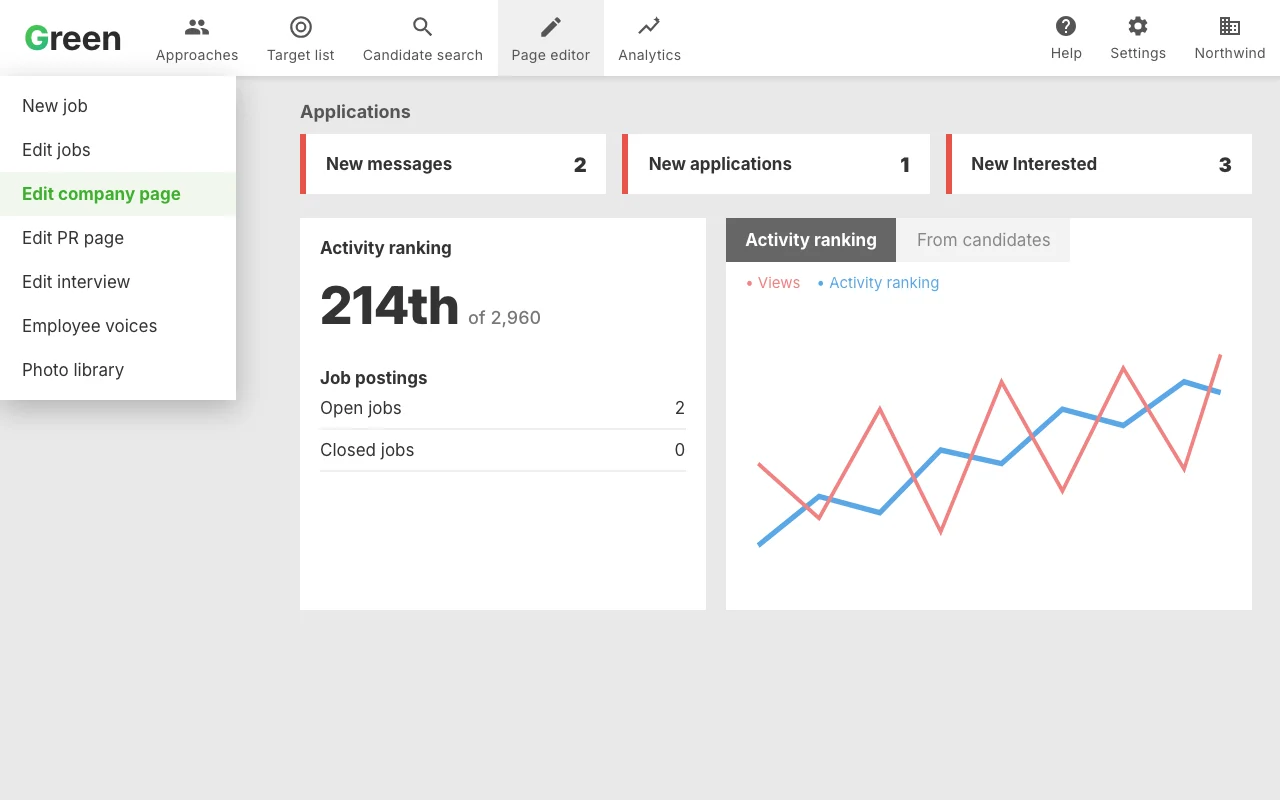
Green interviews you and takes photos. You then complete your company, PR and interview pages in the page editor. Job pages go live only once the company page does.
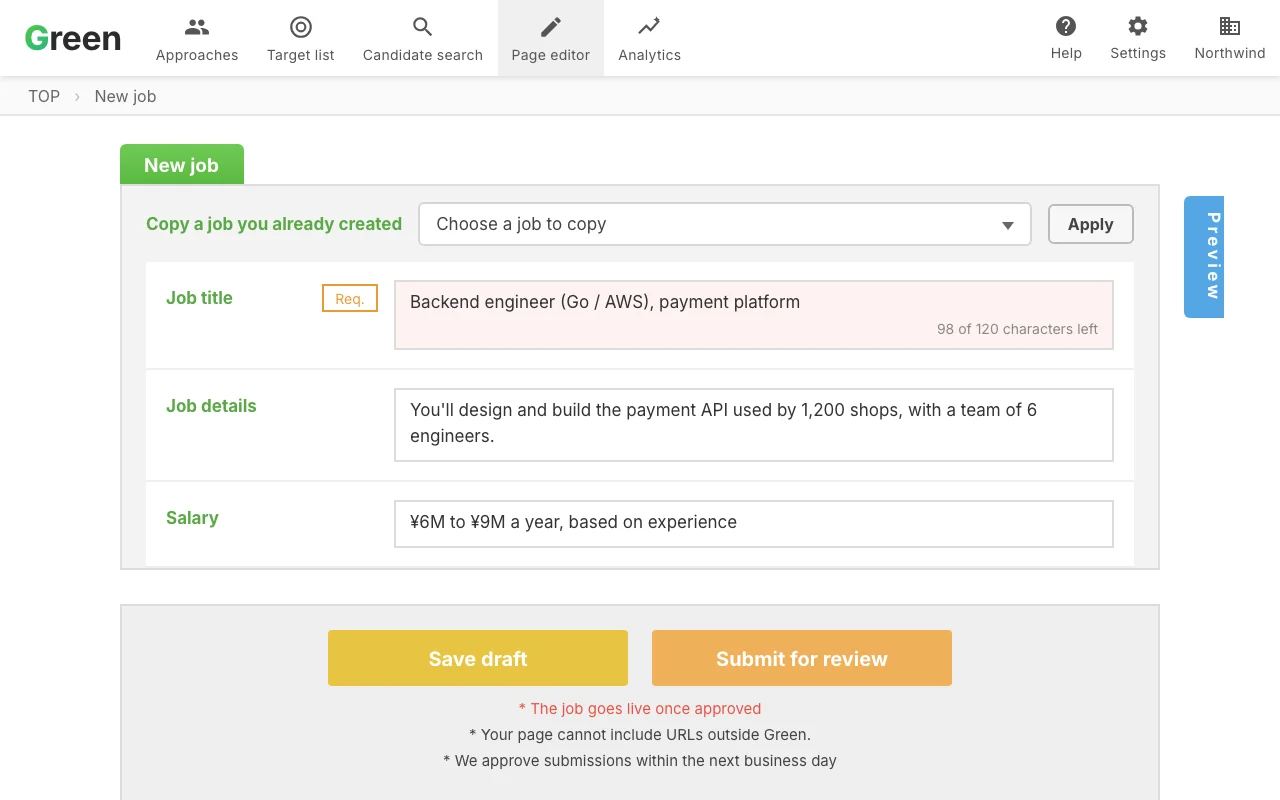
Post your jobs
Create each job and submit it: Green approves it within the next business day. Pick the job category with care, as it sets the success fee. Add at least 3 photos and the lower end of the salary.
Daily work: from search to hire
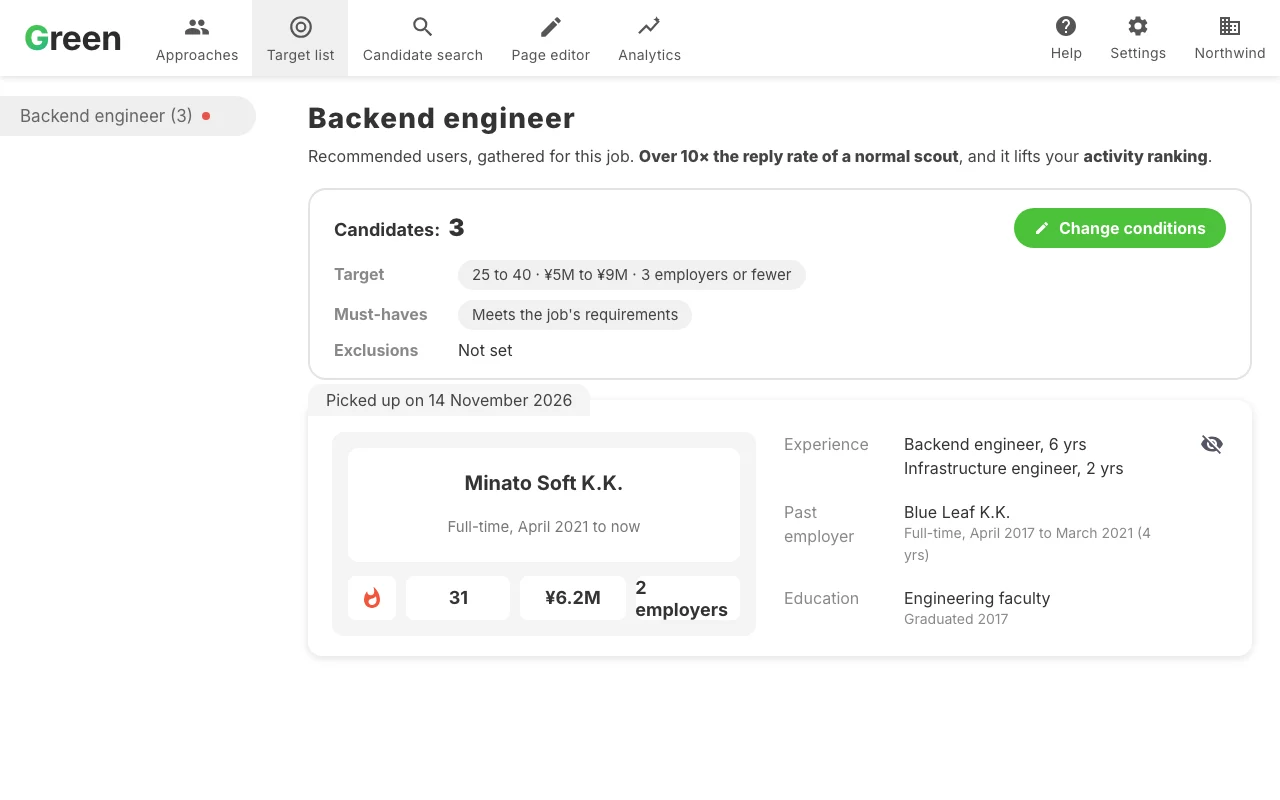
Set the target list
For each job, describe the target, the must-haves and the exclusions. Green picks matching members three times a day. Hide the bad matches: it learns from them.
Search, send Interested clicks and scouts
Turn on the likely-to-reply filter and save your searches. Send Interested to up to 100 members at once, and scouts to the profiles you'd meet this week.
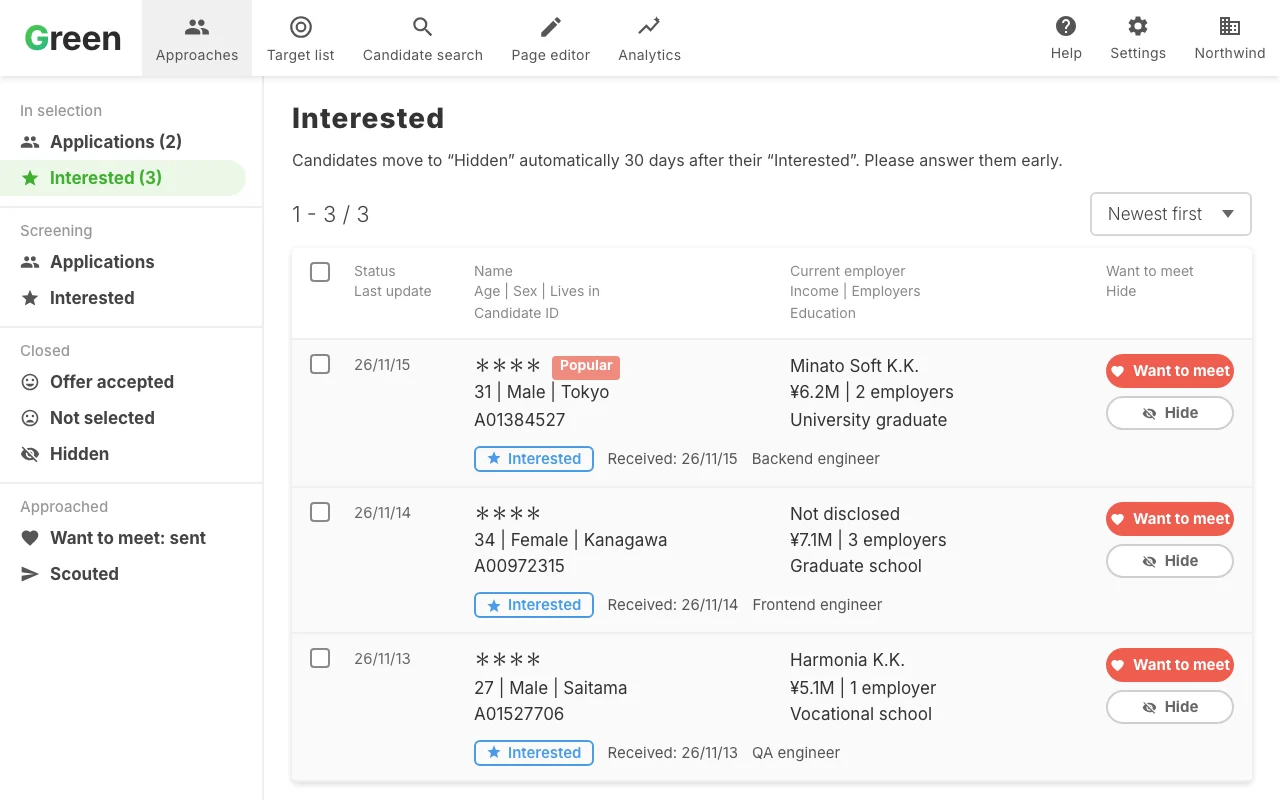
Answer Interested with Want to meet
Open the Interested folder every day. Read each resume, then send Want to meet to the people you'd meet, and hide the others.
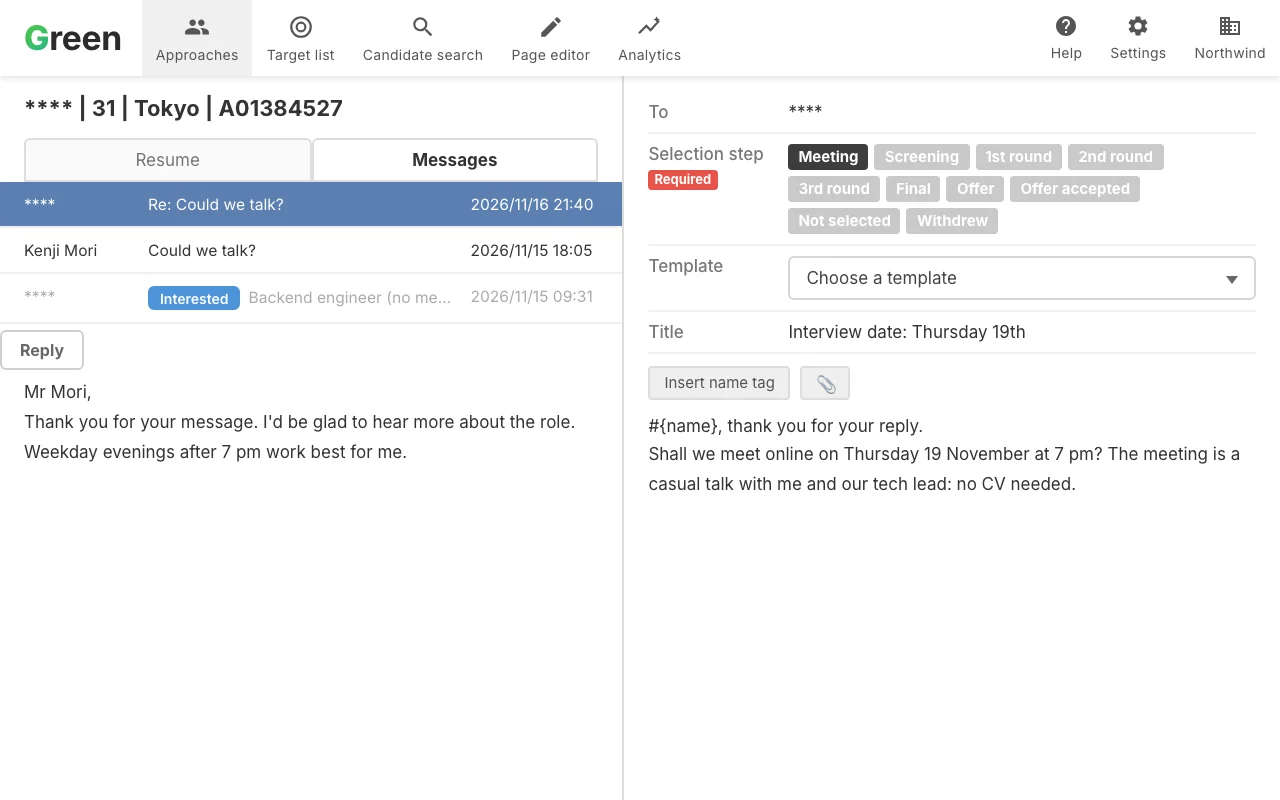
Meet, then move each candidate through the steps
Offer a casual meeting first: Green calls it an exchange of information, so skip the questions about motivation. Every message you send sets the selection step, from meeting to offer or rejection.
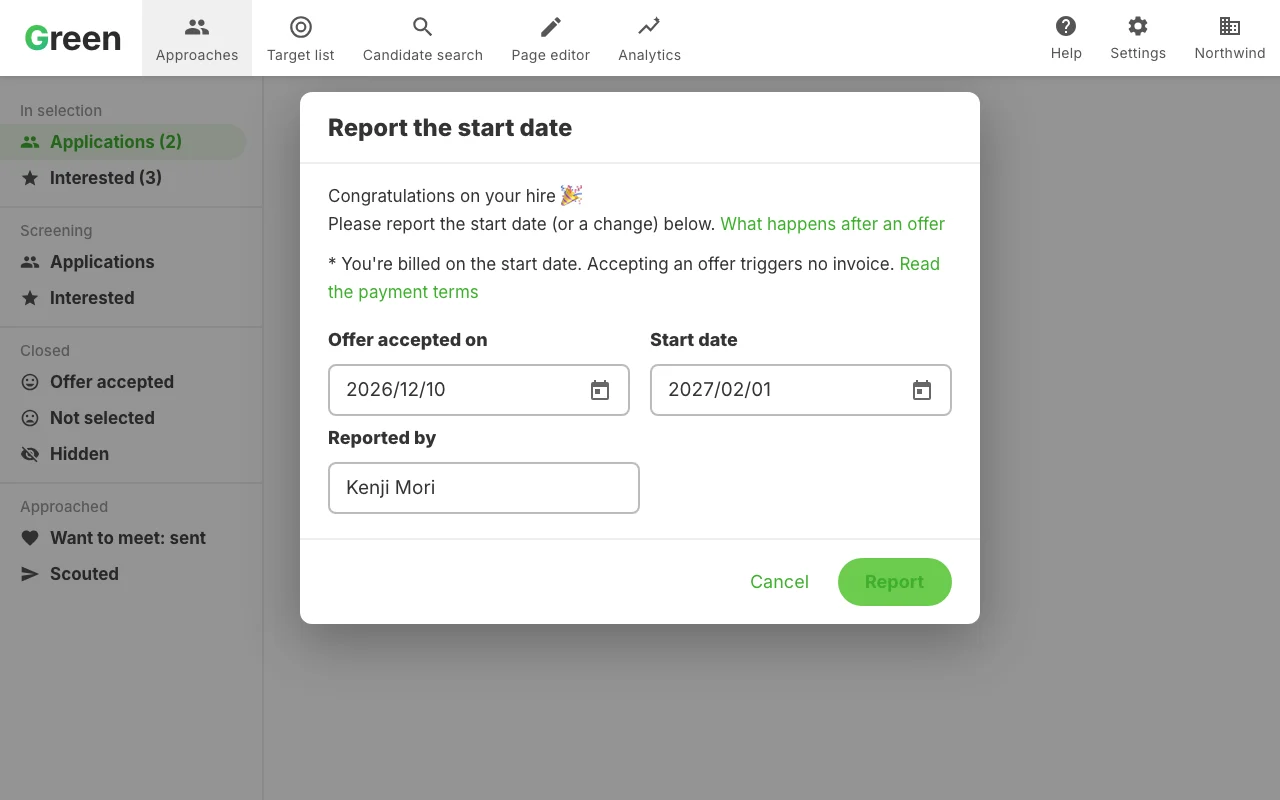
Report the hire
When the candidate accepts, report the offer date and the start date. For applicants from 12 January 2027, also report the annual pay within 14 days of the decision. The invoice follows the start date.
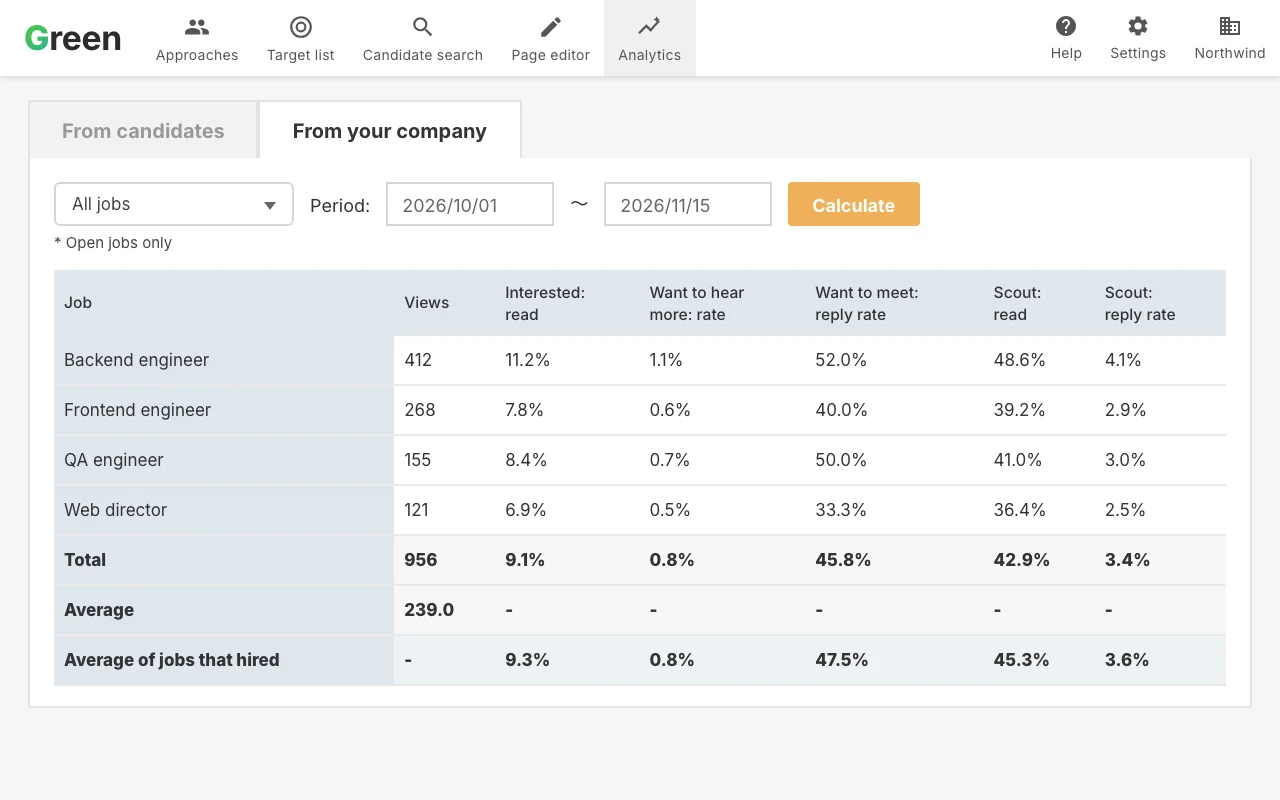
Compare your numbers with the benchmark
Every two weeks, open Analytics, set the period and read each job against the average of jobs that hired.
Results
How to measure success on Green, and improve
Once your jobs are live, two questions come up: how long until the first hire, and whether your numbers are normal.
How long it takes to hire through Green
The start takes a few weeks. Green says a job goes live 3 to 4 weeks after the contract, 2 days at the fastest, because of the interview, the photos and the review. After that, Green's published cases hired for the first time 1 to 4 months after posting: CARROT and Aprender in about a month, CI, a 20-person developer, in just under 4.
Selection then takes its usual time. What to do once candidates answer is in our hiring process guide.
Hiring through Green, week by week
Jobs live after 3 to 4 weeks, first hires 1 to 4 months later
- Week 1Meeting, plan and contract
- Weeks 2 to 4Interview, photos, pages approved
- Weeks 5 to 12Daily approaches, then meetings with those who answer
What a good reply rate on Green looks like
Three numbers matter on Green: the reply rate to scouts, to Want to meet, and the share of Interested clicks that turn into a request to hear more. Green's analytics page sets each against the average of jobs that hired. In a screenshot from its help center, those averages are 3.6% for scouts, 47.5% for Want to meet and 0.8% for Interested clicks.
Scouts on Green get fewer replies than on most platforms. Direct Sourcing, which runs scouts for client companies, measured reply rates on over 800,000 scouts it sent:
Scout reply rate by platform
Replies to scouts sent by one agency, September 2025
Findy
Wantedly
YOUTRUST
LinkedIn
BizReach
OpenWork
Green
Source: Direct Sourcing. One agency's data, not a platform average.
The low figure isn't a verdict on Green: its scouts are cheap and plentiful, so companies send more of them, to wider lists. On Green, the scout is the backup. Interested clicks and Want to meet do most of the work.
How to improve your Green reply rate
The entry fee is already paid, so every extra reply makes each hire cheaper. These habits make the biggest difference:
- Answer within a day: Green says a one-day delay lowers the reply rate by 10%. Open the Interested folder every morning.
- Filter on the flame: switch on likely to reply, and drop the last-login filter, which hides active people.
- Scout people watching you: their reply rate is 2.91 times the usual. The target list goes further, picking members that fit each job three times a day.
- Write for one person: Green's team found 5 points in scouts that get answers: what you valued in the resume, the role you see for them, proof of what you claim, a word of consideration, and an easy way to reply.
- Fix the job page first: every member reads it before answering. Use a precise title, 3 photos of real people and the lower end of the salary.
FAQ
Frequently asked questions about Green
What is Green?
Green is a Japanese job site for hiring experienced IT and web professionals, run by Atrae since 2006. You post jobs for a one-off entry fee, approach members with free Interested clicks and up to 1,000 scouts a month, and pay a success fee when someone joins.
How much does Green cost for employers?
A one-off entry fee of ¥450,000 to ¥1.2 million, depending on the plan, then a fee per hire. There is no monthly fee and no limit on job posts. One reseller lists four plans: ¥600,000, ¥750,000, ¥900,000 and ¥1.2 million.
What is the Green success fee?
For people who apply until 11 January 2027, it is fixed by job type: ¥1.2 million for engineers and executives, ¥900,000 for sales, marketing, back-office and creative roles, ¥600,000 for assistants, service and construction. From 12 January 2027, it is 20% of the hire's annual pay, never below those amounts and never above ¥2 million. Tax is extra.
What changes on Green in January 2027?
For people who apply from 12 January 2027, the success fee becomes 20% of annual pay, with the old fixed fees as a minimum and a ¥2 million cap. The ¥300,000 discount for salaries of ¥3 million or less ends, and you report the hire's pay within 14 days of the decision. Clients who haven't accepted the change by 8 January 2027 see their jobs closed until they do.
Does Green refund the fee if the hire leaves?
Half of it. Green refunds 50% of the success fee if the person leaves within 30 days of starting, as long as you reported the start date in advance and tell Green within 7 days of the departure. The entry fee is never refunded.
What is the difference between Interested and a scout on Green?
Interested is a click with no message: free, unlimited, and up to 100 members at once. The candidate sees your job and can answer "want to hear more". A scout carries your message, counts against 1,000 a month, and commits you to meet whoever replies.
What is Want to meet on Green?
It is your answer to a member who pressed Interested on one of your jobs: a message that offers a meeting, with no limit on how many. Green puts its reply rate at about 50%, and says about 3 in 10 of its hires come through it.
How many people use Green?
More than 1.63 million registered users, and 51,902 who logged in during September 2026. 11,277 companies have registered since launch, and 3,075 people joined a company through Green in the year to September 2026.
What reply rate should I expect from Green scouts?
Around 3 to 4%. In Green's own analytics, jobs that led to a hire average 3.6% for scouts and 47.5% for Want to meet. Direct Sourcing, which scouts for client companies, measured 2.2% on Green in September 2025.
How long does it take to hire with Green?
Green says a job goes live 3 to 4 weeks after the contract, 2 days at the fastest. Its published cases made their first hires 1 to 4 months after posting.
Is Green a good fit for a small company?
Only if it hires several engineers a year and has someone to run Green every day. For one or two hires, the entry fee and a ¥1.2 million success fee make Green only about 15% cheaper than an agency, and a flat plan like Wantedly costs less. Green pays off at scale, with an in-house recruiter.
Can I cancel Green?
Yes, at any time, but the entry fee is not refunded, and coming back later means paying it again. Green suggests closing your jobs instead: closed jobs cost nothing and reopen for free.
Can I use Green in English?
No. The employer console and the candidate site are in Japanese only, and candidates cannot enter an English resume. You can still post a job that requires English, in Japanese.
Does Green have AI features?
Yes, three. The target list picks members for each job three times a day and learns from your feedback. The flame mark shows who is likely to reply, and the Watching you label marks members who viewed your pages or similar jobs.
How is Green different from Wantedly and BizReach?
Green charges a one-off entry fee and a success fee, with 1,000 scouts a month included. Wantedly charges only a monthly plan. BizReach adds 15% of salary per hire to a ¥850,000 six-month plan, and reaches older, higher-income candidates.
DIY Hiring Kit
Everything You Need To Hire On Your Own
A downloadable hiring framework for small businesses in Japan, with step-by-step guides, spreadsheet ATS, LinkedIn scouting system, interview questions bank, offer letter and employment contracts, and a ton more!
1Dashboard11Checklists8Spreadsheets30Template docs4Weeks of Q&ABilingual
- Download every file as Word, Google Docs, Excel or Google Sheets


 14 years in talent acquisition
Related
Related guides and tools
 Guide
What is BizReach? Pricing, scouts and how to hire with it
The scouting platform for experienced, higher-income candidates.
 Guide
What is Wantedly? Pricing, plans and how to hire with it
The flat-fee platform for people in their 20s and 30s.
 Hiring practices
What is direct recruiting? Scouting vs agencies
The method behind Green's scouts, and what other platforms cost.
 Hiring practices
What is a casual interview?
The first meeting Green asks you to offer after a reply.
 Tool
Cost per hire: averages and calculator
Work out the entry fee and success fee per hire with your numbers.
 Guide
How to design a hiring process for SMBs
What happens after a candidate replies: selection to offer.
Official sources
The main sources for this guide. Other references are linked where they are used in the text.
- Atrae, Inc.ssl4.eir-parts.net Results presentation, year to September 2026 Registered and active users, client companies, hires, and the success-fee change of January 2027.
- Greensupport.green-japan.com Success fee for applicants from 12 January 2027 20% of annual pay, the minimum by job type, the ¥2 million cap and the reporting rules.
- Greensupport.green-japan.com Success fee for applicants from 1 November 2022 The fixed fee by job type that applies until 11 January 2027.
- Greensupport.green-japan.com Interested and scouts: the difference No message vs a message, unlimited vs 1,000 a month, and when you can send again.
- Greenget.green-japan.com Green for employers Lead time to go live, scouts included, and the age and job profile of hires.
- Direct Sourcingdirectsourcing-lab.com Scout reply rates by platform Reply rates measured on over 800,000 scouts, Green included (September 2025).