
What Is BizReach?Pricing, Scouts and How to Hire With It
A practical guide to BizReach for companies hiring experienced people in Japan. It covers how platinum scouts work, pricing and the success fee, and the steps to start hiring with it.

Basics
What is BizReach?
In short
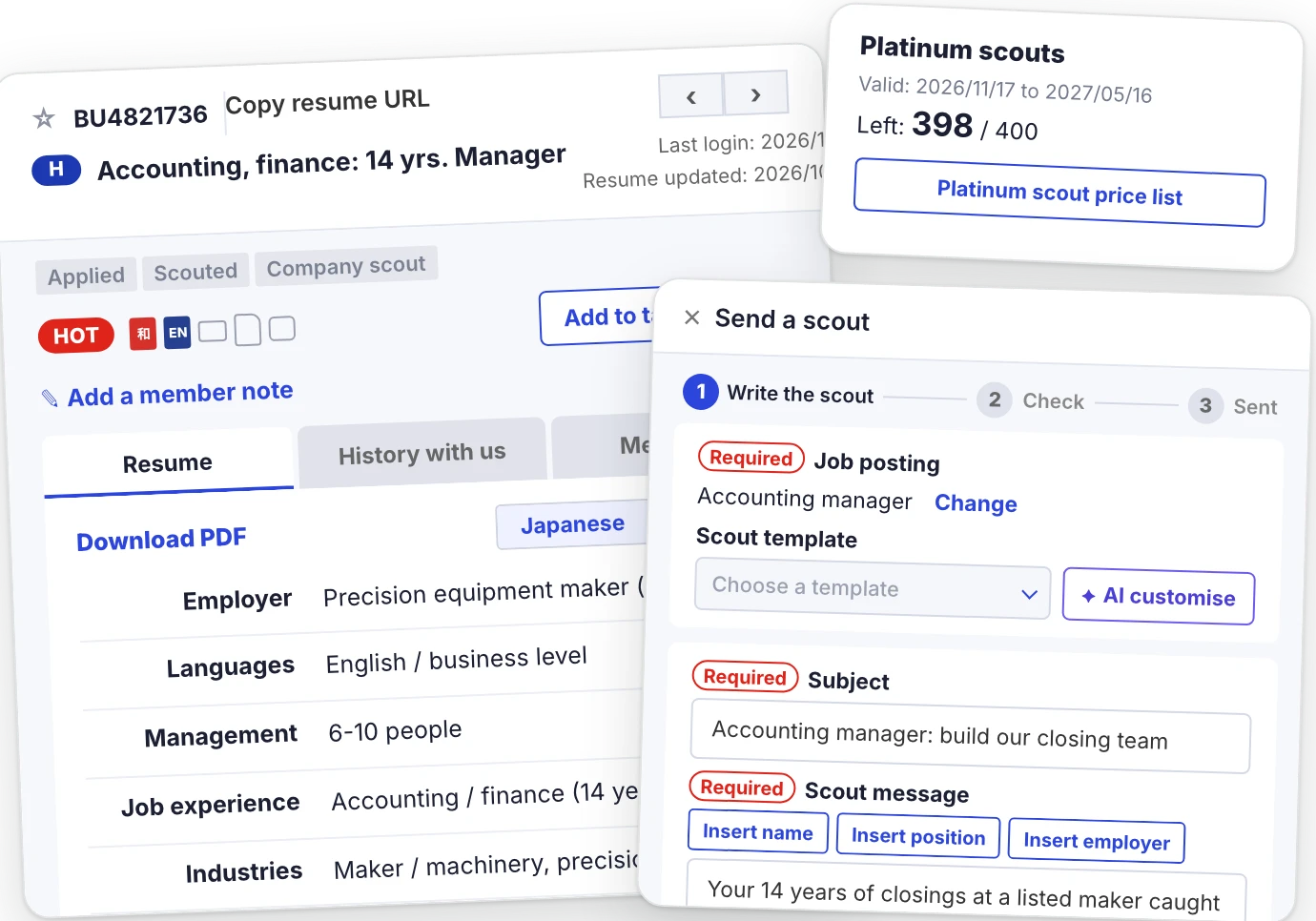
BizReach is a Japanese scouting platform for hiring experienced, higher-income professionals. Companies search a database of screened members by job type, income or experience, and send them scout messages, called platinum scouts, that promise a first meeting.
You probably have a senior role to fill: a plant manager, a finance head, a sales director. Agencies ask for about 30% of the salary, and job ads bring nobody at that level. You've heard that on BizReach, companies scout these people themselves. But its price list sits behind a form, and its members get messages from thousands of other employers. So you need two answers: what it really costs, and whether a company your size gets replies.
I've worked in recruiting for more than 14 years, at Google and Persol Career among others, and contacting candidates directly was part of my daily work. I now run recruitment consulting services for small and mid-size companies, and many free consultations open with the same question: where do we find experienced people? For this guide, I went through BizReach's employer help center, its parent company's securities report and published campaign data. You're reading one chapter of our hiring playbook.
- First, how BizReach's scouts work, and why it's neither a job board nor an agency.
- Then the plans and pricing: the base fee, the 15% success fee, and what a hire really costs.
- Next, who its 3.53 million members are, followed by the pros and cons.
- After that, BizReach next to other scouting platforms, and its place in your hiring strategy.
- The guide ends with practice: getting started step by step, and the reply rates to aim for.
How it works
How BizReach scouts work, and why companies use it
Isn't BizReach just a job site with a higher price tag? You do post jobs on it, and candidates can apply. But posting isn't what you pay for. What you buy is the right to knock on a candidate's door, and every knock is counted.
BizReach vs job boards and recruiting agencies
A BizReach contract lets you do four things:
- Search the member database by job type, industry, income, management experience or last login.
- Send platinum scouts: scout messages to the candidates you picked. Each one promises a meeting.
- Publish job postings, as many as you like. Members can also apply on their own.
- Message and schedule with everyone who replies, and follow each candidate up to the hire.
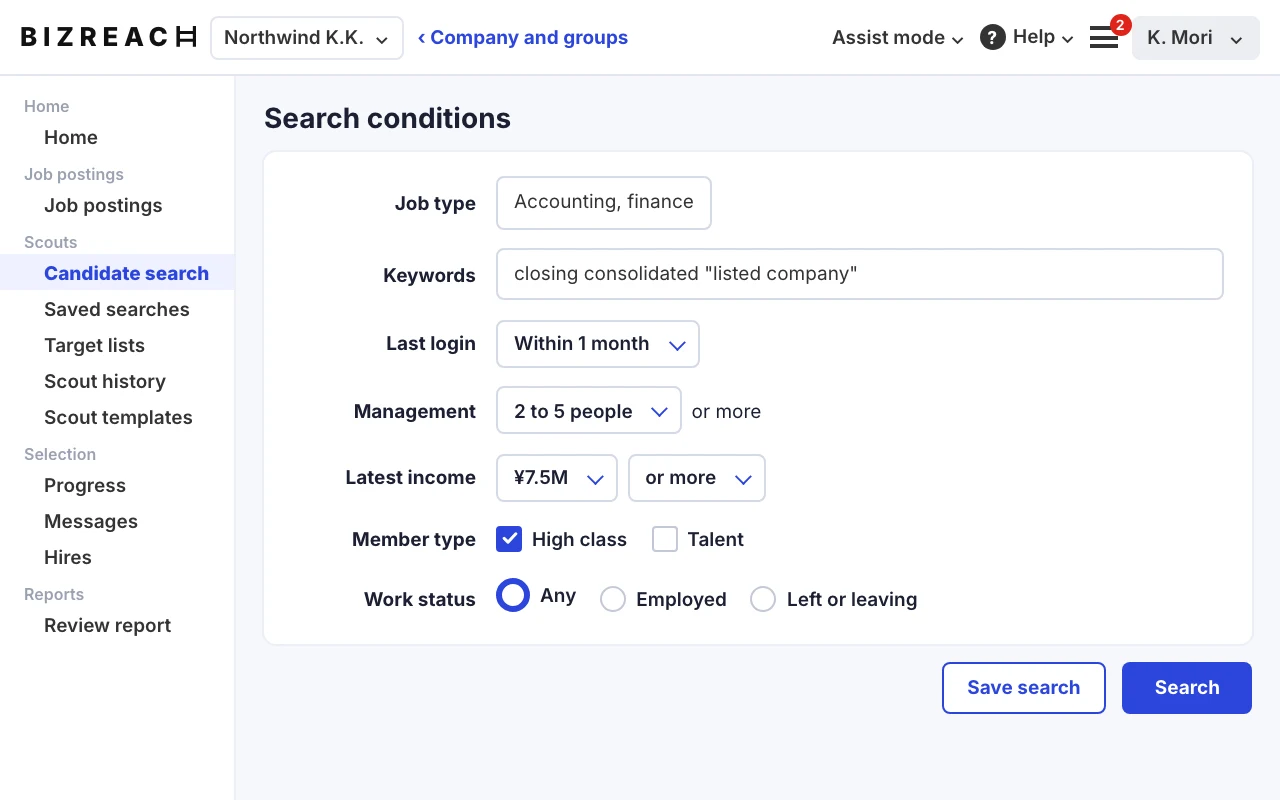
A search looks like this:
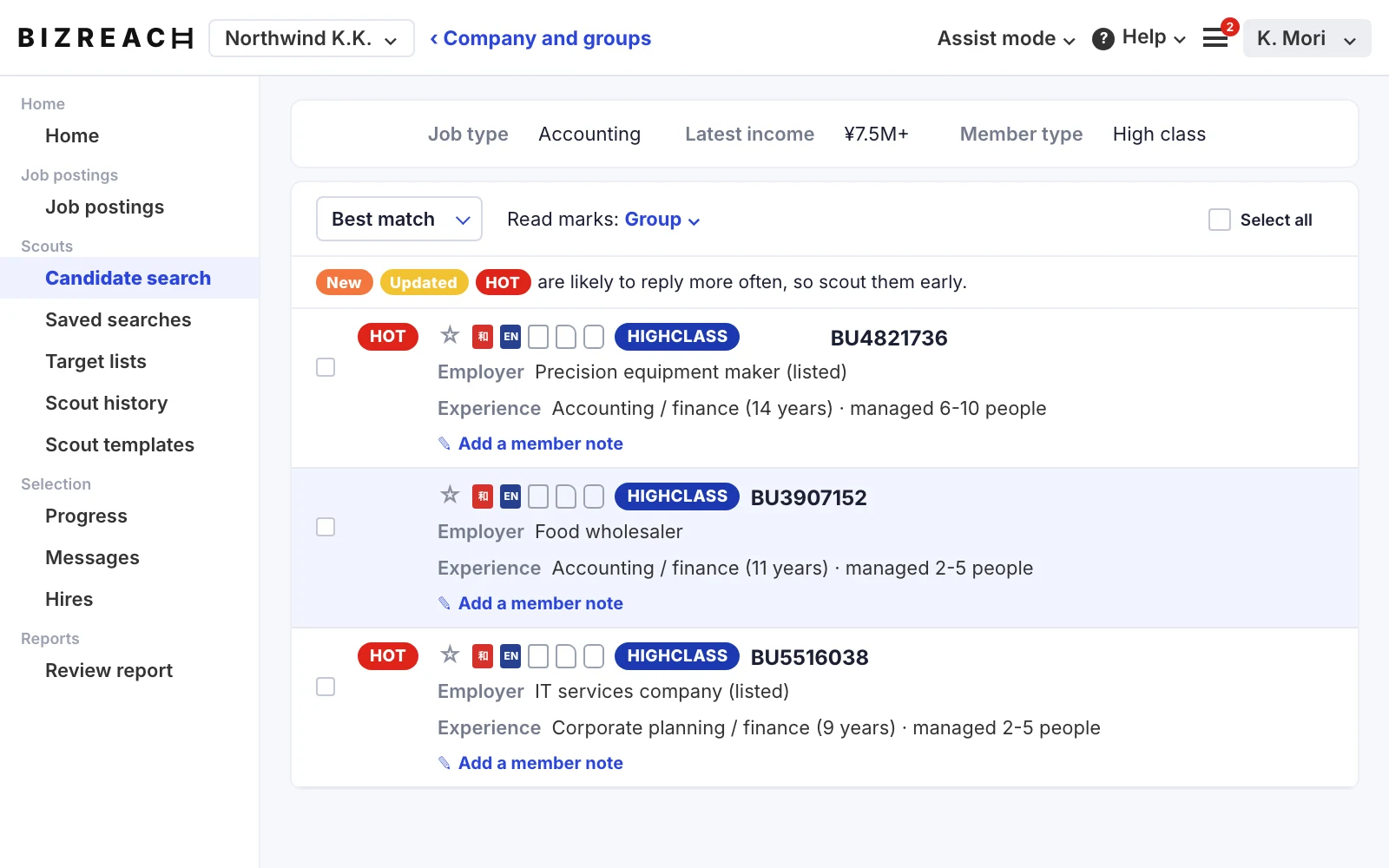
Candidate search on BizReach (mock-up)
- Search conditions: job type, latest income, member type
- HOT: candidates BizReach expects to reply more often
- HIGHCLASS: the member's class, set by current income
- Member ID: no name until the candidate replies
So far, it resembles any resume database. But 3 differences shape your budget:
- Difference 1You pay twice: to get in, and for each hire. A job board charges for the ad. An agency charges only when you hire. BizReach does both: a base fee for the length of the contract, then a success fee on each hire's salary.
- Difference 2Every scout promises a meeting. BizReach has one kind of scout, the platinum scout, and it commits you to a meeting or an interview with whoever replies. So you can't write to a thousand people and sort them later. Your plan also includes a fixed number of them.
- Difference 3You're not the only one knocking. 23,100 companies used BizReach in the year to July 2026, and 9,500 headhunters scout the same members. A good candidate's inbox is crowded, and a generic message gets no answer.
So how many answers can you count on? In a 2023 interview on its own guide site, BizReach puts its overall average reply rate at 8%. And its price guide sizes the 6-month plan, with 400 platinum scouts, for 1 to 2 hires. That's 200 to 400 scouts for each hire.
Here's what BizReach comes down to: it's a paid seat at a table where experienced candidates already sit. It suits companies that will write to each person as a person. It's the wrong tool for filling ten junior roles quickly.
Platinum scouts: BizReach's only scout
Older articles describe two kinds of scouts on BizReach. Today there's only one: the platinum scout. It works on five rules.
- A promised meeting: a platinum scout tells the candidate you'll meet them if they reply. BizReach asks you to hold at least one meeting, which can be a casual interview.
- A fixed number: scouts come with the contract, not month by month. The 6-month plan includes 400, and each scout you send uses one.
- Two free sends: the pick-up candidates BizReach lists each day can be scouted without using one. So can the automatic resend to people who haven't replied.
- Anonymous until the reply: you see a member ID, an employer and a career. The name and age appear once the candidate answers.
- Free and paying members alike: candidates can pay for a premium plan, but it changes nothing for you. Both can read and answer your scout.
One limit decides who you can write to. BizReach sorts its members into two classes by current income: high class members earn ¥7.5 million or more, and talent members earn less. A job posting is open to one class or both, and your scouts only reach that class.
Headhunters on BizReach: the other senders
Companies aren't BizReach's only clients. Recruiting agencies use it too: their consultants appear as headhunters, and they scout the same members to place them with their own clients. They pay BizReach for it, and bring in a third of its revenue.
For you, that means two things. The candidate you write to may already be talking to several headhunters. And a headhunter may present you a BizReach member: that person then comes at the agency's fee, like any agency introduction.
Candidates see a score and a rank for each headhunter, from S down to D, and the best-ranked ones can send a so-called exclusive scout. None of that applies to the scouts a company sends itself.
Which companies use BizReach
BizReach counts 45,800 client companies since its launch, and 23,100 used it in the year to July 2026, according to its parent company's securities report. They aren't all large: by BizReach's own figures, about half have 100 employees or fewer, a third have 101 to 500, and 18% have more than 500.
Its case studies show what they come for. A manufacturer in Hamamatsu hired an executive officer and a future sales office head. A logistics company in Osaka hired 24 people in 4 years, most of them managers. A small IT company hired 6 engineers in 6 months. The common thread is experience: companies use BizReach for the roles a job ad can't fill.
Plans and pricing
BizReach plans and pricing: the base fee and the success fee
Up to here, I've described what BizReach does. Now for what it charges. Every plan has the same two parts: a base fee for the length of the contract, and a success fee for each person you hire.
BizReach says it has four plans, but its price guide only outlines two. They differ on one thing: the length of the contract, and with it the number of platinum scouts.
What a BizReach plan includes
| Feature | 6-month plan | 12-month plan |
|---|---|---|
| Platinum scouts | 400 | 800 |
| Sized for | 1 to 2 hires | 2 to 3 hires |
| Job postings | Unlimited | Unlimited |
| Support contact | Included | Included |
| AI tools | Included | Included |
Both scout figures include 50 scouts granted for the first month only. Source: BizReach, pricing for employers (checked November 2026)
Three things are the same on every plan: job postings without a limit, a contact at BizReach who helps you get started, and the AI tools that draft a job posting or adapt a scout to a resume.
If you run out of platinum scouts, you can buy more through your sales contact. BizReach doesn't publish that price.
BizReach pricing: what the plan and the success fee cost
BizReach's site shows no prices: the price list comes by email, after a 7-question form. But its parent company, Visional, states the main figures in its securities report. On the Standard plan, the base fee is ¥850,000 for 6 months, and the success fee is 15% of the hire's annual salary.
BizReach price list (Standard plan)
| Item | Standard plan |
|---|---|
| Base fee, 6 months | ¥850,000about ¥142,000 a month |
| Platinum scouts included | 400¥2,125 each |
| Success fee, per hire | 15%of the theoretical annual salary |
| Base fee, 12 months | On request |
Prices exclude tax. Sources: Visional securities report (October 2026), BizReach price guide
The success fee is calculated on the theoretical annual salary: 12 months of fixed monthly pay, plus the bonus the position normally earns. For someone hired at ¥8 million, that's ¥1.2 million.
Before you sign, read 4 contract rules:
- The success fee has a floor. Contracts carry a minimum amount per hire. BizReach doesn't publish it, so ask for it with the quote.
- Leaving early doesn't cancel the fee. If your hire quits after a month, BizReach doesn't refund or reduce the success fee.
- The fee follows the candidate, not the contract. It's due for anyone you first met through BizReach, even if they join after your contract ends, and even as a contractor or a part-timer.
- Nothing renews by itself. You pay the base fee upfront. You can stop mid-contract, but nothing comes back. At the end, you sign again or you're out.
There's no free trial. What you can do is run a free trial search: after a short form, it shows how many members match the job type and industry you're hiring for.
How BizReach fits within your budget
Two fees mean your cost per hire has two parts. The base fee is shared between your hires. The success fee isn't: you pay it in full each time.
Start with the number of hires a plan can bring. BizReach sizes the 6-month plan, and its 400 platinum scouts, for 1 to 2 hires. At its average reply rate of 8%, those scouts bring about 32 replies.
From 400 platinum scouts to a hire
A 6-month Standard plan, with BizReach's own average and plan sizing. The pills show the reply rate, and the scouts needed for each hire.
- 400Platinum scouts sent
- 32Replies8%reply
- 1–2Hires200–400scouts each
Sources: BIZREACH Guide (average reply rate), BizReach price guide (plan sizing)
Now the cost. Take a manager hired at ¥8 million a year. The success fee is ¥1.2 million. Add the base fee of ¥850,000, split across the hires you make in those 6 months.
Cost per hire with BizReach, by number of hires
6-month Standard plan and hires at ¥8 million a year, set against what an agency would charge
Agency fee, 1 hire
1 hire
2 hires
3 hires
4 hires
Agency fee: 30% of an ¥8 million salary. BizReach: the ¥850,000 base fee shared between hires, plus 15% for each. The hours you spend aren't counted.
With one hire, you save about 15% against an agency. With two, about a third. But the cost never drops below the ¥1.2 million success fee, whatever the number of hires. And on a ¥5 million salary, one hire alone ends up dearer than the agency: ¥1.6 million against ¥1.5 million. To test your own figures, use the cost per hire calculator.
Then there's your time. One agency that sends scouts for companies counts 15 to 30 minutes for each personalised scout. Sending 400 scouts in 6 months means 17 to 33 hours of work every month. If nobody can give those hours, the scouts go unused.
So is it worth it? This is how I'd decide:
- Worth it if you hire 2 or more people at ¥7 million and above within 6 months. The base fee spreads out, and 15% beats an agency's 30%.
- A close call for a single senior hire. You save a little, and you do the agency's work yourself.
- Not worth it for a single hire below ¥6 million, or for a role you could fill through a job board. The base fee eats the saving.
Audience
Who you'll find on BizReach: 3.53M members, 8 in 10 aged 30 or over
Whether those fees pay off depends on who you can actually scout. So here's the database, in numbers.
BizReach has 3.53 million scoutable members as of July 2026, according to Visional's securities report. A scoutable member is someone whose resume is open to companies or headhunters. The number grew by 460,000 in a year, and it has more than doubled since 2021.
Scoutable members on BizReach
At the end of July each year
- 2021:1.38M
- 2022:1.70M
- 2023:2.14M
- 2024:2.58M
- 2025:3.07M
- 2026:3.53MJuly 2026
Source: Visional, securities reports and results presentations (2021 to 2026)
Two things set these members apart from a job board's audience: income and age.
On income, members are screened when they register, then sorted into the two classes. According to Neo Career, a BizReach reseller, about 28% of members earn ¥7.5 million or more (January 2026). That's roughly 1 million people in the high class group.
BizReach members by income class
Share of members, January 2026
- High class: ¥7.5M or more
- 28%
- Talent: under ¥7.5M
- 72%
Source: Neo Career, BizReach reseller (January 2026)
On age, 8 members in 10 are 30 or over, and 45% are 40 or over. People in their 30s form the largest group, at 36%.
BizReach members by age
Share of approved members, July 2026
- Under 30
- 18.7%
- 30 to 39
- 36%
- 40 and over
- 45.3%
Source: BizReach, data published on its employer site (July 2026)
By job type, a third of members come from sales and service roles. Management, administration and HR follow, at 18%. IT, games and design account for 1 member in 10.
BizReach members by job type
Share of approved members, July 2026
Source: BizReach, data published on its employer site (July 2026). The 8 largest of 12 groups.
The hires BizReach is best at
Put these numbers next to BizReach's case studies, and 3 kinds of hires stand out.
Managers and executives in their 40s
Nearly half of the members are 40 or over, and they answer. In one scouting agency's campaigns, candidates aged 43 to 49 replied to 12.8% of BizReach scouts, against 5 to 6% for people around 30. At that age, a smaller company can offer what a large one can't: a bigger title, and a real say.
Specialists that job ads don't reach
Finance heads, site supervisors, logistics centre heads, sales office heads: BizReach's case studies feature them again and again, often at companies outside Tokyo. These people rarely answer ads. More than 8 members in 10 say they use BizReach to check their market value, so most are open to an offer without searching for one.
Experienced sales and back-office people
Sales, management, administration and HR profiles make up half of the database. If you need someone who has done the job for 10 years, the search finds them by job type, industry and management experience.
Pros and cons
BizReach pros and cons: senior candidates, at a price
BizReach's main strength is the database itself: experienced people, screened when they register, whom you can search by income and seniority.
The same candidates as an agency, at half the rate
The second advantage is the fee. The 9,500 headhunters on BizReach scout the same members, and a hire through one of them costs an agency fee. When you scout them yourself, you pay 15% instead of about 30%. Hotlink, an IT company, says it cut its hiring costs by 80% in a year after moving most of its hiring from agencies to BizReach.
There's a price for that discount: you become the agency. You search, you write, you chase and you schedule.
What companies say about BizReach
ITreview, a B2B review site, gives BizReach 3.8 out of 5 across 33 company reviews (November 2026). Features get 4.3. Price gets 2.8. The comments explain the gap:
- Senior profiles. Reviewers find many experienced, high-level candidates in the database.
- Interviews follow. One reviewer counts about 15 interviews per job posting in a year.
- Support that helps. Several mention useful advice from their BizReach contact.
- Expensive. For some, the cost doesn't match the results.
- Manual work. Scouts are sent by hand, one candidate at a time.
- No refund. If a hire leaves early, the success fee stays paid.
Small and unknown companies get fewer replies
For a small company, BizReach's biggest drawback is the reply rate. Averages hide a wide gap. For a construction firm of about 20 people in a regional city, hiring site supervisors, BizReach's account manager put the average for similar companies at 0.8 to 0.9%. That's 1 reply for more than 100 scouts. Candidates at this level choose between many offers, and a name they don't know has to earn the click.
To keep all of this in view, the table below sets BizReach's pros and cons against each other, topic by topic.
| Topic | Pros | Cons |
|---|---|---|
| Cost | A 15% success fee, half an agency's rate | A base fee on top, and no refund if the hire leaves early |
| Who you reach | 3.53 million screened members, 8 in 10 aged 30 or over | About 28% earn ¥7.5 million or more; young engineers reply the least |
| Candidates | Experienced people who don't answer job ads | They hear from 23,100 companies and 9,500 headhunters |
| Company size | Half of its client companies employ 100 people or fewer | Small, unknown companies get far fewer replies |
| Workload | AI drafts job postings and adapts scouts | 15 to 30 minutes per scout, sent one by one |
| Scouts | Each one promises a meeting, so replies are serious | A fixed number per contract |
Comparison
BizReach vs other scouting platforms: fees, members and scout prices
BizReach is rarely the only quote on your desk. This table lines it up with the main alternatives in Japan on three points: reach, entry price and scouts.
| Sort by | ||||
|---|---|---|---|---|
 dodaJob board, agency and scouts (Persol) | 10.99MJune 2026 | Not public | Not public | Not public |
 Rikunabi NEXTJob board (Recruit) | 10M+Unofficial estimate | Not public | Not public | Not public |
 LinkedIn Recruiter CorporateAll professions | 5M | ¥1,700,00012 months | 150¥944 per scout | None |
| LinkedIn Recruiter LiteAll professions | 5M | ¥16,0001 month | 30¥533 per scout | None |
 Wantedly StandardMid-career, new grads | 4.57M | ¥900,0006 months | 25¥6,000 per scout | None |
 BizReachExecutives, high income | 3.53M | ¥850,0006 months | 67¥2,125 per scout | 15%of salary |
 OpenWorkMid-career, new grads | 1.83M | ¥1,200,00012 months | 833¥120 per scout | ¥300K–800K |
 GreenIT and web | 1.63M | ¥600,000One-off | 1,000Included | 20%of salary |
 YOUTRUSTMid-career | 500K | ¥2,400,00012 months | 20¥10,000 per scout | None |
 doda XExecutives | 400K | ¥1,050,0008 weeks | 217¥2,625 per scout | None |
 FindyIT engineers | 165K | ¥360,0006 months | 35–70 a weekLikes | 30–35%of salary |
 LAPRASIT engineers | 40K | ¥945,0006 months | Unlimited | None |
 Recruit Direct ScoutHigh-income professionals | Not public | ¥0Success fee only | Unlimited | 15%of salary |
Source: SaiyouTeam research, platforms' published figures (November 2026). Green's success fee: 20% of annual pay for people who apply from 12 January 2027. Click a column to sort.
Here's what the table shows. Like Green, OpenWork and Findy, BizReach charges both a plan and a success fee: Recruit Direct Scout charges only the 15%, while LinkedIn and Wantedly charge only the plan. Its scouts sit mid-table, at about ¥2,125 each: cheaper than Wantedly's or YOUTRUST's, dearer than LinkedIn's. And it's the service job changers actually use: in a late-2025 poll of 2,000 people who had moved jobs via a scouting service, 47.55% had used BizReach, more than any other.
Strategy
How BizReach fits in your hiring strategy
BizReach seldom works alone. Most companies run it next to an agency, a job board or a second scouting platform. The direct recruiting guide compares those options; here, the question is the mix for one role.
Below are 2 hiring cases, each with the channels and the plan I'd pick.
-
Scenario 1
2 headcounts at a 60-person manufacturer: a plant manager and a finance head
Candidate personaManagers in their 40s at larger companies, ready to trade a big name for a bigger role.
Strategy
- BizReach
- Recruiting agency
BizReach first. Keep an agency as a backup for the role that stays open.
Plan
Standard, 6 monthsTwo hires at ¥8 million cost ¥1.63 million each, against ¥2.4 million through an agency. Candidates over 43 answer more than 1 scout in 8, so 400 scouts are enough.
-
Scenario 2
1 headcount for a bilingual sales director at ¥12 million
Candidate personaA senior salesperson at a foreign company in Japan, who gets found by recruiters, not by job ads.
Strategy
- BizReach
- LinkedIn
Two databases: Japan's senior professionals, and its bilingual ones.
Plan
Standard, 6 monthsThe success fee is ¥1.8 million. With the base fee, the hire costs ¥2.65 million, against ¥3.6 million at an agency's 30%. LinkedIn Recruiter Lite adds ¥16,000 a month.
Should you send BizReach scouts yourself or outsource them?
The scouts are where the hours go: finding 200 candidates, reading each resume, writing to each person. If your team can't do that every week, you can get help in 2 ways.
- BizReach's own services: it sells a scout-sending service, Platinum Scout Support, and full recruitment outsourcing. Prices are on request.
- A scouting agency: it searches, writes and sends for you. Fees usually run from ¥300,000 to ¥500,000 a month, or ¥500 to ¥3,000 per scout, on top of BizReach's own fees.
One shortcut is closed: BizReach forbids entering member data into outside AI services. To speed up the writing, use the AI customise button inside BizReach.
Getting started
Getting started with BizReach
Decided to try it? The path has two parts: from the first search to a published job posting, then from the candidate search to a signed hire. Each step has a picture of the screen it uses.
From the trial search to your first job posting
Run the free trial search
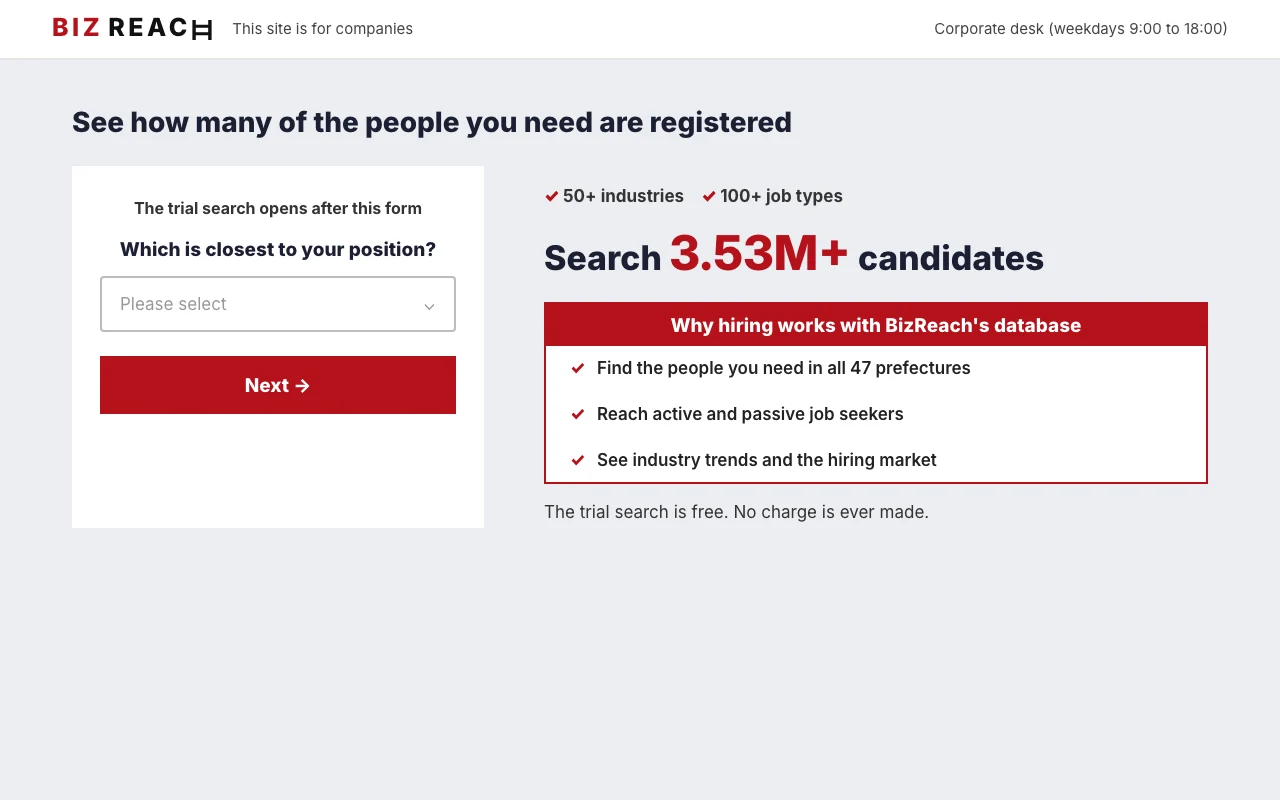
On BizReach's trial search page, answer the 7-question form, then search by industry and job type. You'll see how many members match before you talk to anyone in sales.
Ask for the price list and a proposal
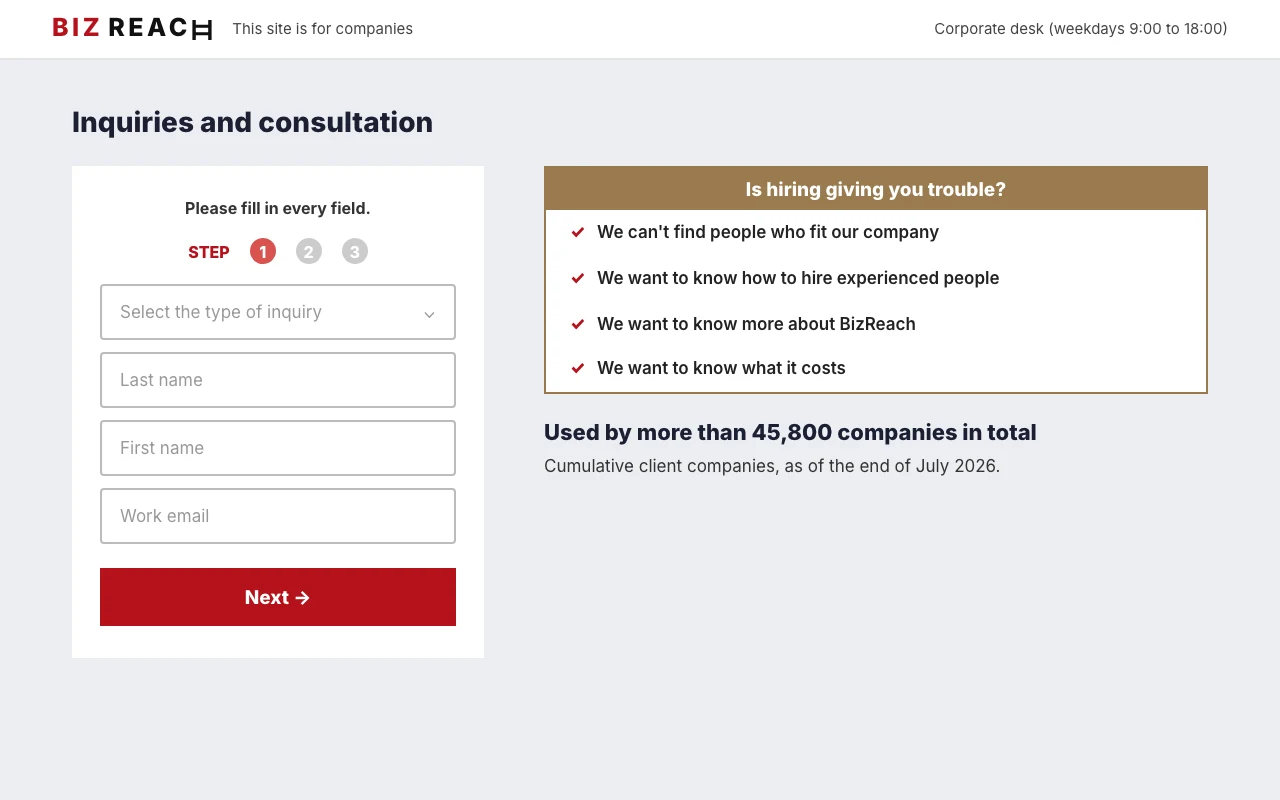
Send the inquiry form. BizReach answers with a proposal, then a contract and a kick-off meeting. It says you can start about 6 business days after your inquiry.
Set up accounts and groups
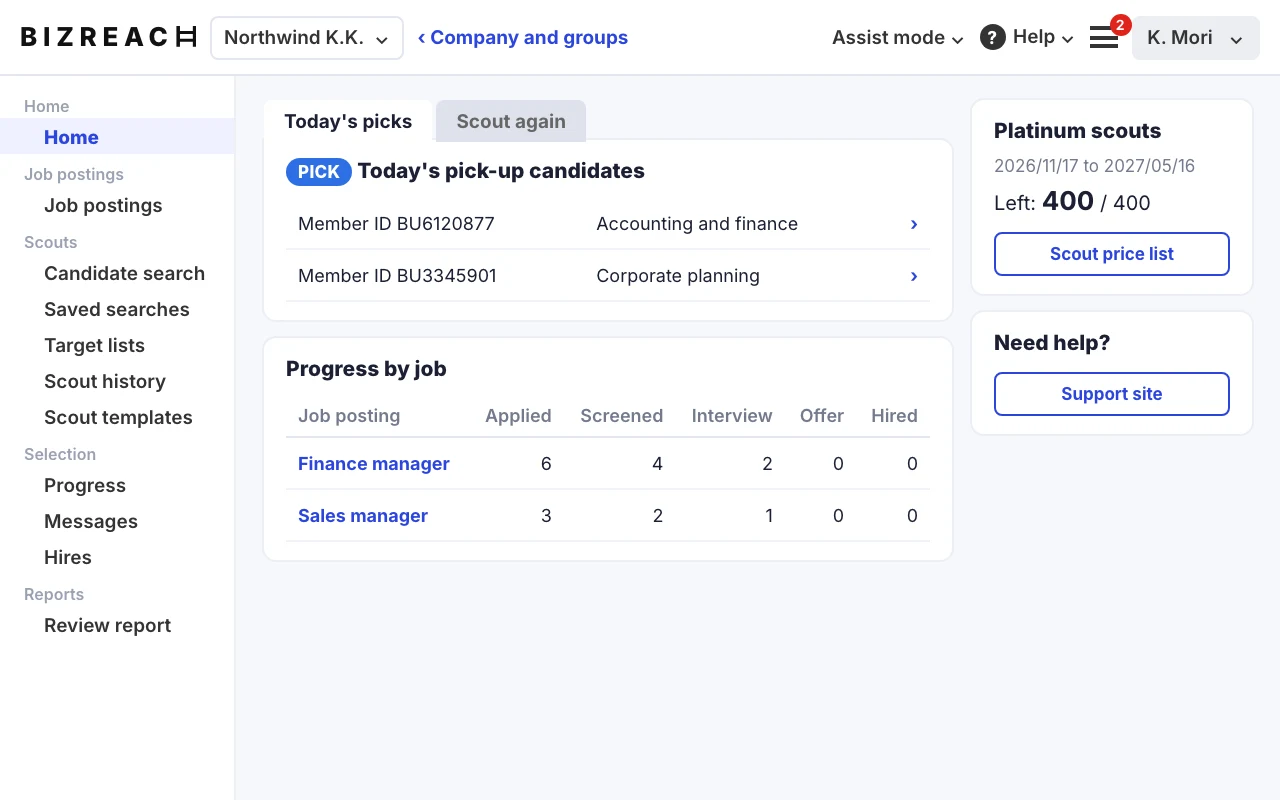
Create an account for each person who will search or interview. Put them in a group and give each a role: group admin, recruiter or scheduler. The home screen shows how many platinum scouts you have left.
Publish a job posting
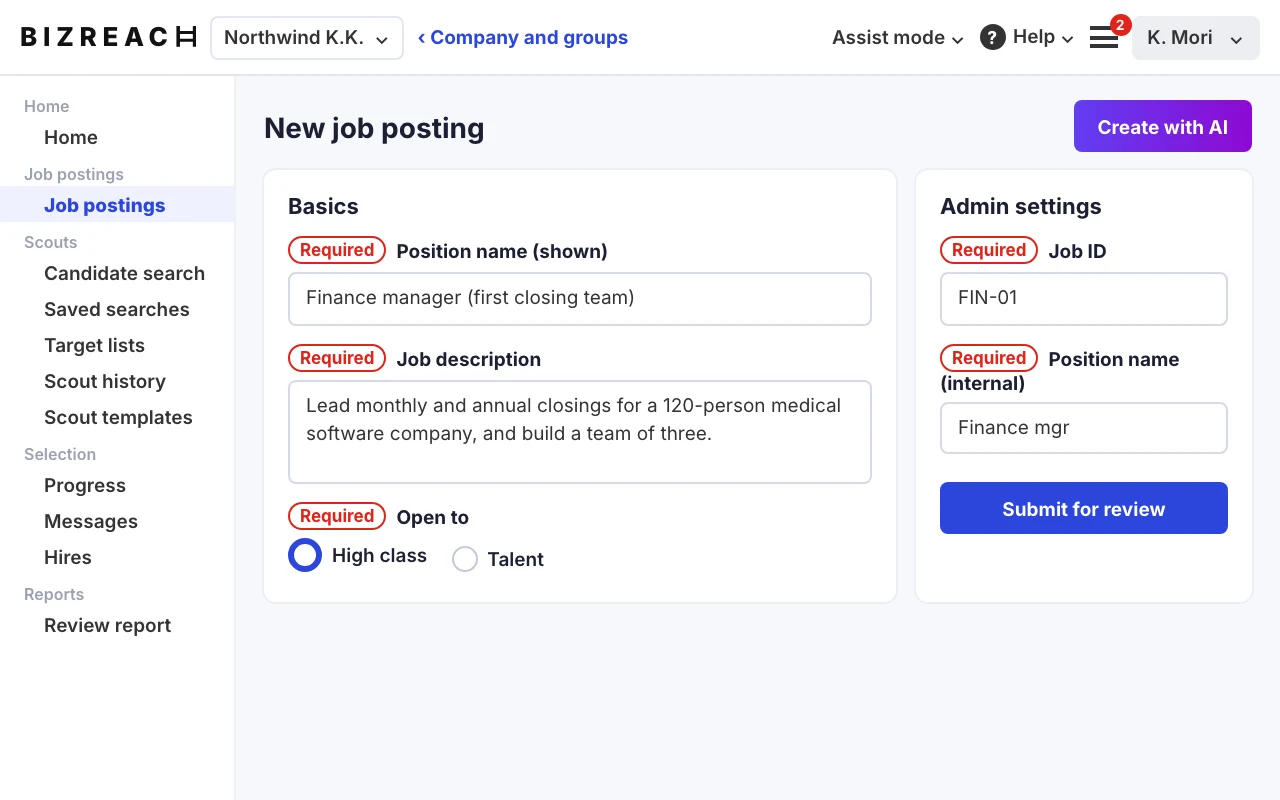
Every scout is attached to a job posting, so this comes before any search. Choose who it's open to, high class or talent members, and write the job description, or let the AI draft it. BizReach reviews each posting within 1 to 2 business days. A job description prepared in advance saves time here.
From candidate search to a hire
Search for candidates
Filter by job type, latest income, management experience and last login. BizReach's own guide suggests aiming for about 200 results, and starting with people who logged in within the last month.
Send platinum scouts
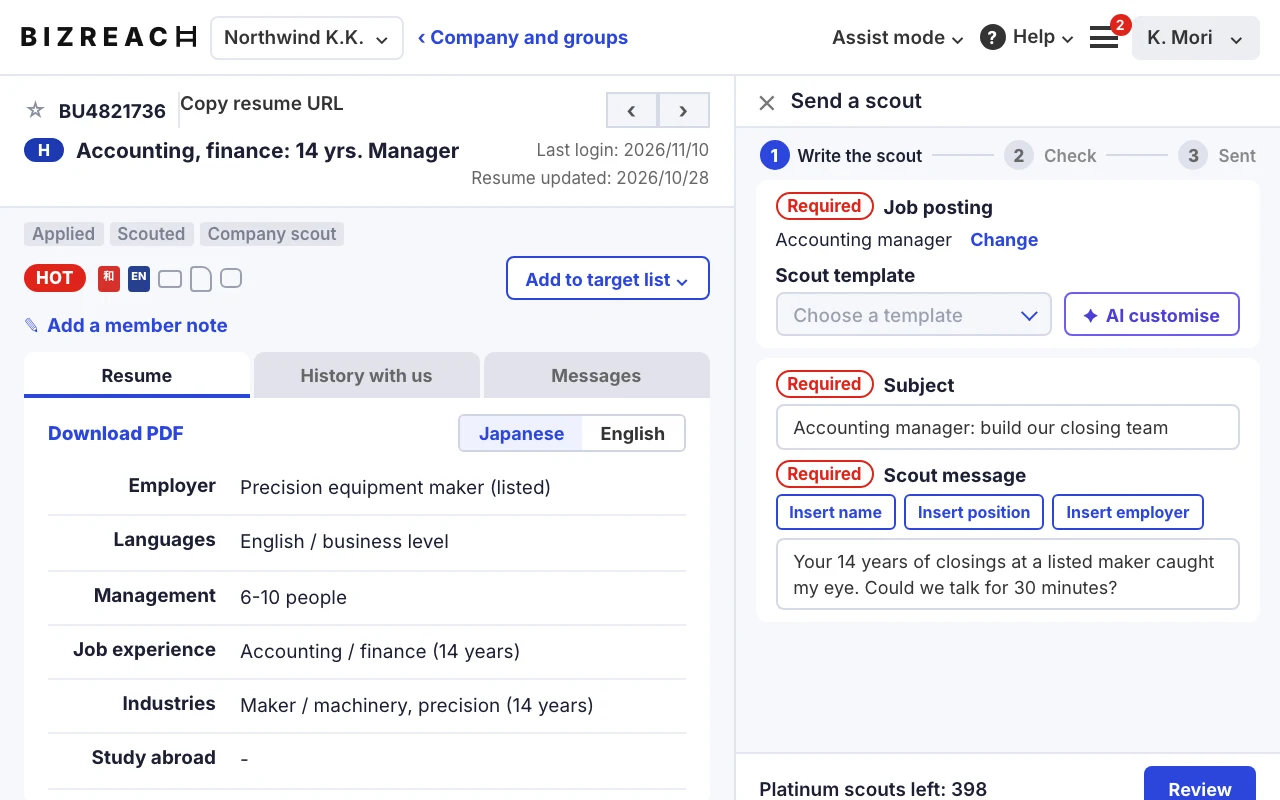
Open a resume, pick the job posting, then write a subject and a message for that person. The AI customise button adapts your template to the resume. Check the preview and send: one platinum scout is used.
Offer a meeting to everyone who replies
When a candidate answers, their name appears. Propose dates in the message thread, and keep it a casual interview rather than a formal one. BizReach's guide says to answer within 3 hours when you can.
Track the selection and register the hire
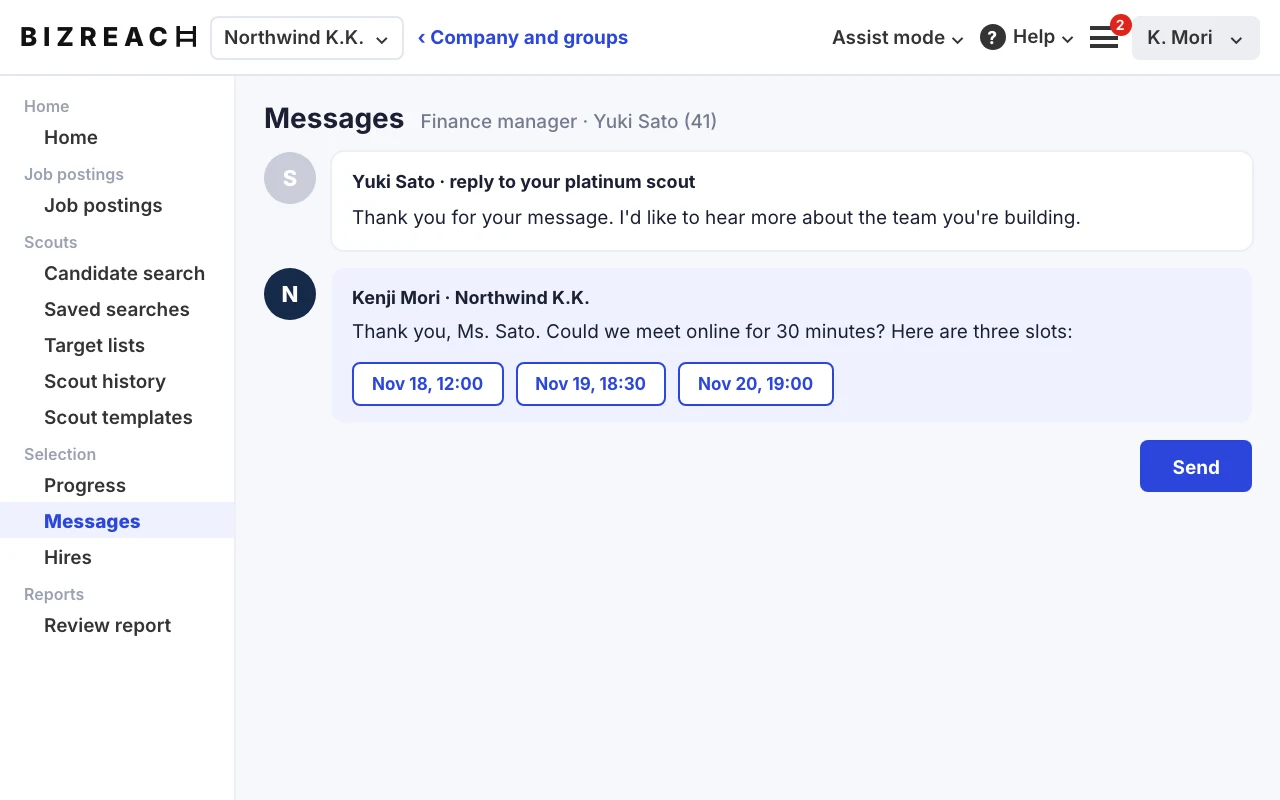
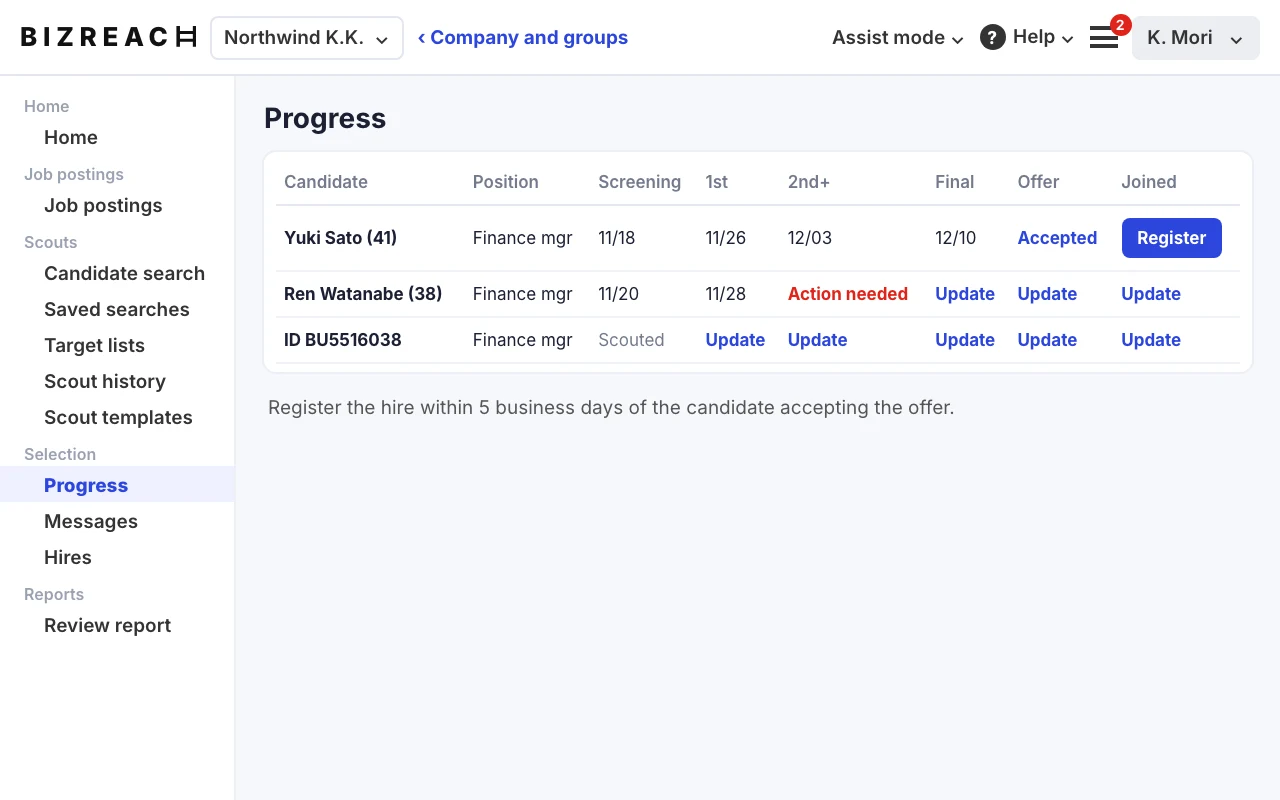
The progress screen follows each candidate from screening to offer. When someone accepts, register the hire within 5 business days. On their first day, confirm that they've joined: that starts the success fee invoice.
Read the review report every week
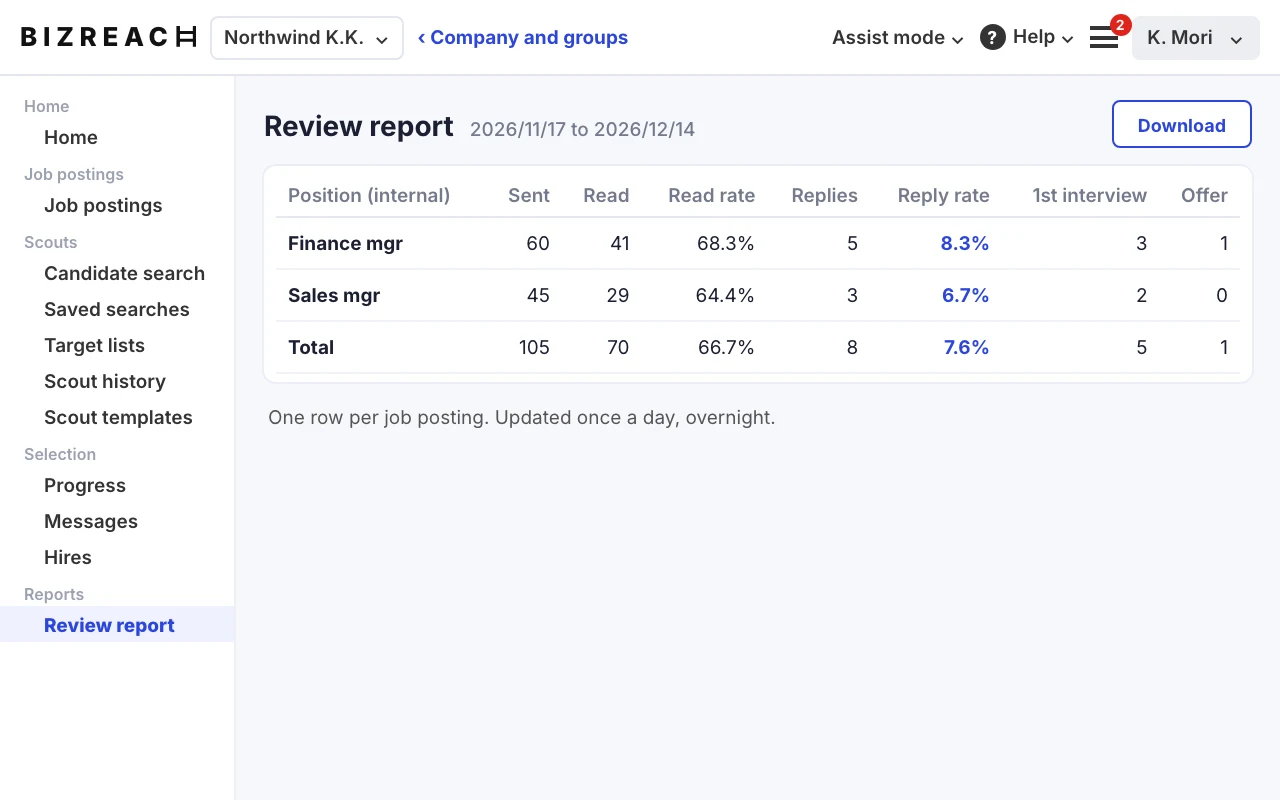
For each job posting, it shows the scouts sent, read and answered, then the interviews and offers. The reply rate benchmarks further down tell you whether your numbers are on track.
Results
How to measure success with BizReach, and improve
Once the first scouts are out, you'll wonder two things: how long until someone signs, and whether your reply rate is normal. Both have an answer.
A timeline to hiring results with BizReach
The start is fast. BizReach opens your account about 6 business days after the inquiry, and approves a job posting in 1 to 2 days. You can send your first scouts in week 2.
The hire takes longer, because candidates at this level have a job to leave. BizReach publishes no average, but its case studies give a sense of the timing: Tokyu Agency went from scout to offer in 1 to 2 months, and Anchor Service's first hire joined 2 months after it signed up. Buddy Data, a scouting agency, says that results settle from the second or third month.
A hire moves through stages, and our article on how to build a hiring process covers each one. BizReach handles the first, finding candidates, and gives you screens to track the others.
Hiring through BizReach, week by week
First scouts in week 2, first offers after 1 to 3 months
- Week 1Inquiry, proposal and contract
- Week 2Job posting approved, first scouts sent
- Weeks 3 to 8Scouts every week, a meeting for each reply
What a good BizReach scout reply rate is
The number to watch is the reply rate: replies divided by scouts sent. BizReach itself cites an overall average of 8%. Direct Sourcing, a scouting agency, measured 6.3% on its own BizReach campaigns in September 2025. So 6 to 8% is normal.
But that average moves a lot with the person you write to. In the same agency's data, age changes everything:
BizReach scout reply rate, by candidate age
Direct Sourcing's own campaigns on BizReach
22 or under
23 to 27
28 to 32
33 to 37
38 to 42
43 to 49
50 and over
Source: Direct Sourcing, campaigns it ran on BizReach. A single agency's figures, not BizReach's averages.
People around 30 receive the most scouts and answer the fewest. Above 43, more than 1 scout in 8 gets a reply. So judge your rate against the age you're targeting, not against 8%.
How to improve your BizReach reply rate
Every extra reply cuts your cost per hire: the same 400 scouts bring more meetings. Most of what works comes from BizReach's own guides:
- Scout people who logged in recently. Set the last login to within a month. BizReach marks as HOT the candidates it expects to reply more often.
- Ask for a meeting, not an interview. BizReach's template guide says to propose a casual meeting in a platinum scout. The candidate hasn't applied to anything yet.
- Turn on the automatic resend. A resend template sends a second message 3, 5 or 10 business days later, and uses no platinum scout.
- Use the AI customise button, then edit. BizReach reports that this feature lifts the expected reply rate by 26%. The subject line stays yours to write.
- Answer within 3 hours. A candidate who replied to you is hearing from headhunters too.
And when you're a small company, your message has to answer one question before any other: why would someone leave a larger employer for you?
FAQ
Frequently asked questions about BizReach
What is BizReach?
BizReach is a Japanese scouting platform for hiring experienced, higher-income professionals. Companies search a database of screened members by job type, income or experience, and send them scout messages, called platinum scouts, that promise a first meeting.
How much does BizReach cost for employers?
On the Standard plan, ¥850,000 for 6 months (excluding tax), plus a success fee of 15% of each hire's annual salary. The plan includes 400 platinum scouts. A 12-month plan includes 800, and its price is on request. BizReach only sends its price list after a form.
What is the BizReach success fee?
On the Standard plan, 15% of the hire's theoretical annual salary: 12 months of fixed pay plus the expected bonus. That's ¥1.2 million for a hire at ¥8 million. It's due for every person hired through BizReach, contractors included, and it isn't refunded if they leave early.
Is BizReach free for companies?
No. There's no free plan and no free trial. The only free tool is the trial search, which shows how many members match your job type and industry. For candidates, registering and replying to scouts are free.
What is a platinum scout?
It's the only kind of scout on BizReach: a scout message that promises a meeting or an interview to the candidate who replies. Each plan includes a fixed number, 400 for 6 months. Every scout you send uses one.
How many platinum scouts do I get, and what does one cost?
400 for 6 months and 800 for 12 months, including 50 that are only valid in the first month. On the 6-month Standard plan, that works out at about ¥2,125 per scout. You can buy more through your sales contact, at a price BizReach doesn't publish.
Can members on the free plan answer my scouts?
Yes. Free members can read and answer platinum scouts and apply to job postings, just like paying members. The paid plan, about ¥5,500 a month, adds career tools for the candidate. A premium ticket gives a candidate that paid plan free for a period. None of this changes who you can scout.
What's the difference between high class and talent members?
Current income. High class members earn ¥7.5 million or more, and talent members earn less. About 28% of members are high class. A job posting is open to one class or both, and your scouts can only go to the class it targets.
How many people are on BizReach?
3.53 million scoutable members as of July 2026, up 460,000 in a year. 8 in 10 are 30 or over. 45,800 companies have used BizReach, and 9,500 headhunters scout on it.
What is a good scout reply rate on BizReach?
6 to 8% is normal. BizReach cites an overall average of 8%, and one scouting agency measured 6.3% in September 2025. It varies with age: about 5% for candidates around 30, and over 12% above 43.
How long does it take to hire through BizReach?
Plan for 1 to 3 months to a first offer. The account opens about 6 business days after your inquiry, and a job posting is approved in 1 to 2 business days. BizReach's case studies show offers 1 to 2 months after the first scouts.
Is BizReach worth it for a small company?
It can be: about half of BizReach's client companies have 100 employees or fewer. It pays off when you hire 2 or more people at ¥7 million and above within 6 months. For one hire under ¥6 million, an agency costs about the same, and small, unknown companies get fewer replies.
Who is BizReach best for?
Companies hiring managers, executives and experienced specialists, especially people over 40. It doesn't suit junior roles, hiring many people at once, or young engineers, who get the most scouts and answer the fewest.
How is BizReach different from a recruiting agency?
An agency finds the candidate for you and takes about 30% of the salary when you hire. On BizReach, you search and write yourself, and you pay a base fee plus 15%. Agencies use BizReach too: their consultants scout the same members as headhunters.
What are the headhunter score, the S rank and the exclusive scout?
They belong to the headhunter side of BizReach. Candidates see a score out of 5 and a rank from S to D for each headhunter, and top-ranked headhunters can send an exclusive scout. None of them apply to the scouts a company sends itself.
Can I cancel a BizReach contract?
You can stop during the contract, but nothing is refunded or reduced. The base fee is paid upfront. The contract doesn't renew automatically: to continue, you sign a new one.
How does BizReach compare with LinkedIn and Wantedly?
BizReach reaches experienced Japanese professionals, LinkedIn reaches bilingual candidates, and Wantedly reaches people in their 20s and 30s at startups. LinkedIn and Wantedly charge a plan with no success fee. BizReach charges ¥850,000 for 6 months plus 15% per hire.
Can I use BizReach in English?
Only in part: the employer screens are in Japanese. You can publish job postings written in English, and filter candidates who have an English resume. For English-speaking hires, start with LinkedIn.
Does BizReach have AI features?
Yes, at no extra cost. One drafts a job posting from your requirements, and all client companies have had it since April 2025. Another, released in October 2025, adapts a scout message to the candidate's resume. BizReach doesn't allow member data to be entered into outside AI services.
DIY Hiring Kit
Everything You Need To Hire On Your Own
A downloadable hiring framework for small businesses in Japan, with step-by-step guides, spreadsheet ATS, LinkedIn scouting system, interview questions bank, offer letter and employment contracts, and a ton more!
1Dashboard11Checklists8Spreadsheets30Template docs4Weeks of Q&ABilingual
- Download every file as Word, Google Docs, Excel or Google Sheets


 14 years in talent acquisition
Related
Related guides and tools
 Hiring practices
What is direct recruiting? Scouting vs agencies
The method behind BizReach, and what the other platforms cost.
 Guide
What is Wantedly? Pricing, plans and how to hire with it
The flat-fee platform for people in their 20s and 30s.
 LinkedIn hiring
What is LinkedIn Recruiter?
The database for bilingual candidates.
 Hiring practices
What is a casual interview?
The meeting every platinum scout promises.
 Tool
Cost per hire: averages and calculator
Test a base fee and a success fee on your own numbers.
 Guide
How to design a hiring process for SMBs
What happens once a candidate has replied.
Official sources
The main sources for this guide. Other references are linked where they are used in the text.
- Visional, Inc.disclosure2dl.edinet-fsa.go.jp Annual securities report, year to July 2026 Scoutable members (3.53 million), client companies, the ¥850,000 plan and the 15% success fee.
- BizReachbizreach.biz Pricing for employers Contract lengths and the platinum scouts included: 400 for 6 months, 800 for 12.
- BizReach support sitehelp.cr-support.jp About platinum scouts One kind of scout, a promised meeting, and how scouts are used up.
- BizReach support sitehelp.cr-support.jp About the success fee Who the fee applies to, the minimum, and no refund when a hire leaves early.
- BizReach support sitehelp.cr-support.jp High class and talent members The ¥7.5 million line between the two member classes.
- Direct Sourcingdirectsourcing-lab.com Scout reply rates by platform and age One scouting agency's BizReach reply rates, by candidate age.