
What is LAPRAS?LAPRAS SCOUT pricing, scores and how employers use it
A guide to LAPRAS for companies that want to hire software engineers in Japan through scouting. It covers the tech skill score, LAPRAS SCOUT pricing (the employer side's former name), what companies say about it, and how employers use it.

Basics
What is LAPRAS?
In short
LAPRAS is an engineer scouting platform: companies in Japan use it to find software engineers themselves and approach them directly. It builds each engineer's profile from their public work on GitHub, Qiita, Zenn and similar sites, and scores their technical skill. Companies search its engineers, check who is open to a move, then send interest notifications or scouts. The employer side used to be called LAPRAS SCOUT.
You've opened an engineering role, and the applications aren't coming. The strongest engineers rarely browse job boards. But plenty of them publish code on GitHub or write tech articles. LAPRAS lets you find them through that public work. Its prices aren't online, though, and you pay upfront. So two questions matter: what one engineer will cost you, and whether anyone will answer your scouts.
I've spent more than 14 years hiring people, for employers that include Google and Persol Career. These days I help small and mid-size firms build their teams with my recruitment consulting services. When clients need engineers, the choice of scouting platform keeps coming up. Before writing, I studied LAPRAS's employer site, its terms for hiring companies (revised October 2024) and its help center for recruiters. Prices come from recruiting firms and comparison sites, checked against each other, and results from LAPRAS's case studies. You'll find this guide in our hiring playbook, and it focuses on the points to settle before you sign.
- First, how LAPRAS works: profiles built from public work, the tech skill score, and job-change intent.
- Then the pricing: the Light, Self and BPaaS Premium plans, success fees, and the terms to check.
- Next, who's on LAPRAS, how employers rate it, and where it's strong or weak.
- After that, LAPRAS against its rivals on price, and where it fits in your hiring strategy.
- Last, the steps to get started, with reply-rate benchmarks and ways to raise yours.
How it works
How LAPRAS works: profiles built from public work
Who writes the profiles on LAPRAS? Mostly, not the engineers. LAPRAS assembles them from what engineers publish online. Once you see how, you'll know who you'll find there, and who you'll miss.
LAPRAS gathers engineers' public activity from over ten services, including GitHub, X, Qiita, Zenn, note, connpass and Speaker Deck. Code, articles, talks and events become skill "tags" and a "score". The database holds about 1.5 million engineers, including people who never signed up.
A LAPRAS contract gives you six things:
- Candidate search: filter engineers by keyword, past roles and years in them, desired salary, job-change intent and tech skill score.
- Scores and AI skill highlights: besides the tech skill score, AI adds labels such as "engineering lead experience", read from the person's career history and other data.
- Job-change intent and wants: you see the intent each engineer sets (High, Mid or None), plus what they want in salary and work style.
- Interest notifications and scouts: approach people with a one-click notification or a written scout.
- Talent pool and Talent Sonar: keep people on a list, and get alerts when, for example, their intent goes up.
- Job posts and customer success: publish jobs on LAPRAS, with a manager to support you. You can create as many accounts as you need.
What sets LAPRAS apart from other scouting platforms
In search, each candidate shows up as a card like this:
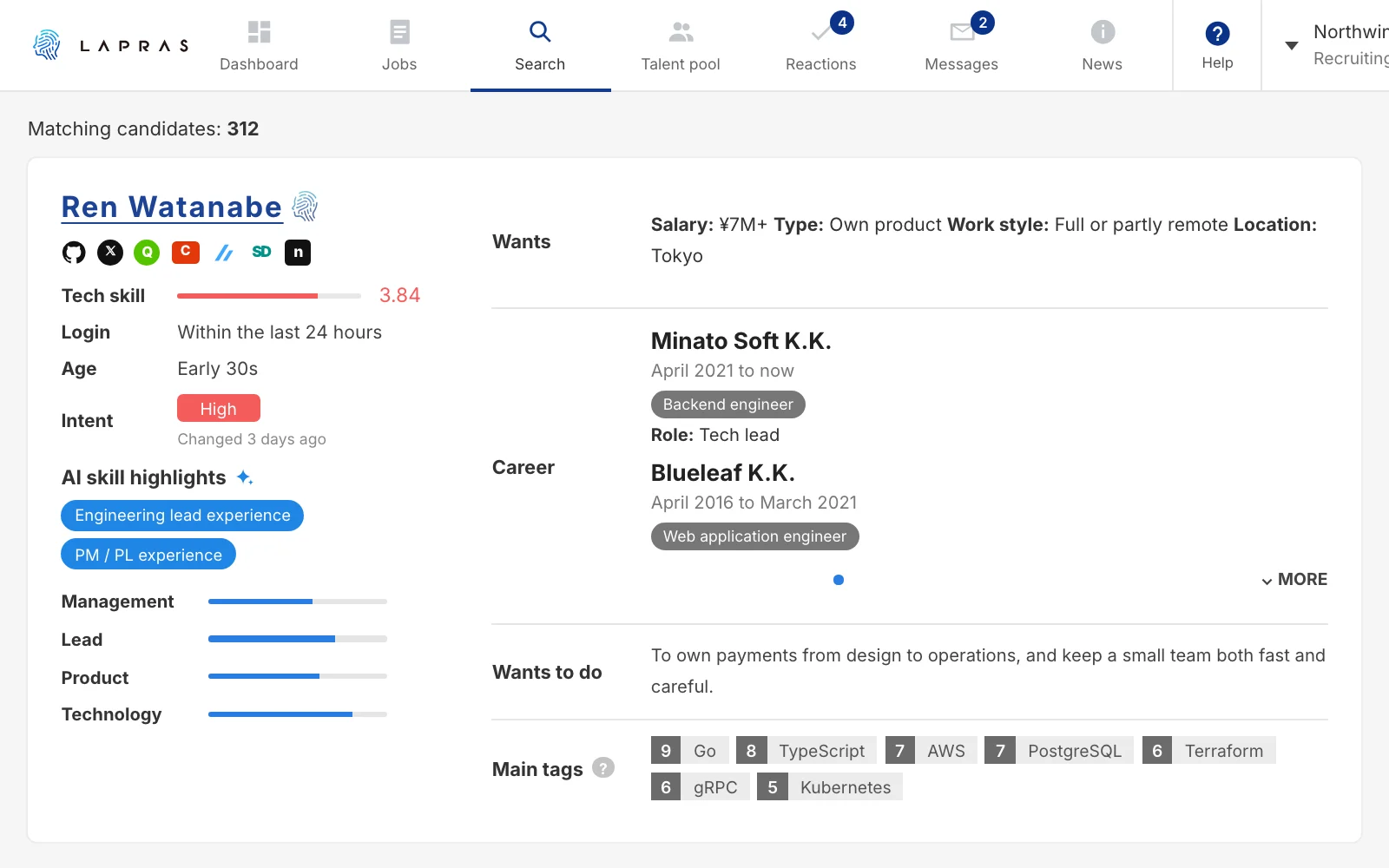
A candidate in search results (mock-up)
- Tech skill: 1.0 to 5.0, from public work
- Intent: High, Mid or None, set by the engineer
- AI skill highlights: labels AI reads from the career
- Career traits: the four areas of the market value score
At first sight, it's the candidate list every scouting platform has. But LAPRAS does three things the others don't.
- Difference 1Profiles fill in without the engineer writing them.Even engineers with no resume online show their main skills and a tech skill score, from GitHub and their articles. That's how you reach people who never join job sites.
- Difference 2You see who is open to a move, and get told when that goes up.Each engineer sets their intent to High, Mid or None, and companies see it. People who switched to High or Mid within the last week get a flame icon. So you can pick your moment.
- Difference 3There's no cap on scouts.The Light and Self plans have no limit on scouts sent. But if candidates report two or more messages as unpleasant, LAPRAS can set a monthly cap for up to six months.
LAPRAS suits companies hiring engineers who publish code or articles online. Engineers who build internal systems and share little score lower, so they're harder to find.
What the tech skill score and market value score are
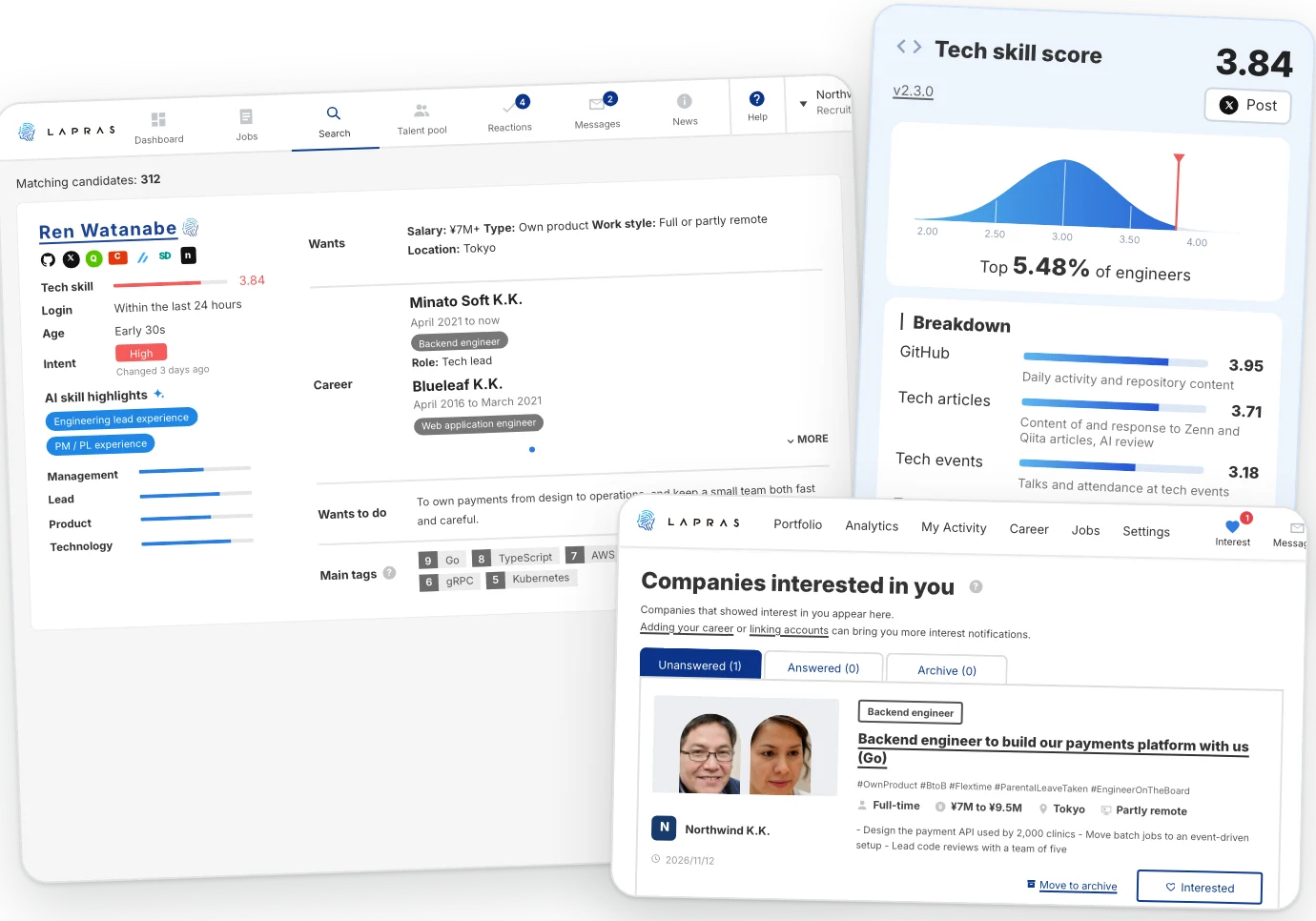
The first number you'll notice is the tech skill score. LAPRAS computes it from four sources: GitHub, tech articles, tech events and skill tags. It runs from 1.0 to 5.0, and scores are set so the average is 3.0. According to the recruiter help center, filtering at 3.5 or more leaves the top 4%.
LAPRAS gives rough bands for reading it:
- Up to 3.0: junior engineers, or engineers who don't publish online (at systems integrators, for example)
- 2.8 to 3.4: mid-level engineers
- 3.4 to 4.0: leaders such as lead engineers
- 4.0 and up: CTOs and engineers with a public name
Source: LAPRAS help center for recruiters. The overlap between bands is LAPRAS's own.
Since 2026, employers see a second rating too: the market value score. It places each engineer among LAPRAS users, out of 5, across technology, lead, product and management. Since 24 February 2026, employers can see its summary and the engineer's strengths, and since March, search results show the four areas as bars.
Use both scores as a first filter, not a verdict. Some strong engineers simply can't publish their work code. And people who moved into management write less code, so their tech skill score tends to drop.
Job-change intent, and interest notifications vs scouts
Engineers on LAPRAS set their intent at one of three levels. High means they're job hunting. Mid means they aren't, but would hear out a good offer. None means they have no plans to move.
You have two ways to approach someone. They differ in effort, and in how the engineer receives them.
| Approach | Interest notification | Scout |
|---|---|---|
| Message | None | Free text |
| Sent with | One of your jobs | Your job and company pitch |
| Their answer | Interested, Not interested, and so on | A written reply |
| Reply benchmark | Not published | 20–30%LAPRAS's figure |
Sources: LAPRAS help center for recruiters (interest notifications), same (scouting through X).
The order that works is notification first. LAPRAS says messages to engineers who answered Interested get about 50% replies on average. As of 2024, LAPRAS said scouts to engineers whose intent is None could only be scheduled, and that it checked the text first.
Engineers who aren't registered: visible, but out of reach
Search results include engineers who never joined LAPRAS. But as the recruiter help center explains, you can only approach registered users. Of about 1.5 million people in the database, about 40,000 can be contacted.
One more thing to know: engineers can see which companies viewed their profile, and when. They can also hide themselves from specific companies. And anyone who changes jobs through LAPRAS disappears from company view for two years.
Which companies use LAPRAS
LAPRAS cites 1,300 client companies to date on its employer site and over 1,000 on its case-study page. The case studies include companies with small engineering teams: kickflow with 13 engineers, SalusTech with four full-time engineers, and WHERE with a single recruiter.
Pricing
LAPRAS pricing: a flat-fee plan, and plans with a fee per hire
How much will LAPRAS cost you? That's the first thing most companies ask. The answer depends on the plan: one charges a monthly fee only, others charge per hire. And depending on how many people you hire, it can cost less than a single agency fee.
There's no public price list. The employer site asks you to contact sales for details. What you do get is a 7-day free trial, to check that the people you want are there.
Light, Self and BPaaS Premium: the three plans compared
The employer site lists three plans. What separates them is who you can approach, and who writes the scouts.
| Feature | Light | Self | BPaaS Premium |
|---|---|---|---|
| How you pay | Mainly a fee per hire | Monthly fee only | Monthly fee plus success fee |
| Who you can approach | People under ¥7M, or seeking contract or SI work | All registered users | Set to your needs |
| Who sends scouts | You | You | LAPRAS's team |
| Scouts you can send | No limit | No limit | Sent by LAPRAS |
| Term | 6 months | 6, 12 or 24 months | 6, 12 or 24 months |
Sources: LAPRAS for employers, Light plan announcement (July 2026). Self and BPaaS Premium terms are recruiting firms' research.
On Self, you search and send scouts yourself, and pay a monthly fee only. There's no success fee, whatever your number of hires. Light launched in July 2026: it keeps upfront costs low and charges mainly when you hire. On BPaaS Premium, LAPRAS's engineer-hiring team handles the outreach for you.
LAPRAS price list (from recruiting firms' reports)
| Term | Self | BPaaS Premium |
|---|---|---|
| 6 months | ¥1.2M¥300K setup + ¥150K a month | ¥1.5M¥250K a month on average |
| 12 months | ¥1.95M¥150K setup + ¥150K a month | ¥2.55M¥212.5K a month on average |
| 24 months | ¥3.6MNo setup fee, ¥150K a month | ¥4.8M¥200K a month on average |
| Success fee | None | 35% of annual pay |
Before tax. Sources: Direct Sourcing (updated August 2025), an RPO firm's survey (updated January 2025). Direct Sourcing notes that the BPaaS Premium success fee only applies to some hires, depending on how the candidate was found. LAPRAS doesn't publish its prices.
Direct Sourcing puts Self at ¥1.2 million for six months, and the RPO firm's ¥300,000 setup fee plus six months at ¥150,000 comes to the same total. The monthly fee stays at ¥150,000 on every term, and the setup fee falls as the term gets longer. The comparison site meetsmore lists ¥165,000 a month and a ¥330,000 setup fee, which is the same price with 10% consumption tax added.
LAPRAS success fees: none on Self, 20% on JOB BOARD
Whether you pay a success fee comes down to the plan. The employer site's FAQ says some plans need no success fee, only a monthly fee. That's Self.
Next to the three plans, there's LAPRAS JOB BOARD, which only publishes your jobs. There's no setup or monthly fee: you pay 20% of the hire's annual pay, only when you hire. You can't send scouts on it; you wait for applications. It started at 15% in 2024, and LAPRAS has quoted 20% since its October 2025 announcement. Articles that still say 15% are out of date.
Five clauses to read in the terms before you sign
LAPRAS's terms for hiring companies hold five clauses worth knowing before you apply.
- You prepay the whole term: the setup fee and monthly fees for every month of the contract, at once. Signing mid-month doesn't prorate anything.
- No refunds: fees aren't returned, unless LAPRAS itself is at fault for the service being unavailable.
- Automatic renewal: unless either side declines at least one week before the term ends, the contract renews on the same terms.
- No cancellation clause: nothing in the terms lets a company end the contract mid-term for its own reasons.
- No contact outside LAPRAS after you leave: once you cancel, you can't email people individually using personal data you found on LAPRAS, unless they agreed beforehand.
The terms also have a success-fee clause, covering hires within one year of the last contact. But it only applies if separately agreed. If you sign up for Self, look for any success fee on the application form before you sign it.
LAPRAS cost per hire: how many hires pay it back
On Self, your cost per hire is what you prepaid, divided by your hires during the term. So start with how many scouts one hire takes. Direct Sourcing's averages for LAPRAS SCOUT put it at about 60 scouts per hire.
From 60 scouts to a hire
LAPRAS's average reply rate and the rates after it, turned into what one hire takes.
- 60Scouts
- 15Replies~25%reply
- 7–8Casual interviews~50%meet
- 1Offer accepted~13%accept
Source: Direct Sourcing (average LAPRAS SCOUT results), chart by SaiyouTeam
Now compare Self for six months, at ¥1.2 million, with an agency, for an engineer earning ¥6 million. At 35% of salary, the agency fee is ¥2.1 million per hire.
LAPRAS cost per hire, by number of hires
Hiring ¥6M engineers on Self for 6 months, vs a 35% agency fee
Agency (1 hire)
LAPRAS (1 hire)
LAPRAS (2 hires)
LAPRAS (3 hires)
Before tax. SaiyouTeam estimate from recruiting firms' Self prices and typical agency rates
One hire in six months already costs about 40% less than an agency. From the second hire, the cost per person drops sharply. But if you hire no one, the ¥1.2 million stays spent. A flat fee is cheap when you hire, and expensive when you don't. Ask three questions to see if it fits:
- Is the role a web engineer? The languages most LAPRAS users work in are TypeScript, Go and Ruby, all common in web development. Roles in sales or in-house IT won't find many candidates there.
- Can someone write each message by hand? Before each of those 60 scouts, someone reads the candidate's GitHub or articles. A practical split: your CTO or engineering lead picks candidates, HR writes and schedules.
- Will you hire at least one person in six months? If a hire looks unlikely, LAPRAS JOB BOARD or an agency, which only charge when you hire, carry less risk.
Who you can reach
Who you'll find on LAPRAS: 40,000 users, 1.5 million searchable
Whether LAPRAS is worth the fee depends on whether your target engineers have signed up. LAPRAS's published figures show who's there.
LAPRAS has about 40,000 registered users (September 2026). Those 40,000 are the people you can approach. The search database holds about 1.5 million people, but those who never signed up are view-only.
LAPRAS registered users over time
Registered users LAPRAS reported at each date
Sep 2020
Jan 2022
Nov 2023
Jul 2024
Sep 2026
Sources: LAPRAS Inc. announcements, HR TECH LAB, employer site
Growth has slowed over the last two years. By registered users, LAPRAS is smaller than Findy (165,000) or Green (1.63 million). In return, of the users who set an intent, about half chose Mid or High.
Users who set a job-change intent
Share with Mid or High intent, as published on the employer site
- Intent set to Mid or High
- 50%
- Intent set to None
- 50%
Source: LAPRAS for employers (September 2026)
Pay expectations are high too. LAPRAS says about 70% of its users receive offers of ¥6 million or more. So set the salary on your job with that level in mind.
LAPRAS registered users by language
The top three languages LAPRAS publishes
TypeScript
Go
Ruby
Source: LAPRAS for employers (September 2026). Lower ranks aren't published
The roles LAPRAS fills best
Put the published figures and case studies together, and four kinds of hire stand out.
Backend and frontend web engineers
The most common languages among users are TypeScript, Go and Ruby, all common in web development. SalusTech, with four full-time engineers, hired one four months after starting.
Engineers with lead or management experience
LAPRAS counts over 4,000 candidates with PM, lead or management experience, and its AI skill highlight labels let you filter for them. Bengo4.com hired an engineering manager after six approaches in all.
AI engineers
About 3,300 people carry the "AI product development experience or interest" label (March 2026). Adixi hires young AI engineers at a pace of one a month.
Engineers from South Korea
LAPRAS also runs LAPRAS Global Bridge, which introduces Korean engineers who speak Japanese, with no setup fee and a fee only on hire. LITALICO hired a Korean engineer in about nine months.
Pros and cons
LAPRAS pros and cons: unlimited scouts for a flat fee, but 40,000 users
The case for LAPRAS is that for a flat fee, you can reach engineers early, as soon as they start thinking about a move. The case against: only 40,000 registered users, and a prepaid contract with no refunds.
Alerts when engineers start thinking about a move
LAPRAS lets you keep candidates in a talent pool. Talent Sonar, launched in September 2026, watches candidates every day and flags who looks worth approaching now. It reacts to five signals:
- Intent updates: people who raised their job-change intent.
- Career milestones: people who reached about three years (35 months) at their current employer.
- Profile updates: people who added a new job to their career history.
- Frequent job views: people who viewed one of your public jobs in the past seven days.
- Re-approaches: people who haven't answered a message you sent 90 or more days ago.
The first three only flag people who match one of your public jobs on role, desired salary, work style and location. Engineers whose intent is None are never flagged.
Within your talent pool, you get up to 20 alerts a day. LAPRAS says some early users saw their reply rate rise to about 30% within a month. WHERE, with one recruiter, hired three people, two of whom reached out to the company first.
What companies say about LAPRAS
Reviews by employers are still scarce. ITreview, which collects reviews of IT products, carries one, from March 2026. So I added recruiting firms' articles and LAPRAS's case studies to see what companies think.
Four strengths come up:
- Rich detail on engineers' skills and experience, which makes the right people easy to find (ITreview).
- Its own scores give an objective measure (ITreview).
- High-quality candidates (ICEONE, a firm that runs LAPRAS for clients, interviewed on LAPRAS's site).
- Interest notifications sent to people with a matching tech stack get reactions from close to 30% (a client company, quoted on LAPRAS's site).
Three weaknesses come up:
- More users would make it easier to build a candidate pool (ITreview).
- The screens differ from other scouting platforms, so they take time to learn (VOLLECT).
- Sending a large batch at once can trigger a temporary sending limit (VOLLECT).
Watch out: a prepaid contract, and profile views candidates can see
The biggest catch is the prepaid contract with no refunds. You pay for the whole term at once, and the terms give you no way to cancel mid-term. It renews automatically, so if you're stopping, decline at least one week before it ends.
The other is that candidates see your profile views. Engineers can check which companies looked at them, and when. Open only the profiles you need, and contact those people soon after: it leaves a better impression.
Here are the strengths and weaknesses side by side:
| Topic | Pros | Cons |
|---|---|---|
| Cost | Self is a flat fee, no success fee | Prepaid, no refund if you hire no one |
| Reach | Search about 1.5M profiles from public work | Only about 40,000 users can be contacted |
| Candidates | Skill shows in a score and public work | People who don't publish score lower |
| Success fee | Zero on Self, however many you hire | Light and BPaaS charge one |
| Workload | Talent Sonar tells you when to approach | The screens take time to learn |
| Scouts | No limit on Light and Self | Two complaints can trigger a monthly cap |
How it compares
LAPRAS vs other hiring platforms: flat fees and success fees
Companies weighing LAPRAS usually look at a few other platforms too. Here are the small engineer-only services and the big all-role ones, on the same measures.
| Sort by | ||||
|---|---|---|---|---|
 dodaJob board, agency and scouts (Persol) | 10.99MJune 2026 | Not public | Not public | Not public |
 Rikunabi NEXTJob board (Recruit) | 10M+Unofficial estimate | Not public | Not public | Not public |
 LinkedIn Recruiter CorporateAll professions | 5M | ¥1,700,00012 months | 150¥944 per scout | None |
| LinkedIn Recruiter LiteAll professions | 5M | ¥16,0001 month | 30¥533 per scout | None |
 Wantedly StandardMid-career, new grads | 4.57M | ¥900,0006 months | 25¥6,000 per scout | None |
| Wantedly PremiumMid-career, new grads | 4.57M | ¥1,320,0006 months | 50¥4,400 per scout | None |
 BizReachExecutives, high income | 3.53M | ¥850,0006 months | 67¥2,125 per scout | 15%of salary |
 OpenWorkMid-career, new grads | 1.83M | ¥1,200,00012 months | 833¥120 per scout | ¥300K–800K |
 GreenIT and web | 1.63M | ¥600,000One-off | 1,000Included | 20%of salary |
 YOUTRUSTMid-career | 500K | ¥2,400,00012 months | 20¥10,000 per scout | None |
 doda XExecutives | 400K | ¥1,050,0008 weeks | 217¥2,625 per scout | None |
 FindyIT engineers | 165K | ¥360,0006 months | 35–70 a weekLikes | 30–35%of salary |
 LAPRASIT engineers | 40K | ¥1,200,0006 months | Unlimited | None |
Source: SaiyouTeam research, platforms' published figures (November 2026). LAPRAS's price is recruiting firms' research for the Self plan, and "None" for the success fee also applies to Self. Click a column to sort.
In the table, LAPRAS has the fewest users. But on Self there's no success fee, and no cap on scouts. Like Wantedly and LinkedIn, it charges nothing per hire. Findy charges 30 to 35% of annual pay, Green 20% for applicants from 12 January 2027, and BizReach 15%.
Findy and LAPRAS both focus on engineers, but they run in opposite directions. On Findy, you can only write once an engineer has answered Maybe. On LAPRAS, you read their public work and intent, and approach first. LAPRAS pays off the more people you hire; Findy suits you better if you'd rather talk only to engineers who have already shown interest.
In the DIY Hiring Kit, the hiring platforms sheet sets the main platforms' features and prices side by side, so you can pick the ones that match your roles.
Strategy
The role LAPRAS plays in your hiring strategy
LAPRAS works best for companies hiring several web engineers within six months, alongside other channels. With 40,000 users, it can't cover every role and pay level on its own.
Here's how three companies could fit LAPRAS in.
-
Scenario 1
2 web engineers to hire in six months, at a 30-person SaaS company
ProfileTypeScript or Go engineers, 3 to 7 years in. Target pay ¥6M to ¥7.5M.
Strategy
- LAPRAS
- Referrals
LAPRAS leads. The CTO picks candidates by tech skill score and main tags, and HR sends the interest notifications. To those who answer Interested, the CTO writes a scout that mentions their GitHub. Employee referrals run in parallel.
Plan
Self, ¥1.2M for 6 monthsTwo hires put the cost at ¥600,000 each, under a third of an agency fee for a ¥6M engineer (¥2.1M).
-
Scenario 2
4 tech leads and EMs to hire in a year, at a 200-person IT company
ProfileEngineers with 7+ years and lead or management experience. Target pay ¥8M to ¥10M.
Strategy
- LAPRAS
- BizReach
On LAPRAS, AI skill highlights and Talent Sonar find people with lead experience whose intent just moved. Managers who code less publicly don't show well in the score, so you add BizReach, where you search by career history.
Plan
Self, ¥1.95M for 12 monthsFour hires come to about ¥490,000 each. The monthly fee stays at ¥150,000, and the setup fee is ¥150,000 lower than on six months.
-
Scenario 3
2 backend engineers for the IT team of a 60-person manufacturer with no dedicated recruiter
ProfileBackend engineers who build internal web systems. Target pay ¥5.5M to ¥7M.
Strategy
- LAPRAS
- Careers site
No one in-house can pick candidates or write the messages, so LAPRAS's team handles the outreach. The careers site shows the dev team's work, and each scout links to it.
Plan
BPaaS Premium, ¥1.5M for 6 monthsEach hire adds 35% of annual pay on top of the ¥1.5M, so the total runs above an agency fee. Treat it as a bridge while you have no one to run it, then switch to Self.
Run LAPRAS in-house, or hand it off?
Running LAPRAS is two jobs: choosing who to approach, and writing to them. Choosing well takes someone who understands the code and articles they're reading.
- In-house: your CTO or engineers pick candidates; HR sends notifications and scouts, and books meetings. That's the Self or Light plan.
- Hand it to LAPRAS: on BPaaS Premium, LAPRAS's team handles the outreach. The AI support plan only takes over interest notifications, and sends as many as needed.
- Hand it to a scouting agency: some firms run LAPRAS on behalf of clients. You pay them on top of your LAPRAS fee.
Whoever runs it, LAPRAS can't be used to hire for group companies or clients. The terms forbid using it for anything other than your own hiring.
Getting started
Getting started with LAPRAS
Getting set up takes three steps. Daily work takes four.
Setup: from the brochure to a published job
Request the brochure and the free trial
Request the brochure on LAPRAS's employer site. Use the 7-day free trial to check that the engineers you want are registered.
Pick a plan and sign
Choose Light, Self or BPaaS Premium, and prepay the term. You can create as many accounts as you need, with three roles: admin, standard and profile viewer.
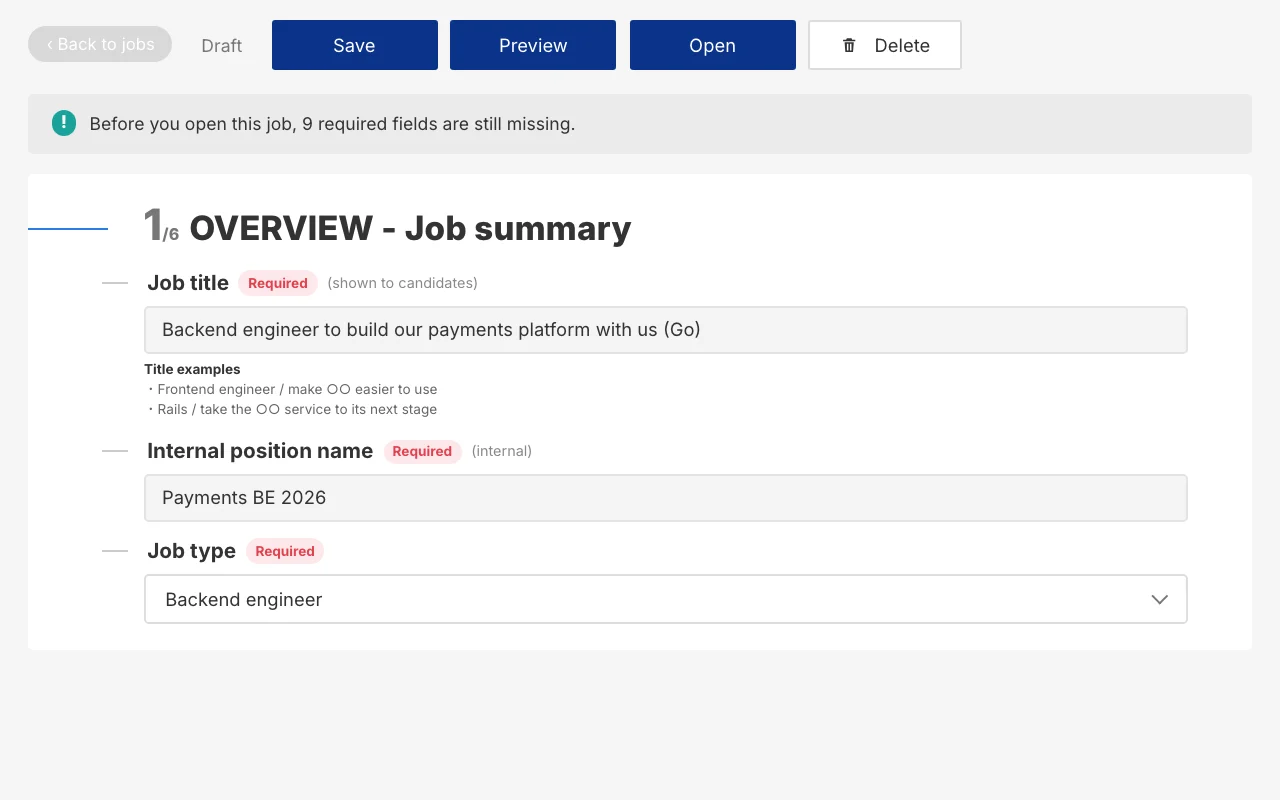
Write a job post
Enter the title, role, duties and terms, then publish. You choose who can see it: anyone, LAPRAS users only, or only people you share it with.
Day to day: from search to a first meeting
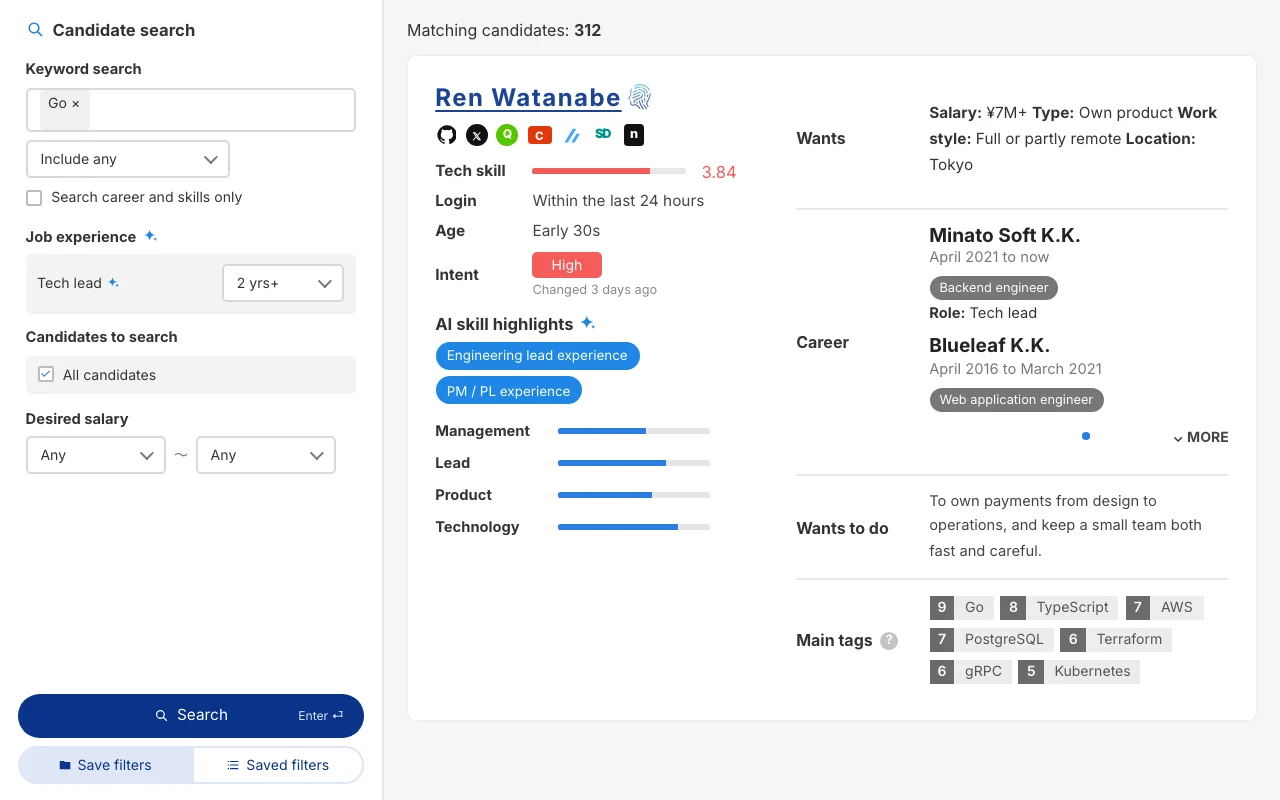
Search for candidates
Filter by keyword, past roles and years in them, desired salary and job-change intent. A tech skill score of 3.5 or more is the top 4%.
Use Talent Sonar to time your approach
Engineers whose intent went up, or who keep viewing your jobs, arrive in a list every day. From each card, you can send a notification or a scout.
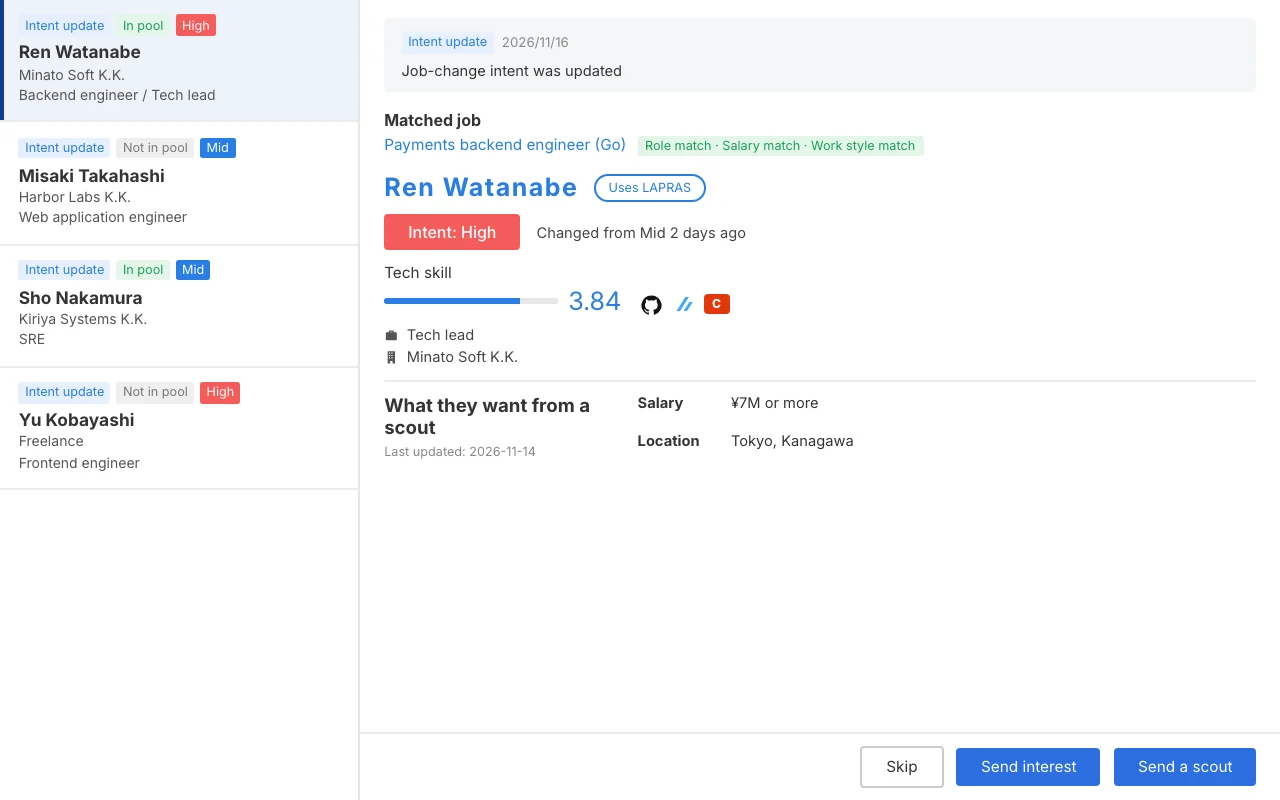
Send interest notifications, then scout those who answer Interested
Pick a job and send the notification. The engineer gets your job card with an Interested button. When they answer, write about what stood out in their articles or repositories.
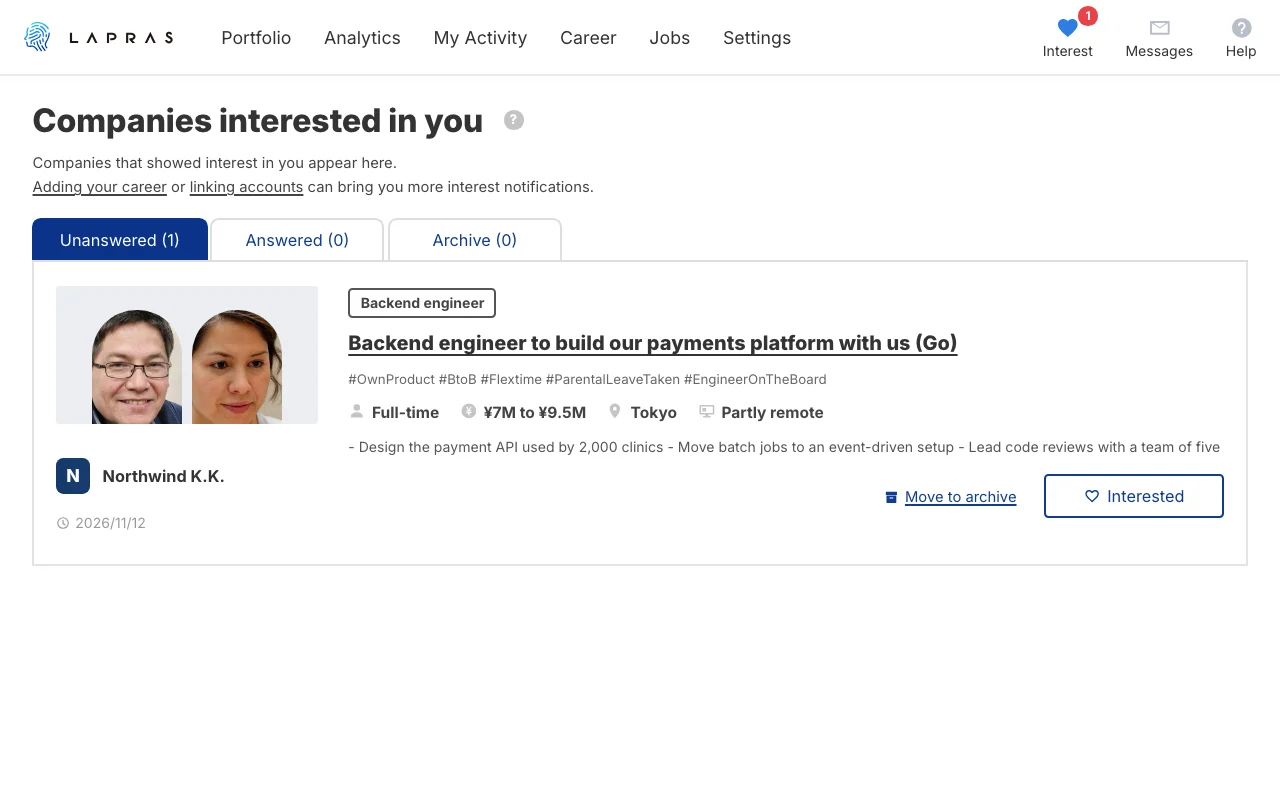
Meet in a casual interview
When someone replies, use a casual interview to present the company and the role. LAPRAS's rules forbid calling a meeting "casual" when it's really part of selection.
Measure and improve
Measuring results on LAPRAS, and raising your reply rate
Once you're running, you'll want to know two things: when the first hire will come, and how your reply rate stacks up.
How long the first LAPRAS hire takes
LAPRAS doesn't publish an average time to hire. In its case studies, SalusTech hired one person after four months and ispec hired two in six months. So plan on four to six months. On its 2024 managed outreach plan, LAPRAS says some companies landed a first casual interview within one to two weeks.
On a six-month term, aim to build up replies and casual interviews in the first two months. After the interview, selection takes as long as for candidates from any other channel. For setting up selection, see the hiring process guide.
From sign-up to a hire on LAPRAS, week by week
In the case studies, the first hire came after four to six months
- Weeks 1–2Brochure and free trial
- Weeks 3–4Contract and job post
- Week 5 onNotifications and scouts
What reply rates to expect on LAPRAS
On LAPRAS, three numbers matter: the share of notifications answered Interested, your scout reply rate, and the share of repliers who take a casual interview. LAPRAS puts scouts in general at 5 to 10%, and its own at about 20 to 30%.
LAPRAS reply-rate benchmarks
LAPRAS's figures, and Direct Sourcing's averages for LAPRAS SCOUT
Messages after Interested
LAPRAS scouts
Bar to clear before adding volume
Sources: LAPRAS help center for recruiters, Direct Sourcing, LAPRAS onboarding deck
LAPRAS's onboarding deck advises quality over volume until you can hold a 15% reply rate. Below 15%, fix who you pick and what you write before you send more. Note that Direct Sourcing's reply-rate comparison across platforms doesn't include LAPRAS.
How to raise your reply rate
Self is a flat fee. More replies mean more hires, so each hire costs less. These five habits help most:
- Answer Interested within the hour: data LAPRAS published, relayed by a recruiting firm, show 66.6% replies when the scout goes out within an hour, falling to 27.7% after 31 days.
- Sort by intent change date: candidate search can list the most recent intent changes first. Check Talent Sonar alerts the same day.
- Name the specific work: say which repository or article caught your eye, and why. LAPRAS's guidelines also ask for messages that reflect the candidate's situation.
- Rewrite the job: each notification carries your job card. Make the work, the pay and the work style clear at a glance.
- Use X direct messages too: LAPRAS recommends scouting on X as well, and its own research puts reply rates there at 50 to 60%.
FAQ
Frequently asked questions about LAPRAS
What is LAPRAS?
LAPRAS is a Japanese platform for scouting software engineers, operated by LAPRAS Inc. It builds engineer profiles from public work on GitHub, Qiita, Zenn and similar sites, and scores technical skill. Companies search its engineers, check who is open to a move, and send interest notifications or scouts.
What is the difference between LAPRAS SCOUT and LAPRAS?
They're the same service. The employer product "LAPRAS SCOUT" and the engineer product "LAPRAS" merged under the single name LAPRAS on 1 October 2024. Many articles still call the employer side LAPRAS SCOUT.
How much does LAPRAS cost for employers?
LAPRAS doesn't publish prices. Its employer site asks you to contact sales. Recruiting firms report ¥1.2 million for six months on the self-run Self plan (a ¥300,000 setup fee plus ¥150,000 a month, before tax). Twelve months reportedly cost ¥1.95 million, and 24 months ¥3.6 million.
Does LAPRAS charge a success fee?
It depends on the plan. On Self you only pay the monthly fee, however many hires you make. Light is built mainly around a fee per hire, and Recruiting BPaaS Premium adds a success fee to its monthly fee. LAPRAS JOB BOARD, a job-post-only plan, has no setup or monthly fee and charges 20% of the hire's annual pay.
What is the LAPRAS tech skill score?
It's a number from 1.0 to 5.0 that rates an engineer's technical skill from four sources: GitHub, tech articles, tech events and skill tags. Scores are set so the average is 3.0, and 3.5 or more puts someone in the top 4%. Engineers who publish little online score lower.
What is the LAPRAS market value score?
It's a five-point score that places an engineer among LAPRAS users. It rates four areas: technology, lead, product and management. Since 24 February 2026, employers can see its summary and the engineer's strengths.
How many engineers are on LAPRAS?
About 40,000 people had registered by September 2026. The search database holds about 1.5 million engineers, including people who never signed up. But you can only send interest notifications and scouts to registered users.
Can I contact engineers who aren't registered on LAPRAS?
No. You can search and view the profiles of engineers who never signed up, but you can only approach LAPRAS users. In 2020 a feature let companies notify people who weren't registered, but that's not how the service works today.
What reply rate can I expect on LAPRAS?
LAPRAS puts its own scout reply rate at 20 to 30%, against 5 to 10% for scouts in general. Messages to engineers who answered an interest notification with Interested get about 50% on average. These are LAPRAS's figures: the third-party reply-rate tables that compare platforms don't include LAPRAS.
Interest notification vs scout on LAPRAS: what's the difference?
An interest notification is a one-click signal tied to one of your jobs. A scout is a written message. Sending the notification first, then a scout to engineers who answer Interested, gets more replies.
Can I cancel LAPRAS before the term ends?
The terms have no clause that lets a company cancel mid-term for its own reasons. You prepay the whole term, and fees aren't refunded unless LAPRAS itself can't provide the service. The contract renews on the same terms unless either side declines at least one week before it ends.
Is LAPRAS a recruitment agency?
LAPRAS Inc. holds a paid placement licence, and its terms describe the service as a placement service for hiring companies. But on the Self plan, no agent recommends candidates: you search, and you send the notifications and scouts yourself.
Can small companies hire with LAPRAS?
Yes, if you plan to hire at least one web engineer within six months, and a team member can read candidates' work and write to them. LAPRAS's case studies include a company with four full-time engineers and a company with a single recruiter.
Is LAPRAS available in English?
No, LAPRAS is Japanese only, for employers and engineers alike. Since February 2026, LAPRAS has offered English and Korean interpreter support to overseas companies. Candidate search has a filter for the English level engineers report themselves (native, business, conversational).
How does LAPRAS compare with Findy and Green?
LAPRAS's Self plan is a flat fee, with no success fee and unlimited scouts. Findy only opens scouts once you and the engineer match through Likes, and adds a success fee of 30 to 35% of annual pay to its term fee. Green charges a setup fee plus 20% of annual pay for applicants from 12 January 2027, and also covers roles outside engineering.
DIY Hiring Kit
Everything You Need To Hire On Your Own
A downloadable hiring framework for small businesses in Japan, with step-by-step guides, spreadsheet ATS, LinkedIn scouting system, interview questions bank, offer letter and employment contracts, and a ton more!
1Dashboard11Checklists8Spreadsheets30Template docs4Weeks of Q&ABilingual
- Download every file as Word, Google Docs, Excel or Google Sheets


 14 years in talent acquisition
Related
Related guides and tools
 Guide
What is Findy? Pricing, reviews and hiring engineers
The engineer platform where you talk only after a match.
 Guide
What is Green? Pricing and success fees
The IT and web platform with a one-off entry fee.
 Hiring practices
What is direct recruiting? Scouting vs agencies
The method behind LAPRAS's search and scouts.
 Hiring practices
What is a casual interview?
How to run the first meeting after a reply.
 Tool
Cost per hire: averages and calculator
Divide a flat fee by the people you hire, with your numbers.
 Template
How to write a job description
Write the job that travels with each interest notification.
Official sources
The main sources for this guide. Other references are linked where they are used in the text.
- LAPRAS Inc.scout.lapras.com LAPRAS terms for hiring companies Prepayment, refunds, automatic renewal, the success-fee clause and prohibited conduct (revised 1 October 2024).
- LAPRAS Inc.scout.lapras.com LAPRAS for employers The three plans, about 40,000 registered users by language, and the share open to a move (September 2026).
- LAPRAS Inc.help.lapras.com LAPRAS help center for recruiters Candidate search filters and the tech skill score range (3.0 average, top 4% at 3.5 or more).
- LAPRAS Inc.help.lapras.com What candidates see Only registered users can be approached, and candidates can see which companies viewed them.
- LAPRAS Inc.help.lapras.com Scouting through X direct messages Reply-rate benchmarks: 5 to 10% for scouts in general, 20 to 30% on LAPRAS.
- Direct Sourcingdirectsourcing-lab.com LAPRAS SCOUT plans and how to use them Self and BPaaS Premium prices, and the rates from reply to hire (updated August 2025).