
What is OpenWork?OpenWork Recruiting pricing, scouts and your reviews
A guide to OpenWork for companies that want to reach candidates who read their employee reviews in Japan. It covers how OpenWork's ratings work, OpenWork Recruiting pricing and success fees, when reviews can be removed, and how employers use it.

Basics
What is OpenWork?
In short
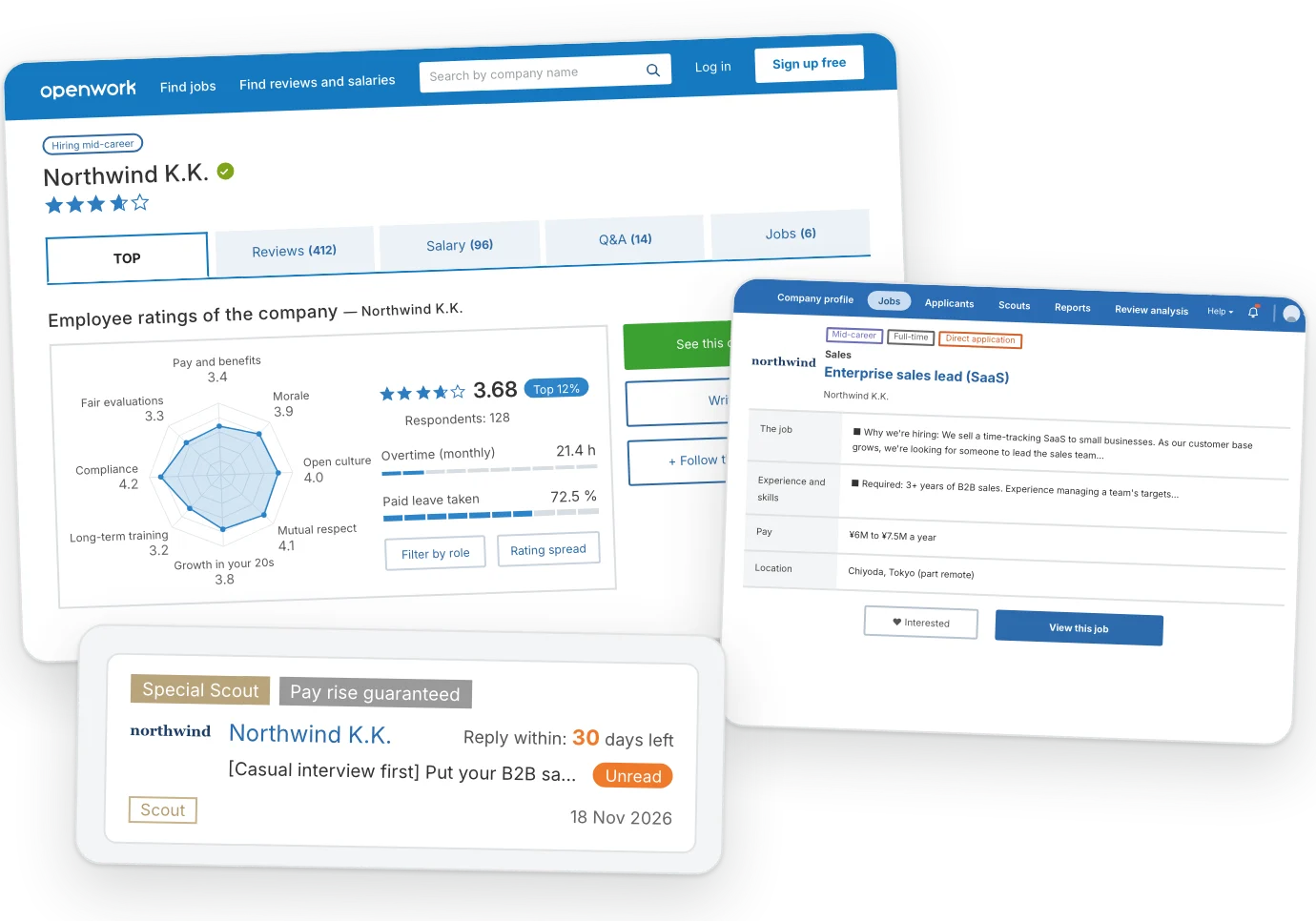
OpenWork is a Japanese employee-review site run by OpenWork Inc. Each company has a page with reviews and ratings on eight items from current and former staff, and 8.37 million people are registered. With OpenWork Recruiting, a company can show its jobs to those users and send them scouts. Pricing combines a base fee with a fixed fee for each hire.
In Japan, many job seekers check a company's reputation before they apply. OpenWork's own survey found that 74% of people who changed jobs had used employee reviews (April 2018). OpenWork is where those reviews live, and it's also where companies can scout. So candidates read your scout with your ratings one click away.
My background is 14+ years of recruiting, including roles at Persol Career and Google; these days I help small and mid-size businesses hire through our recruitment consulting service. OpenWork comes up in two kinds of conversations: worries about a company's own reviews, and the search for a scouting platform. For this guide I read OpenWork Recruiting's pricing and feature pages, the fee schedule it filed with the labor ministry, and OpenWork Inc.'s financial reports. It's part of a series on hiring platforms in our hiring playbook.
- We start with the company page candidates see, and what OpenWork Recruiting lets you do.
- Next come the fees: the three plans, when the success fee falls due and when it's refunded.
- Then the size of the audience, and how to deal with your own reviews, including what can be removed.
- After that, strengths and weaknesses, how OpenWork stacks up against rivals, and three example companies.
- We close with the console steps, typical reply rates and tips for better scouts.
How it works
How OpenWork works: employee reviews and scouts
OpenWork has two sides. One is the employee-review site, where staff and former staff rate their companies. The other is OpenWork Recruiting, which puts companies' jobs and scouts in front of the same users, on the same site as the reviews.
It started in 2007 as Vorkers and took its current name in May 2019. OpenWork Inc. listed on the Tokyo Stock Exchange Growth market in December 2022.
The company page candidates see
When a candidate looks up your company, a page like this opens. People who get a scout from you can check it before deciding whether to answer.
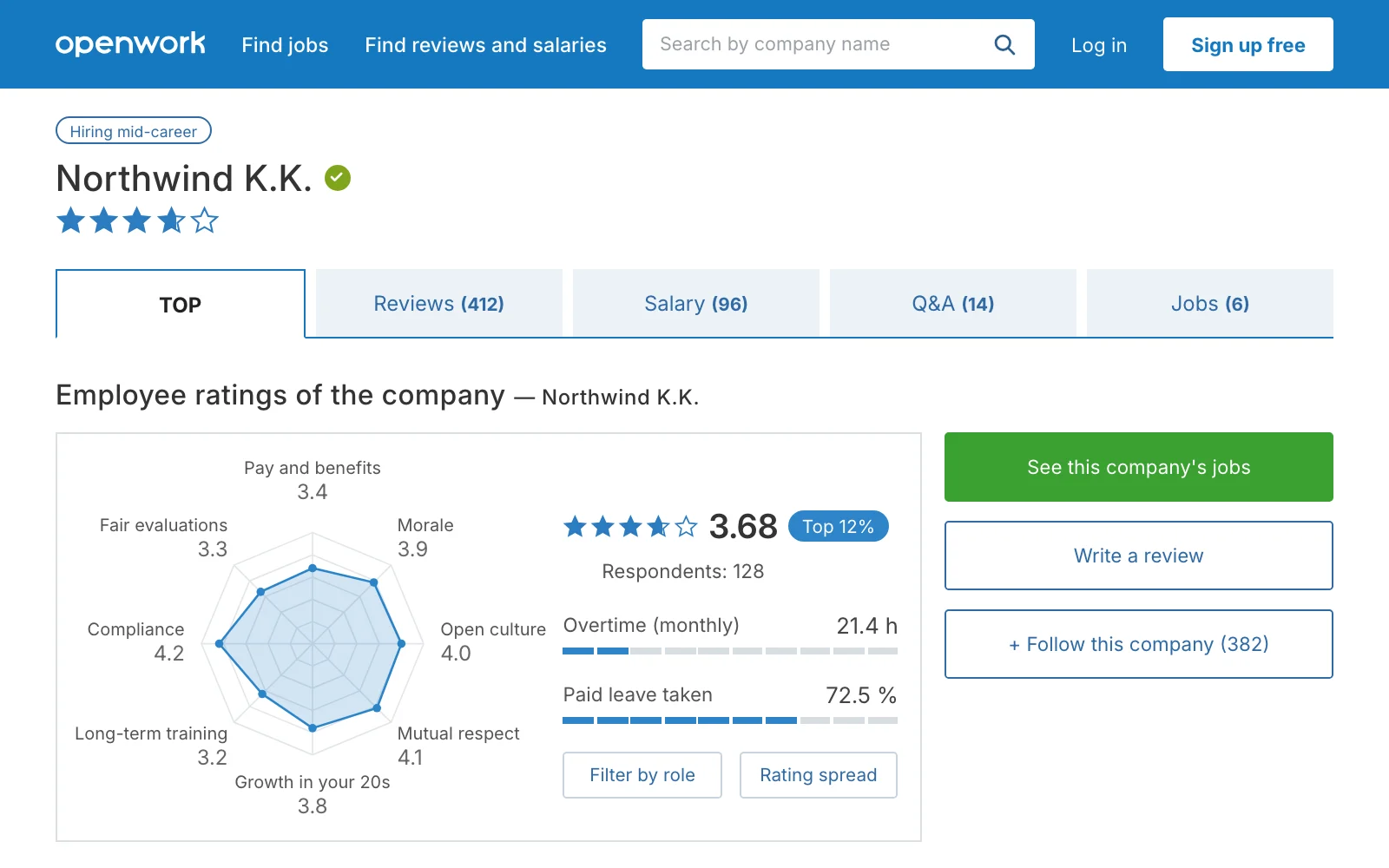
Company page (mock-up)
- Overall rating: stars, score and percentile
- Ratings: a radar chart of eight items
- Overtime and leave: figures from staff answers
- Jobs: the tab listing your openings
The eight ratings are pay and benefits satisfaction, morale, open culture, mutual respect, growth for people in their 20s, long-term training, legal compliance and fair evaluations. The score isn't a plain average: OpenWork calculates it with its own algorithm, weighing how recent and how numerous the answers are.
To read every review, users must post a review, save an online résumé or pay for a membership. So the people who research most have a reason to file a résumé.
What OpenWork Recruiting lets you do
The feature page lists five main tools:
- Job posts: publish a public job anyone can apply to, or a private one that only scout recipients can see.
- Candidate search: search online résumés by past roles, industries, management experience and English level for mid-career hires, or by university and graduation year for students.
- Scouts: send regular scouts, or Special Scouts with a box for your reason. People who don't answer can get an automatic resend that doesn't use another scout.
- Interested and job prompts: see who marked your jobs as Interested, while matching users get your jobs suggested automatically.
- Review analysis: break down your ratings by age or hiring route and compare them with competitors. It requires a live job post.
Three things that set OpenWork apart
Searching and writing to candidates works much as it does on BizReach. The difference lies in three points:
- Difference 1Candidates can check your reputation before they answer. Job listings show each company's rating, and users can sort jobs by rating. OpenWork says companies with higher ratings tend to get more applications.
- Difference 2The success fee is flat, whatever the salary. Agency fees usually run at 30 to 35% of the new hire's salary. OpenWork charges ¥700,000 to ¥800,000 per mid-career hire, so the gap widens as salaries rise.
- Difference 3One contract covers mid-career and graduate hiring. The same base fee lets you scout professionals and students. Even the smallest 12-month plan gives 10,000 scouts for each.
Candidates' names and contact details stay hidden until they apply. Replying to a scout is treated as applying, and only then is their name shared with you.
The free job-posting plan vs the paid scout plans
OpenWork Recruiting has a job-posting plan with no base fee. But only the posting is free.
| Item | Job-posting plan | Scout plans |
|---|---|---|
| Base fee | ¥0 | From ¥700K for 6 months |
| Job posts | Unlimited | Unlimited |
| Scouts | None | Up to the plan allowance |
| Success fee, mid-career | ¥800K | ¥700K to ¥800K |
| Success fee, graduate | ¥400K | ¥300K to ¥400K |
Before tax. Sources: OpenWork Recruiting pricing, fee schedule filed with the labor ministry (which splits fees into experienced hires and students).
A hire on the job-posting plan still costs a success fee. It isn't on the pricing page, but the fee schedule filed with the ministry sets it at ¥800,000 for an experienced hire and ¥400,000 for a student.
Pricing
OpenWork Recruiting pricing: three plans and a flat success fee
Pricing combines a base fee covering the contract term with a success fee for every hire. Until the base fee arrived in March 2025, the service charged only success fees; scouting now requires a base fee.
OpenWork Recruiting price list: the three plans
The three plans give different numbers of scouts. OpenWork publishes the amounts on its pricing page.
| Plan | 6 months | 12 months | Mid-career scouts (12 months) |
|---|---|---|---|
| Light | ¥700K | ¥1.2M | 10,000 |
| Standard | ¥1.1M | ¥1.8M | 30,000 |
| Premium | ¥2M | ¥3.5M | Unlimited |
Before tax. Graduate scouts come in the same numbers as mid-career ones. The price table suggests Light for up to about 15 hires a year, Standard for 15 to 50, Premium for 50 or more. Source: OpenWork Recruiting pricing.
Even Light on 12 months gives 10,000 mid-career scouts, over 800 a month. You'll run out of time to write scouts long before you run out of scouts. There's no cap on users, so anyone in the company can use the console.
OpenWork's success fee doesn't change with the plan
The success fee depends not on the plan but on whether you contract mid-career scouting, graduate scouting, or both.
| What you contract | Mid-career (experienced) | Graduate (student) |
|---|---|---|
| Mid-career and graduate scouts | ¥700K | ¥300K |
| Mid-career scouts only | ¥800K | ¥400K |
| Graduate scouts only | ¥800K | ¥350K |
| Job-posting plan only | ¥800K | ¥400K |
Before tax. Sources: OpenWork Recruiting pricing, fee schedule filed with the labor ministry. The fees for hiring a student on a mid-career-only contract, or an experienced hire on a graduate-only contract, come from the fee schedule.
The fee is triggered by the accepted offer. The official setup guide asks you to set the applicant's status to "offer accepted" in the console as soon as they accept; OpenWork then sends payment details for the success fee.
The fee schedule also sets refund rules. If a student turns down the job after accepting, for their own reasons, the whole fee is refunded. For anyone else, if they quit or are dismissed within 30 days of starting and OpenWork agrees the cause lies with them, half the fee is refunded or waived.
The schedule exists because OpenWork holds a fee-charging job placement licence (13-yu-307725). Its annual securities report describes OpenWork Recruiting as a fee-charging placement business.
Five points to clear up before signing
The detailed terms of the paid plans aren't online. Public documents point to five things to check:
- Contract length is described two ways: the pricing page offers 6 or 12 months, while the plan page says contracts run "in one-year units".
- Graduate scouting needs a form: to use both segments, you file a change-of-scope form. A segment you don't use gets no scouts.
- Special Scouts come once: you get 100 for mid-career hiring with your first contract. You can buy more, but the price isn't published.
- Reporting hires is your job: OpenWork learns about hires from the employer. The securities report mentions penalties for companies that fail to report them.
- Renewal and cancellation terms aren't public: ask whether the contract renews automatically, and what happens to the base fee if you stop early.
What one OpenWork hire costs
Your cost is the base fee plus one success fee per hire. Using Light for 12 months for mid-career only, one hire costs ¥1.2 million plus ¥800,000: ¥2 million. An agency charging 35% on a ¥6 million salary would bill ¥2.1 million, so OpenWork comes out slightly cheaper from the first hire.
How many you hire on OpenWork, and the cost of each
A ¥6M mid-career hire on Light for 12 months (mid-career only), next to a 35% agency fee
Agency (1 hire)
OpenWork (1 hire)
OpenWork (2 hires)
OpenWork (3 hires)
OpenWork (5 hires)
Before tax. Mid-career-only contract, so ¥800K per hire. SaiyouTeam estimate based on OpenWork's published prices and a common agency rate
However many you hire, each one never costs less than the ¥800,000 success fee. But unlike an agency fee, it doesn't rise with salary, so OpenWork favors well-paid roles. For a single hire on ¥4 million a year, an agency (¥1.4 million) is cheaper.
- What will the role pay? For one hire, the break-even with an agency sits around ¥5.7 million a year. If most of your roles pay less, compare agencies and job ads too.
- Will you hire graduates too? With both segments, the success fee drops to ¥700,000 per mid-career hire and ¥300,000 per graduate.
- What's your rating? Candidates can see it before answering. If it's low, fix your official company information first.
Who you can reach
OpenWork has 8.37 million users and 1.92 million online résumés
OpenWork Inc.'s financial reports give the size of the platform. At the end of September 2026, it had 8.37 million registered users, 22.4 million reviews and ratings combined, and 154,000 live job posts.
OpenWork users, and who can receive scouts
Registered users, people with an online résumé, and students
Registered users
Online résumés
Students
Sources: OpenWork Inc. results presentation (September 2026); students from the employer site's FAQ (undated)
Not everyone can receive scouts. Professionals can only once they save an online résumé; students can from the moment they sign up. For mid-career hiring, the 1.92 million online résumés are the pool to look at, though that running total includes students.
Users are mostly in their 20s and 30s: about 70%, says OpenWork (another of its pages says about 80%). Over half earn ¥5 million a year or more. There's no published breakdown by job type.
The hires OpenWork handles best
Judging by its users and its published case studies, OpenWork is strongest in three kinds of hiring.
Mid-career hires on ¥5 million or more
Because the success fee is flat, better-paid hires cost relatively less. Sansan made nine hires over three years through OpenWork, and Uzabase nine offers in all.
Graduate hiring, including top universities
Over half of student users attend leading universities. At Cloud Ace, five of the ten graduates who accepted offers for 2026 came through OpenWork.
Companies with strong ratings
Candidates can check your reputation before applying, so a high rating is an asset in itself. ULS Consulting says that simply putting its 4.26 rating in its scouts raised its reply rate.
Your own reviews
Handling your own OpenWork reviews: removal rules and official information
Your company can have reviews on OpenWork even if you never sign up for OpenWork Recruiting. So knowing how your page looks is worth a few minutes of any recruiter's time.
Who can write OpenWork reviews
Under the posting guidelines, only people who worked at least a year as full-time or contract employees can post. Part-timers and agency temps can't, and each person can review the same company once a year, or once after leaving.
Every submission is checked by software and by staff, and in 2025 79% were published and 21% weren't. OpenWork says it doesn't decide based on whether a review is good or bad for the company. Posters are about half current and half former employees.
When a company can get a review removed
OpenWork won't remove a review just because a company finds it inconvenient. Its operating policy covers two cases:
- Clearly untrue content: the documents you submit show the review doesn't match the facts.
- Likely rights violations: the review is likely defamatory or invades someone's privacy.
Requests are accepted by email only, not by phone or in person. You need a takedown request form, documents showing the facts, and a company registry extract and seal certificate issued within the last three months. A review team that includes lawyers decides.
OpenWork warns that if a request is made in bad faith, it may publish the company's name and the request. And it never reveals who wrote a review, even when a company asks.
Put your official information next to the reviews
OpenWork doesn't offer an official way to reply to reviews. The way to speak as a company is OpenWork Recruiting's company profile content: up to five sections of text, images, video or slides. Once two sections are filled in, you can post jobs.
Asking employees to write reviews breaks OpenWork's terms. To lift your ratings, fix the issues reviews raise most often, then explain what changed on your careers site and company profile. For a deeper look at your own reviews, OpenWork sells an employee review report (¥800,000 before tax, as of November 2024).
Pros and cons
OpenWork Recruiting pros and cons
OpenWork Recruiting's strengths are its flat success fee and generous scout allowance. Its weaknesses: your results depend on your own rating, and scouting needs a base fee paid before you hire anyone.
What employers say about OpenWork Recruiting
Review sites have almost no employer feedback yet. ITreview and IT Trend show zero reviews, and BOXIL doesn't list it (November 2026). The employer views available are OpenWork's own case studies:
- At HP Japan, two months passed from scout to offer.
- Adobe made three offers in three months.
- In graduate hiring at Feedforce, 150 applicants, 75% of the total, came through OpenWork.
- Rise Consulting got a 20% reply rate on scouts to 2027 graduates.
Every case-study page is labeled "as of May 2026", but the stories date from 2019 onwards.
Watch out: your rating, and the effort scouting takes
The main catch is that a low rating works against you. People who get your scout can check your rating on your company page. If your score sits low in your industry, spell out how you work and what you offer in your company profile before you start scouting.
The other is that you do the scouting. OpenWork isn't an agency, so your recruiters find candidates and write to them. A recruiting consultant from OpenWork helps with job ads and scout writing.
Here's how the two sides compare:
| Topic | Pros | Cons |
|---|---|---|
| Cost | Flat success fee, whatever the salary | A base fee comes first |
| Reach | 8.37M users, graduates included | Only résumé holders can be scouted |
| Candidates | Over half earn ¥5M or more | No split by job type |
| Contract | Mid-career and graduates in one contract | Renewal and cancellation terms not public |
| Workload | Auto resend and bulk sends from lists | You search and write yourself |
| Replies | Well-rated companies get answers more easily | Reply rates of 2.9 to 6.3% |
How it compares
OpenWork vs other hiring platforms: a success fee that ignores salary
Next to its rivals, OpenWork's position becomes clear. The table ranks general platforms and engineer-only services by reach and price.
| Sort by | ||||
|---|---|---|---|---|
 dodaJob board, agency and scouts (Persol) | 10.99MJune 2026 | Not public | Not public | Not public |
 Rikunabi NEXTJob board (Recruit) | 10M+Unofficial estimate | Not public | Not public | Not public |
 LinkedIn Recruiter CorporateAll professions | 5M | ¥1,700,00012 months | 150¥944 per scout | None |
| LinkedIn Recruiter LiteAll professions | 5M | ¥16,0001 month | 30¥533 per scout | None |
 Wantedly StandardMid-career, new grads | 4.57M | ¥900,0006 months | 25¥6,000 per scout | None |
| Wantedly PremiumMid-career, new grads | 4.57M | ¥1,320,0006 months | 50¥4,400 per scout | None |
 BizReachExecutives, high income | 3.53M | ¥850,0006 months | 67¥2,125 per scout | 15%of salary |
 OpenWorkMid-career, new grads | 1.92M | ¥1,200,00012 months | 833¥120 per scout | ¥300K–800K |
 GreenIT and web | 1.63M | ¥600,000One-off | 1,000Included | 20%of salary |
 YOUTRUSTMid-career | 500K | ¥2,400,00012 months | 20¥10,000 per scout | None |
 doda XExecutives | 400K | ¥1,050,0008 weeks | 217¥2,625 per scout | None |
 FindyIT engineers | 165K | ¥360,0006 months | 35–70 a weekLikes | 30–35%of salary |
 LAPRASIT engineers | 40K | ¥945,0006 months | Unlimited | None |
Source: SaiyouTeam research, platforms' published figures (November 2026). OpenWork's reach is its online résumés; its price is Light for 12 months, and its monthly scouts are the mid-career allowance divided by 12. Click a column to sort.
With so many scouts included, OpenWork costs about ¥120 per scout, among the lowest in the table. Its success fee is a flat ¥300,000 to ¥800,000, set differently from scouting services, which often charge 15 to 20% of salary, and from agencies, which charge 30 to 35%.
For senior candidates with long track records, BizReach is worth a look, and Green for IT and web roles. OpenWork suits companies whose reputation is a selling point, and those hiring mid-career staff and graduates at the same time.
When choosing a platform for each role, use the hiring platforms sheet from the DIY Hiring Kit, which sets the main services side by side.
Strategy
Three ways to fit OpenWork into your hiring strategy
OpenWork puts your reputation and your jobs on the same screen. It works best when your company page is ready to win people over before you write to them, rather than when you compete on volume.
Three companies of different sizes show how that plays out.
-
Scenario 1
3 hires in engineering and B2B sales, over the next year at an 80-person software company
ProfileServer-side engineers with 5+ years and B2B salespeople. Target pay ¥5.5M to ¥7.5M.
Strategy
- OpenWork
- BizReach
The company rates above its industry average, so its OpenWork page does much of the selling. Scouts go out as Special Scouts, each saying why that person was chosen. Candidates close to management level are also searched on BizReach.
Plan
Light, 12 monthsMid-career only: ¥1.2M plus 3 × ¥800K makes ¥3.6M, or ¥1.2M per hire, below an agency's fee on ¥6.5M salaries (about ¥2.28M).
-
Scenario 2
7 hires, graduates and mid-career, in the same year at a 320-person parts maker
Profile5 graduates (science and engineering) and 2 experienced hires in production control and quality assurance.
Strategy
- OpenWork
- Graduate job sites
One OpenWork contract covers scouts to students and professionals. Graduates are searched by university and faculty, alongside the graduate job sites that fill information sessions.
Plan
Light, 12 months (both)¥1.2M plus 5 × ¥300K and 2 × ¥700K makes ¥4.1M, or about ¥590K per hire.
-
Scenario 3
1 salesperson this year, for a 35-person staffing services firm
Profile2 to 3 years of B2B sales. Target pay ¥4.5M to ¥5.5M.
Strategy
- OpenWork
- Careers site
No scouts: a public job on OpenWork's free job-posting plan. The company profile and the careers site show the team's work in detail.
Plan
Job-posting planNo base fee, just ¥800K when someone is hired: less than half an agency's ¥1.75M on a ¥5M salary. Whether anyone applies depends on the company page.
You do the scouting: your team and outside help
OpenWork Recruiting isn't an agency, so OpenWork won't pick and present candidates to you. There are three ways to staff it:
- Your own team: with no cap on users, hiring managers can join recruiters in the console. You can create up to 200 groups.
- A consultant's support: your OpenWork recruiting consultant helps with job ads and scout writing. How much depends on your contract and usage.
- An outside firm: recruitment outsourcing firms use OpenWork Recruiting too. Since the platform ties scouts to your reputation, keep the messages close to your own voice.
Getting started
Getting started with OpenWork Recruiting
Setup takes three steps; after that, four steps make up the routine. The console is meant for a desktop browser; phones and tablets aren't supported.
Setup: from applying to publishing jobs
Apply as a company
Apply through the OpenWork Recruiting employer site with a company email address; free webmail isn't accepted. After a review you sign the contract, and you can start in as little as 2 to 3 business days (5 on average).
Publish your company profile and a job
Once two company profile sections are filled in, you can create jobs. Choose public or private for each; jobs are reviewed before they go live.
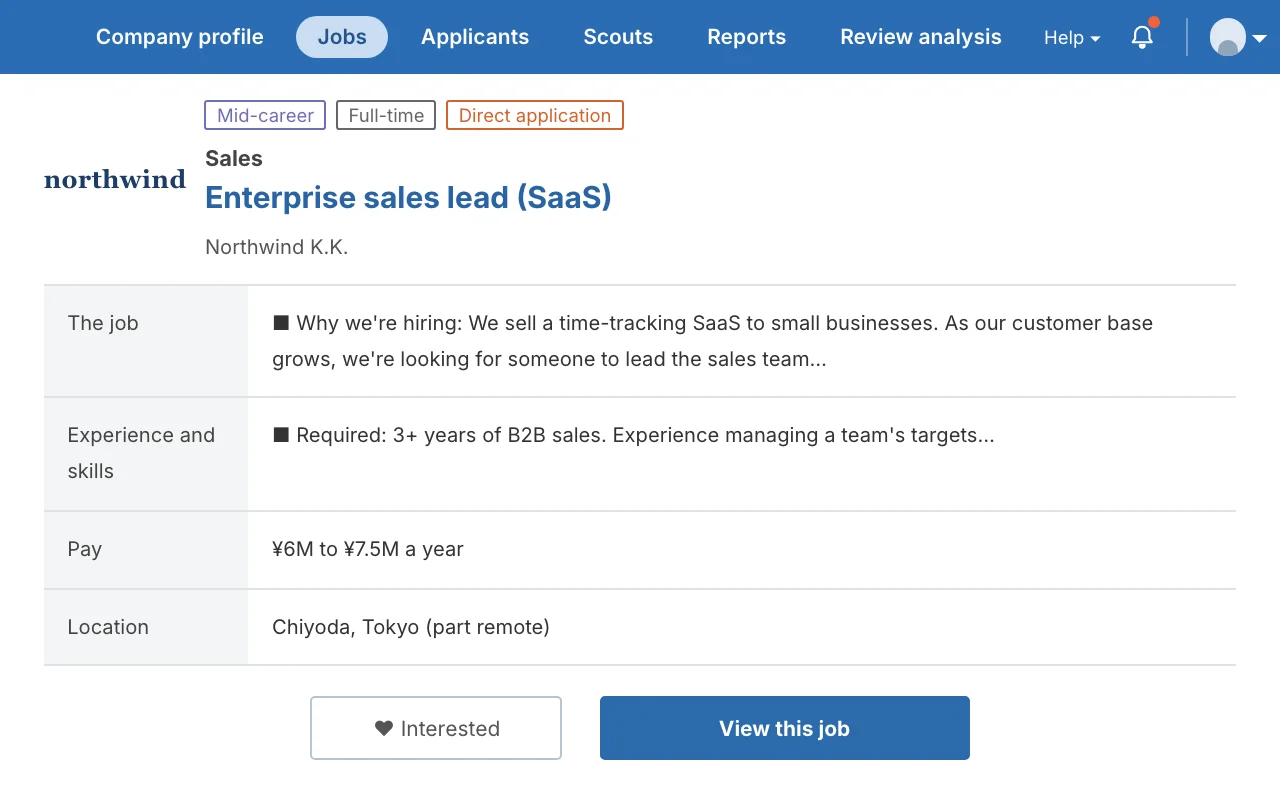
Invite your team
An admin invites the colleagues involved in hiring. There's no limit on users, and you can split them into groups by role or department.
Daily routine: search, scout, report
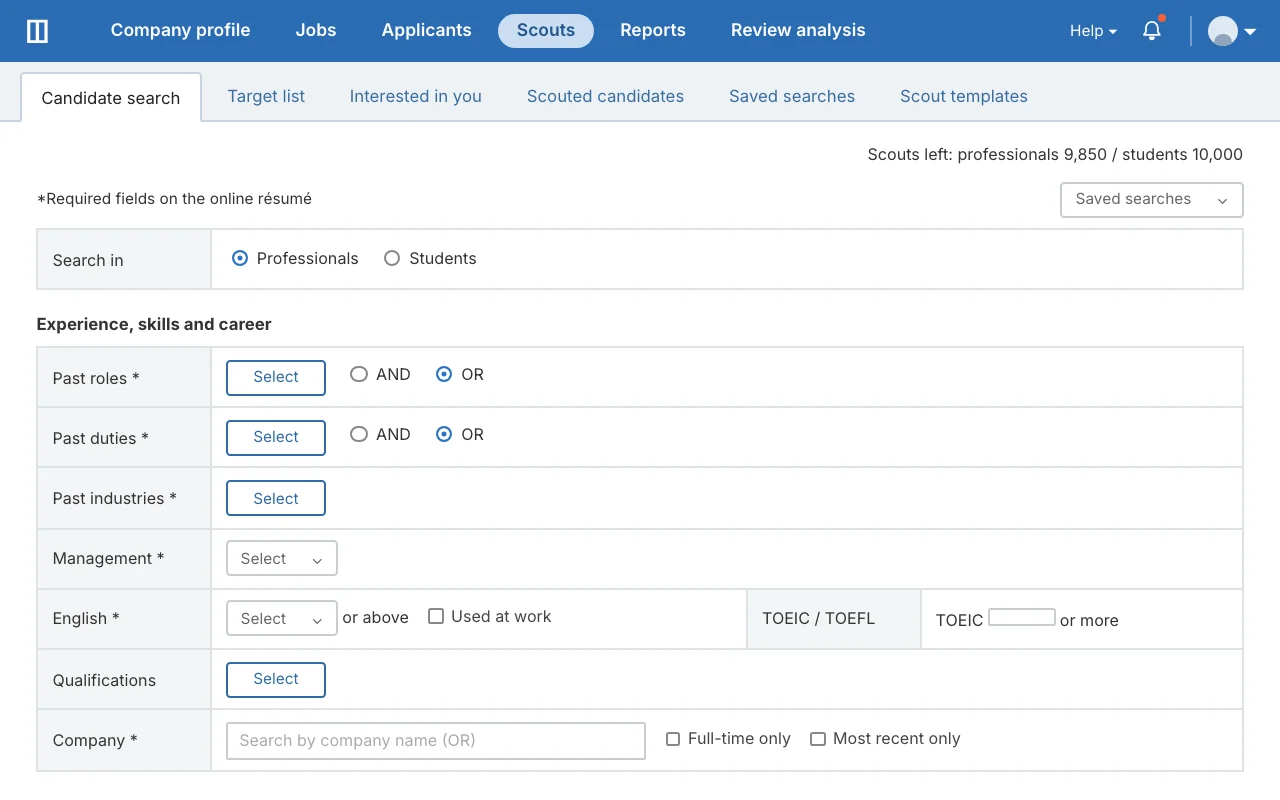
Search for candidates
For mid-career hires, filter by past roles, duties, industries, management experience, English level and more. Save the searches you reuse, and gather candidates in target lists.
Send scouts
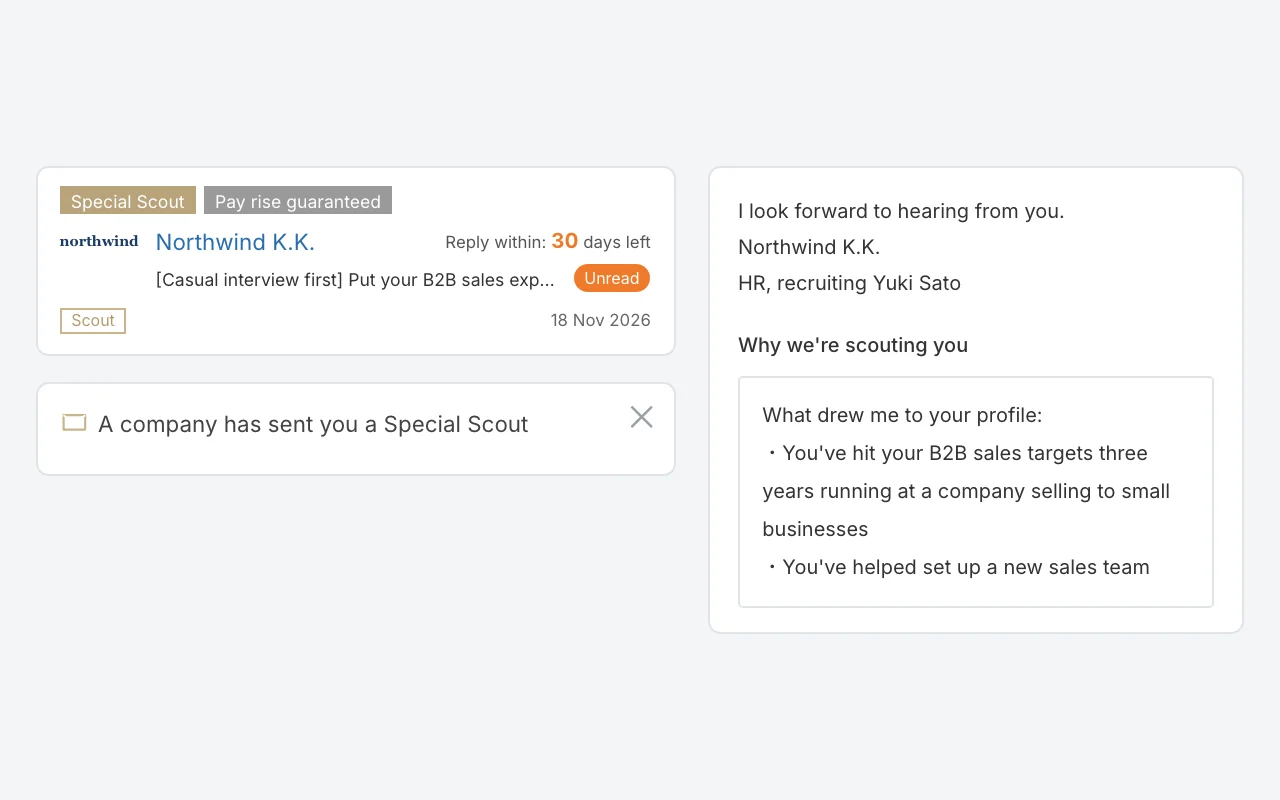
Send a regular scout, or a Special Scout with your reason for writing. A Special Scout stands out on the candidate's screen.
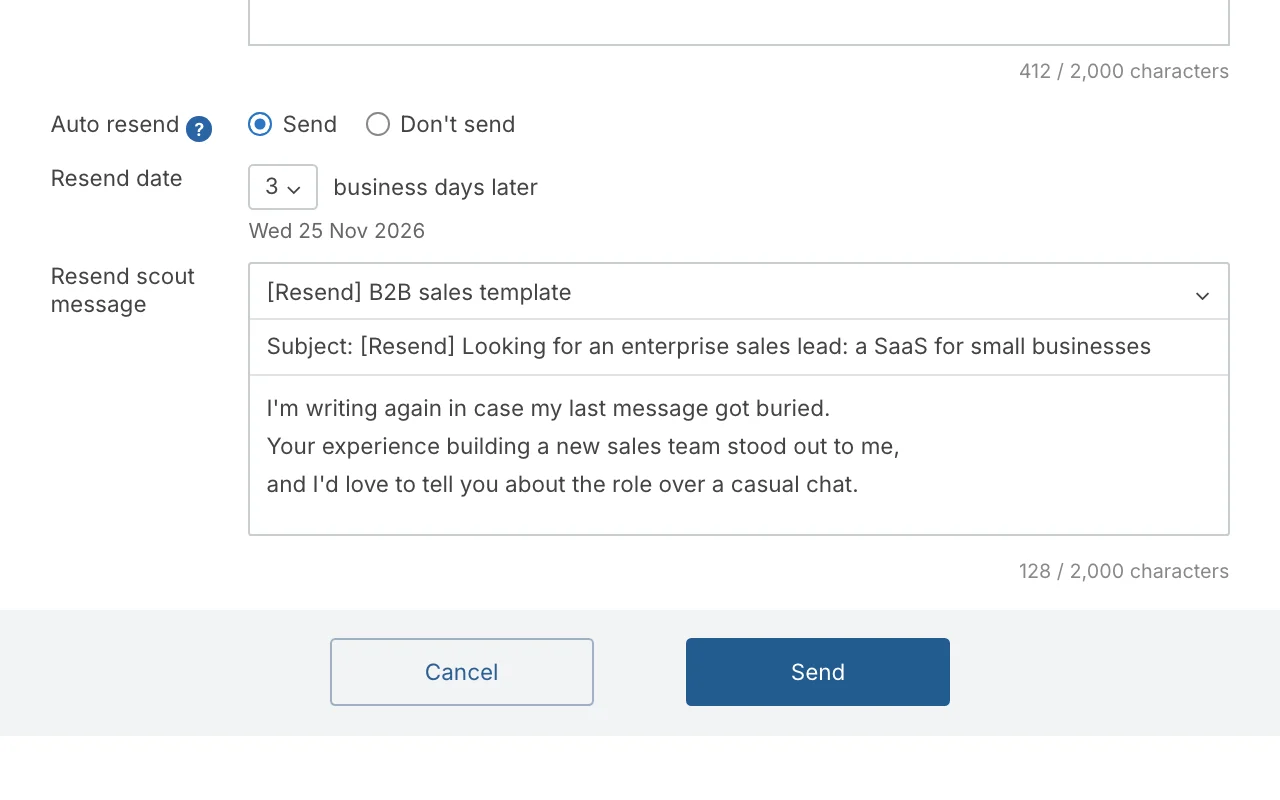
Resend automatically to people who don't reply
Switch auto resend to Send, then pick how many business days to wait and which message to use. Resends don't use up scouts.
Report the accepted offer
Because a reply is treated as an application, move on to a casual interview or an interview. When the candidate accepts your offer, set their status to "offer accepted" in the console.
Reply rates
OpenWork scout reply rates, and how to get better results
Once you're live, keep an eye on the time each hire takes and the share of scouts that get answers.
How long an OpenWork hire takes
There's no official figure for time to hire, so the case studies are the best guide. At HP Japan, two months passed from scout to offer, and Adobe made three offers in three months. Expect two to three months to your first offer.
The first weeks go on your company profile, jobs and the review of both. From the first meeting on, selection follows the timeline you'd expect from any channel. Setting up your interview stages is covered in the hiring process guide.
From application to offer
First offer within two to three months in the case studies
- Week 1Apply, review, contract
- Weeks 2–3Company profile and jobs live
- Week 4 onSearch and scouts
OpenWork reply-rate benchmarks
OpenWork publishes no official reply rate for scouts. The closest benchmark comes from Direct Sourcing, a firm that runs scouting for client companies and publishes rates from the 800,000+ scouts it has handled.
Scout reply rates by platform
Direct Sourcing data, scouts sent in September 2025
Findy
Wantedly
YOUTRUST
LinkedIn
BizReach
OpenWork
Green
Source: Direct Sourcing. One firm's data, which may differ from the platform average. Findy counts replies after a match
OpenWork scored 4.8% in July, 6.3% in August and 2.9% in September, below Direct Sourcing's 6.7% average across platforms. Plan around 3 to 6%. Graduate hiring can do better: one case study reports 20%.
Five habits that improve OpenWork replies
With scouts to spare, the quality of each message makes the difference. Five habits help:
- Use Special Scouts and give your reason: OpenWork's engineering blog sets an average of 140+ characters as the target for the reason.
- Turn on auto resend: resends to people who haven't answered don't use up scouts.
- Fill in your company profile: anyone who wants to check out your scout will look at your page. Describe how you work and what you offer, with numbers.
- Start with people who marked you Interested: they've already shown interest in your jobs, so write to them first.
- Keep target lists small: a list holds up to 1,000 people for one bulk send, but split lists by role and tailor each message.
FAQ
Frequently asked questions about OpenWork
What is OpenWork?
OpenWork is a Japanese employee-review site run by OpenWork Inc. Current and former staff post reviews, ratings on eight items and salary data, and it has 8.37 million registered users (September 2026). Through OpenWork Recruiting, companies can post jobs and send scouts to those users.
What is OpenWork Recruiting?
It's the service that lets companies send jobs and scouts directly to OpenWork's users, for both mid-career and new-graduate hiring. Unlike an agency, OpenWork doesn't pick candidates for you: your recruiters search and write the scouts.
How much does OpenWork Recruiting cost?
Pricing is a base fee covering the contract term plus a fee every time you hire. The smallest plan, Light, costs ¥700,000 for 6 months or ¥1.2 million for 12 months, before tax. With both mid-career and new-graduate scouting, the success fee is ¥700,000 per mid-career hire and ¥300,000 per graduate.
When is the OpenWork success fee charged?
When a candidate accepts your offer. You set the applicant's status to "offer accepted" in the console, and OpenWork then sends the success-fee invoice. The amount is fixed, whatever the salary.
Can I use OpenWork for free?
Posting jobs is free of base fees. That plan doesn't include scouts, and a hire still costs a success fee: ¥800,000 for an experienced hire and ¥400,000 for a student, according to the fee schedule filed with the labor ministry.
What is an OpenWork Special Scout?
It's a scout that stands out in the candidate's inbox and has a box where you explain why you're writing. Special Scouts are for mid-career hiring only. You get 100 with your first contract, and you can buy more.
How many people use OpenWork?
OpenWork has 8.37 million registered users, and 1.92 million online résumés have been saved, students included (both September 2026). Professionals can receive scouts once they save their résumé; students can from the moment they sign up.
What is OpenWork's scout reply rate?
OpenWork doesn't publish a reply rate. Direct Sourcing, a scouting outsourcer, measured 2.9 to 6.3% on OpenWork from July to September 2025, below its 6.7% average across platforms.
Can I cancel OpenWork Recruiting mid-contract?
The public terms, last revised in 2019, say you can ask to cancel at any time. They don't say whether the base fee of a paid plan is refunded, so ask before you sign.
Can a company get its OpenWork reviews removed?
Not just because it dislikes them. OpenWork removes a review when it's clearly untrue, or likely defamatory or a privacy breach, and a team that includes lawyers decides. Requests go by email only, with a certified company registry extract and seal certificate.
Who writes OpenWork reviews?
People who worked at the company for at least a year as full-time or contract employees. Part-timers and agency temps can't post, and each review needs at least 500 characters. In 2025, 21% of submissions weren't published after machine and human checks.
Can employers find out who wrote a review?
No. OpenWork won't give a poster's details to a company that asks. It responds only to formal legal requests, such as a court disclosure order.
Is the OpenWork rating a simple average?
No. OpenWork calculates it with its own algorithm, weighing how recent the answers are and how many people responded. Until enough ratings come in, the score barely moves.
Can I use OpenWork for graduate hiring?
Yes. About 310,000 students use OpenWork, and one contract covers scouts to both professionals and students. Using both requires a change-of-scope form, and the success fee for a graduate is then ¥300,000.
Is OpenWork available in English?
No. Both the member site and the employer console exist only in Japanese, and reviews in other languages aren't accepted. Only OpenWork Inc.'s corporate and investor pages have English versions.
Is OpenWork Japan's Glassdoor?
It's the closest equivalent. Like Glassdoor, it collects anonymous employee reviews, ratings and salaries, and links them to job listings. Unlike Glassdoor, it's Japanese only, and employers are charged for each hire made through it.
DIY Hiring Kit
Everything You Need To Hire On Your Own
A downloadable hiring framework for small businesses in Japan, with step-by-step guides, spreadsheet ATS, LinkedIn scouting system, interview questions bank, offer letter and employment contracts, and a ton more!
1Dashboard11Checklists8Spreadsheets30Template docs4Weeks of Q&ABilingual
- Download every file as Word, Google Docs, Excel or Google Sheets


 14 years in talent acquisition
Related
Related guides and tools
 Guide
BizReach scouts for employers
A mid-career scout database you search by career history.
 Guide
What is Green? Pricing and success fees
A success-fee job site strong in IT and web roles.
 Hiring practices
What is direct recruiting? Scouting vs agencies
Finding candidates yourself and approaching them.
 Guide
How to use a careers site
Where your official story lives, next to what reviews say.
 Hiring practices
What is a casual interview?
How to run the first meeting after a reply.
 Tool
Cost per hire: averages and calculator
Spread the base fee and success fees over your hires.
Official sources
The main sources for this guide. Other references are linked where they are used in the text.
- OpenWork Inc.business.openwork.jp OpenWork Recruiting plans and pricing Base fees, scout allowances and success fees for the three plans (before tax).
- OpenWork Inc.business.openwork.jp OpenWork Recruiting features Candidate search, scouts and Special Scouts, auto resend, job posts.
- Ministry of Health, Labour and Welfarejinzai.hellowork.mhlw.go.jp OpenWork Inc. fee schedule (licence 13-yu-307725) Success fees by plan, and the refund rules.
- OpenWork Inc.eir-parts.net Q3 FY2026 results presentation 8.37 million users, 1.92 million online résumés and client numbers (September 2026).
- OpenWork Inc.openwork.jp OpenWork operating policy How ratings are calculated, and when reviews are removed.
- Direct Sourcingdirectsourcing-lab.com Scout reply rates by platform Reply rates measured on over 800,000 scouts, OpenWork included (July to September 2025).