
What Is Wantedly?Plans, Pricing and How to Hire With It
Wantedly, explained for companies that want to hire directly in Japan. It covers the Light, Standard and Premium plans, pricing, scouts, and the steps to start hiring with it.

Basics
What is Wantedly?
In short
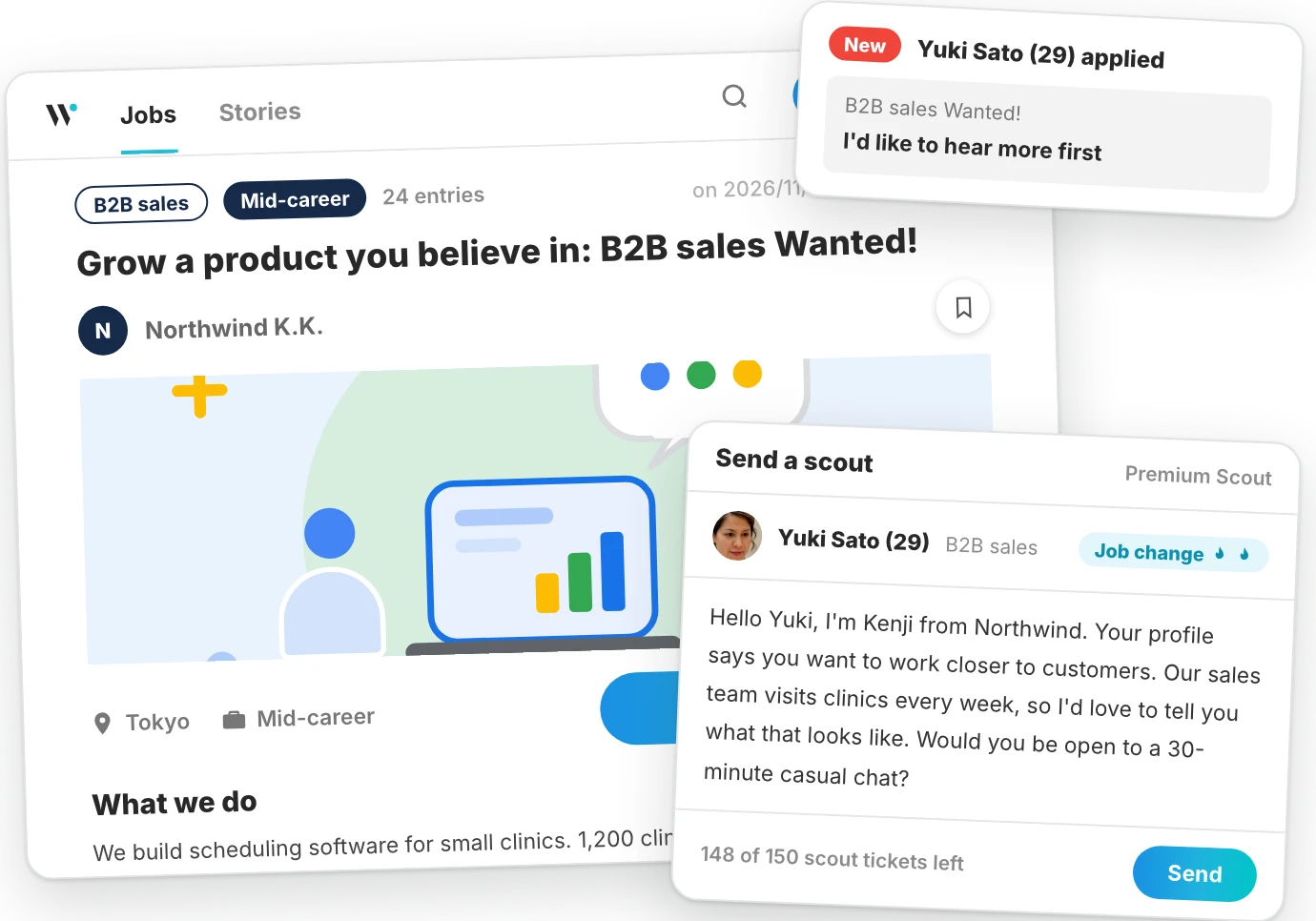
Wantedly is a Japanese hiring platform where companies attract candidates with their mission and culture, not with salary. You publish a company page, job posts and stories. Candidates click “Want to Visit” to meet you for a casual chat, and you can also message them first with scouts.
If you're reading this, you'd like to hire without paying an agency each time. Maybe a competitor's page on Wantedly caught your eye. Or a sales rep just quoted you a 12-month plan. But Wantedly doesn't publish its prices, and it works very differently from a job board. That leaves 2 questions: what does it cost, and does it suit a company like yours?
I've spent over 14 years in recruiting, including at Google and Persol Career. Today I offer recruitment consulting services to small and mid-size companies, and where to look for candidates comes up early in every free consultation. So I read through Wantedly's price list, help center and investor reports. This guide is the result. It's part of our hiring playbook.
- We'll start with how Wantedly works, and what sets it apart from a job board.
- Next come the 3 plans, Light, Standard and Premium, and what each one costs.
- After that: who is on Wantedly, and its pros and cons.
- You'll see how it stacks up against other platforms, and where it belongs in your hiring strategy.
- The last part is practical: how to get started, one step at a time, and which numbers to watch.
How it works
How Wantedly works, and why companies use it
Isn't Wantedly just another job board, like Indeed or doda? On both, you publish a job post and wait for candidates. But the two differ in what you're allowed to say, and that changes who replies: on Wantedly, you can't sell a job with its salary.
Wantedly vs a regular job board
Start with what you get. On a paid plan, you can:
- Build a company page: your mission, your values and your team members.
- Publish as many job posts as you want, for mid-career hires, new graduates, interns or contractors.
- Write stories: blog articles about your team and your culture.
- Send scouts: messages you write to candidates found by searching profiles.
- Message every candidate who shows interest, with no limit.
This is the page a candidate sees:
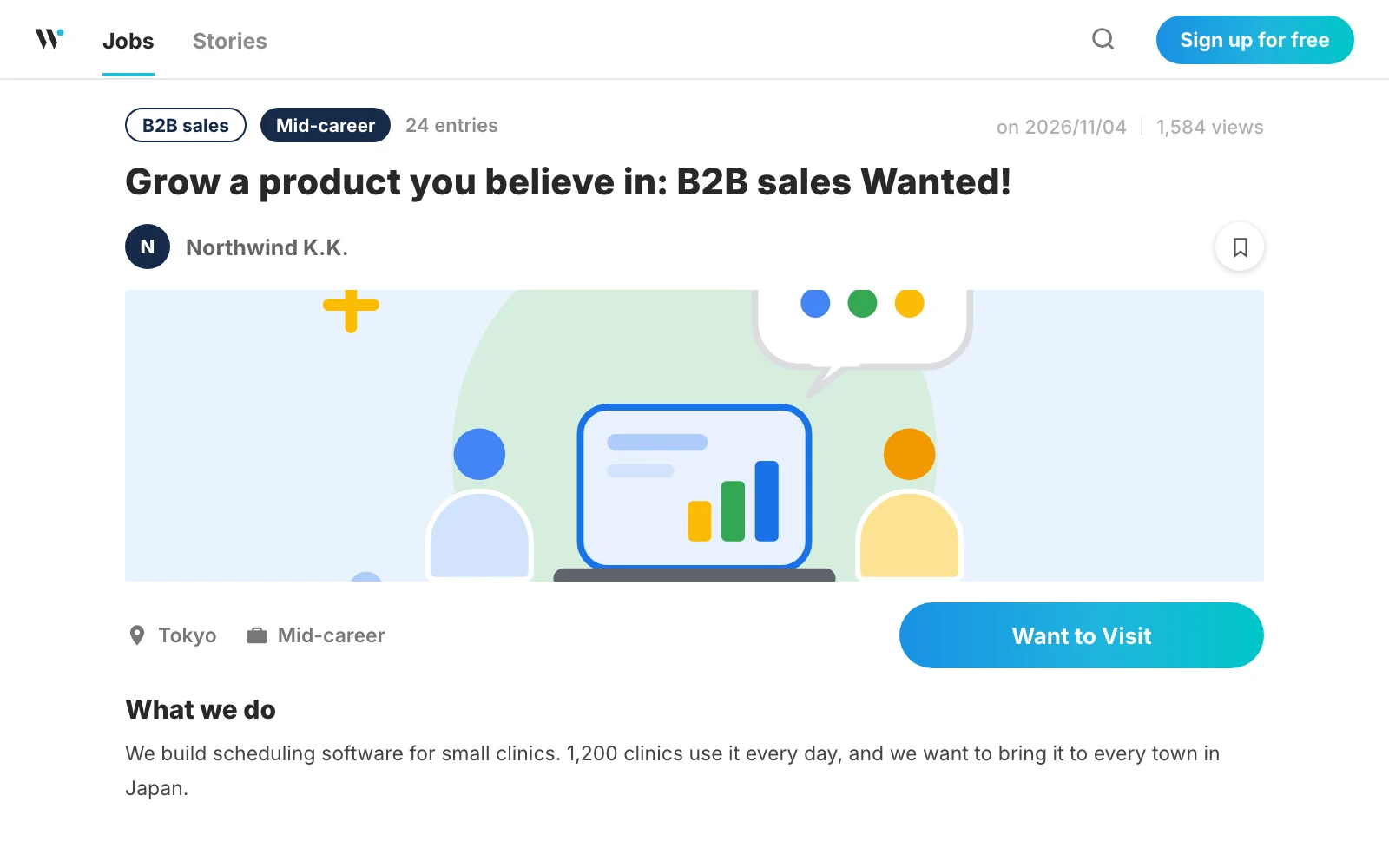
Job post on Wantedly (mock-up)
- Entries: how many people asked to meet you
- Title: an invitation, not just a job title
- Want to Visit: the candidate's only button
- What we do: the first of 4 fixed sections
It looks like a job board. But there are 3 key differences:
- Difference 1You can't advertise the salary. Pay, benefits and working conditions are banned from the title, the cover photo and the text. A post that lists them gets shown less. Every post has the same 4 sections instead: what we do, why we do it, how we do it, and what you'll do as a new team member. Since October 2025, you enter the pay in a separate Working Conditions record, which Wantedly shows candidates in a set block. You still can't make it your headline.
- Difference 2Candidates don't apply, they ask to meet you. The only button is “Want to Visit”. At that point, most candidates haven't decided to apply. So the first meeting is a casual interview, not a job interview, and Wantedly asks you not to request a resume before it.
- Difference 3Your visibility depends on your activity. Wantedly says its ranking doesn't depend on how much you pay. Posts are ranked by signals such as page views, entries and recommendations, and only new posts appear in the “new” list. A page you set up once and never touch sinks.
So how many candidates does it bring? Wantedly says its client companies get about 25 entries a month on average. An entry is one person clicking “Want to Visit”. That's an average: a well-known startup gets far more, and an unknown company with one old post gets far fewer.
Here's the idea behind Wantedly: it's built to make people curious about your company. It rewards companies that have a story to tell, and the time to tell it. It isn't built to fill a role fast by showing a high salary.
Scouts: contacting candidates first
Waiting for entries is only half of Wantedly. The other half is the scout. You search candidate profiles, and you send a direct message to the people you want to meet. This is what Japan calls direct recruiting.
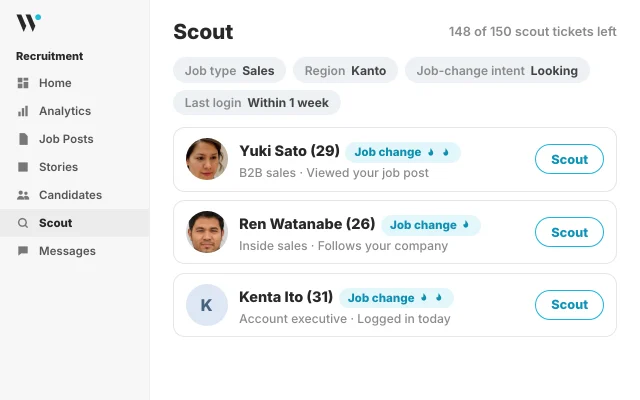
- Search: you filter profiles by job type, region and graduation year. You can also filter by how actively the person is looking: “looking”, “open to a good offer” or “not looking”.
- Signals: you can see who viewed or bookmarked your job posts, who follows your company, and who logged in this week. These people already know you.
- Volume: scouts come as a fixed number for your whole contract, for example 300 scouts for 12 months. They aren't monthly credits.
There's one number you need to know before you buy scouts. Wantedly has over 4.5 million registered users, but you can only scout the ones who chose to receive scouts. On its own scout page, Wantedly puts that at about 250,000 people at most (August 2025). So scouts reach roughly 1 user in 18.
Which companies use Wantedly in Japan
As of August 2026, 45,000 companies are registered on Wantedly in Japan, according to its financial results. Most of its clients have 100 employees or fewer: startups and small businesses that the large recruiting services didn't serve. Web and mobile companies form the largest group, followed by consulting firms, then advertising and marketing companies.
Larger companies use it too. Money Forward, a listed fintech company, hires 30 to 40 new graduates a year through it. But the typical user is a small company with a small hiring budget and a clear mission.
Plans
Wantedly plans: Light, Standard & Premium
So far, I've described Wantedly as a single product. But what you can do depends on the plan you buy. There are 3 plans: Light, Standard and Premium.
All 3 include the company page, unlimited job posts, stories and messages. They differ on 2 things: scouts, and how many of your colleagues can use the account.
What changes between Light, Standard and Premium
Scouts
This is the biggest difference. Light includes no scouts: you publish, and you wait for entries. Standard adds scouts, and Premium gives you twice as many as Standard for the same contract length.
The scouts in both plans are Wantedly's top tier, called Premium Scout. It opens every search filter, and it lets you send a second message to a candidate who hasn't replied after a week. Both plans also include an AI agent mode that builds candidate lists from your requirements.
| Contract length | Light | Standard | Premium |
|---|---|---|---|
| 6 months | Not available | 150 | 300 |
| 12 months | Not available | 300 | 600 |
| 24 months | Not available | 600 | 1,200 |
| AI agent mode | Not available | Included | Included |
Scouts included in each plan, by contract length. On any plan, you can buy extra scouts: ¥400,000 for 100, valid for 2 months.
One thing most guides miss: even without a scout plan, you can send free scouts. Any company with a published job post can scout a limited set of candidates for free. These are people who just registered, who log in often, or who pay for Wantedly's premium membership.
Job posts and admin users
Job posts, stories and messages are unlimited on every plan. The only cap is 30 new posts a day. What changes is how many people can log in to write posts and reply to candidates. That's 15 on Light, 30 on Standard, and no limit on Premium. For a small company, 15 is plenty.
| Feature | Light | Standard | Premium |
|---|---|---|---|
| Job posts | Unlimited | Unlimited | Unlimited |
| Stories | Unlimited | Unlimited | Unlimited |
| Messages | Unlimited | Unlimited | Unlimited |
| Admin users | 15 | 30 | Unlimited |
Sources: Wantedly Help, paid plans, Wantedly, Direct Scout (checked November 2026)
Wantedly pricing: what each plan costs
Wantedly doesn't show its prices on its site: you fill in a form to download the price list. So here are the numbers. You pay a fixed fee for 6, 12 or 24 months, and nothing else: no setup fee and no success fee, however many people you hire.
Wantedly price list
| Contract | Light | Standard | Premium |
|---|---|---|---|
| 6 months | On request | ¥900,000¥150,000 a month | ¥1,320,000¥220,000 a month |
| 12 months | ¥720,000¥60,000 a month | ¥1,680,000¥140,000 a month | ¥2,280,000¥190,000 a month |
| 24 months | ¥1,200,000¥50,000 a month | ¥3,120,000¥130,000 a month | ¥3,840,000¥160,000 a month |
Prices exclude tax. Sources: Wantedly's price list and a reseller's published table (November 2026)
The longer you commit, the lower the monthly rate. But there are 4 contract rules you should know before you sign:
- You can't cancel mid-contract. You can't pause or change plans either, and there's no refund. A 12-month plan is a 12-month commitment.
- The contract renews automatically. To stop it, turn off auto-renewal in the admin console before the end date.
- How you pay depends on the method. By credit card, you pay monthly. By invoice, you pay the whole period upfront.
- Unused scouts are lost at the end of the contract, unless you renew the same plan.
Before paying, you can try it. The 30-day free trial gives you a company page, 5 job posts, stories, and messages with your first 5 candidates. You get it once per company, and it doesn't turn into a paid plan by itself.
How Wantedly fits within your budget
Since the fee is fixed, your cost per hire depends on one thing: how many people you hire during the contract. So how many can you expect?
For scouts, Neo Career, a Wantedly reseller, publishes Wantedly's own reference numbers. Out of 150 scouts, about 15 candidates reply, 12 come to a casual interview, and 1 or 2 get an offer.
From 150 scouts to an offer
Wantedly's reference numbers for a 6-month Standard plan. The pills show the share that moves on to each step.
- 150Scouts sent
- 15Replies10%reply
- 12Casual interviews80%meet you
- 9First interviews70%apply
- 3Final interviews30%pass
- 1–2Offers50%pass
Source: Wantedly reference values, published by Neo Career (2026)
Add the candidates who come from your job posts, and a small company can reasonably aim for 2 to 4 hires a year. Now let's take the Standard plan for 12 months, at ¥1,680,000, and divide.
Cost per hire on Wantedly Standard, by number of hires
12-month contract at ¥1,680,000, compared with one agency fee
Agency fee, 1 hire
1 hire
2 hires
3 hires
4 hires
6 hires
Agency fee: 30% of a ¥5 million salary. Plan fee only, your own time not included.
With a single hire, Wantedly costs more than a recruitment agency, which charges about 30% of the salary. With 2 hires, each one costs ¥840,000, a little over half the agency fee. And from 4 hires, each one costs less than ¥500,000. You can run your own numbers with the cost per hire calculator.
But the plan fee isn't your only cost. Wantedly takes time: writing posts and stories, sending scouts, replying to candidates. Agencies that run Wantedly accounts for companies put it at 20 to 30 hours a month. If nobody in your company has that time, the plan will sit unused.
So which plan should you pick? Here's how I'd choose:
- Light works if candidates already look for you: you have a known brand, or people who write well and often. Without paid scouts, you mostly wait.
- Standard is where I'd start if you plan 2 to 4 hires a year. Scouts let you act instead of waiting.
- Premium makes sense if you hire all year, or if several teams recruit at once. On a 12-month contract, you get twice the scouts for about 35% more.
Audience
Who uses Wantedly: 4.57M users, 7 in 10 under 40
A price only makes sense once you know who's on the other side. So who will you meet on Wantedly?
Wantedly has 4.57 million registered users in Japan as of August 2026, and it has added about 250,000 a year since 2022. By its own count, that's about 1 in 8 of the 37 million people employed by companies in Japan. The figure counts every Wantedly account, including people who only use its business card app.
Wantedly users in Japan
Registered users at the end of August, by year
- 2021: 3.18M
- 2022: 3.55M
- 2023: 3.83M
- 2024: 4.09M
- 2025: 4.32M
- 2026: 4.57MAugust 2026
Source: Wantedly, financial results (2021 to 2026)
Wantedly's October 2026 results presentation shows the 2 things that define this audience: age and job type.
On age, nearly 7 in 10 users are under 40. People in their 30s are now the largest group, at 38%. The share of people in their 20s has fallen from 45% in 2017 to 31% in 2026. Wantedly's first users are getting older with it.
Wantedly users by age
Share of registered users, October 2026
- 20 to 29
- 31%
- 30 to 39
- 38%
- 40 and over
- 31%
Source: Wantedly, financial results presentation (October 2026)
On job type, almost half of users are engineers or designers. Sales and marketing people follow. Corporate roles, such as accounting, HR or legal, only make up about 1 user in 10.
Wantedly users by job type
Share of registered users, October 2026
Source: Wantedly, financial results presentation (October 2026)
Where Wantedly is strongest
These numbers point to 3 groups. If your target candidate is in one of them, Wantedly deserves a serious look.
Engineers and designers
With 46% of its users, this is Wantedly's core. These candidates often choose a job for the product and the team. That's exactly what a Wantedly post shows. Several platforms for engineers charge a success fee. So a fixed fee matters more here: engineers are among the most expensive people to hire.
Candidates in their 20s and 30s
If you hire junior or mid-level people, 7 users in 10 fit your age range. Early in a career, people weigh what they'll learn and who they'll work with. A small company can win on that, even against a bigger name with a bigger salary.
Interns and new graduates
Every plan lets you post jobs for interns and new graduates, and scouts have a graduation-year filter. So you don't need a separate new-graduate site. Money Forward built its yearly intake of 30 to 40 graduates this way, starting with no name recognition among students.
Pros and cons
Wantedly pros and cons: low cost per hire, but real work
What Wantedly does best is cost. It charges a fixed fee with no success fee, so the more you hire, the less each hire costs.
It reaches people who aren't job hunting yet
There's a second advantage that's easy to miss. Since the first step is a casual chat and not an application, people who aren't ready to change jobs still raise their hand. Wantedly itself says casual interviews let you meet people who haven't started job hunting. In recruiting, these “passive candidates” are often the best ones: they perform well where they are, so they don't answer job ads.
The other side of the coin is lower intent. A candidate who “wants to visit” may only be curious. You'll have casual interviews that lead nowhere, and you have to convince people, not just assess them.
What companies say about Wantedly
On the review site ITreview, Wantedly scores 3.7 out of 5 from 16 company reviews, most of them from small and mid-size companies. The same points keep coming up:
- Candidates who fit the culture. People apply after reading about the company, so the first conversation is easier.
- No agency fee. Reviewers like meeting motivated young candidates without paying per hire.
- Content that stays. Posts and stories keep working after you publish them.
- Hiring takes a long time. Since a post can't sell the conditions, some candidates meet you and never apply.
- A narrow range of job types. Reviewers want more candidates outside tech and web roles.
- Colleagues have to join in. A company page with few member profiles looks empty.
You need time, and a story to tell
Wantedly's biggest drawback is the work. A post you publish once won't bring candidates for long, so someone has to write, scout and reply every week. And if your best argument is the salary, you can't use it here.
That's a lot to weigh. So here are Wantedly's pros and cons side by side, one topic per row.
| Topic | Pros | Cons |
|---|---|---|
| Cost | No success fee: one fixed fee, however many people you hire | No cancelling mid-contract, and a single hire costs more than an agency fee |
| Who you reach | 4.57 million users, 7 in 10 under 40, almost half engineers or designers | Only about 250,000 can be scouted, and few senior or corporate profiles |
| Candidates | Passive candidates who would never apply to a job ad | Lower intent: some casual interviews lead nowhere |
| Salary | You attract people who care about the mission, not only the pay | You can't lead with the salary, even when it's your best argument |
| Workload | Your page and stories keep working as a careers site | 20 to 30 hours a month of writing, scouting and replying |
| Scouts | Reply rates above most other platforms | A fixed number per contract, sent one by one |
Comparison
Wantedly vs LinkedIn, BizReach and Green: price, reach and scouts compared
You're probably weighing Wantedly against a few other names. This table puts the main ones next to each other on price, reach and scout volume.
| Sort by | ||||
|---|---|---|---|---|
 dodaJob board, agency and scouts (Persol) | 10.99MJune 2026 | Not public | Not public | Not public |
 Rikunabi NEXTJob board (Recruit) | 10M+Unofficial estimate | Not public | Not public | Not public |
 LinkedIn Recruiter CorporateAll professions | 5M | ¥1,700,00012 months | 150¥944 per scout | None |
| LinkedIn Recruiter LiteAll professions | 5M | ¥16,0001 month | 30¥533 per scout | None |
 Wantedly StandardMid-career, new grads | 4.57M | ¥900,0006 months | 25¥6,000 per scout | None |
| Wantedly PremiumMid-career, new grads | 4.57M | ¥1,320,0006 months | 50¥4,400 per scout | None |
 BizReachExecutives, high income | 3.53M | ¥850,0006 months | 67¥2,125 per scout | 15%of salary |
 OpenWorkMid-career, new grads | 1.83M | ¥1,200,00012 months | 833¥120 per scout | ¥300K–800K |
 GreenIT and web | 1.63M | ¥600,000One-off | 1,000Included | 20%of salary |
 YOUTRUSTMid-career | 500K | ¥2,400,00012 months | 20¥10,000 per scout | None |
 doda XExecutives | 400K | ¥1,050,0008 weeks | 217¥2,625 per scout | None |
 FindyIT engineers | 165K | ¥360,0006 months | 35–70 a weekLikes | 30–35%of salary |
 LAPRASIT engineers | 40K | ¥945,0006 months | Unlimited | None |
Source: SaiyouTeam research, platforms' published figures (November 2026). Green's success fee: 20% of annual pay for people who apply from 12 January 2027. Click a column to sort.
Two things stand out. Wantedly has no success fee, like LinkedIn and YOUTRUST, while Green, BizReach and Findy charge one on top of their plan. But its scouts are among the most expensive: ¥4,400 to ¥6,000 each. The plan price also pays for the job posts and stories, so Wantedly pays off when you use both the scouts and the job posts.
Strategy
How Wantedly fits in your hiring strategy
Few companies hire through a single channel. So where does Wantedly sit next to LinkedIn, job boards and agencies?
The answer depends on who you're hiring. So instead of a rule, here are 3 hiring situations, and what I'd do in each.
-
Scenario 1
4 headcounts at a 30-person web startup: 2 engineers, 1 designer and 1 salesperson
Candidate personaPeople in their late 20s and 30s working at web companies, drawn by the product more than the pay.
Strategy
- Wantedly
- Green
Wantedly first, plus an IT job board for the engineers.
Plan
Standard, 12 monthsFour hires on a ¥1,680,000 plan cost ¥420,000 each. Spend the 300 scouts on the engineers and the designer, where competition is the toughest. Job posts and stories can bring the salesperson.
-
Scenario 2
10 headcounts a year for interns and new graduates at a 100-person IT company
Candidate personaStudents who want to start their career at a growing company rather than a large corporation.
Strategy
- Wantedly
 OfferBox
Wantedly + a scouting site for new graduates.
Plan
Premium, 12 monthsWith 10 hires a year, each one costs about ¥230,000. The graduation-year filter lets you scout students directly, and stories written by last year's hires do the convincing.
-
Scenario 3
1 headcount for a finance manager with 15 years of experience
Candidate personaA manager in their 40s, working at a listed company, who will compare salary offers.
Strategy
- BizReach
- Recruiting agency
A platform for senior candidates + a recruiting agency.
Plan
No Wantedly planOnly 3 Wantedly users in 10 are 40 or over, and corporate roles are rare. You also can't lead with the salary, which counts at this level. And with a single hire, the whole fixed fee falls on that one hire: an agency costs less here.
Should you run Wantedly in-house or outsource it?
By now it's clear that Wantedly needs someone's hours every week. An agency that runs Wantedly accounts estimates 2 to 4 hours for a new job post, 4 to 8 hours for a story, and another 4 to 8 hours to send 50 scouts. If your team can't spare them, get outside help instead of paying for a plan that sits idle.
You can get that help in 2 ways:
- Wantedly's own support plans bundle a 6-month plan with writing and setup by Wantedly's team. They cost about ¥1,020,000 to ¥1,950,000 for the 6 months.
- An outside agency runs your account for you: posts, stories, scouts and replies. Fees range from ¥50,000 to ¥450,000 a month, depending on how much they do, on top of the plan. Wantedly asks you to get its consent before a third party operates your account.
Getting started
Getting started with Wantedly
Ready to give it a go? The 2 walkthroughs below take you from the trial sign-up to your first casual interviews, then on to a paid plan with scouts. Each step shows the screen you'll see.
Starting with the free trial
Sign up for the 30-day trial
Fill in your company name, your name, email and phone number on Wantedly's trial page. The trial starts right away, and you get it once per company.
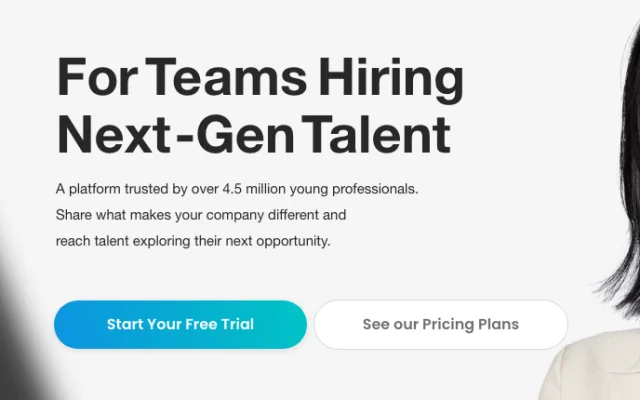
Build your company page
Write your mission and your values, then add your team members. Ask 3 or 4 colleagues to create a profile: a page with faces gets more trust. There's no draft mode, so every edit goes live at once.
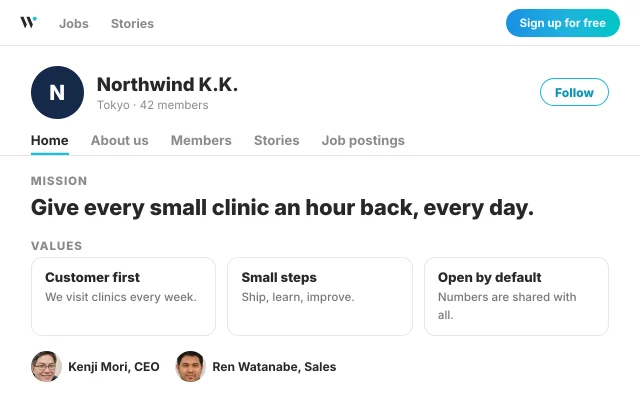
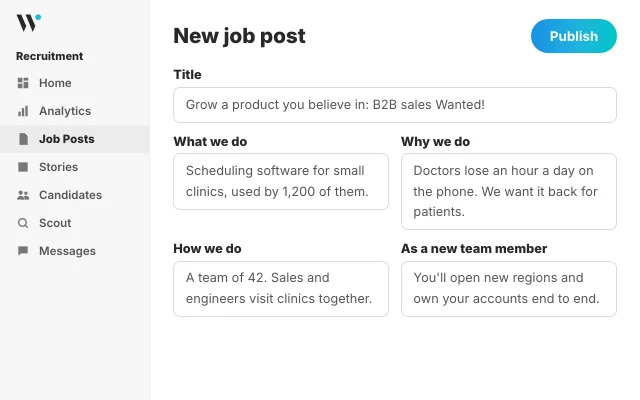
Write your first job post
Give it a title of up to 37 characters, written as an invitation. Then fill in the 4 sections: what we do, why we do it, how we do it, and what the new team member will do. It's easier if you write a job description first.
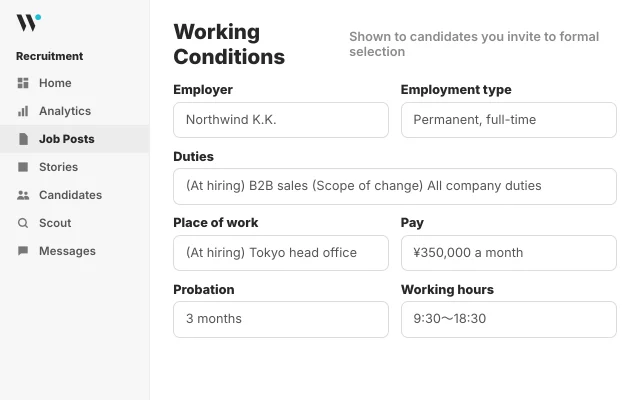
Add the working conditions
Create a Working Conditions record with the pay, the duties and the place of work, and link it to the post. Wantedly reviews each post before it goes live, in as little as 1 hour.
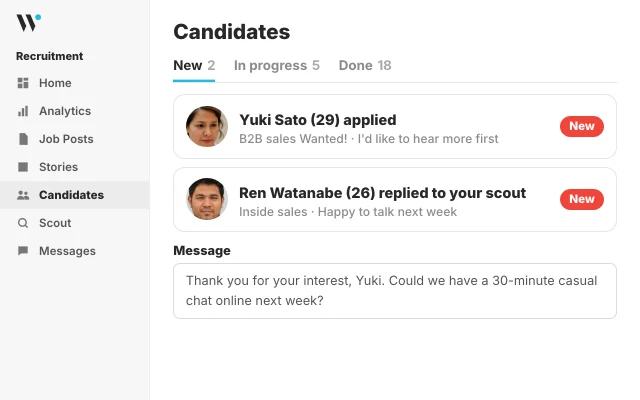
Reply to your first entries
New entries appear in your candidate list. Reply within 24 hours and offer a casual interview, not a job interview. On the trial, you can message your first 5 candidates.
Moving to a paid plan and sending scouts
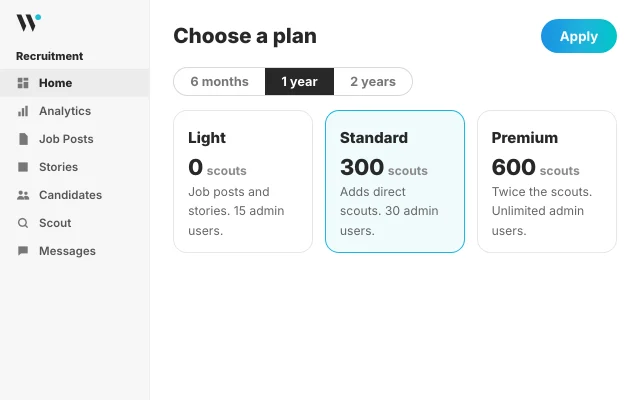
Choose a plan and a contract length
In the admin console, click “Choose a plan”, then pick 6, 12 or 24 months, and Light, Standard or Premium. Wantedly screens new contracts, and may ask for company documents.
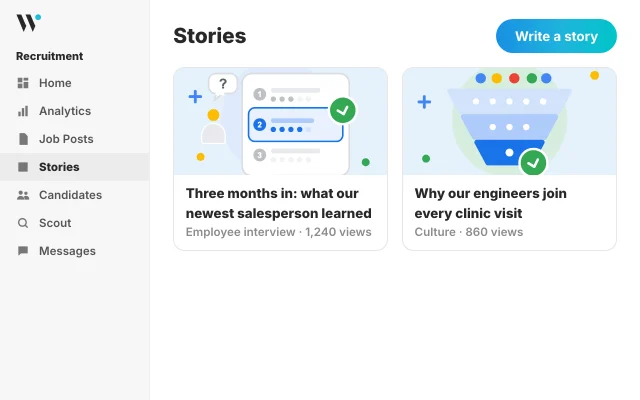
Publish a story
Start with an interview of a recent hire. Wantedly's own guideline is 1 story a month, up to about 4,000 characters. You'll link it in your scouts.
Search candidates and send scouts
Filter by job type, region and how actively the person is looking. Start with people who viewed your posts or follow your company. Each scout is written and sent one by one.
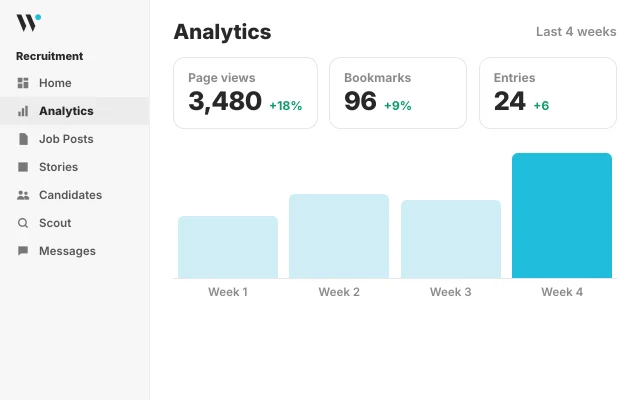
Check your numbers every week
The analytics page shows page views, bookmarks and entries for each post. See what good numbers look like below.
Results
How to measure success with Wantedly, and improve
Two questions come up in the first weeks. When will the first hire happen? And are we doing well so far? This section answers both.
A timeline to hiring results with Wantedly
Setup is quick: you can publish your first job post within a day. The first entries should come within 2 weeks. If a post has few views and no entries by then, rewrite it instead of waiting.
Hires take longer. In Wantedly's own case studies, the first hires come 2 to 3 months after the start. Scouts work faster than stories: a scout can lead to a casual interview the same week, while a company page usually takes 3 to 6 months to build its audience.
A hire happens in phases, which I detail in the guide on how to build a hiring process. Wantedly takes care of the first one: attracting candidates.
A hiring campaign with Wantedly
First entries within 2 weeks, first hires in 2 to 3 months
- Week 1Company page, first job posts, working conditions
- Week 2First entries. Rewrite the posts with few views
- Weeks 3 to 8Send scouts, publish a story, reply within 24 hours
What good numbers look like
For job posts, Wantedly gives its own targets: 300 to 500 page views a month per position, and an entry rate of 1 to 1.5%. That's 3 to 7 entries a month for each role you're hiring for.
For scouts, Wantedly doesn't publish an average reply rate. Its own blog says scouts in general get a reply rate of 5 to 10%, and its resellers quote 10 to 15% for Wantedly. Direct Sourcing, a scouting agency, publishes the results of its own campaigns: in September 2025, Wantedly scouts got a far higher reply rate than those it sent on LinkedIn or BizReach.
Scout reply rates, by platform
Direct Sourcing's own campaigns, September 2025
Findy
Wantedly
YOUTRUST
LinkedIn
BizReach
OpenWork
Green
Source: Direct Sourcing, its own scouting data. One firm's results, not platform averages.
How to improve your results
A better entry rate or reply rate lowers your cost per hire, since the plan fee doesn't change. Here's what moves these numbers:
- Publish new posts instead of editing old ones. Only a new post enters the “new” list. Wantedly's target is 1 to 2 new posts a month per position.
- Ask your colleagues to recommend your posts. A recommendation shares the post on social media. The extra views and entries can push it into the “popular” list.
- Scout the people who already know you. Filter on candidates who viewed your posts or follow your company, then on those who are “looking” and logged in this week.
- Reply fast. According to Wantedly, about 70% of candidates answer a first message sent within 24 hours. After 72 hours, it's about 50%.
- Talk more than you listen in the casual interview. Wantedly suggests you do about 80% of the talking: the candidate came to learn about you.
Log every entry, reply and casual interview. It's the only way to see where candidates drop off.
FAQ
Frequently asked questions about Wantedly
What is Wantedly?
Wantedly is a Japanese hiring platform where companies attract candidates with their mission and culture, not with salary. You publish a company page, job posts and stories. Candidates click “Want to Visit” to meet you for a casual chat, and you can also message them first with scouts.
How much does Wantedly cost?
Between ¥720,000 and ¥2,280,000 for a 12-month contract, excluding tax: ¥720,000 for Light, ¥1,680,000 for Standard and ¥2,280,000 for Premium. Standard and Premium also exist for 6 months (¥900,000 and ¥1,320,000) and all 3 plans for 24 months. There's no setup fee and no success fee.
Is Wantedly free?
Only for 30 days. The free trial gives you a company page, 5 job posts, stories, and messages with your first 5 candidates, once per company. After that, your posts stop taking entries unless you buy a plan. Your company page and stories stay online.
Does Wantedly charge a success fee?
No. You pay a fixed fee for the contract period, however many people you hire. That's why the cost per hire falls with each extra hire.
What's the difference between Light, Standard and Premium?
Scouts and admin users. Light includes no scouts and 15 admin users. Standard adds 150 scouts per 6 months and allows 30 admin users. Premium doubles the scouts (300 per 6 months) and has no user limit. All 3 include unlimited job posts, stories and messages.
Can I write the salary in a Wantedly job post?
Not in the title, the cover photo or the text. A post that lists pay or benefits there gets shown less. Since October 2025, you enter the pay in a separate Working Conditions record linked to the post, which Wantedly shows candidates in a set block.
What does “Want to Visit” mean?
It's the button candidates click to show interest in a job post. It isn't a formal application: most candidates haven't decided to apply yet. So the first meeting is a casual interview, and Wantedly asks companies not to request a resume before it.
What is a Wantedly scout?
A scout is a direct message you send to a candidate you found by searching profiles. Standard and Premium plans include a fixed number of Premium Scouts per contract. You can only scout users who chose to receive scouts: about 250,000 people at most.
What is a good scout reply rate on Wantedly?
Wantedly's resellers quote 10 to 15%. Wantedly doesn't publish an average, and says scouts in general get a 5 to 10% reply rate. In the scouting agency Direct Sourcing's own campaigns in September 2025, Wantedly scouts had a 26.7% reply rate, against 9.2% on LinkedIn.
How many people use Wantedly?
4.57 million registered users and 45,000 companies in Japan, as of August 2026. Nearly 7 users in 10 are under 40, and almost half are engineers or designers. Only about 250,000 of them can be reached with scouts.
Who is Wantedly best for?
Companies hiring engineers, designers and people in their 20s and 30s, including interns and new graduates. It suits small companies with a clear mission and the time to publish content. It's a poor fit for senior managers, corporate roles, or companies whose main argument is the salary.
Is Wantedly worth it?
Yes, if you hire at least 2 people during the contract and can give it 20 to 30 hours a month. With a single hire, a 12-month Standard plan (¥1,680,000) costs more than an agency fee. With 4 hires, each one costs ¥420,000.
How long does it take to hire on Wantedly?
Allow 2 to 3 months for the first hires. You can publish a job post within a day, and the first entries should come within 2 weeks. Scouts work faster than stories, which build an audience over 3 to 6 months.
Can I cancel a Wantedly plan?
Not during the contract. You can't cancel, pause or change plans mid-contract, and there's no refund. The contract also renews automatically, so turn off auto-renewal in the admin console before the end date if you want to stop.
How much time does Wantedly take?
About 20 to 30 hours a month, according to agencies that run Wantedly accounts. A new job post takes 2 to 4 hours, a story 4 to 8 hours, and 50 scouts another 4 to 8 hours. If you don't have that time, one of these agencies can run your account for ¥50,000 to ¥450,000 a month.
How does Wantedly compare with LinkedIn?
Wantedly reaches young Japanese talent, especially engineers and designers; LinkedIn reaches bilingual and senior candidates. Both charge no success fee. Wantedly's entry plan with scouts costs ¥900,000 for 6 months, while LinkedIn Recruiter Lite starts at ¥16,000 a month.
Can I use Wantedly in English?
Partly. You can switch the interface to English, but job posts and stories stay in the language they were written in, and most are in Japanese. Scouts have no language filter. To hire English speakers in Japan, LinkedIn is the better starting point.
Does Wantedly have AI features?
Yes. Since November 2025, plans with scouts include an AI agent mode at no extra cost. It reads your hiring requirements and builds a list of candidates. Each scout you send them still counts against your plan's scouts.
DIY Hiring Kit
Everything You Need To Hire On Your Own
A downloadable hiring framework for small businesses in Japan, with step-by-step guides, spreadsheet ATS, LinkedIn scouting system, interview questions bank, offer letter and employment contracts, and a ton more!
1Dashboard11Checklists8Spreadsheets30Template docs4Weeks of Q&ABilingual
- Download every file as Word, Google Docs, Excel or Google Sheets


 14 years in talent acquisition
Related
Related guides and tools
 Hiring practices
What is direct recruiting? Scouting vs agencies
The other scouting platforms, and how to compare their costs.
 Hiring practices
What is a casual interview?
The first conversation with candidates who want to visit.
 LinkedIn hiring
What is LinkedIn Recruiter?
The platform for bilingual and senior candidates.
 Tool
Cost per hire: averages and calculator
Compare the cost of one hire across channels.
 Guide
Company careers site: pros, cons and how to use it
Your own site, next to your Wantedly page.
 Guide
How to design a hiring process for SMBs
From attracting candidates to interviews and offers.
Official sources
The main sources for this guide. Other references are linked where they are used in the text.
- Wantedly, Inc.ssl4.eir-parts.net Financial results for the year to August 2026 Registered users (4.57 million) and companies (45,000) in Japan.
- Wantedly Helphelp.wantedly.com Posting fees and paid plans What Light, Standard and Premium include: scouts and admin users.
- Wantedlywww.wantedly.com Direct Scout Scout tiers, and how many users can be scouted.
- Wantedly Helphelp.wantedly.com The free trial of the recruitment service 30 days, 5 job posts and the first 5 candidates.
- Wantedly Helphelp.wantedly.com Working Conditions The record that holds pay, duties and place of work for each post.
- Wantedly Helphelp.wantedly.com Cancelling a paid plan No cancellation mid-contract, and how to stop auto-renewal.