
TokyoDev vs Japan DevPricing, reviews and how to post jobs
A guide to TokyoDev and Japan Dev for companies hiring English-speaking developers in Japan. It covers how the two job boards differ, how the success fee works, who uses them, what people say, and how to post a job.
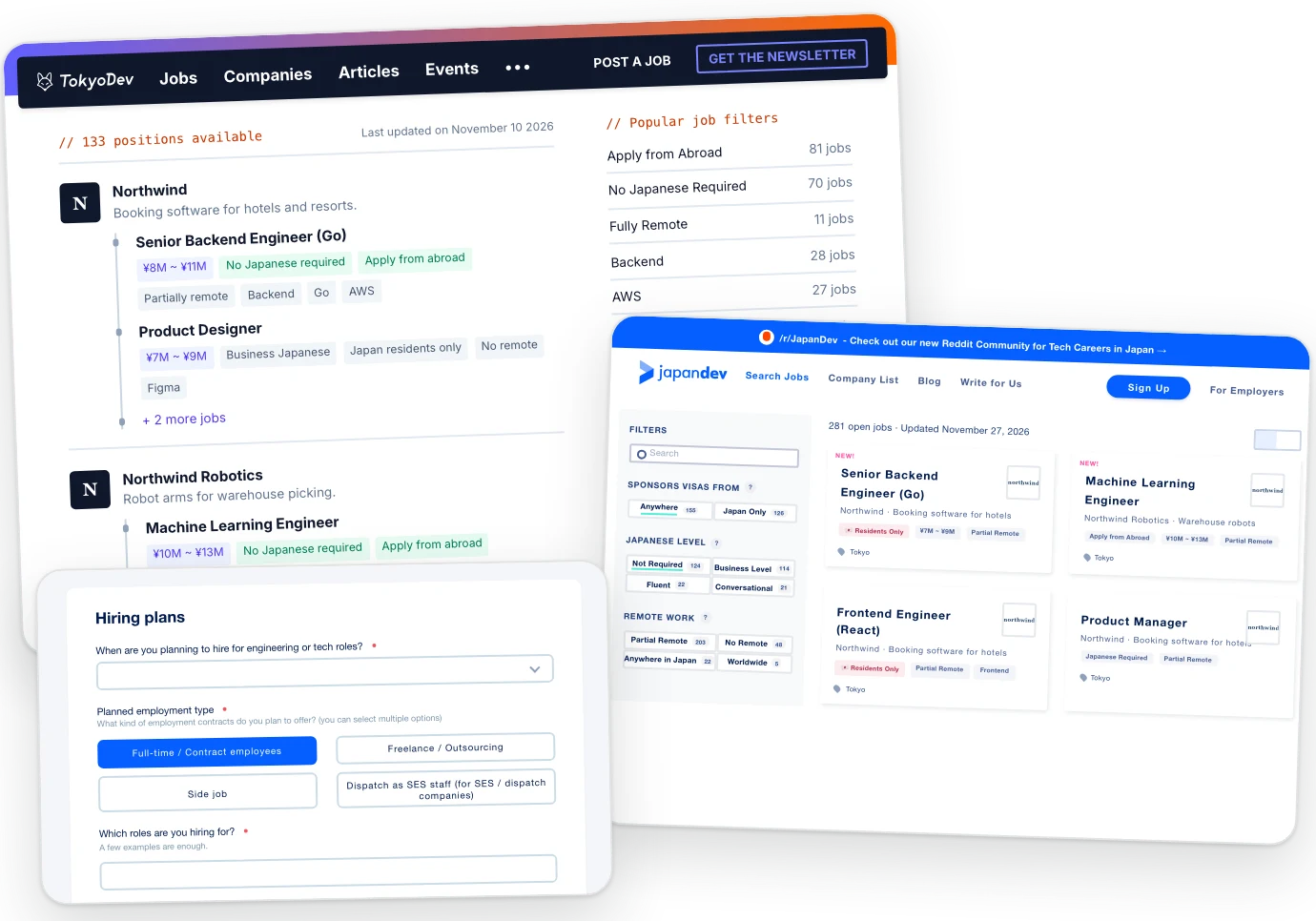

Basics
What are TokyoDev and Japan Dev?
In short
TokyoDev and Japan Dev are job boards that gather jobs in Japan for software developers who want to work in English. On both, posting is free and the only cost is a success fee once you hire. Neither publishes the amount. TokyoDev Inc. runs TokyoDev from Karuizawa, and Japan Dev, Inc. runs Japan Dev from Kawasaki.
Your team writes code and talks in English. But Japanese job boards don't bring you developers who work in English, and an agency wants 30% to 35% of salary. So two names keep coming up: TokyoDev and Japan Dev, job boards built for English-speaking developers.
Hiring has been my work for more than 14 years, with stints at Google and Persol Career. Since going independent, I've offered recruitment consulting services to smaller companies across Japan. For this guide, I compared both boards' employer pages and listing rules, TokyoDev's developer survey and their labor ministry filings. Our hiring playbook covers other job boards and hiring services too.
- First, a side-by-side view of TokyoDev vs Japan Dev.
- Then how a job gets listed, and who's allowed to post.
- Pricing covers how the success fee works, and what to compare a quote with.
- User and job numbers show what they're good for, before the reviews and a comparison of nine job boards.
- It closes with the steps from first contact to reporting a hire, and how to write the ad.
TokyoDev vs Japan Dev
TokyoDev vs Japan Dev: operators, job counts, who can post
Both boards focus on jobs for English-speaking developers, and both charge a success fee. Where they differ is how many jobs they carry and which ones they accept.
| Item | TokyoDev | Japan Dev |
|---|---|---|
| Run by | TokyoDev Inc. | Japan Dev, Inc. |
| Started | 2010 (as a blog) | April 2019 |
| Jobs listed | 133 | 281 |
| Monthly visitors | 45,000+ | 100,000 |
| Newsletter | 11,000+ | 52,000 |
| Fee | Success fee | Flat fee per hire |
Jobs: TokyoDev on 11 November 2026, Japan Dev on 27 November. Sources: both employer pages and job lists
Their rules differ too. TokyoDev lists product-team roles only, so no sales or HR jobs. Japan Dev sets salary floors, and its Japanese about page says it will discuss non-tech roles such as sales (Japan Dev).
Neither shows a price. Japan Dev's English page says "flat fee per hire". TokyoDev says nothing about the amount and asks you to get in touch. Get a quote from both and compare.
How they work
How TokyoDev and Japan Dev work: from request to listing
When you ask to post, both sites have their own team take the job and publish it. That's the big difference from a regular job board, where you type the ad in yourself.
The TokyoDev job list
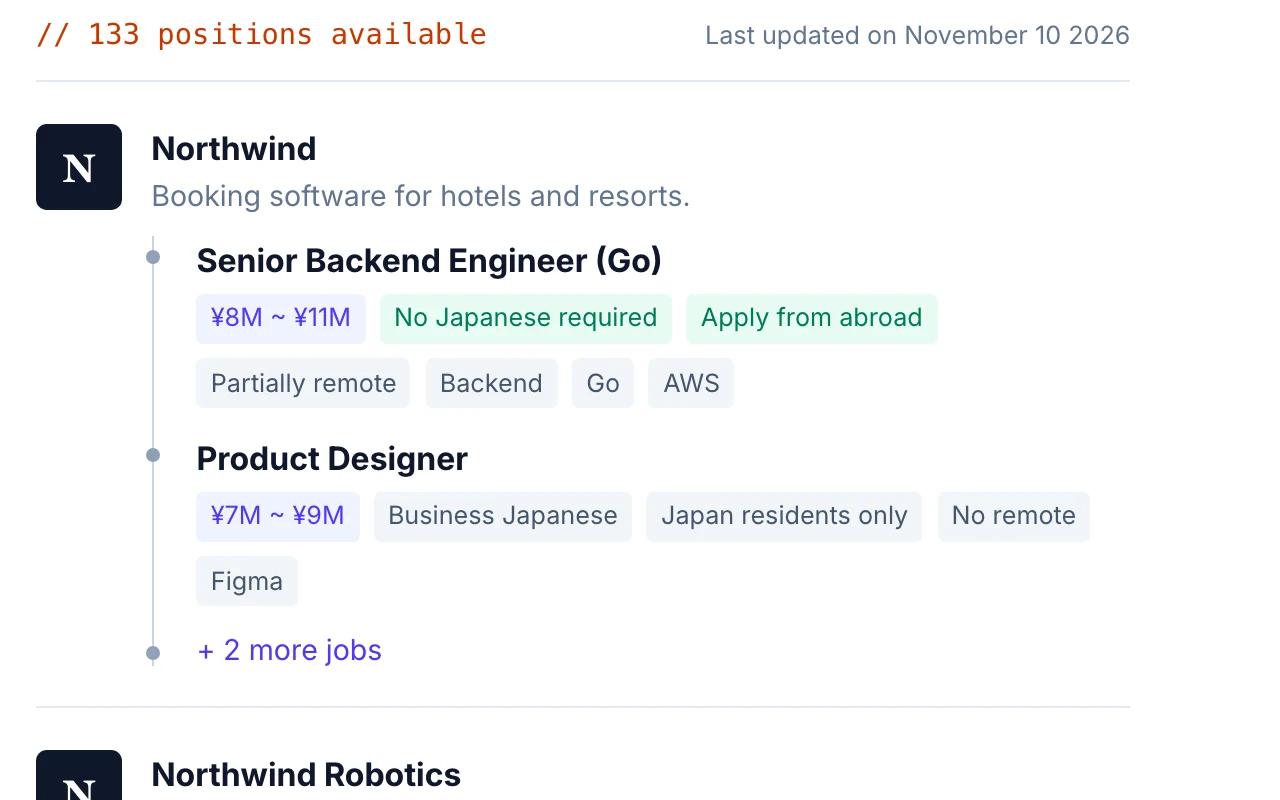
TokyoDev groups jobs by company, with tags for salary, Japanese level and whether people abroad can apply. Candidates can narrow the list to jobs with no Japanese, or open to applicants abroad.
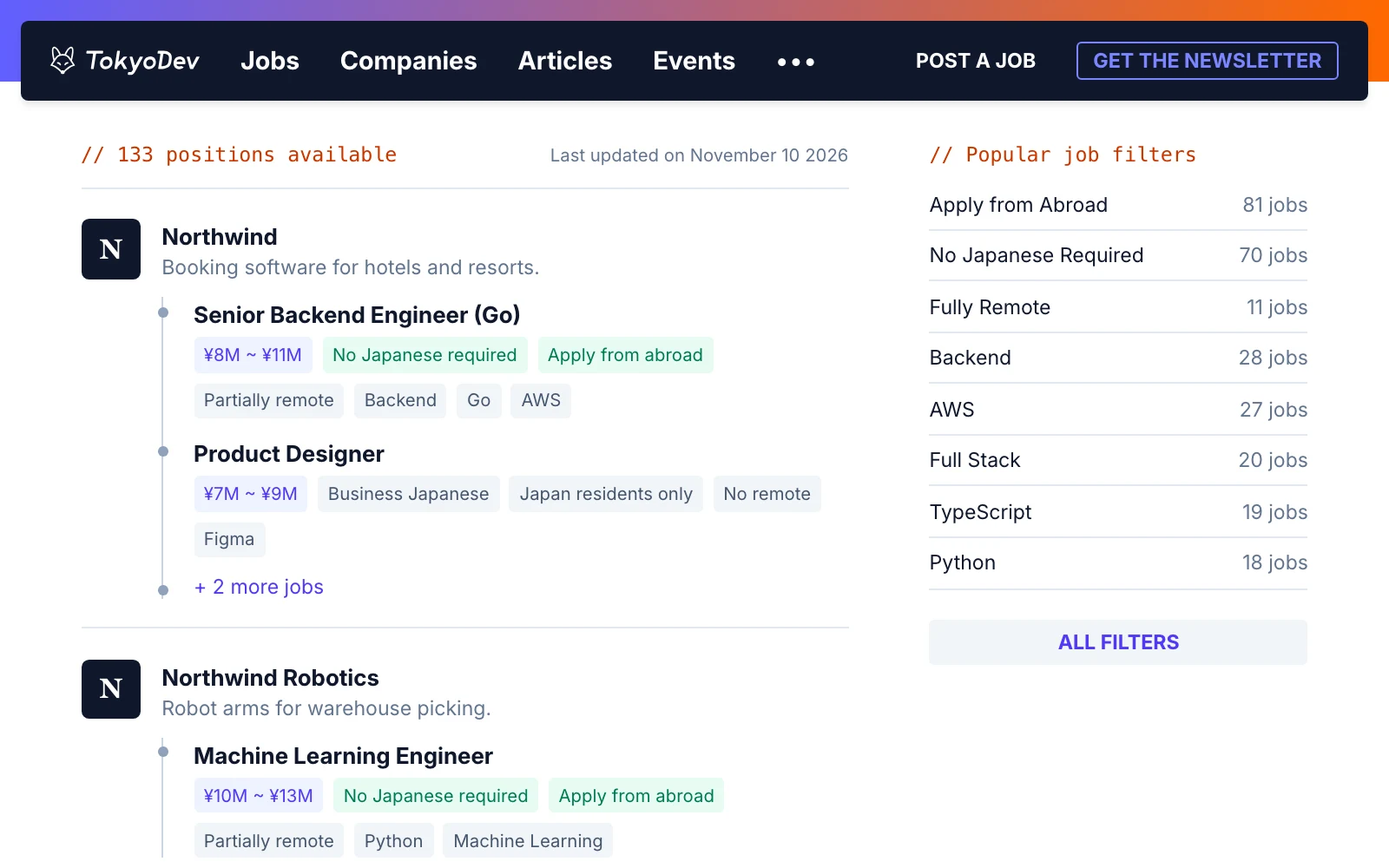
TokyoDev job list (mock-up)
- Salary: the yearly range
- Japanese: no Japanese required
- Abroad: open to applicants abroad
- Popular filters: jobs per filter
TokyoDev checks every job before it goes up. It rewrites postings to fit its headings, and asks you to confirm big edits. If you send a job in Japanese and English, it keeps only the English (TokyoDev article).
Every three months, it asks whether your jobs are still open. Open jobs go back to the top of the list.
The Japan Dev job list and filters
On Japan Dev, candidates filter by where they can apply from and the Japanese level. There's a full Japanese version of the site, filters included.
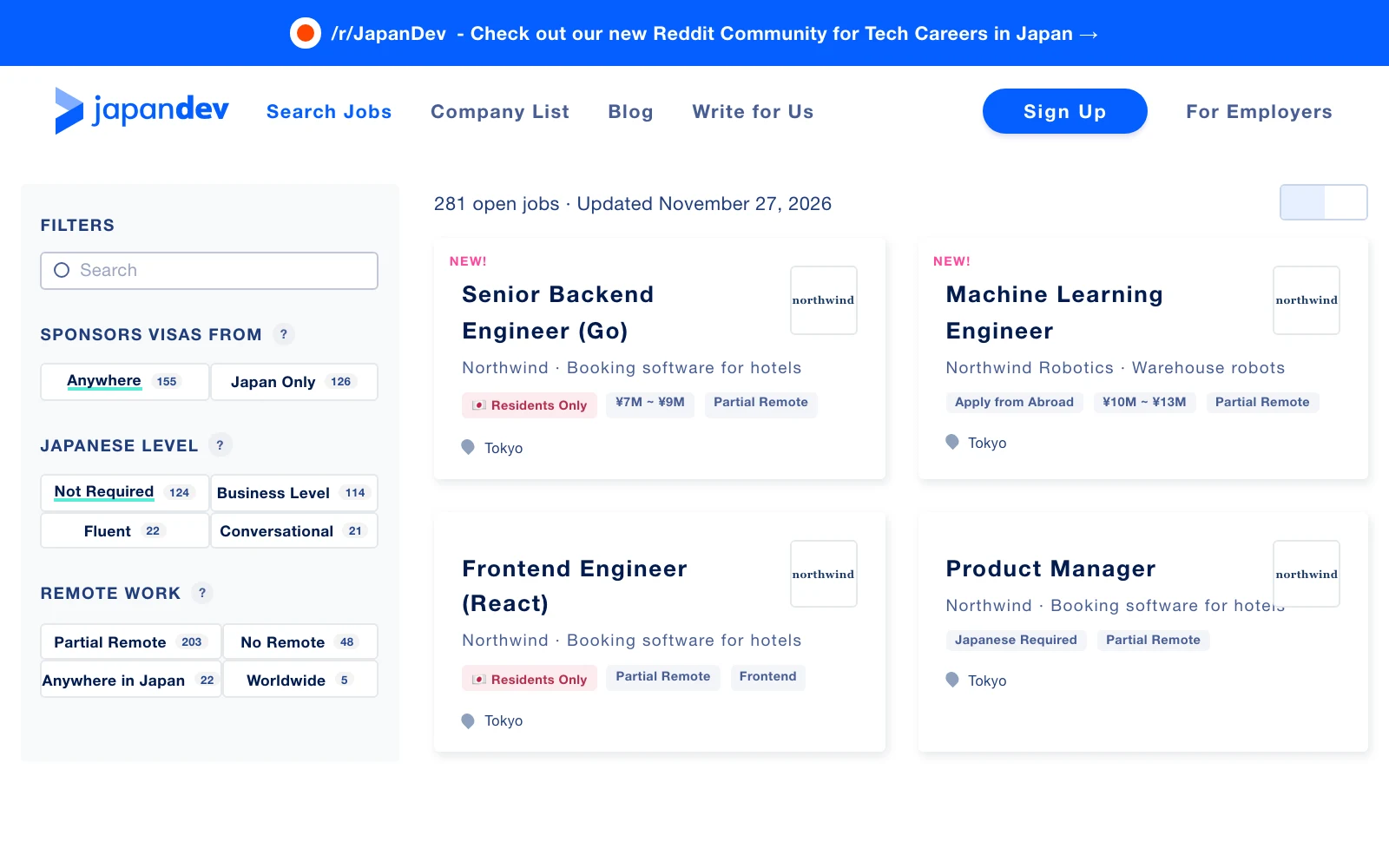
Japan Dev job list (mock-up)
- Where you apply from: Anywhere or Japan Only
- Japanese Level: Not Required to Fluent
- Job: company and role
- Badges: Residents Only or Apply from Abroad
Japan Dev does the data entry for you. You don't need an account: send the URLs of your jobs, or let it import them from your applicant tracking system (ATS) (employer page).
Who can post
Neither site takes every company that asks. Check these rules before you get in touch.
- TokyoDev: English is used in the company to some degree, the Japanese asked for is "fluent" at most, the role sits in a product team, and the company sponsors visas or at least helps renew them (August 2024).
- Japan Dev: salaries of 4 million yen or more for juniors and 6 million yen or more for experienced engineers. It also wants tech companies that value software, not subcontractors.
- Agencies: Japan Dev's Japanese form says agencies can't use it to search for candidates (company form).
Applications come straight to you
TokyoDev does no screening. It emails applications to you unaltered, or links to your own application page (privacy policy). Japan Dev links to your job page or ATS, so you and the candidate deal with each other directly.
Three things these boards do well
- Strength1Built for English-speaking developers.Both sites exist for developers job-hunting in English. Your ad reaches people who rarely browse Japanese job boards.
- Strength2No cost until you hire.Posting is free, and you pay only when someone joins. Leaving a job up longer costs nothing.
- Strength3They format and import the listing.Their teams fit your job to their layout or import it from your ATS. What you supply is the job itself, written in English.
Pricing
TokyoDev and Japan Dev pricing: a success fee per hire
Neither TokyoDev nor Japan Dev publishes an amount. What we do know is the model: posting is free, and you pay when you hire.
How the success fee works
- TokyoDev: its contract with each company says it's paid when someone is hired through the site (August 2024). You get the price through its inquiry form.
- Japan Dev: the English page says "Posting jobs is 100% free. Pay nothing until your first successful hire", then "an affordable flat fee per hire" (November 2026). The Japanese page says you start from zero yen, and doesn't mention the fee per hire.
- Invoicing: you tell Japan Dev about the hire, and it sends an invoice. Its contract adds a late fee that grows every month a hire goes unreported (2022 article).
Japan Dev's "50%" isn't its job-board price
Search for Japan Dev in the labor ministry's register and a recruitment agency licence turns up, with a fee table. The table says 50% of first-year wages (or 3 million yen) (fee table, April 2024).
That's the ceiling for agency work, and the same filing says Japan Dev doesn't currently run an agency business. It's not the job board's success fee. TokyoDev has no agency licence. It says it doesn't need one, because every job is public and it doesn't screen applicants (2020 article).
What to compare a quote with: agency fees
With no published price, compare the quote with an agency using cost per hire. The median pay of international developers in Japan is 9.5 million yen (TokyoDev Developer Survey 2026). An agency taking 35% of salary would bill 3.325 million yen.
Agency fee for one hire
At 35% of salary; compare it with your quote
Salary ¥4M
Salary ¥6M
Salary ¥9.5M
Salaries: Japan Dev's salary floors and the TokyoDev Developer Survey 2026 median. Fees: our estimate
In the quote meeting, ask these four things.
- The amount: a flat fee or a % of salary, and whether it changes by role or pay.
- When it's due: on offer acceptance, on the start date, or after probation.
- Early leavers: whether part of the fee comes back if the hire quits within months. Neither site publishes this.
- Reporting: how and by when you must tell them about a hire.
People and jobs
Who uses TokyoDev and Japan Dev, and what jobs they carry
By their own figures, TokyoDev gets 45,000+ visitors a month and Japan Dev 100,000 to 120,000. Japan Dev's numbers don't agree with each other: 100,000 on its English page, over 120,000 on its Japanese one (27 November 2026).
Official audience figures
From each site's employer page
 Japan Dev: monthly visitors
Japan Dev: newsletter
 TokyoDev: monthly visitors
TokyoDev: newsletter
Sources: employer pages (TokyoDev, archived 4 November 2026; Japan Dev, 27 November)
TokyoDev reports 93 hires in 2025 (employer page). Japan Dev says around 60% of its users are already in Japan.
How much Japanese international developers speak
TokyoDev's annual developer survey had 733 respondents in 2026. 38% could work in Japanese (2026 survey).
Japanese level of international developers in Japan
TokyoDev Developer Survey 2026: the 720 who answered this question
None
Basic
Conversational
Business
Fluent
Native
Source: TokyoDev Developer Survey 2026; shares are our calculation
In the same survey, 79% lived in Greater Tokyo, and 58% held a residence status tied to their job, such as Engineer/Specialist. Median pay was 9.5 million yen.
The jobs: about half need no Japanese
Jobs that need no Japanese make up 51% on TokyoDev and 44% on Japan Dev. The shares open to applicants abroad, and with a salary shown, are close too.
Job conditions on TokyoDev and Japan Dev
Share of all jobs
TokyoDev: no Japanese required
Japan Dev: Japanese not required
TokyoDev: apply from abroad
Japan Dev: apply from anywhere
TokyoDev: salary shown
Japan Dev: salary shown
Sources: TokyoDev, 138 jobs (4 November 2026); Japan Dev, 281 jobs (27 November). Shares are our calculation
On Japan Dev, "Apply from Anywhere" doesn't always mean visa sponsorship. One listing shows it next to "No relocation to Japan". Say in your ad whether you sponsor visas.
The hires these boards suit
Going by the jobs and the audience, three kinds of hire fit best.
Developers for teams that work in English
Nearly nine in ten jobs are engineering roles (Japan Dev, 27 November 2026). They suit teams that build in English and don't require Japanese.
Developers who live abroad
Six in ten TokyoDev jobs accept applicants from abroad. If you can support a visa application, your ad reaches developers outside Japan too.
Product managers and designers
Both sites take product-team roles. Japan Dev had 15 product and 7 design jobs. Use them for PMs and designers who work in English as well.
Pros and cons
TokyoDev and Japan Dev pros and cons
The upside: English-speaking developers see your job at no upfront cost. The downside: you won't know the fee until you ask, and both sites have rules on who can post.
TokyoDev and Japan Dev reviews from employers
We found no employer reviews on independent review sites. What exists are the sites' own testimonials. Money Forward says it hired 42+ engineers through Japan Dev in two and a half years (Japan Dev).
TokyoDev shows quotes from Cybozu, PayPay, HENNGE and others. Several companies, and even the same recruiters, endorse both boards, so some teams clearly use the two together.
Is Japan Dev legit? Is TokyoDev?
Yes. Both are on the labor ministry's register of job-information providers. Japan Dev also holds a recruitment agency licence (labor ministry register).
TokyoDev grew out of a blog its founder, Paul McMahon, started in 2010, and became a company in October 2022 (About TokyoDev). Japan Dev was started in 2019 by Eric Turner, an engineer, and Manami, a designer.
Watch out for: reporting hires, and jobs that don't fit the rules
The success fee depends on you reporting the hire. On Japan Dev, the late fee grows the longer you wait. Tell the site as soon as someone accepts, with their start date.
TokyoDev won't list roles needing native Japanese or roles outside a product team. Japan Dev won't list jobs below its salary floors. Check that your job qualifies before you get in touch.
Here's the balance, item by item:
| Item | Pros | Cons |
|---|---|---|
| Cost | Posting is free | Fee amount not public |
| Reach | English-speaking developers | Smaller: 45K to 120K a month |
| People | Reaches people abroad | About 4 in 10 can work in Japanese |
| Contract | Nothing to pay until you hire | You report hires yourself |
| Running it | They format or import the ad | You supply the English ad |
| Listing | Back to the top every 3 months (TokyoDev) | No native-Japanese roles (TokyoDev) |
How they compare
TokyoDev and Japan Dev vs other job boards
The table lines up nine job boards that foreign nationals and bilinguals use in Japan. It compares reach, the entry plan, the posting period and the success fee.
| Sort by | ||||
|---|---|---|---|---|
 GaijinPot JobsEnglish speakers | 650Kvisitors a month | ¥55,00030 days, unofficial | 30 days | None |
 YOLO WORKForeign residents | 400Kregistered | ¥0pay on hire | Not stated | ¥350,000per permanent hire |
 CareerCrossForeign and global firms | 370Kregistered | ¥600,0003 mo., unofficial | 2 monthsat least | Nonea fee option exists |
 DaijobBilingual mid-career | 360K+published résumés | ¥520,000Single | 2 monthsat least | None |
| Japan DevSoftware developers | 100Kvisitors a month | ¥0pay on hire | Not stated | Not publicflat per hire |
| TokyoDevSoftware developers | 45K+visitors a month | ¥0pay on hire | Not stated | Not publicsuccess-based |
 Jobs in JapanEnglish speakers | 20K+monthly applicants | ¥24,200tax included | 30 days | None |
 HirePlannerBilingual mid-career | Not public | ¥300,000under 10 staff | 12 months | None |
 NINJAForeign nationals, N2+ | Not public | ¥0pay on hire | 12 monthsauto-renews | From ¥200,000per hire, by region |
Sources: each site's own pages (GaijinPot, YOLO WORK, Japan Dev, TokyoDev, Jobs in Japan, HirePlanner, NINJA). Reach is each site's own published figure.
Of the nine, only TokyoDev and Japan Dev focus on developers. GaijinPot is mostly teaching and hospitality jobs, paid per 30 days.
Daijob and CareerCross are strongest for experienced bilinguals who can work in Japanese as well, on contracts of two months or more. For developers without a Japanese requirement, TokyoDev and Japan Dev fit better.
YOLO WORK and NINJA also bill on hire, and they publish their fees. But neither focuses on developers.
The DIY Hiring Kit's "Job boards (including free ones)" sheet shows which boards cost nothing.
Strategy
Using TokyoDev and Japan Dev in your hiring strategy
Posting is free on both, so if your job qualifies, post on both. You'd post on only one when a job fails the other's listing rules.
Three roles show how: a backend engineer, a senior ML engineer and a product manager.
-
Case 1
A logistics SaaS company with 35 staff adding backend engineers within six months2 people
Who you need3+ years building with Go or Python. Team talk and code review in English, no Japanese needed. ¥7 to 9 million a year.
Strategy
- TokyoDev
- Japan Dev
Post the same English ad on TokyoDev and Japan Dev. Both are free to post on, and applications land in your ATS.
Plan
Post on bothYou pay only once you hire. Two hires on ¥8 million through an agency at 35% would cost ¥5.6 million, so compare that with your quotes.
-
Case 2
A robotics company with 150 staff bringing in a machine-learning engineer from abroad1 person
Who you need5+ years of applied machine learning. Lives abroad now and can move to Japan. ¥10 to 13 million a year.
Strategy
- Japan Dev
- TokyoDev
On Japan Dev, open the job to applicants from anywhere, and state visa support and relocation help. Accept applicants abroad on TokyoDev as well.
Plan
Post on bothDepending on pay and background, the Highly Skilled Professional status may be an option. At 35%, an agency would charge ¥4.025 million on ¥11.5 million.
-
Case 3
A fintech company with 60 staff hiring a PM with business-level Japanese1 person
Who you need3+ years as a product manager. Meetings with the business side in Japanese, with developers in English. ¥9 to 11 million a year.
Strategy
- Japan Dev
- TokyoDev
Business-level Japanese is within both sites' rules. On Japan Dev, the ad shows up for candidates who filter by Business Level Japanese.
Plan
Post on bothOnly 38% of surveyed developers could work in Japanese. If applications stay low, discuss whether the Japanese requirement can come down.
What posting on both costs
Posting is free on both, and you pay the fee only to the site that brought the hire. Ask each applicant where they saw the job, and keep a record. TokyoDev asks candidates to mention TokyoDev when they apply.
Getting started
How to hire on TokyoDev and Japan Dev (employers)
Six steps lead from the first inquiry to a hire, and the first three are preparation. The screens shown are mock-ups based on both sites' public pages (October to November 2026; TokyoDev from Internet Archive copies). Employer dashboards sit behind a login, so they're not shown.
Before posting: from first contact to the English ad
Get in touch
Fill in TokyoDev's inquiry form or Japan Dev's company form with your company name, the roles, the Japanese requirement and where candidates can apply from (Japan Dev form).
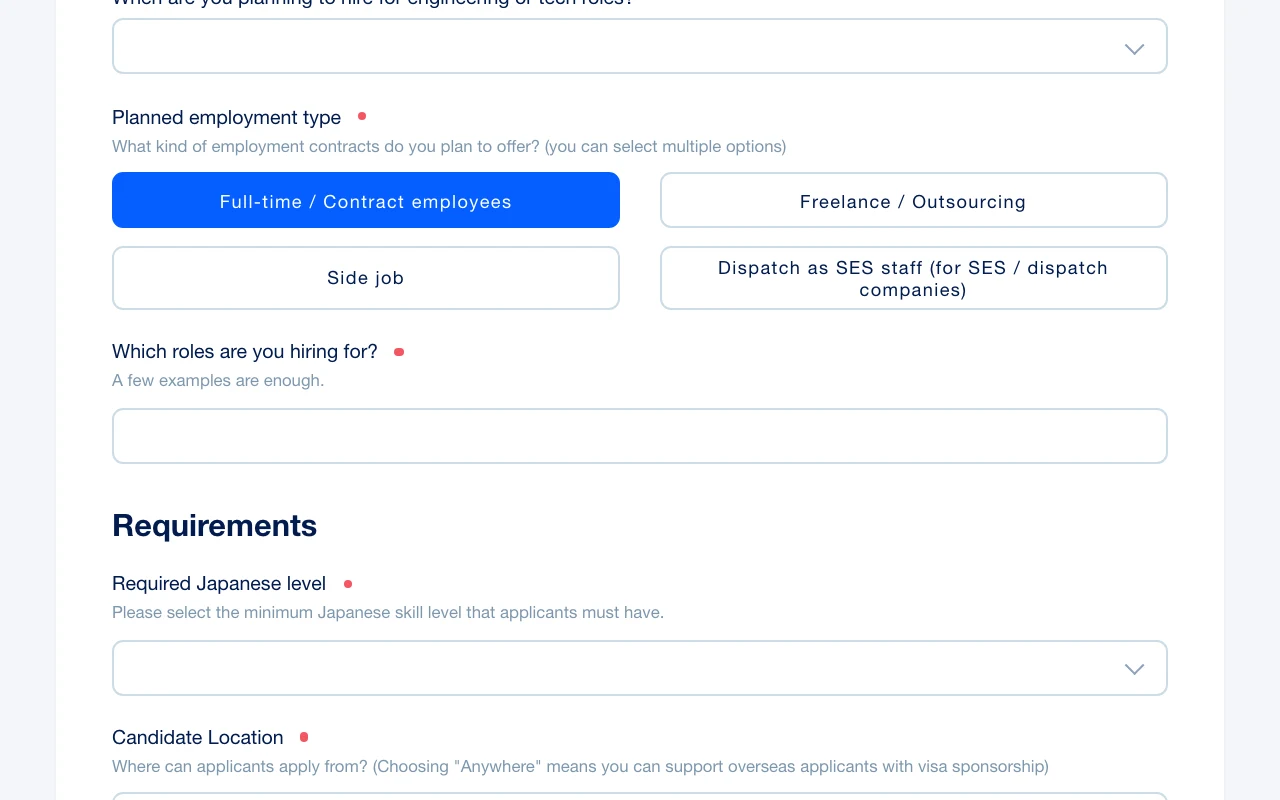
Check the price and the contract
Ask the fee, when it's due and how to report a hire, then sign. Japan Dev keeps its contract in English and Japanese.
Prepare the job in English
Use the fields of a job posting as your base, then add the salary range, Japanese level, whether people abroad can apply, and visa support.
After posting: applicants, interviews, reporting the hire
Get the job listed
TokyoDev rewrites the job to its headings; Japan Dev imports it from your job page or ATS. TokyoDev checks every job before it goes live.
Reply to applicants
Applications reach your email or ATS. Make the first call a casual interview about the role, in English. Send a result to people you won't take forward, too.
Report the hire and check the residence card
If the candidate lives in Japan, check on the residence card that they're allowed to work before you make the offer. Once it's accepted, tell the site that brought the hire.
Before the offer: the residence status
Neither site offers to handle visa paperwork. Checking is your job, and so is supporting the application when you hire from abroad.
- Residence card: look at the status, expiry and work-restriction fields, then confirm the card is genuine with the reader app.
- Status: most engineers hold Engineer / Specialist in Humanities / International Services. In the survey, 58% held a status tied to their job.
- Notification: each time you hire or lose a foreign employee, file the employment status notification with Hello Work (in Japanese).
Getting applicants
How to write an ad that gets developers to apply
Each week a job is live, track applications per job and the interview rate. Since neither site shares typical application numbers, your first month sets the bar for the next ad.
Time from listing to hire
Testimonials talk of hires four to eight weeks after posting (Japan Dev testimonials). The number of interviews changes that, so decide how many English rounds you'll run before the job goes up.
Timeline: first contact to offer
Based on employer testimonials; a SaiyouTeam estimate
- Week 1Contact, contract
- Week 2+Listing, replies
- Week 5+Interviews and offer
Five fixes that bring more applicants
The quickest win: fill in everything candidates filter on.
- Show the salary range: Japan Dev lets candidates filter by "Has Salary Range". On both sites, 60% to 70% of jobs show one.
- Be honest about Japanese: only 38% of surveyed developers can work in Japanese. If you don't need it, say so.
- Decide on applicants abroad: if you accept them, add visa support and relocation help.
- State the remote policy: partly remote or in the office. About 7 in 10 Japan Dev jobs were partly remote.
- Spell out the hiring process: TokyoDev jobs have a section for interview steps. Knowing the process makes it easier to apply.
FAQ
TokyoDev and Japan Dev FAQ for employers
What is TokyoDev?
TokyoDev is a job board for English-speaking software developers looking for work in Japan. It's run by TokyoDev Inc., and started in 2010 as founder Paul McMahon's personal blog. Besides jobs, it runs a weekly newsletter, a Discord community and an annual developer survey.
What is Japan Dev?
Japan Dev is a job board for English-speaking engineers, designers and product managers in Japan. It launched in April 2019 and is run by Japan Dev, Inc. On 27 November 2026 it listed 281 jobs.
TokyoDev vs Japan Dev: what's the difference?
The main differences are the number of jobs and what each will list. Japan Dev had 281 jobs and TokyoDev 133 (November 2026). TokyoDev won't list roles that need native Japanese or roles like sales or HR. Japan Dev sets salary floors.
How much does TokyoDev cost?
TokyoDev doesn't publish its price. It says its contract with companies pays it a fee when someone is hired through the site. You get the price by filling in its inquiry form.
Is Japan Dev free for employers?
Posting is free, but a hire isn't. Japan Dev's English employer page says you pay nothing until your first hire, then a flat fee per hire. Its Japanese page says you start from zero yen, and doesn't mention the fee per hire.
When and how do you pay the success fee?
Neither site publishes when the fee is due, so raise it when they send pricing. On Japan Dev, you report the hire and it sends an invoice, with a late fee that grows each month a hire goes unreported. TokyoDev also relies on companies telling it about hires.
Can recruitment agencies post on TokyoDev or Japan Dev?
Japan Dev's Japanese form says agencies can't use it as a database to find candidates; it's for companies hiring for themselves. We found no rule about agencies on TokyoDev.
Can I post a job that needs Japanese?
Yes, within limits. TokyoDev lists jobs up to "fluent" Japanese and never roles seeking native speakers. Japan Dev states no ceiling: 114 of its jobs asked for business-level Japanese on 27 November 2026.
Can I hire developers who live abroad?
Yes. On both sites, each job says whether people abroad can apply. To bring someone over, you'll need to support their visa application. TokyoDev requires visa sponsorship, or at least help renewing a residence status, to list a job.
Where do applications go?
Straight to you. TokyoDev sends them by email or links to your own application page; Japan Dev links to your applicant tracking system (ATS). TokyoDev says it does no screening and forwards applications unaltered.
Do I have to include a salary?
It isn't required, but it's encouraged. TokyoDev asks companies to add a salary range, and Japan Dev lets candidates filter by "Has Salary Range". On both sites, between 60% and 70% of jobs showed a salary.
Is Japan Dev legit? Is TokyoDev?
Yes. Both appear on the labor ministry's register of job-information providers. Companies such as Money Forward, HENNGE and Cybozu put their names to testimonials on their sites.
Can I post on both TokyoDev and Japan Dev?
Yes. Posting on both is free, and you only pay the site that brought the hire. The same companies, and even the same recruiters, endorse both boards.
Is the 50% in Japan Dev's fee table its job-board price?
No. The 50% (or 3 million yen) in the labor ministry's register is the ceiling Japan Dev filed for its recruitment agency licence. The same filing says it doesn't currently run an agency business.
DIY Hiring Kit
Everything You Need To Hire On Your Own
A downloadable hiring framework for small businesses in Japan, with step-by-step guides, spreadsheet ATS, LinkedIn scouting system, interview questions bank, offer letter and employment contracts, and a ton more!
1Dashboard11Checklists8Spreadsheets30Template docs4Weeks of Q&ABilingual
- Download every file as Word, Google Docs, Excel or Google Sheets



 14 years in talent acquisition
Related
Related guides and tools
 Guide
GaijinPot Jobs for employers: pricing and reviews
30-day job ads for English-speaking foreign nationals.
 Guide
What is Daijob? Pricing and reviews
For bilingual mid-career hires who also work in Japanese.
 Guide
Engineer / Specialist in Humanities visa in Japan
The status most foreign engineers hold.
 Guide
Highly Skilled Professional visa in Japan
An option for senior, well-paid engineers.
 Guide
How to write a job posting in Japan
The items to put in an English job ad.
 Tool
Cost per hire: averages and calculator
Compare a success fee with an agency fee, per hire.
Official sources
The main sources for this guide. Other references are linked where they are used in the text.
- TokyoDev Inc.tokyodev.com Hire developers (employer page) Audience, hires and how to ask for pricing (archived 4 November 2026).
- TokyoDev Inc.tokyodev.com How TokyoDev improves your job hunt Listing criteria, how jobs are edited, and the success-fee contract (August 2024).
- TokyoDev Inc.surveys.tokyodev.com TokyoDev Developer Survey 2026 Pay, Japanese level and location of 733 international developers in Japan.
- Japan Dev, Inc.japan-dev.com Hire tech talent (employer page) Audience, what is free, the flat fee per hire and testimonials (checked 27 November 2026).
- Japan Dev, Inc.japan-dev.com How and why I built Japan Dev How hires are invoiced, and the late fee for unreported hires (August 2022).
- Ministry of Health, Labour and Welfarejinzai.hellowork.mhlw.go.jp Register of recruitment businesses Japan Dev's recruitment agency licence and its filed fee table.