
What is Daijob?Pricing, reviews and how employers hire with it
A guide to Daijob for companies in Japan that need people who speak English and Japanese. It covers how posting and scouting work, plans and contract rules, who is registered, what employers say about it, and how to use it.
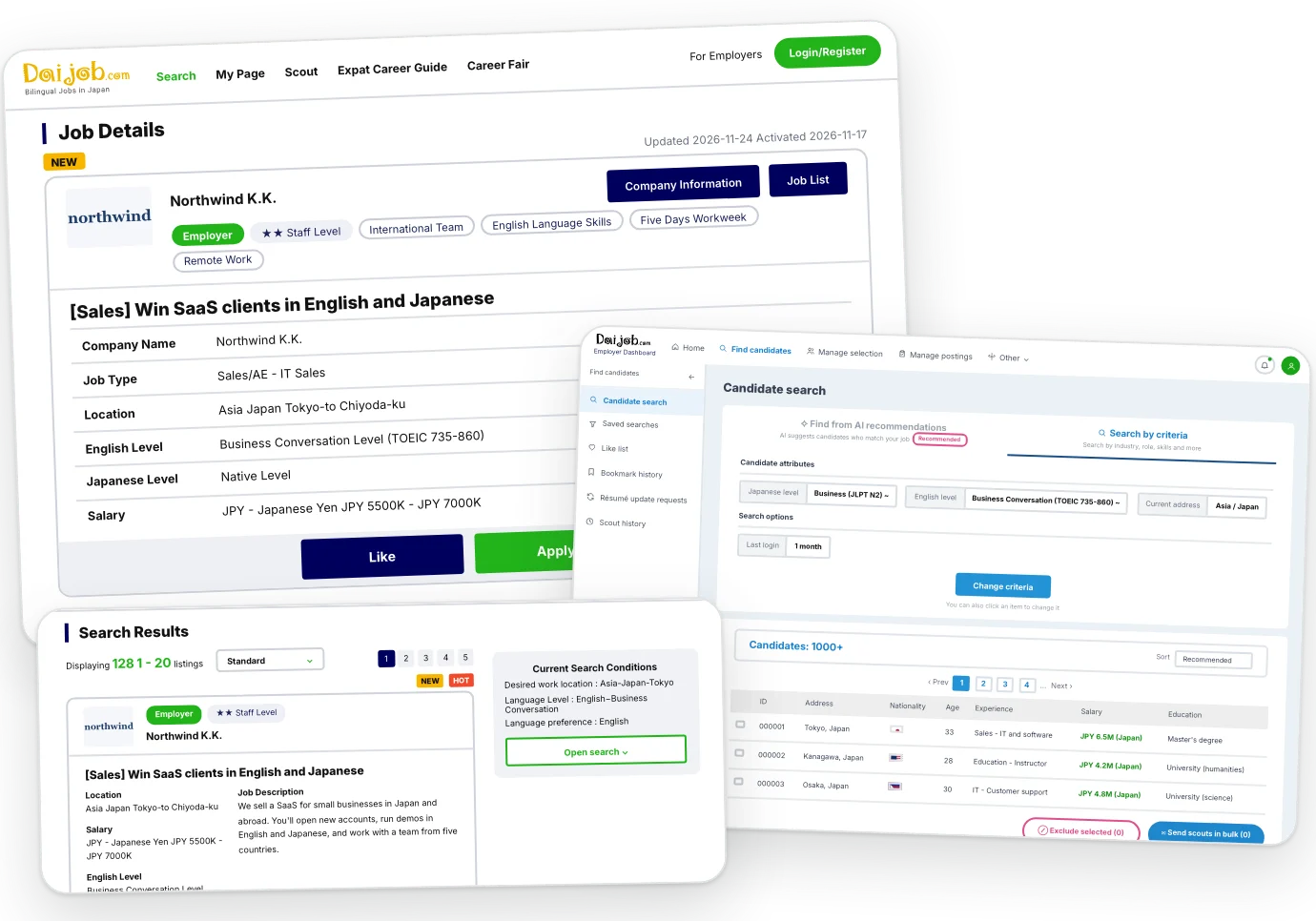

Basics
What is Daijob?
In short
Daijob is a job site in Japan for bilingual people who use English and Japanese. About 940,000 people have registered in total, and over 360,000 résumés are published for employers to scout. The price is fixed by your plan and how long your job stays up, with no success fee on top. Human Resocia has run it since May 2026.
On an ordinary job site, a sales role with clients abroad, or a job on a team with foreign colleagues, rarely draws enough applicants with the language skills. Daijob is built for people who use both English and Japanese. That makes it smaller than the big job sites, and its cheapest plan costs more than any other bilingual board with public prices (see the comparison table).
I've spent 14 years in recruiting, including at Persol Career and Google. Today my recruitment consulting is for small and mid-size businesses, and Daijob is one option when a role needs English. For this page I read Daijob's FAQ, terms, brochure and case studies, and its operator's announcements. The rest of the hiring process is in our hiring playbook.
- First, what a Daijob job looks like to a candidate, and the tools a posting comes with.
- Then pricing: what Single, Standard and Premium cost, and the contract terms worth reading first.
- After that, who is registered, how old they are and which languages they use, and what Daijob suits.
- Next, its strengths and limits, other bilingual job boards side by side, and where Daijob fits.
- Finally, the steps from posting to answering applicants, and how to read reply rates.
How it works
How Daijob works: job posts and scouting
You can do two main things on Daijob: post a job and wait for applications, or search published résumés and contact people yourself. It opened in 1998, and the company calls it Japan's first job site specializing in bilingual people.
The job page candidates see
Open a job, and the page looks like this. Unlike on an ordinary job site, each job lists the English and Japanese levels it needs.
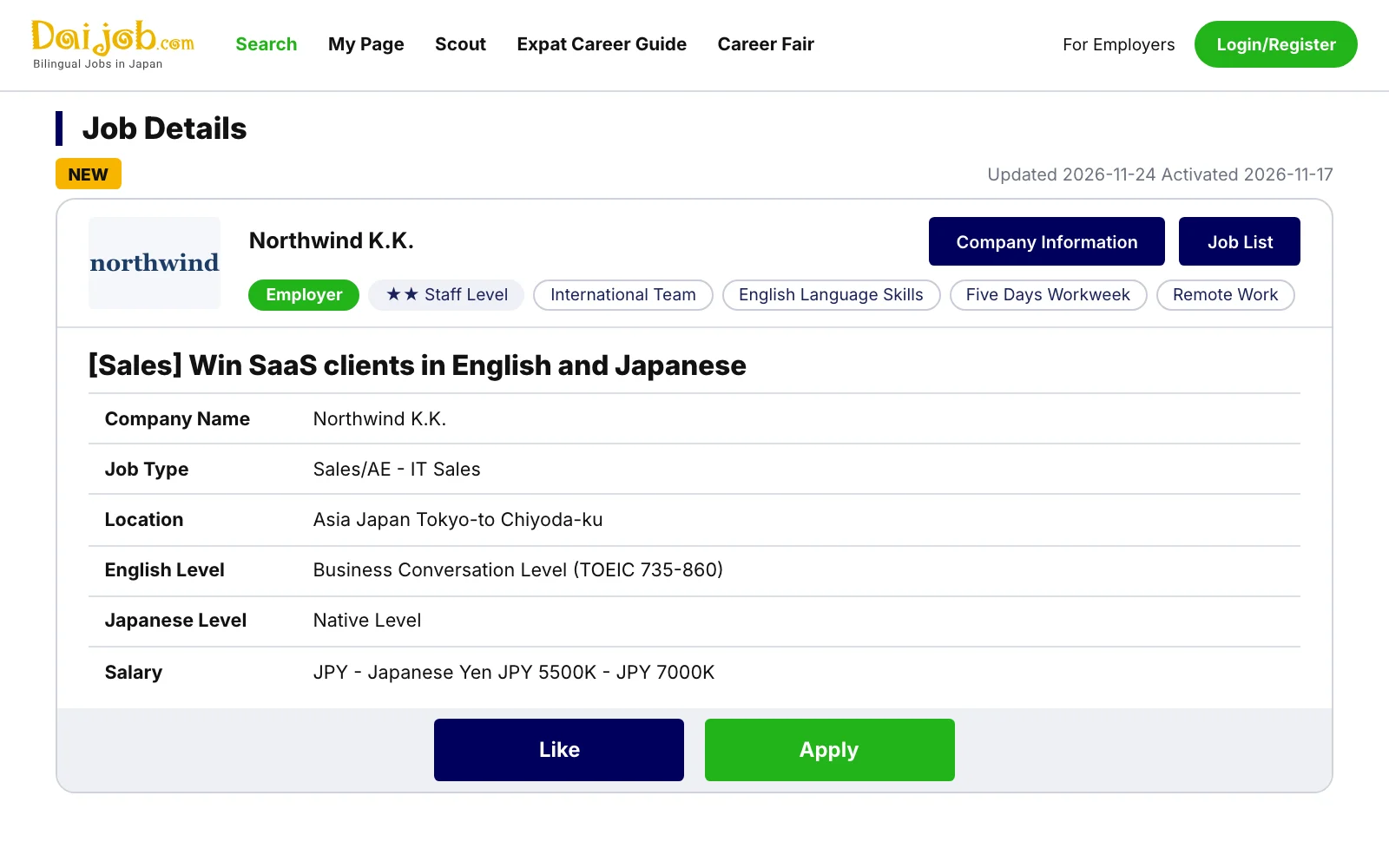
Job page (mock-up)
- Employer: the company posts it itself
- Languages: English and Japanese levels
- Salary: a yen range
- Apply: the candidate's button
You can post a job in Japanese, in English or in both. The employer FAQ says an English version can be made from a Japanese draft. The 2025 price sheet also lists Chinese.
Agencies post jobs alongside employers. By number of companies, 75% of those posting in fiscal 2025 were employers and 25% agencies (April 2025 to March 2026, October 2026 brochure). Daijob doesn't publish the split by number of jobs.
What companies can do on Daijob
A posting plan gives you four tools:
- Job and company pages: besides the job itself, you can add company information and "highlights" about the work and conditions.
- Resume Bank: search over 360,000 published résumés by language level, role, industry, location and more.
- Scout Mails: email people you find, with a job attached.
- Automatic Scout and AI suggestions: scouts go out automatically to people who match, and AI suggests candidates for each job.
How candidates answer a scout
Résumés are published without names. A candidate who gets a scout has three buttons:
- I'm interested: they'd like to go ahead. Only then are their name and other details shown to you.
- Ask a Question: they can ask the recruiter something without giving personal information.
- Not interested: they turn the scout down.
According to Daijob's page for candidates, personal information isn't shared with the company until the candidate answers "I'm interested". Candidates can also block companies they don't want to see their résumé.
Three ways it differs from an ordinary job site
- Difference 1You can search by language level. There are six levels, with TOEIC scores as the guide for English and JLPT levels for Japanese. You can combine them with role and location.
- Difference 2It works in Japanese and in English. Jobs go up in Japanese, English or both. The Employer Dashboard and the candidate site also come in the two languages.
- Difference 3Japanese and foreign nationals are about half each. At business level or above, over 70% of registered Japanese nationals use English, and about 58% of registered foreign nationals living in Japan use Japanese (employer FAQ).
A new dashboard from 30 November 2026
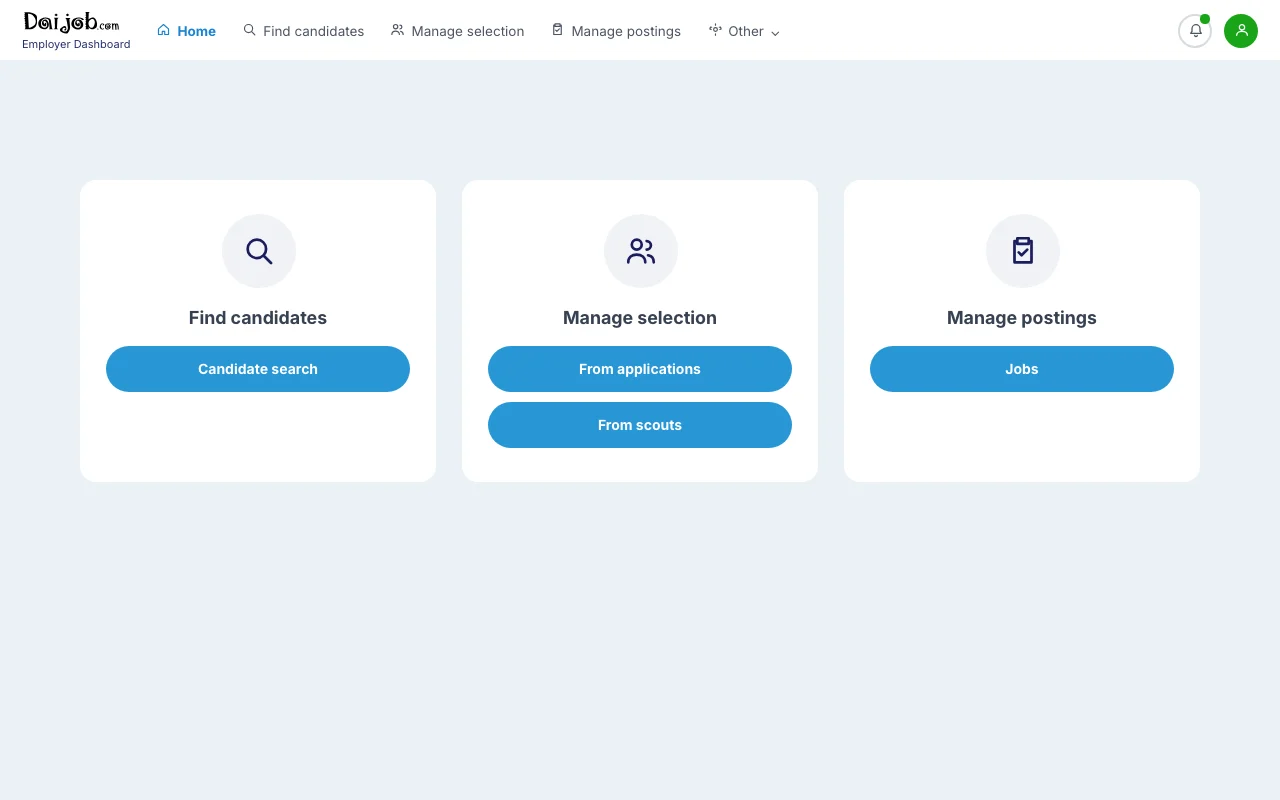
Daijob has announced that it will change the design of its Employer Dashboard from 30 November 2026. The old screens stay usable for three months, and neither fees nor contracts change. The pictures of the dashboard in this guide show the new one, with labels we translated from Japanese.
Pricing
Daijob pricing: a fixed fee by plan and contract length
The price depends on your plan and how long the job stays up. Daijob's own column says you pay nothing extra however many people you hire, and the price is the same if you hire no one. The FAQ gives the equivalent of ¥162,500 a month on a 12-month contract as the starting price, and the page for its RPO (recruitment outsourcing) service gives ¥520,000 for two months.
Single, Standard and Premium: what changes
What changes most is how many jobs you can post at once. Scouts are 70 a month on Single, and 200 on both Standard and Premium.
| Plan | Jobs | Scouts (a month) |
|---|---|---|
| Single | 1 | 70 |
| Standard | 5 | 200 |
| Premium | 10 | 200 |
Source: Daijob brochure (October 2026). The 2024 brochure gave 400 scouts for Premium.
Daijob price list (before tax)
| Plan | 2 months | 6 months | 12 months |
|---|---|---|---|
| Single | ¥520K | ¥1.17M | ¥1.95M |
| Standard | ¥886K | ¥2.01M | ¥3.37M |
| Premium | ¥1.24M | ¥2.815M | ¥4.72M |
Totals, before tax. Three months cost ¥715K on Single, ¥1.2M on Standard and ¥1.68M on Premium. Source: Daijob brochure (October 2026, available on request).
The longer the contract, the less you pay per month. On Single, two months work out to ¥260,000 a month and twelve months to ¥162,500, almost 40% less. But as the next section shows, you can't leave early.
An extra job costs ¥50,000, and 10 more scouts a month ¥20,000, before tax. Translation between Japanese and English, and having Daijob run the account, are paid extras.
Five rules to read before you apply
Daijob revised its terms of service for employers on 1 May 2026. Five rules matter most:
- No early exit: once the contract starts, you're in it until the end date.
- No refunds: the fees Daijob has received aren't returned, whatever the reason. If Daijob is at fault and the service still isn't back after 24 hours on business days, your period is extended by the days lost.
- Fees start with your login: you're charged from the day Daijob sends your ID and password.
- Yen only, by bank transfer or PayPal: foreign currency isn't accepted, and late payment adds 14.6% a year.
- Outside recruiters need approval: a recruitment outsourcing firm can't use your dashboard until Daijob approves it in writing.
The terms contain no clause about automatic renewal. Ask about renewal before you apply.
What each Daijob hire costs
With a fixed fee, every extra person you hire lowers your cost per hire. An agency charging 35% would ask ¥2.1 million for someone on ¥6 million a year. Single for six months costs ¥1.17 million, so one hire already comes out cheaper.
The cost of each hire, posting on Single for six months (¥1.17M)
Next to an agency at 35% of a ¥6M salary
Agency (1 hire)
Daijob (1 hire)
Daijob (2 hires)
Daijob (3 hires)
Before tax. SaiyouTeam estimate from the brochure price and a common agency rate
All of that assumes you actually hire. If nobody is hired, the ¥1.17 million isn't refunded. Check three things before you apply:
- How many people match your criteria? In a free consultation and demo, you can search by role and language level and see the number before deciding.
- How fast do you need to hire? Two months start at ¥520,000. Longer contracts are cheaper per month, but you can't end them early.
- Can you reply right away? Yumoto Electric answered within a day and held interviews within a week, and hired three people in six months.
Who is on it
Daijob has about 940,000 registered users and 360,000 published résumés
Daijob gives two numbers. The 940,000 total counts everyone since 1998. The people you can actually contact are the 360,000 or more with a published résumé. For scouting, the second number is the one to use.
Daijob users, and people you can scout
Total registrations and published résumés
Registered in total
Published résumés
Source: Daijob service page and operator announcements (September to November 2026)
The biggest age group is 25 to 34, at 48%, followed by 35 to 44 at 22%.
Ages of Daijob users
Fiscal 2025 registration data (April 2025 to March 2026)
- 25 to 34
- 48%
- 35 to 44
- 22%
- 24 or under
- 16%
- 45 or older
- 14%
Source: Daijob brochure (October 2026)
74% of users have business-level English or higher. Their last salary was under ¥3 million for 39%, ¥3 to 5 million for 27%, ¥5 to 8 million for 15% and ¥8 million or more for 19%. Of its foreign users who live in Japan, about 58% have business-level Japanese.
Among jobs that were filled, sales made up 24%, hotels, leisure, restaurants and travel 11%, and consulting 10%.
Jobs filled through Daijob, by role
Share of jobs filled in fiscal 2025
Sales
Hotels, leisure, dining, travel
Consulting
Finance
IT (open systems, web)
Planning, marketing, PR
Source: Daijob brochure (October 2026). Top six roles
The hires that suit Daijob
Looking at who is registered and what got filled, three kinds of hiring suit Daijob best.
Sales roles in English
About a quarter of filled jobs are in sales. Nearly half of all users are 25 to 34, so people with a few years of experience are the easiest to find.
Engineers and specialists
Galileo hires four to eight foreign engineers a year through Daijob. Veeva Japan made two hires, in product support and professional services. Avtel hired four people from the 38 who visited its booth at the May 2022 Career Fair.
Hotels, travel and restaurants
Hotels, leisure, dining and travel account for 11% of filled jobs. Travelience, which runs a marketplace for guided tours, made five hires from its postings, using Daijob's RPO as well.
Executives look harder to find. 19% of users last earned ¥8 million or more, against 39% who earned under ¥3 million, and one employer's review says there are no high-level or executive candidates (BOXIL, 2021).
Pros and cons
Daijob pros and cons: language filters, but no refunds
Daijob's main advantage is that you can filter candidates by language level. The main drawback is that you pay for the whole period, even if you hire nobody.
What employers say about Daijob
There are very few employer reviews. ITreview has one, at 4.0 stars: it praises how Daijob specializes in bilingual, global talent, and says the dashboard is a little old (July 2025). The new dashboard arrives on 30 November 2026.
BOXIL had five reviews in January 2026, only one of them from an employer (the page has since been taken down). It called the price "affordable compared with success-fee platforms" (our translation, May 2021). Candidates complain about agency jobs mixed in with the others, and scouts that don't match them.
Watch out: a fixed fee, and how fast you answer
There are two things to watch. One is the fee, which is due for the whole contract whatever happens. Posting alone may bring few applications, so decide who will send scouts every week before you sign.
The other is speed. Candidates get scouts from other companies too. When "I'm interested" comes in, offer interview times the same day.
Here are both sides in one table:
| Topic | Pros | Cons |
|---|---|---|
| Cost | Hire as many as you like for the same fee | No refund if you hire nobody |
| Reach | 360,000+ résumés, searchable by level | Smaller than the big job sites |
| Candidates | Nearly half are 25 to 34 | Few executives and senior managers |
| Contract | From two months | No early exit during the period |
| Workload | Automatic Scout and AI suggestions | You search and answer yourself |
| Dashboard | In Japanese and English | New design to learn from 30 November 2026 |
How it compares
Daijob vs other bilingual job boards: price and reach
Daijob isn't the only job board for bilinguals and foreign nationals in Japan. The table sets nine of them side by side: reach, price, posting period and success fee.
| Sort by | ||||
|---|---|---|---|---|
 GaijinPot JobsEnglish speakers | 650Kvisitors a month | Not public | 30 daysat most | Not public |
 YOLO WORKForeign residents | 400Kregistered | ¥0pay on hire | Not stated | ¥350,000per permanent hire |
 DaijobBilingual mid-career | 360K+published résumés | ¥520,000Single | 2 monthsat least | None |
 Japan DevSoftware developers | 100Kvisitors a month | ¥0pay on hire | Not stated | Not publicflat per hire |
 TokyoDevSoftware developers | 45K+visitors a month | Not public | Not stated | Not publicsuccess-based |
 Jobs in JapanEnglish speakers | 20K+monthly applicants | ¥24,200tax included | 30 days | None |
 HirePlannerBilingual mid-career | Not public | ¥300,000under 10 staff | 12 months | None |
 NINJAForeign nationals, N2+ | Not public | ¥0pay on hire | 12 monthsauto-renews | From ¥200,000per hire, by region |
 CareerCrossForeign and global firms | Not public | Not public | Not stated | Not publica fee option exists |
Sources: the boards' own pages (GaijinPot, YOLO WORK, Japan Dev, TokyoDev, Jobs in Japan, HirePlanner, NINJA) and SaiyouTeam research (November 2026). Each board counts its reach differently. Click a heading to sort.
Among boards with public prices, Daijob's cheapest plan costs the most: ¥520,000 for two months. HirePlanner gives a company with fewer than 50 employees a full year for ¥575,000.
If you only want to pay once you hire, NINJA takes ¥400,000 per hire in the Tokyo area and YOLO WORK ¥350,000 per permanent hire. Two hires in two months on Daijob's Single plan cost ¥260,000 each, less than NINJA in Tokyo or YOLO WORK.
The people differ as well. About half of Daijob's users are Japanese, whereas GaijinPot, YOLO WORK and NINJA are for foreign nationals. For engineers only, TokyoDev and Japan Dev collect applications in English.
To choose a job site, open "Job boards, including free ones" in the DIY Hiring Kit. It lines up the boards bilingual candidates use, and shows which ones are free.
Strategy
Daijob's place in your hiring strategy
Daijob is strong for roles that need both English and Japanese. Use it only for the jobs with a language requirement and fill the rest through other channels, and the fee pays its way.
Three examples follow: a software company, a hotel operator and a manufacturer.
-
Scenario 1
2 hires, sales staff who speak English, over six months at a 25-person foreign software company
ProfileNative-level Japanese, business-level English or higher. 3+ years in B2B sales. Target pay ¥5.5M to ¥7M.
Strategy
- Daijob
 LinkedIn
Daijob job posts and scouts reach bilingual salespeople in Tokyo. Candidates found by the head office abroad are contacted on LinkedIn. The job is posted in Japanese and in English.
Plan
Single, 6 months¥1.17M gives ¥585K per hire for two. That's under 30% of the ¥2.1M an agency charges for a ¥6M salary. If nobody is hired, the ¥1.17M is still spent.
-
Scenario 2
5 hires, hotel staff who serve guests in English, in a year at an 80-person hotel operator
ProfileJapanese at JLPT N2 level or higher, business-level English, able to work in Japan. Target pay ¥3.2M to ¥4M.
Strategy
- Daijob
- Referrals
Hotels, leisure, dining and travel make up 11% of the jobs filled on Daijob. Five jobs go up, for the front desk, the restaurant and reservations. Foreign staff already working there are asked to bring people they know.
Plan
Standard, 12 months¥3.37M for five hires is ¥674K each. Standard covers five jobs at once, with no extra charge.
-
Scenario 3
1 hire, an overseas sales specialist, this spring at a 40-person manufacturer
ProfileAble to negotiate with clients abroad in English, and to work in Japanese. Target pay ¥5M to ¥6M.
Strategy
- Daijob
- Job boards
Only the one role that needs languages goes on Daijob; the others are filled on the usual job boards. Scouts go to people who've worked in export or trade.
Plan
Single, 3 monthsOne hire for ¥715K, a little under 40% of the ¥1.925M an agency charges on a ¥5.5M salary. If no one is found in three months, the fee isn't returned.
Who runs the scouting: your team, Daijob's team or RPO
Daijob assumes you send the scouts yourself, but you can hand the work over. You can run it in one of three ways:
- Your own team: a dedicated contact at Daijob advises you on job ads, the dashboard, scout wording and interviews. Daijob's sales staff all speak both languages.
- Managed operation: for ¥100,000 a month before tax, Daijob sends scouts and does other account work for you.
- RPO: Daijob handles everything from writing the job ad to setting up the first interview. For two months, the RPO Light package costs ¥900,000, and the brochure's RPO package starts at ¥1.2 million.
Getting started
Getting started with Daijob
Three steps get you ready, and four keep you going once the job is live.
Getting ready: from a consultation to the job ad
Find out how many candidates match
Tell Daijob the role, the language levels and your other criteria, and see how many people match in the real dashboard. Decide whether to sign once you know the number.
Apply and pass the review
Choose a plan and a contract length, and apply. Daijob reviews the company. Jobs usually go live within four business days of applying, or as early as the next business day if you're in a hurry.
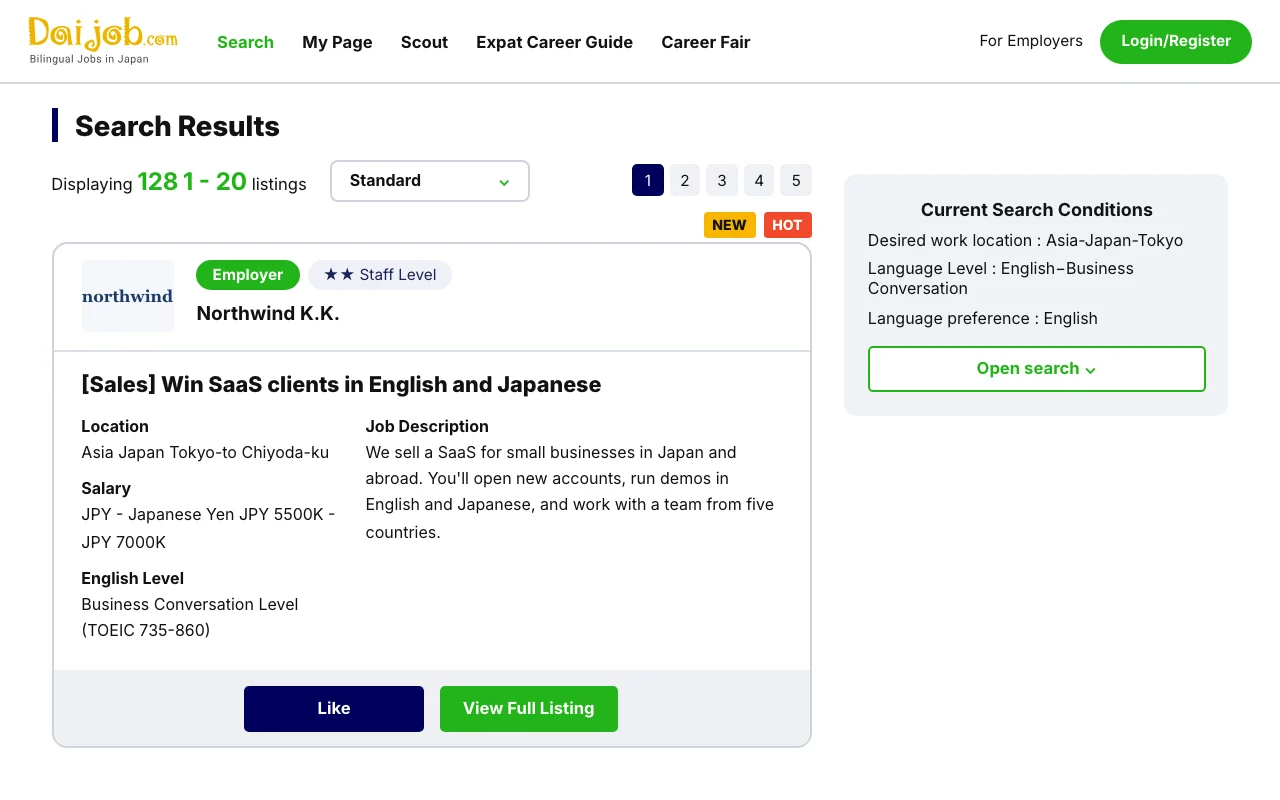
Write the job in Japanese and English
Add company information and highlights, and fill in each job posting. In the search results, it looks like this.
Running it: search, scout, answer
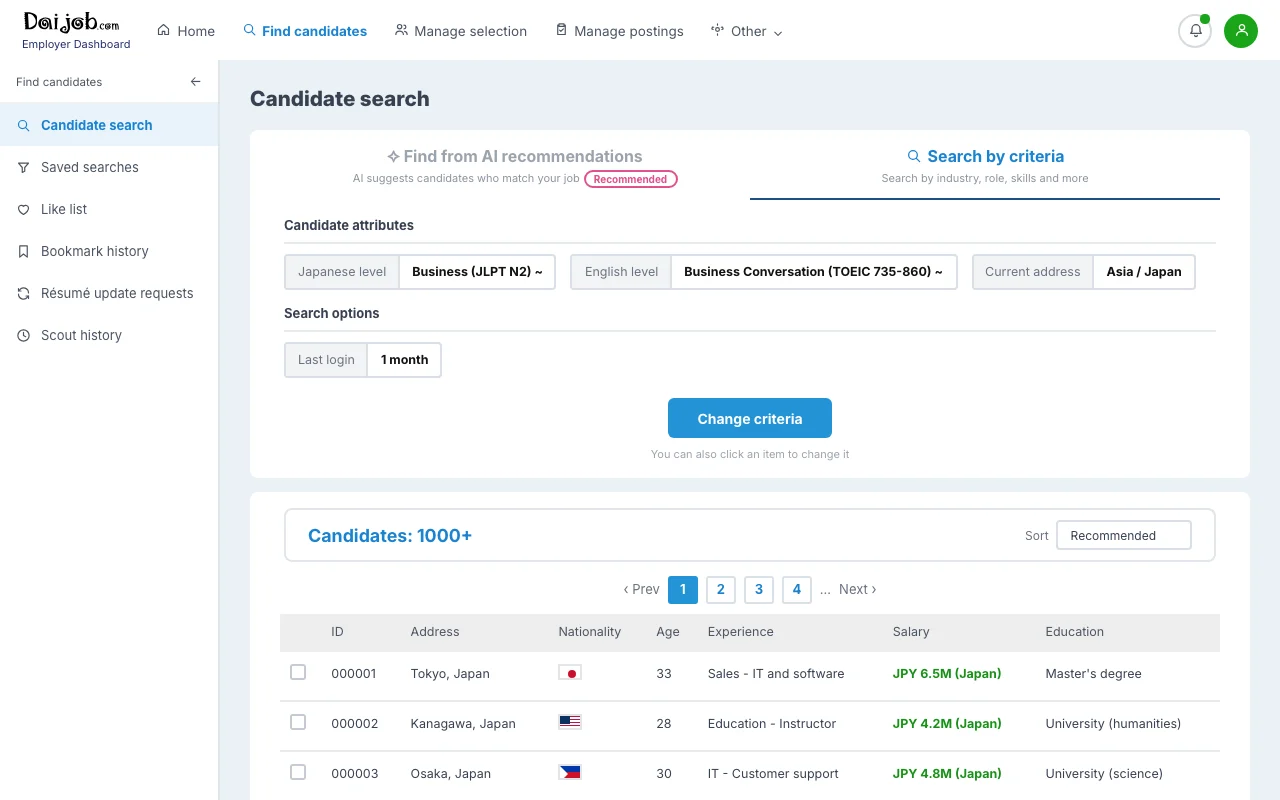
Search for candidates
Set the Japanese level, English level, location, last login and so on. You can also choose from the candidates AI suggests for each job.
Send scouts
Send Scout Mails to people you find, and set conditions for automatic scouts too. Plan to use your full scout allowance every month.
Answer applications and replies
People who apply and people who answer a scout with "I'm interested" are managed on one screen. Answer the same day.
Meet them, and check their residence status
Invite everyone who answers "I'm interested" to a casual interview. For foreign nationals, check their residence status before you make an offer (see below).
What employers do when hiring foreign nationals
On Daijob, people enter their own nationality, residence status and expiry date. Daijob doesn't guarantee that it's correct. Before you decide to hire, you have to check it yourself.
- Look at the residence card: check the status, the expiry date and whether the person may work. Cards issued since 14 June 2026 no longer print the period of stay, so check it with the reader app.
- See whether the job fits the status: a specialist job needs a status such as Engineer / Specialist in Humanities.
- Report to Hello Work: when you hire, and when the person leaves, file the notification of foreign workers.
On visas, Daijob columns published since August 2026 say the site doesn't help with obtaining or applying for them (the interview-questions column). Its RPO page lists visa application support, so ask your contact. If a change of status is needed, the person applies, with documents from the company.
Reply rates
Reading Daijob's reply rates, and getting more applications
Once your job is live, watch two numbers: the reply rate of your scouts, and how many of the people who reply come to an interview.
Daijob's reply rate depends on which page you read
Daijob publishes different reply rates on different pages. It doesn't say how each one is counted, so read them as a range.
Scout reply rates Daijob publishes
One figure per official page
Page for recruitment agencies
Service page
October 2026 brochure
Source: Daijob's own pages
A Daijob column says the average reply rate for scouts to global talent is 5 to 10% (August 2026). Treat that as the floor and 20% as a good result, and compare your own rate with them. A scouting agency's article says replies include people who only press "I'm interested" (July 2026).
How long posting to hiring takes
Daijob doesn't publish an average. Its FAQ says it depends on the role and the language level. Going live usually takes up to four business days.
From applying to the offer
Our estimate. Yumoto Electric hired three people in six months
- Week 1Apply, review, job ad
- Week 2 onSearch and scouts
- Month 2 onInterviews, offer
Five tips for more applications and replies
You've already paid the fee, so better scouts and a clearer job ad are what bring the cost per hire down.
- Post in Japanese and in English: some candidates search in one language only. With both, you turn up more often.
- Match the language level to the work: if you ask for more than the job needs, fewer people apply. Say in the job description when English is used.
- Use Automatic Scout: new people who match get a scout automatically, and you spend the time on replies instead.
- Ask for a fuller résumé: when one is thin, a button asks the candidate to update it, so you see their work history before the meeting.
- Reply at once: when "I'm interested" arrives, offer two or three meeting times the same day.
FAQ
Frequently asked questions about Daijob
What is Daijob?
Daijob is a job site in Japan for bilingual people who use English and Japanese. Companies post jobs on it, and can search published résumés and contact candidates directly. Since May 2026 it has been run by Human Resocia.
How much does Daijob cost for employers?
Daijob's FAQ gives a starting price equivalent to ¥162,500 a month on a 12-month contract, before tax. There are three plans, Single, Standard and Premium, for 2, 3, 6 or 12 months. Single for 2 months costs ¥520,000.
Does Daijob charge a success fee?
Not on its job-posting plans. Daijob's own column says you pay nothing extra however many people you hire. The same company's placement service is a separate contract, with a fee of 35% of the expected annual salary (at least ¥1.2 million).
Is Daijob free for employers?
No. The shortest posting is two months. Before you sign, a free consultation and demo shows you how many registered candidates match what you need.
How many people use Daijob?
About 940,000 people have registered in total, and over 360,000 résumés are published, which is how many candidates you can scout. Japanese and foreign nationals each make up about half.
What is Daijob's scout reply rate?
Daijob's own pages give figures between 13.8% and 20%. A scouting agency's article says people who only press "I'm interested" count as replies, so look at how many go on to meet you as well.
Can I cancel a Daijob contract early?
No. The terms say a company can't cancel during the contract period and that fees aren't refunded. You're charged from the day Daijob sends you your login.
Does Daijob handle visas for foreign hires?
Daijob columns published since August 2026 say the site doesn't help with obtaining visas or residence status, or apply on your behalf. Its RPO page, on the other hand, lists visa application support. Plan for you and the candidate to handle it, and ask Daijob to clarify.
Is Daijob available in English?
Yes. Both the Employer Dashboard and the candidate site have Japanese and English versions. You can post a job in Japanese, English or both.
What is the Daijob Career Fair?
It's an in-person hiring event that Daijob holds four times a year in Akihabara, Tokyo. Bilingual job seekers come to talk to employers on the spot. In Daijob's brochure, a booth costs ¥500,000 to ¥900,000 before tax.
Are Daijob's RPO and placement services the same as posting a job?
No. Posting is a fixed-fee service in which you search for people and write to them yourself. With RPO you hand over the work, from drafting the job ad to setting up the first interview. Placement charges a fee when you hire.
What roles suit Daijob?
Among jobs filled in fiscal 2025, sales led with 24%, followed by hotels, leisure, restaurants and travel, then consulting, finance and IT. It suits roles that need English; executives and senior managers are fewer.
Is Daijob legit?
Yes. It's run by Human Resocia, a subsidiary of Human Holdings, which is listed on the Tokyo Stock Exchange's Standard market, and it's registered as a job-information provider. The complaints you'll find online are about agency-posted jobs mixed in with direct ones, and scouts that don't fit.
Is daijob.com the same as daijob.work?
No. daijob.work is a separate site for foreign workers called DAIJOB GlobalCareerConnect, and we found no link between it and Human Resocia.
How does Daijob compare with CareerCross and GaijinPot?
Daijob and CareerCross specialize in bilingual people, while GaijinPot is aimed at the foreign community. Daijob charges a fixed fee for the posting period. CareerCross has a monthly service and a success-fee service, without public prices. GaijinPot jobs run for up to 30 days, with prices on request.
DIY Hiring Kit
Everything You Need To Hire On Your Own
A downloadable hiring framework for small businesses in Japan, with step-by-step guides, spreadsheet ATS, LinkedIn scouting system, interview questions bank, offer letter and employment contracts, and a ton more!
1Dashboard11Checklists8Spreadsheets30Template docs4Weeks of Q&ABilingual
- Download every file as Word, Google Docs, Excel or Google Sheets



 14 years in talent acquisition
Related
Related guides and tools
 Guide
What is LinkedIn Recruiter? Lite vs Corporate
Reach members worldwide, with no fee per hire.
 Guide
How to write a job posting in Japan
One set of items for the Japanese and the English version.
 Hiring practices
What is direct recruiting? Scouting vs agencies
Finding candidates yourself and approaching them.
 Guide
Engineer / Specialist in Humanities visa in Japan
The residence status for hiring foreign specialists.
 Hiring practices
What is a casual interview?
How to run the first meeting after a reply.
 Tool
Cost per hire: averages and calculator
Divide a fixed posting fee by the people you hire.
Official sources
The main sources for this guide. Other references are linked where they are used in the text.
- Human Resocia Co., Ltd.biz.daijob.com Daijob.com FAQ for employers The ¥162,500-a-month starting price, contract lengths, posting languages and time to go live.
- Human Resocia Co., Ltd.biz.daijob.com Daijob.com service brochure (October 2026) Price grid by plan, fiscal 2025 user data and the new dashboard (the page where it's requested).
- Human Resocia Co., Ltd.biz.daijob.com Member company terms Early cancellation, refunds and payment (revised 1 May 2026).
- Human Resocia Co., Ltd.biz.daijob.com Daijob.com service page Over 360,000 published résumés, Scout Mails and language levels.
- Human Resocia Co., Ltd.biz.daijob.com Operating company The change of operator on 1 May 2026.
- Ministry of Health, Labour and Welfaremhlw.go.jp Notification of foreign workers What employers file when they hire, or stop employing, foreign nationals.