
What is the Business Improvement Subsidy?Requirements, amount and how to apply
Japan's Business Improvement Subsidy explained simply: the requirements, the subsidy amount, eligible expenses, the deadline to apply and how to apply, with real examples. Calculate your amount with the free tool and save it as a PDF.

Calculate your Business Improvement Subsidy
–
Estimated subsidy
¥0–
- Subsidy¥0
- You pay¥0
How it's calculated
Key figures
- Course
- –
- Subsidy rate
- –
- Cap
- –
- Deadline
- –
The calculation
| Item | Amount |
|---|---|
| Subsidy (lower of the two) | – |
Findings
An estimate based on MHLW's guide to the fiscal 2026 Business Improvement Subsidy and the grant guidelines (Tables 1 and 2). The Prefectural Labour Bureau decides whether a grant is made and how much.
Overview
What is the Business Improvement Subsidy? A grant for equipment that comes with a wage raise
Key point
The Business Improvement Subsidy is a Ministry of Health, Labour and Welfare (MHLW) program that pays SMEs and small businesses part of the cost of equipment and other investments that raise productivity, up to ¥6 million, when they raise the lowest hourly wage in a workplace by ¥50 or more.
It is for companies that raise hourly pay to keep up with the minimum wage, and they must apply before raising pay. A company that raised pay before applying, or on or after the day the new minimum wage takes effect, or that signed contracts for machines or software before the grant decision, can't get it. Whether you can use it comes down to three steps in this order: apply, raise wages, then sign the equipment contracts.
The subsidy pays for equipment and similar costs, such as a POS system, machines or consulting to rework how jobs are done, not for the wages themselves. You receive the cost times the subsidy rate (4/5 or 3/4) or the cap, whichever is lower, after the project ends. There is no advance payment (Business Improvement Subsidy Q&A Q66).
Its official Japanese name translates as the Subsidy for Measures to Support SMEs in Raising the Minimum Wage. Because it is paid within the national budget, applications can close before the window ends (guide to the fiscal 2026 Business Improvement Subsidy).
Main changes from fiscal 2025
- CoursesFiscal 2025: ¥30, ¥45, ¥60, ¥90Fiscal 2026: ¥50, ¥70, ¥90
- 4/5 rate appliesFiscal 2025: Under ¥1,000Fiscal 2026: Under ¥1,050
- When to raise payFiscal 2025: Before or after applyingFiscal 2026: After applying only
- VehiclesFiscal 2025: Allowed for special casesFiscal 2026: Special-purpose only
- Workers raisedFiscal 2025: Any workerFiscal 2026: Insured workers only
- Rising-cost conditionFiscal 2025: 1 of the last 3 monthsFiscal 2026: Last 6 months, averaged
In fiscal 2025, a company that had raised pay on or after September 5, 2025 and by the day before the minimum wage took effect could still apply afterwards. Source: MHLW, notice of changes to the fiscal 2026 Business Improvement Subsidy.
Application period
When is the Business Improvement Subsidy deadline? The fiscal 2026 window and the outlook for fiscal 2027
Key point
In fiscal 2026 (April 2026 to March 2027), you can apply from September 1, 2026 until the day before the minimum wage takes effect in your workplace's prefecture or November 30, whichever comes first. As of November 5, 2026, only workplaces in Saga, Kyoto, Iwate, Kumamoto and Okinawa can still apply.
Your application must reach the Labour Bureau by the deadline: by post it must arrive by the last day, in person by 5:15 pm on the last day, and on jGrants it must be completed by the last day. When the last day falls on a weekend or public holiday, post and in-person filings are due the open day before (Q&A Q50). In the other 42 prefectures, the deadline (the day before the minimum wage effective date) has passed and applications are closed.
Prefectures still open on November 5, 2026
Saga
E-filing deadline: November 14. Post or in person: Nov 13 (Fri)
New minimum wage Nov 15
9 days leftKyoto
E-filing deadline: November 15. Post or in person: Nov 13 (Fri)
New minimum wage Nov 16
10 days leftIwate
E-filing deadline: November 30. Same day by post or in person
New minimum wage Dec 1
25 days leftKumamoto
E-filing deadline: November 30. Same day by post or in person
New minimum wage Dec 1
25 days leftOkinawa
E-filing deadline: November 30. Same day by post or in person
New minimum wage Dec 2
25 days left
The large date is the e-filing (jGrants) deadline. Sources: MHLW, fiscal 2026 regional minimum wages; Business Improvement Subsidy Q&A, Q50.
Saga's and Kyoto's deadlines fall on a weekend, so post and in-person filings are due by Friday, November 13.
The Business Improvement Subsidy in fiscal 2027
In its fiscal 2027 budget request, MHLW asks for ¥54.3 billion for the Business Improvement Subsidy, about 26 times the fiscal 2026 initial budget (¥2.1 billion). It plans to revise the subsidy-rate bands, raise the caps for some courses and lengthen the application period (fiscal 2027 budget request of the Employment Environment and Equal Employment Bureau). A budget request is only the amount asked for; the requirements and the application period are announced once the budget is set.
Business Improvement Subsidy budget
Fiscal 2027 is the amount requested. Source: MHLW
If you missed fiscal 2026, work out the lowest wage in your workplace and get quotes for the equipment now, so you can apply as soon as fiscal 2027 applications open.
Who can apply
Who is eligible for the Business Improvement Subsidy? Employers, and the workers whose pay is raised
You can apply if you are an SME or small business that meets all three conditions below. You apply for each workplace with workers, such as a factory, shop or office, not for the company as a whole, and each workplace can apply once a fiscal year. Companies that received the subsidy before can apply again.
SME or small business
Judged by capital or headcount. A deemed large company (one largely owned by a large company) is excluded.
Lowest wage in range
At or above the old minimum wage and below the new one (chart below).
No dismissals or pay cuts
No dismissals or pay cuts from 6 months before applying.
All three are required. Sources: MHLW, guide to the fiscal 2026 Business Improvement Subsidy; grant guidelines, Articles 2 and 4.
Who can apply, by the lowest wage in the workplace (Kyoto)
Kyoto (minimum wage ¥1,180 from November 16, 2026). Sources: grant guidelines, Table 1; Q&A Q3, Q6
For example, a workplace in Kyoto can apply if its lowest wage is ¥1,122 or more and under ¥1,180. At ¥1,180 or more when you apply, you can't, and a workplace below ¥1,122 isn't eligible either (Q&A Q3 and Q6). Workplaces without workers, and workplaces not enrolled in labour insurance or behind on their premiums, aren't eligible (Q4).
Which companies count as SMEs
Retail
Capital¥50M or less
or
Workers50 or fewer
Services
Capital¥50M or less
or
Workers100 or fewer
Wholesale
Capital¥100M or less
or
Workers100 or fewer
Other industries
Capital¥300M or less
or
Workers300 or fewer
Meeting either limit makes you an SME. Capital means stated capital or total capital contributions, and workers means the number of workers regularly employed. Medical corporations, social welfare corporations and others without capital are judged by headcount (grant guidelines, Article 2; Q&A Q1).
How to work out the lowest wage in the workplace
The lowest wage in the workplace is the lowest hourly pay among workers insured under employment insurance who have been employed for more than six months. You work it out the same way as for the minimum wage: divide monthly pay by the average scheduled hours per month, and leave out attendance, commuting and family allowances (Q&A Q7). How to compare pay with the minimum wage explains how to convert monthly and daily pay.
Which workers count as raised
The number of workers raised, which sets the cap, counts the worker on the lowest wage and any workers whose pay that raise would overtake. Both count only if their pay goes up by at least the amount of your course, and only if they are insured under employment insurance on the day you apply. The lowest wage is set by workers employed for more than six months, but workers employed for less than six months can count as raised (Q&A Q20 to Q22).
Worker A
¥1,050¥1,100
On the lowest wage. Raised by ¥50.
Counts
Worker B
¥1,070¥1,120
Would be overtaken by A. Counts if also raised by ¥50 or more.
Counts
Worker C
¥1,100
Already at or above A's new wage, so not counted.
Doesn't count
Example on the ¥50 course: worker A, on ¥1,050 an hour, is raised to ¥1,100 (Q&A Q20).
Amount
How much is the Business Improvement Subsidy? Caps, subsidy rates and the calculation
The subsidy is the lower of two amounts: the equipment and other costs times the subsidy rate, and the cap (anything under ¥1,000 is dropped). The cap depends on how much you raise the lowest wage (the course), how many workers you raise and the size of the workplace, and goes up to ¥6 million (grant guidelines, Article 4).
Caps for the ¥50, ¥70 and ¥90 courses
Fiscal 2026 caps (by workers raised)
Caps for workplaces with 30 or more workers. Source: grant guidelines, Tables 1 and 2
Caps for workplaces under 30 workers (1 to 3 raised)
From 4 workers raised, the caps match workplaces with 30 or more. Source: grant guidelines, Table 1
Workplaces with fewer than 30 workers get higher caps for 1 worker and for 2 to 3 workers. The 10+ worker band applies only when a special-case employer raises 10 or more workers; otherwise the 8+ worker amount is the cap. The course makes a big difference: for 4 to 5 workers, the cap is ¥700,000 on the ¥50 course and ¥2.7 million on the ¥90 course.
Subsidy rates and special-case employers
The subsidy rate is 4/5 if the lowest wage before the raise is under ¥1,050, and 3/4 at ¥1,050 or more. An employer that meets either condition below is a special-case employer and can use the 10+ worker cap band.
The wage condition is a lowest wage under ¥1,050. The rising-cost condition applies when outside factors, such as higher raw material costs, have pushed the average profit margin (gross or operating) over the 6 months before applying 3 percentage points or more below the previous fiscal year. You show it with a statement on business conditions and monthly profit and loss statements or similar.
| Measure | Standard | Wage condition | Rising costs |
|---|---|---|---|
| 10+ worker cap band | Not available | Available | Available |
| New PCs and similar devices | Not available | Not available | Available |
Worked example
This is MHLW's worked example. A workplace whose lowest wage is ¥1,040 raises 8 workers to ¥1,130 an hour (¥90 course) and buys ¥6 million of equipment. The rate is 4/5, so cost times rate is ¥4.8 million, but the cap for the ¥90 course with 8 or more workers is ¥4.5 million, so the subsidy paid is ¥4.5 million.
Worked example: ¥6 million of equipment
Lowest wage ¥1,040, 8 workers raised to ¥1,130 (¥90 course)
- Subsidy
- 75%
- ¥4.5M
- You pay
- 25%
- ¥1.5M
Source: MHLW's guide to the fiscal 2026 subsidy, worked example
This example is preloaded in the calculator at the top of the page.
Eligible expenses
Business Improvement Subsidy eligible expenses: what equipment counts and what doesn't
Eligible spending is equipment and similar investment that raises productivity or work efficiency at the workplace that applies. The expense categories are honoraria, travel, rentals, printing and binding, raw materials, machinery and equipment, fit-out work, management consulting, and outsourcing (grant guidelines, Table 3).
Expenses that qualify, and expenses that don't
Qualifies, for example
Things that raise productivity
- A POS register system
- A special vehicle with a lift
- A process review by a nationally certified consultant
- Moving customer records into a system
- A website that takes orders and payments
Doesn't qualify, for example
Comfort and running costs
- Plain cost cutting, such as LED bulbs
- Layout changes for easier movement, air conditioning, interior work
- Rent, utilities, consumables, general office equipment
- Advertising and sales promotion
- Buildings, solar panels, boats
Sources: MHLW's guide to the fiscal 2026 subsidy; Q&A Q25, Q36
Are PCs, smartphones and tablets covered?
Generally not. Only special-case employers that meet the rising-cost condition may be covered for new PCs, smartphones, tablets and peripherals that raise productivity. Replacing an existing PC isn't covered (Q&A Q24). A PC can qualify when general office equipment won't do, such as one with the specifications needed to run an industrial high-performance printer (Q35).
Are vehicles and trucks covered?
Since fiscal 2026, vehicles are no longer covered, except special-purpose vehicles. What qualifies is, as a rule, a special-purpose vehicle whose plate class number starts with 8 (an 8-series plate), whose registered base of use is the applying workplace (Q&A Q39). MHLW's vehicle example is a special vehicle with a lift that shortens pick-up and drop-off time.
Ordinary trucks and cars aren't covered, and neither are vehicle leases, loans or maintenance (Q38). Even for an 8-series vehicle, only the vehicle itself, standard equipment, registration agency fees, delivery charges and similar costs qualify; vehicle weight tax, compulsory insurance and optional equipment don't (Q34).
The ¥100,000 minimum and competing quotes
Eligible costs must total ¥100,000 or more before tax. An item under ¥100,000 qualifies if, together with other equipment, the total reaches ¥100,000 (Q&A Q26).
For contracts of ¥100,000 or more before tax, get quotes from two or more suppliers for the same specification, and after the grant decision, sign with the cheapest. Quotes from your own company, group companies or the representative's relatives don't count, and used equipment needs three or more quotes from licensed second-hand dealers (Q52). Replacing old equipment qualifies only if a higher-performance machine raises productivity; a like-for-like replacement doesn't (Q30).
Examples
Business Improvement Subsidy examples: equipment and results by industry
Six examples of the Business Improvement Subsidy from MHLW's collection of productivity tips (March 2024).
Non-store retail, Hokkaido, 12 staff
Vacuum lifting crane
2 hourssaved a day (moving raw materials)
Crop farming, Kochi, 8 staff
Automatic sprayer, roller conveyor
30 minor so for one person to spray about 1,000 m² (before: 2 people, 2 hours)
Medical, Tokyo, 8 staff
An extra eye-testing device (refractometer)
About 1 hoursaved a day (testing time)
Other personal services, Hokkaido, 18 staff
High-speed shirt press
1 personon the finishing work (was 3)
Laundry, hair and beauty, Shiga, 4 staff
Shampoo equipment
5%less overtime (and shorter waits)
Accommodation, Iwate, 71 staff
Walkie-talkies and cleaning carts
1 hoursaved a day (the cleaning team's work)
Cases from fiscal 2022. The courses of that time (¥30, ¥60 and others) no longer exist in fiscal 2026. Source: MHLW, collection of productivity tips (March 2024).
Each case puts a number on which task got shorter and by how much. When you replace old equipment, the business plan must show, with concrete figures and supporting documents, that the new machine performs better and raises productivity (Q&A Q30). Timing the task before you buy makes the plan easier to write.
How to apply
How to apply for the Business Improvement Subsidy: 6 steps from application to payment
The order is: grant application, wage raise, grant decision, equipment purchase and payment, performance report, subsidy payment. Raise wages after applying, and sign for and take delivery of equipment after the grant decision.
-
Decide the raise and the equipment, and get quotes
Decide which course to use, how many workers to raise and what equipment to buy. For contracts of ¥100,000 or more before tax, get quotes from two or more suppliers for the same specification.
-
Apply to the Prefectural Labour Bureau
Submit the grant application form (Form 1) with the business plan, copies of the quotes, copies of the wage ledger for the 6 months before applying and other documents to the Employment Environment and Equal Employment Department (or Office) of the Prefectural Labour Bureau for your workplace. You can also apply online on jGrants.
-
Raise wages and put them in the work rules
Raise pay once, after applying and by the day before the minimum wage takes effect. Write the new lowest wage into the work rules or similar, with an effective date that is also after the application.
-
After the grant decision, buy and pay for the equipment
Sign the contract only after you receive the grant decision notice, and complete delivery and payment by January 31 of the grant decision's fiscal year (January 31, 2027 for fiscal 2026). Payment is, as a rule, by bank transfer.
-
Submit the performance report and payment request
Within one month of completing the project, or by April 10 of the following fiscal year if that comes first, submit the performance report (Form 9) and the payment request (Form 10) with copies of the wage ledger, work rules, delivery notes, receipts and similar.
-
Receive the subsidy and file the status report
Once the Labour Bureau's review fixes the amount, the subsidy is paid by transfer. Then file a status report (Form 8) covering the period up to 6 months after the raise or the day before the performance report, whichever is later, within one month of that date.
Telling each worker their new hourly wage with a compensation revision notice also leaves a record of how much it rose and from when.
Schedule from application to payment (fiscal 2026)
Fiscal 2026 schedule
- Sep 1, 2026Applications open
- Nov 30Last day to apply and raise wages (or the day before the effective date, if earlier)
- Jan 31, 2027Project deadline (equipment delivered and paid)
- Mar 31Deadline if an extension is approved
- Apr 10Last day for the report and payment request
Sources: grant guidelines, Articles 12 and 13; Q&A Q40, Q50
The performance report is due one month after the project is completed (the latest of the delivery date, the date payment is completed and the wage raise date) or April 10, whichever comes first. The status report is due within one month of the later of two dates: 6 months after the raise, or the day before the performance report (Q&A Q40; grant guidelines, Articles 12 and 13).
How to apply online (jGrants)
To apply on jGrants, you need a gBizID account (Prime or Member). Since fiscal 2026, there is a separate online form for each prefecture where workplaces are located (MHLW, Business Improvement Subsidy). If you post your application, use a tracked method such as registered mail (Q&A Q50).
Documents you need (checklist)
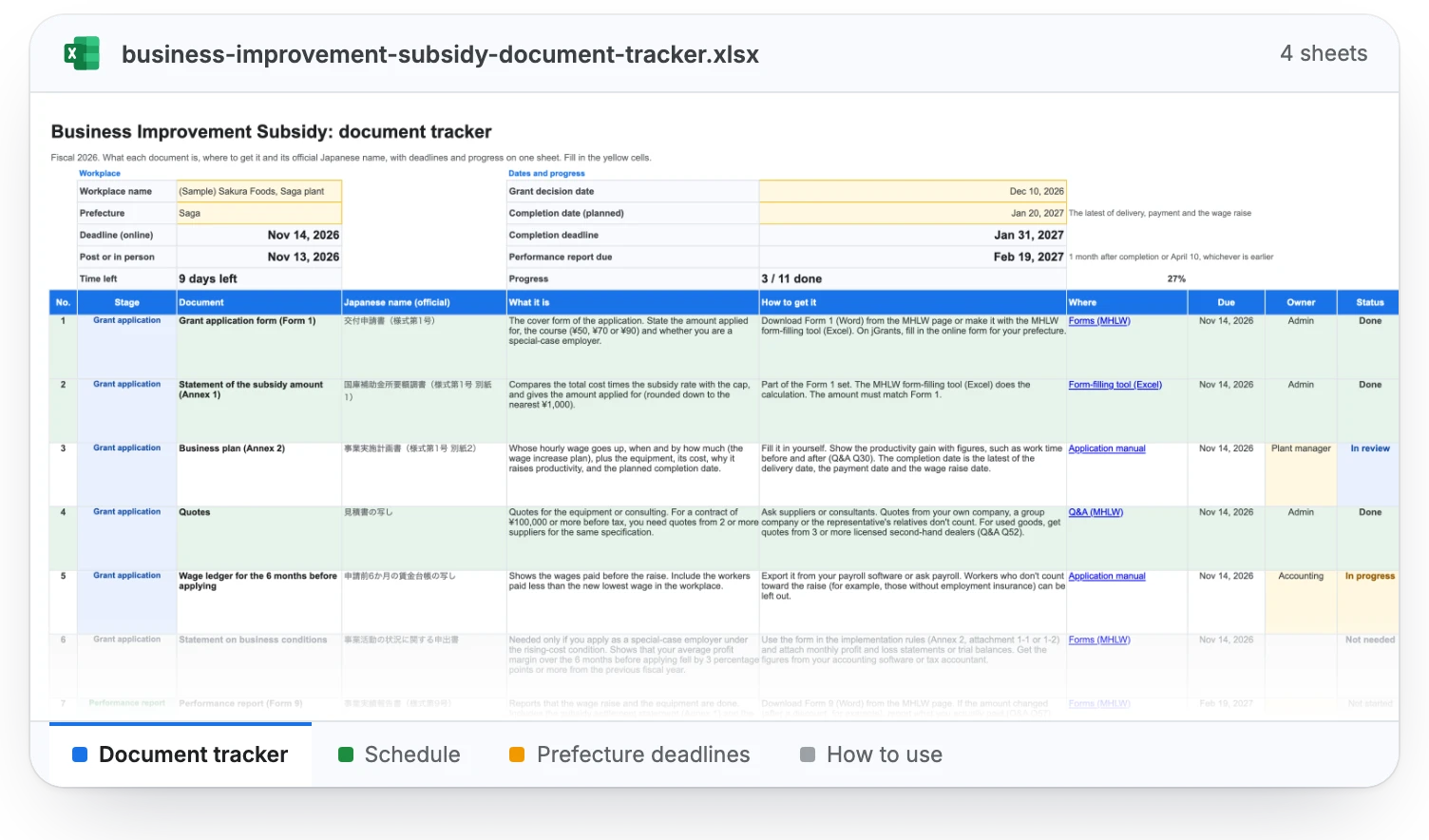
You can download the official forms (in Japanese) in Word from MHLW's page, along with an Excel tool that helps you fill them in. Applications on anything other than the official forms aren't accepted (application manual).
The Excel tracker shows what each document is, where to get it and its official name in Japanese, and lets you track who does what and how far along you are. Choose your prefecture to see the application deadline and the days left; enter the grant decision and completion dates to get the performance report deadline. You can also save the checklist as a PDF with your ticks.
Business Improvement Subsidy
Application document checklist
0 / 12 done
Grant application
Performance report
Items based on the grant application and performance report checklists in MHLW's Business Improvement Subsidy application manual (September 2026).
Pitfalls
Business Improvement Subsidy pitfalls: 8 ways to avoid losing the grant
One mistake in the order or the timing is enough to lose the subsidy. Check these 8 points before you apply.
Don't sign or take delivery before the grant decision
Always sign for and take delivery of equipment after the grant decision. You can get quotes before applying.
BasisQ&A Q27
Raise wages after applying, in one go
Raises made before applying, or on or after the minimum wage effective date, don't count. Raising in two steps isn't allowed either.
BasisQ&A Q15, Q18
Make the work rules take effect after applying
Write the new lowest wage into the work rules. A workplace with fewer than 10 workers makes an equivalent written document and attaches the workers' representative's opinion. An employment contract or written working conditions notice doesn't count.
BasisQ&A Q16, Q58
Don't dismiss anyone or cut pay
A dismissal, a push to resign or a cut in hourly pay disqualifies you if it falls between 6 months before you apply (counted from the day before) and the day before the performance report or 6 months after the raise, whichever is later. Shorter hours at a worker's own request are the exception.
BasisGrant guidelines, Art. 4; Q&A Q42
Pay by bank transfer, on time
Pay costs by bank transfer as a rule. Credit card charges must be debited from your account by January 31, and loans must be paid off. If the supplier pays the transfer fee, it counts as a discount.
BasisApplication manual; Q&A Q41, Q60
Don't stack subsidies on the same cost
You can't receive another national or local subsidy for the same equipment. Workers raised under the Business Improvement Subsidy can't be counted for the Career Up Subsidy (wage rule revision course).
BasisQ&A Q47
Check for corrective recommendations
A corrective recommendation from the Labour Standards Inspection Office disqualifies you if it falls between 1 year before you apply (counted from the day before) and the day before the performance report or 6 months after the raise, whichever is later.
BasisQ&A Q49
Don't dispose of the equipment without approval
To sell, lend or scrap it within the disposal restriction period (set for each type of equipment by an MHLW notice), you need the Prefectural Labour Bureau director's approval in advance. Without it, you may have to pay the subsidy back.
BasisQ&A Q62, Q63
You can write the clause that sets the lowest wage with the work rules template.
FAQ
Business Improvement Subsidy FAQ (Q&A)
What is the Business Improvement Subsidy, in simple terms?
A program in which the government later pays part of the equipment and other costs (up to ¥6 million) for an SME that raises its lowest hourly wage by ¥50 or more and brings in equipment that makes work more efficient. It pays for the equipment and similar costs, not for the wages themselves.
When is the deadline for the Business Improvement Subsidy?
In fiscal 2026, from September 1, 2026 until the day before the minimum wage takes effect in the workplace's prefecture or November 30, whichever comes first. As of November 5, 2026, only workplaces in Saga, Kyoto, Iwate, Kumamoto and Okinawa can still apply; the other prefectures have closed.
Can I apply after raising wages?
Not in fiscal 2026. In fiscal 2025, a company that had raised pay on or after September 5, 2025 and by the day before the minimum wage took effect could apply afterwards. In fiscal 2026, you must raise wages after applying, and the revised work rules must also take effect after the application.
Is the subsidy paid in advance?
No. The Business Improvement Subsidy is paid afterwards, with no advance payment. You pay for the equipment first, and the subsidy is transferred once the amount is fixed after the review of your performance report.
Can I buy PCs or tablets with the Business Improvement Subsidy?
Generally not. Special-case employers that meet the rising-cost condition (an average profit margin over the 6 months before applying 3 percentage points or more below the previous fiscal year) may be covered for new PCs, smartphones, tablets and peripherals that raise productivity. Replacing an existing PC isn't covered.
Are vehicles and trucks covered by the Business Improvement Subsidy?
Since fiscal 2026, vehicles are no longer covered, except special-purpose vehicles. What may qualify is, as a rule, a special-purpose vehicle whose plate class number starts with 8 (such as a pick-up vehicle with a lift), whose registered base of use is the applying workplace. Vehicle leases, loans and maintenance aren't covered.
Can a sole proprietor apply?
Yes. Employers without capital are judged as SMEs by the number of workers they regularly employ. You need at least one worker insured under employment insurance who has been employed for more than six months; a workplace with no workers isn't eligible.
Does raising part-time workers' pay count?
Yes. Workers raised must be insured under employment insurance, and part-time workers are, as a rule, insured if they work 20 hours or more a week and are expected to be employed for 31 days or more.
Can a company that used the Business Improvement Subsidy before apply again?
Yes. Each workplace can apply once a fiscal year. But if, after a past project ended, the workplace's pay fell below the lowest wage set under that grant, it isn't eligible.
Can I combine it with the Career Up Subsidy?
Yes, if they cover different costs. However, workers whose pay you raised under the Business Improvement Subsidy can't be counted as eligible workers for the Career Up Subsidy (wage rule revision course). You also can't stack a national or local subsidy on the same equipment.
Can I apply for the Business Improvement Subsidy online?
Yes, on jGrants. You need a gBizID account (Prime or Member), and since fiscal 2026 there is a separate application form for each prefecture. An online application must be completed by the last day of the application period.
What will the Business Improvement Subsidy look like in fiscal 2027?
In its fiscal 2027 budget request, MHLW asks for ¥54.3 billion (the fiscal 2026 initial budget was ¥2.1 billion) and plans to revise the subsidy-rate bands, raise the caps for some courses and lengthen the application period. The requirements and the application period are announced once the budget is set.
Where do I apply, and who can I ask?
You apply to the Employment Environment and Equal Employment Department (or Office) of the Prefectural Labour Bureau for your workplace. Questions about the program go to the Business Improvement Subsidy call center (0120-366-440, weekdays 9 am to 5 pm, in Japanese).
DIY Hiring Kit
Everything You Need To Hire On Your Own
A downloadable hiring framework for small businesses in Japan, with step-by-step guides, spreadsheet ATS, LinkedIn scouting system, interview questions bank, offer letter and employment contracts, and a ton more!
1Dashboard11Checklists8Spreadsheets30Template docs4Weeks of Q&ABilingual
- Download every file as Word, Google Docs, Excel or Google Sheets


 14 years in recruiting
Related resources
Related guides and templates
 Template
Japan minimum wage 2026 and notice
The minimum wage by prefecture, and a notice to post when it rises.
 Template
Work rules template
Write work rules that set the new lowest wage.
 Template
Compensation revision notice
Tell each worker in writing their new hourly wage and from when.
 Template
Salary increase notice
A notice and sample wording for an individual raise.
 Template
Part-time employment contract
Put a part-timer's hourly wage and conditions in a contract.
 Template
Permanent employment contract
The working conditions to state in writing when you hire.
Official sources
The main sources for this guide, all in Japanese. Other documents are linked where they're used.
- MHLWwww.mhlw.go.jp Business Improvement Subsidy Overview, where to apply, jGrants e-filing, call center.
- MHLWwww.mhlw.go.jp Guide to the fiscal 2026 Business Improvement Subsidy Caps for the ¥50, ¥70 and ¥90 courses, subsidy rates, eligible expenses, worked example.
- MHLWwww.mhlw.go.jp Business Improvement Subsidy grant guidelines (fiscal 2026) Eligible workplaces, caps, grounds for refusal, status and performance report deadlines.
- MHLWwww.mhlw.go.jp Business Improvement Subsidy Q&A (from September 2026) Eligible expenses, when to raise pay, how deadlines are counted, combining subsidies.
- MHLWwww.mhlw.go.jp Fiscal 2026 regional minimum wages Minimum wage and effective date by prefecture.
- MHLWwww.mhlw.go.jp Fiscal 2027 budget request, Employment Environment and Equal Employment Bureau ¥54.3 billion for the subsidy, revised rate bands and a longer application period.
Important. This page is general information based on the grant guidelines, implementation rules and MHLW materials as of November 5, 2026. The Prefectural Labour Bureau decides whether a grant is made and how much. Calculator results and the worked example are estimates.