Japan minimum wage 2026:the list by prefecture and when it rises(with a free notice template to post at work)
Japan minimum wage 2026 by prefecture, when it rises and how to check pay. Make the minimum wage notice with the free template and download as Word or PDF.
Emmanuel GendreFormer Google recruiter, HR and hiring advisor to SMBsLast updated 23 min read
Key takeaways
Japan's minimum wage for 2026 is a weighted national average of ¥1,177 an hour. The ¥56 rise is the second largest since the guideline system began in 1978; the highest is Tokyo at ¥1,280 and the lowest Miyazaki at ¥1,085.
Each new amount applies from its prefecture's effective date. As of November 2, 2026, five prefectures (Saga, Kyoto, Iwate, Kumamoto and Okinawa) are still on the previous amount.
Monthly-paid staff are covered too. In Tokyo, an employee with 125 days off a year and 8-hour days falls below the minimum wage if monthly pay, excluding fixed overtime pay and commuting allowance, is under ¥204,800.
Employers must inform staff of the minimum wage amount, who it covers, the wages not counted and the effective date, by posting it at work or by another method. Failing to do so can bring a fine of up to ¥300,000.
The government aims for a ¥1,500 national average "as early as possible, by the early 2030s at the latest". Reaching it by 2029 would take raises of over 8% a year.
2026 rates
Japan minimum wage 2026 by prefecture: ¥1,177 average, ¥1,280 in Tokyo
In short
The 2026 minimum wage in Japan is a weighted national average of ¥1,177 an hour, up ¥56 from ¥1,121 the year before. The highest is Tokyo at ¥1,280 and the lowest Miyazaki at ¥1,085, and all 47 prefectures rose by between ¥54 and ¥65.
The ¥56 rise is the second largest since the national guideline system began in 1978, after ¥66 in 2025. The lowest amount is 84.8% of the highest, a ratio that has improved for 12 years in a row (MHLW, fiscal 2026 minimum wage reports).
Japan minimum wage 2026 (per hour)
Regional minimum wages in the 47 prefectures
National average
¥1,177
Up ¥56 (5.0%) on 2025
Highest
¥1,280
Tokyo
Lowest
¥1,085
Miyazaki
Lowest as a share of highest84.8%
Amounts are per hour. Sources: MHLW, regional minimum wages for fiscal 2026 (national list) and fiscal 2026 minimum wage reports.
Japan minimum wage 2026 by prefecture, with the 2025 amount and the effective date
Prefecture
2026
2025
From
Hokkaido
¥1,131
¥1,075
Oct 1
Aomori
¥1,090
¥1,029
Oct 29
Iwate
¥1,090
¥1,031
Dec 1
Miyagi
¥1,098
¥1,038
Oct 1
Akita
¥1,090
¥1,031
Oct 14
Yamagata
¥1,092
¥1,032
Oct 30
Fukushima
¥1,094
¥1,033
Oct 16
Ibaraki
¥1,136
¥1,074
Oct 18
Tochigi
¥1,125
¥1,068
Oct 1
Gunma
¥1,120
¥1,063
Oct 3
Saitama
¥1,196
¥1,141
Oct 1
Chiba
¥1,195
¥1,140
Oct 1
Tokyo
¥1,280
¥1,226
Oct 1
Kanagawa
¥1,279
¥1,225
Oct 1
Niigata
¥1,108
¥1,050
Oct 1
Toyama
¥1,119
¥1,062
Oct 1
Ishikawa
¥1,113
¥1,054
Oct 3
Fukui
¥1,112
¥1,053
Oct 4
Yamanashi
¥1,113
¥1,052
Nov 1
Nagano
¥1,117
¥1,061
Oct 2
Gifu
¥1,121
¥1,065
Oct 1
Shizuoka
¥1,154
¥1,097
Oct 15
Aichi
¥1,195
¥1,140
Oct 1
Mie
¥1,143
¥1,087
Oct 1
Shiga
¥1,136
¥1,080
Oct 3
Kyoto
¥1,180
¥1,122
Nov 16
Osaka
¥1,231
¥1,177
Oct 1
Hyogo
¥1,172
¥1,116
Oct 1
Nara
¥1,107
¥1,051
Oct 4
Wakayama
¥1,101
¥1,045
Oct 3
Tottori
¥1,090
¥1,030
Oct 3
Shimane
¥1,092
¥1,033
Oct 10
Okayama
¥1,104
¥1,047
Oct 2
Hiroshima
¥1,141
¥1,085
Oct 11
Yamaguchi
¥1,101
¥1,043
Oct 8
Tokushima
¥1,103
¥1,046
Nov 1
Kagawa
¥1,092
¥1,036
Oct 1
Ehime
¥1,093
¥1,033
Nov 1
Kochi
¥1,086
¥1,023
Oct 29
Fukuoka
¥1,114
¥1,057
Oct 4
Saga
¥1,095
¥1,030
Nov 15
Nagasaki
¥1,087
¥1,031
Nov 2
Kumamoto
¥1,092
¥1,034
Dec 1
Oita
¥1,096
¥1,035
Nov 1
Miyazaki
¥1,085
¥1,023
Oct 24
Kagoshima
¥1,090
¥1,026
Oct 25
Okinawa
¥1,086
¥1,023
Dec 2
National average
¥1,177
¥1,121
Varies
Amounts are per hour. "2026" is the new minimum wage, "2025" the previous one and "From" the date the new amount takes effect (all dates in 2026). As of November 2, 2026, the new amounts for Saga (November 15), Kyoto (November 16), Iwate and Kumamoto (December 1) and Okinawa (December 2) are not yet in effect. Source: MHLW, regional minimum wages for fiscal 2026 (national list).
Highest and lowest minimum wages by prefecture (ranking)
The highest 2026 minimum wages are Tokyo at ¥1,280, Kanagawa ¥1,279, Osaka ¥1,231, Saitama ¥1,196, and Chiba and Aichi at ¥1,195. The lowest are Miyazaki at ¥1,085, Kochi and Okinawa at ¥1,086, and Nagasaki at ¥1,087. The largest raise was ¥65 in Saga, and the smallest ¥54 in Tokyo, Kanagawa and Osaka.
The national guideline put the prefectures in three ranks: rank A (6 prefectures including Tokyo) ¥54, and ranks B (28 prefectures) and C (13 prefectures) ¥56. Thirty-three prefectures went above the guideline, and the other 14 matched it (MHLW, Central Minimum Wages Council report).
Some industries have a higher industry minimum wage
Apart from each prefecture's regional minimum wage, some industries have their own specified (industry) minimum wage: there are 223, covering about 3.01 million workers (as of April 1, 2026). When both cover a worker, the higher amount applies (Minimum Wage Act, Article 6). For example, the Hokkaido steel industry minimum wage is ¥1,221 an hour from December 1, 2026, above the Hokkaido regional minimum wage of ¥1,131. Industry minimum wages do not cover people under 18 or 65 and over, or new hires still learning the job within a set period after hiring, among others.
Effective dates
When does Japan's minimum wage go up? October 1 to December 2 in 2026
Japan's minimum wage does not rise everywhere at once: it goes up on an effective date set for each prefecture. In 2026, 15 prefectures including Tokyo, Osaka and Aichi went up on October 1, and the last, Okinawa, goes up on December 2. Until the day before the effective date, the previous amount is the minimum wage.
The process for raising the minimum wage is the same every year. The national Central Minimum Wages Council sets a guideline for the raise in each rank, each prefecture's regional minimum wages council recommends a new amount based on local conditions, and after a period for objections, the director of the prefectural labour bureau decides it. The decision is published in the Official Gazette and takes effect on the day after 30 days have passed since publication, or on a later date the decision sets (Minimum Wage Act, Articles 10 and 14).
June 26, 2026: The Minister of Health, Labour and Welfare asks the Central Minimum Wages Council for a guideline
July 28: The Central Minimum Wages Council issues the guideline (rank A ¥54, ranks B and C ¥56)
August to September 3: The regional minimum wages councils of all 47 prefectures recommend the new amounts
September 1: Published in the Official Gazette for Tokyo, Hokkaido and others (effective October 1, after the 30-day period)
October 1 to December 2: Takes effect prefecture by prefecture
In 2025, the new amounts took effect in November or later in 27 prefectures, a majority, and the effective dates spread over nearly six months, from October 1, 2025 in Tochigi to March 31, 2026 in Akita. Central Minimum Wages Council materials of June 2026 noted that the effective date should not be used as excessive leverage to secure a large raise, and the 2026 effective dates all fall by December 2.
When will the next minimum wage (2027) be decided?
The 2027 amount has not been decided, and the MHLW gives no projected amount. The MHLW says national deliberations take place around June to July, regional ones around July to August, with the new amounts in effect from October onward. If 2027 follows the same pattern as 2026, the guideline will come in late July 2027 and each prefecture's amount in August to September, and the raises will take effect in turn from October.
[OPINION PLACEHOLDER OP3: For 2027, what raise (in yen or %) do you advise clients to plan their labor costs on, and why?]
Minimum wage notice template (to post at work, with a Japanese version)
Choose a prefecture, and its minimum wage and effective date go into the notice in the preview.
Edit mode is on. You can edit the preview text directly, and the PDF uses your edits. Changing an input resets that item to the input.
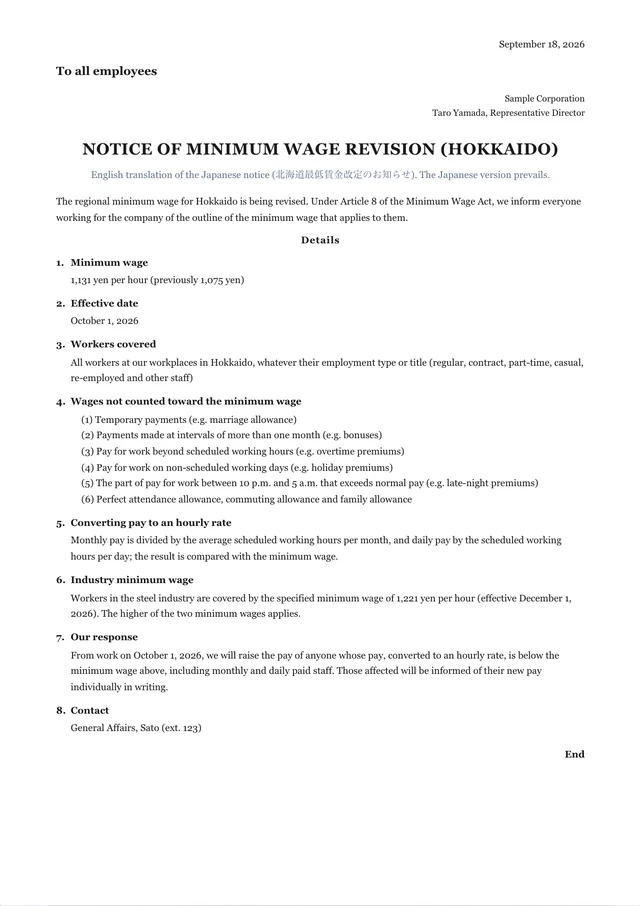
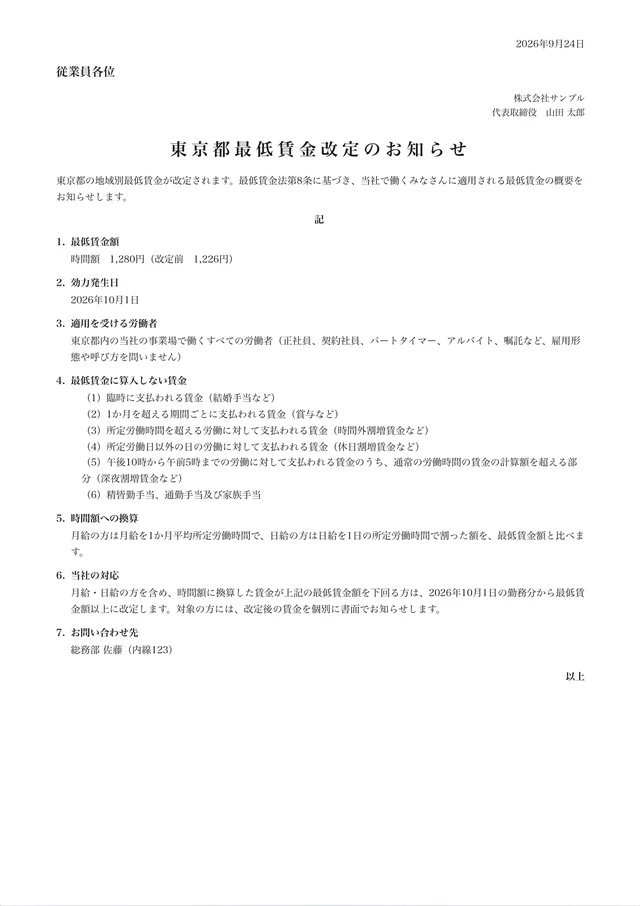
English translation of the Japanese notice (東京都最低賃金改定のお知らせ). The Japanese version prevails.
The regional minimum wage for Tokyo is being revised. Under Article 8 of the Minimum Wage Act, we inform everyone working for the company of the outline of the minimum wage that applies to them.
Details
Minimum wage1,280 yen per hour (previously 1,226 yen)
Effective dateOctober 1, 2026
Workers coveredAll workers at our workplaces in Tokyo, whatever their employment type or title (regular, contract, part-time, casual, re-employed and other staff)
Wages not counted toward the minimum wage(1) Temporary payments (e.g. marriage allowance)(2) Payments made at intervals of more than one month (e.g. bonuses)(3) Pay for work beyond scheduled working hours (e.g. overtime premiums)(4) Pay for work on non-scheduled working days (e.g. holiday premiums)(5) The part of pay for work between 10 p.m. and 5 a.m. that exceeds normal pay (e.g. late-night premiums)(6) Perfect attendance allowance, commuting allowance and family allowance
Converting pay to an hourly rateMonthly pay is divided by the average scheduled working hours per month, and daily pay by the scheduled working hours per day; the result is compared with the minimum wage.
Industry minimum wageWorkers in the (not entered) are covered by the specified minimum wage of (not entered) yen per hour (effective (not entered)). The higher of the two minimum wages applies.
Our responseFrom work on October 1, 2026, we will raise the pay of anyone whose pay, converted to an hourly rate, is below the minimum wage above, including monthly and daily paid staff. Those affected will be informed of their new pay individually in writing.
PDF, Word, check sheet and sample downloads ask for your email address.
Your inputs are processed in your browser, and the PDF is made on your device.
Change the prefecture to make the notice for anywhere in Japan.
Amounts and effective dates follow the MHLW national list of regional minimum wages for fiscal 2026.
Background
Why the minimum wage keeps rising: when will it reach ¥1,500?
Japan's minimum wage rises every year because wages and prices keep going up. By law, the minimum wage is set considering workers' cost of living and wages in the region and the ability of ordinary businesses to pay wages (Minimum Wage Act, Article 9(2)), and the cost of living is weighed against public assistance (welfare) levels so the two stay consistent (Article 9(3)).
In the 2026 deliberations, the average pay rise in the spring wage talks, as tallied by Rengo (the largest union federation), was 5.01%, over 5% for the third year running, and hourly pay for fixed-term and part-time workers in those talks rose 6.18%. The consumer price index (all items less imputed rent) rose 2.1% year on year on average from October 2025 to June 2026, and food prices 4.3% (Central Minimum Wages Council, public members' view). The report asks the government to help SMEs raise wages so that wage growth of about 1% a year above inflation takes hold. On the amount itself, however, the worker and employer sides did not agree, and the guideline was issued as the view of the public-interest members, the council's neutral side.
Japan minimum wage (weighted national average) from 2026 back to 2016: amount, raise and rate (newest first)
Year
Average
Rise
Rate
2026
¥1,177
¥56
5.0%
2025
¥1,121
¥66
6.3%
2024
¥1,055
¥51
5.1%
2023
¥1,004
¥43
4.5%
2022
¥961
¥31
3.3%
2021
¥930
¥28
3.1%
2020
¥902
¥1
0.1%
2019
¥901
¥27
3.1%
2018
¥874
¥26
3.1%
2017
¥848
¥25
3.0%
2016
¥823
¥25
3.1%
The average is the weighted national average. The 2016 and 2023 figures include ¥1 from updating the worker counts used in the calculation. Sources: MHLW, Central Minimum Wages Council reference materials; regional minimum wages for fiscal 2026 (national list).
Since 2016, the raise has been ¥25 or more every year except 2020 (¥1), and since 2023 the raises have been ¥43, ¥51, ¥66 and ¥56, all over ¥40.
When will it reach ¥1,500? How the government target changed
The government's target in its June 2024 action plan was "¥1,500 by the mid-2030s". In October 2024, then Prime Minister Ishiba brought it forward to "a national average of ¥1,500 in the 2020s", and it went into the government's 2025 Basic Policy on Economic and Fiscal Management. The Japan Growth Strategy approved by the Cabinet on July 21, 2026 keeps that aim but adds a deadline: reach a ¥1,500 national average "as early as possible, by the early 2030s at the latest". The press reported this as a de facto postponement of the target (Kyodo News, September 3, 2026).
From ¥1,177 to ¥1,500 is ¥323. Reaching it within the 2020s (by 2029) would take raises of about 8.4% a year over the three remaining revisions; by 2030, about 6.3% a year over four.
How to check
Checking hourly pay against the minimum wage: convert monthly and daily pay to an hourly rate
Compare hourly pay as it is, and monthly or daily pay converted to an hourly rate, with the minimum wage of the prefecture where the workplace is. Only basic pay paid every month counts: overtime pay, bonuses, commuting allowance and the like are left out.
Minimum wage violations are not rare. Of the 20,685 workplaces Labour Standards Inspection Offices inspected from January to March 2026, 2,063 (10.0%) were not paying the minimum wage. In a 2025 survey of businesses with fewer than 30 employees (fewer than 100 in manufacturing and some other industries), 27.7% of workers were paid below the new minimum wage before it took effect (the impact rate) (MHLW, Central Minimum Wages Council materials).
How to compare each pay type with the minimum wage
Pay type
How to compare with the minimum wage
Hourly
Hourly wage ≥ minimum wage
Daily
Daily wage ÷ scheduled hours per day ≥ minimum wage
Monthly
Monthly wage ÷ average scheduled hours per month ≥ minimum wage
Piece rate
Total piece-rate pay ÷ total hours worked in the period ≥ minimum wage
Combined
Each part converted to an hourly rate, then added up ≥ minimum wage
Daily pay with scheduled hours that vary by day is divided by the average daily hours over a week, and monthly pay with hours that vary by month by the average monthly hours over a year (Minimum Wage Act Enforcement Regulations, Article 2). Source: MHLW, "How to check that pay is at or above the minimum wage".
Six kinds of pay not counted toward the minimum wage
Temporary payments (e.g. marriage allowance)
Payments made at intervals of more than one month (e.g. bonuses)
Pay for work beyond scheduled working hours (e.g. overtime premiums)
Pay for work on non-scheduled working days (e.g. holiday premiums)
The part of pay for work between 10 p.m. and 5 a.m. that exceeds normal pay (e.g. late-night premiums)
Perfect attendance allowance, commuting allowance and family allowance
Items (1) to (5) are excluded by the Minimum Wage Act and its Enforcement Regulations, and item (6), perfect attendance, commuting and family allowances, by each prefecture's minimum wage decision (Minimum Wage Act, Article 4(3); Enforcement Regulations, Article 1; Tokyo Labour Bureau, September 1, 2026). For late-night work, only the premium part (the late-night allowance) is left out, and the normal hourly pay part counts. Allowances paid every month in a fixed amount, such as a job allowance, also count.
Examples: hourly, daily and monthly pay in Tokyo (¥1,280)
Example 1, hourly: A part-timer on ¥1,250 an hour is ¥30 below Tokyo's ¥1,280. From work on October 1, 2026, the hourly wage must go up to ¥1,280 or more.
Example 2, daily: Daily pay of ¥9,600 with 8 scheduled hours a day comes to ¥9,600 ÷ 8 hours = ¥1,200, ¥80 short. Daily pay must go up to ¥10,240 (¥1,280 × 8 hours) or more.
Example 3, monthly: An employee has base pay of ¥185,000, a job allowance of ¥15,000, a commuting allowance of ¥12,000 and fixed overtime pay of ¥31,500 (for 20 hours), with 125 days off a year and 8-hour days. Average scheduled hours per month are (365 days − 125 days) × 8 hours ÷ 12 months = 160 hours. Only the ¥200,000 of base pay and job allowance counts: ¥200,000 ÷ 160 hours = ¥1,250, ¥30 short. Base pay plus job allowance must go up to ¥204,800 (¥1,280 × 160 hours) or more.
Monthly-paid staff are covered too, and fixed overtime pay does not count
For an employee working 40 hours a week (8 hours a day, 5 days a week), average scheduled hours are at most about 173.8 a month (40 hours × 365 days ÷ 7 days ÷ 12 months). The monthly pay that meets the minimum wage in that case (base pay plus the allowances that count) is ¥222,476 in Tokyo, ¥204,574 at the ¥1,177 national average, and ¥188,583 even in Miyazaki, the lowest.
Fixed overtime pay is pay for work beyond scheduled hours, so it is not part of the amount compared with the minimum wage. A job posting may show ¥250,000 a month, but if ¥60,000 of it is fixed overtime pay, the amount compared is ¥190,000. At a company with 125 days off a year, as in Example 3, that is ¥190,000 ÷ 160 hours = ¥1,187.5, below Tokyo's ¥1,280.
Raising base pay also raises the overtime rate. If Example 3's base pay plus job allowance goes up to ¥204,800, the overtime rate is ¥1,280 × 1.25 = ¥1,600, and 20 hours come to ¥32,000. The fixed overtime pay of ¥31,500 was enough before the raise (¥1,250 × 1.25 × 20 hours = ¥31,250) but is ¥500 short after it, so review the fixed overtime amount as well (Labor Standards Act, Article 37).
[OPINION PLACEHOLDER OP2: Have you seen monthly-paid staff (including job postings with fixed overtime pay) fall below the minimum wage? In which roles and pay structures, and how often?]
Pay periods that straddle the effective date
Even when the effective date falls in the middle of a pay period, work from the effective date on must be paid at least the new minimum wage. The raise cannot wait until the next month's pay (MHLW minimum wage website). For example, at a company in Kyoto (¥1,180 from November 16) whose pay period ends at the end of the month, work from November 1 to 15 must be paid at least ¥1,122, and from November 16 to 30 at least ¥1,180.
Which prefecture's minimum wage applies: workplace, dispatch and telework
What counts is the prefecture where the workplace is, not where the employee lives. Dispatched workers are covered by the minimum wage of the client's workplace, not the dispatch agency's (Minimum Wage Act, Article 13), and teleworkers by that of the prefecture where their assigned workplace is, wherever they actually work (MHLW telework portal).
Steps
What employers do when the minimum wage rises: 5 steps before the effective date
When the minimum wage rises, employers do two things: raise any pay below it and inform staff of the minimum wage. Work through these steps in order by the day before the effective date.
Check the prefecture and effective date for each workplace
For each workplace, check the new amount and effective date in the list above. If your industry has an industry minimum wage, use the higher of the two.
Convert everyone's pay to an hourly rate and find who falls below
Check hourly pay as it is, and convert monthly and daily pay to an hourly rate. Staff on probation or in training are covered too.
Raise the pay of anyone below it, and tell them in writing
From work on the effective date, raise the pay of anyone below the minimum wage to at least the new amount. Tell each person their new hourly wage with an hourly wage revision notice (compensation revision notice). The law does not require raising the pay of anyone already above the minimum wage.
[OPINION PLACEHOLDER OP1: When the minimum wage rises, do more companies raise only the staff below it, or the staff just above it as well? What do you advise clients about pay reversals and narrowing gaps?]
Post the minimum wage outline and inform staff
Make a notice with the items the law requires using the template above, then post it where staff can easily see it at work or hand it to everyone (Minimum Wage Act, Article 8).
Update employment contracts, wage rules and job postings
[OPINION PLACEHOLDER OP4: After a minimum wage rise, how far above the minimum wage do you advise setting the hourly pay in part-time job postings? Have you seen postings at exactly the minimum wage fail to attract applicants?]
Minimum wage notice vs. hourly wage revision notice
Documents used for a minimum wage revision, who gets them and what they say
Document
Given to
What it says
Minimum wage notice
Everyone (posted or handed out)
The minimum wage amount, who it covers, the wages not counted, the effective date
Hourly wage revision notice
Staff whose pay goes up
Their hourly wage before and after, and the date it applies from
Employment contract or labor conditions notice
New hires
An hourly wage at or above the minimum wage
What to write
What to include in a minimum wage notice, with a sample
A minimum wage notice must include the three items set by Article 6 of the Minimum Wage Act Enforcement Regulations: the workers covered and the minimum wage amount, the wages not counted, and the effective date.
Items in a minimum wage notice, what to write and the legal basis
Item
What to write
Legal basis
1Title
The prefecture in the title, e.g. "Notice of minimum wage revision (Tokyo)"
Not required
2Date and addressee
The date it is posted or handed out, and "To all employees"
Not required
3Company and issuer
The company name, and the representative or HR manager
Not required
4Minimum wage
The hourly amount (the previous amount is optional)
Article 6(i)
5Effective date
The prefecture's effective date
Article 6(iii)
6Workers covered
Every worker at the workplace
Article 6(i)
7Wages not counted
Six kinds (including perfect attendance, commuting and family allowances)
Article 6(ii)
8Converting to an hourly rate
How monthly and daily pay are compared (optional)
Article 2
9Industry minimum wage
If one covers your industry, its amount and effective date
Article 6(i)
10Our response and contact
Raising pay below the minimum wage, and who to ask
Not required
Article numbers refer to the Minimum Wage Act Enforcement Regulations. The law only requires the wages that each minimum wage decision excludes (perfect attendance, commuting and family allowances), but the template lists all six to avoid misunderstandings.
Where and how to post it
If you post it, put it "where it is always easy to see at the workplace", such as a break room or a notice board by the entrance. Besides posting, the law also allows "other methods", so handing everyone a copy or putting it on an internal system staff can open at any time also works (Minimum Wage Act, Article 8). For staff who read English, post the template's English version next to the Japanese one. The MHLW also publishes leaflets on each prefecture's minimum wage in 14 languages, including English, Chinese and Vietnamese, free to print.
The MHLW poster for each prefecture (the 2026 Tokyo version, for example) mainly shows the amount and effective date and does not list the wages not counted. If you post the poster, inform staff of the wages not counted separately so that every item in Article 6 of the Enforcement Regulations is covered.
Sample notice and Word version
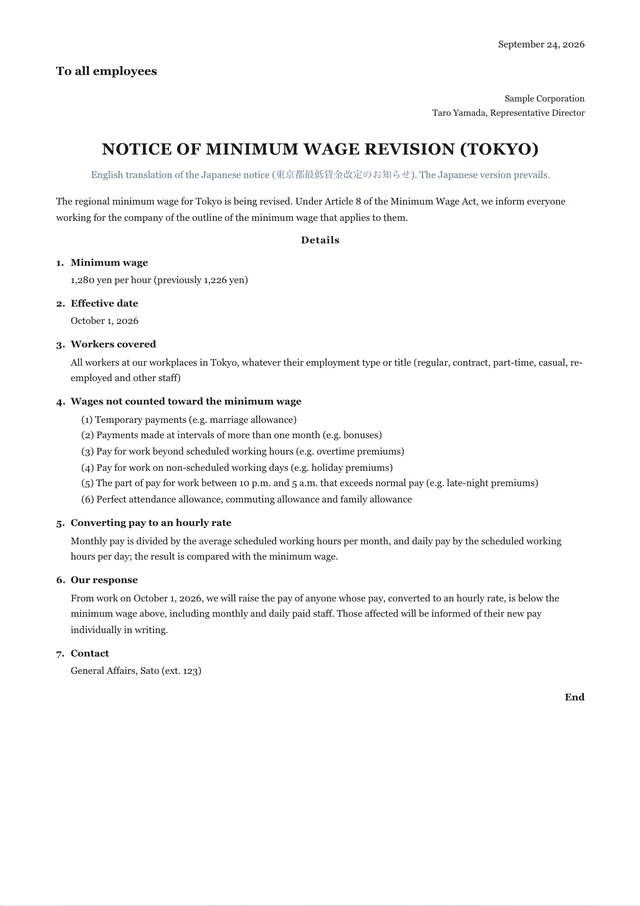
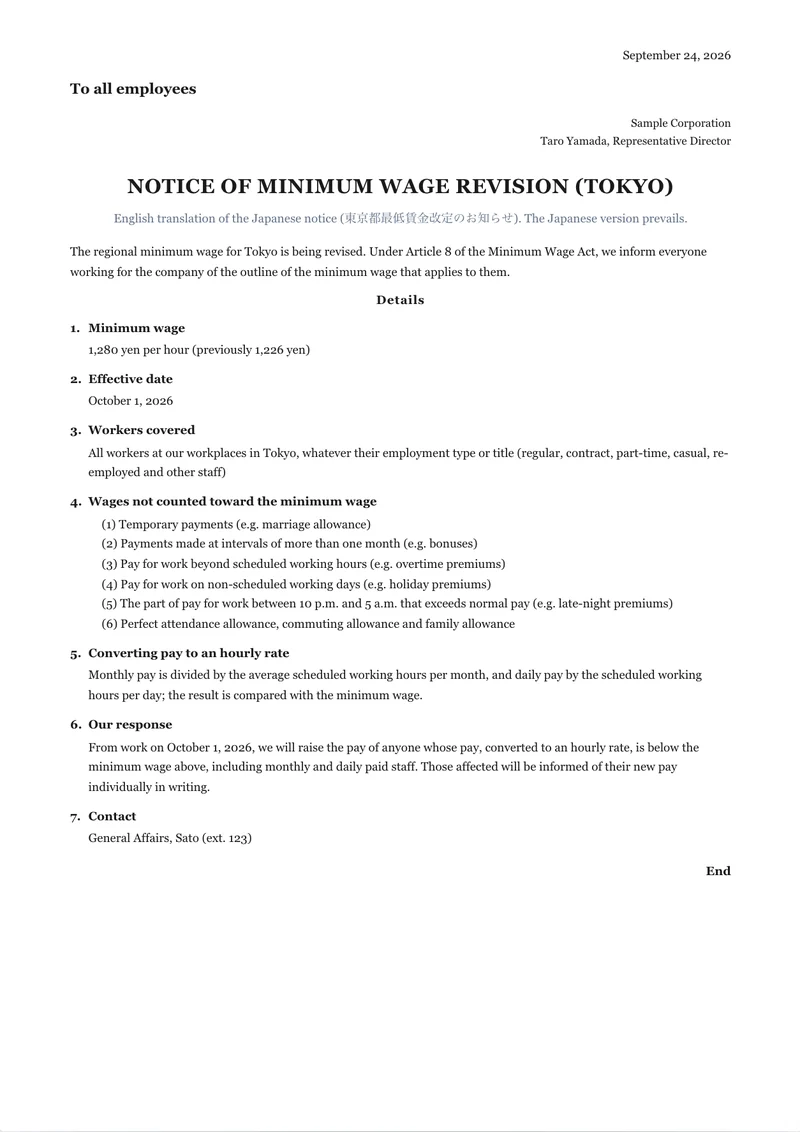
Below is a sample minimum wage notice made with the template above, with Tokyo's minimum wage and the company's response. The sample PDF and the Word template download after you enter your email address. In the Word version, replace the parts in [ ] brackets. To compare each employee's hourly or monthly pay with the minimum wage, enter the pay type and amount in the Excel minimum wage check sheet: it shows the hourly rate and any shortfall.
Sample minimum wage revision notice (Tokyo, effective October 1, 2026, with the company's response). The minimum wage, effective date, workers covered and wages not counted go under Details.
Support
Easing the cost of a minimum wage increase: the Business Improvement Subsidy and wage increase tax credit
SMEs that raise the lowest hourly wage in a workplace by ¥50 or more and invest in equipment or similar to raise productivity can recover part of the cost (up to ¥6 million) through the Business Improvement Subsidy. For fiscal 2026, you must apply before raising wages.
Business Improvement Subsidy (fiscal 2026): requirements
Requirements of the fiscal 2026 Business Improvement Subsidy
Item
Fiscal 2026
Eligible workplaces
Lowest wage in the workplace at or above the fiscal 2025 minimum wage and below the fiscal 2026 one
Raise
Three courses: ¥50, ¥70 or ¥90
Subsidy rate
4/5 (lowest wage under ¥1,050 before the raise), 3/4 (¥1,050 or more)
Maximum
¥300,000 to ¥6 million
Application period
From September 1, 2026 to the day before the effective date or November 30, whichever is earlier
When to raise pay
After applying, by the day before the effective date
Who gets the raise
Employment insurance members working 20 hours or more a week
Other
Raise pay in one step and set it in the work rules or similar
The maximum depends on the course and the number of workers whose pay is raised. The lowest wage in the workplace is the lowest hourly pay among workers employed for more than six months. Equipment and other spending must be ¥100,000 or more. Sources: MHLW, guide to the fiscal 2026 Business Improvement Subsidy and the grant guidelines.
As of November 2, 2026, only workplaces where the new minimum wage is not yet in effect can still apply in time: Saga (until November 14), Kyoto (until November 15), and Iwate, Kumamoto and Okinawa (until November 30). In fiscal 2025, a company that had raised wages by the day before the revision could apply afterwards; in fiscal 2026, no application is accepted after the raise.
[OPINION PLACEHOLDER OP5: Have any clients used the Business Improvement Subsidy? What did they use it for, and how long did it take from application to payment? Which companies do you recommend it to, and which not?]
Wage increase tax credit (for SMEs)
SMEs that file blue-form tax returns can deduct from corporate tax 15% of the increase if total salaries paid to all employees rise 1.5% or more on the previous year, or 30% if they rise 2.5% or more. With a 5% add-on for measures such as support for balancing work and childcare, the credit reaches up to 35%; it is capped at 20% of corporate tax, and any unused amount can be carried forward for five years. For business years starting on or after April 1, 2026, the add-on for training costs no longer applies (National Tax Agency).
The MHLW and the Small and Medium Enterprise Agency list other support too, such as the Career Up Subsidy, which can cover revising wage rules in line with the minimum wage revision, and the labor-saving investment subsidy, which raises the subsidy rate to 2/3 for businesses with many workers near the minimum wage.
Legal basis
Legal background and constraints
The minimum wage is the lowest pay set under the Minimum Wage Act, and no contract can lower it. Check these five points before setting pay.
Pay below the minimum wage is void: the difference and penalties (Minimum Wage Act, Articles 4 and 40)
Employers must pay at least the minimum wage. Even in a contract the employee agreed to, the part below the minimum wage is void and treated as set at the minimum wage (Minimum Wage Act, Article 4(1) and (2)). If you paid a lower amount without noticing the revision, you must still pay the difference promptly. Not paying the regional minimum wage can bring a fine of up to ¥500,000 (Article 40), and the company can be punished as well as the person responsible (Article 42).
The duty to inform staff and the penalty (Minimum Wage Act, Articles 8 and 41)
Employers covered by a minimum wage must inform workers of its outline, by posting it where it is always easy to see at the workplace or by other methods (Minimum Wage Act, Article 8). The items are those in "What to include" above (Enforcement Regulations, Article 6). Failing to do so for the regional minimum wage can bring a fine of up to ¥300,000 (Article 41).
Reduction exception: no lower pay on probation without a permit (Minimum Wage Act, Article 7)
Pay can go below the minimum wage only with a permit from the director of the prefectural labour bureau, and only for these five groups:
Workers whose ability to work is markedly low because of a mental or physical disability
Workers on probation
Workers in accredited vocational training to learn basic skills
Workers doing light work
Workers doing intermittent work
Two copies of the permit application go to the prefectural labour bureau director through the director of the Labour Standards Inspection Office. For workers on probation, the reduction is 20% at most (Enforcement Regulations, Article 5).
Applies whatever the employment type, nationality or age
The regional minimum wage applies to everyone working at a workplace in the prefecture, whatever their employment type or title: regular, contract, part-time, casual, temporary or re-employed. The Tokyo Labour Bureau states that it applies regardless of gender, nationality or age. Paying foreign workers at least the minimum wage is also an employer duty under the guidelines on employment management for foreign workers. Specified Skilled Workers must also be paid at least as much as Japanese staff in the same job. It does not apply to people working in a business that employs only relatives living together, or to domestic workers.
The minimum wage, social insurance and dependent status
Rising minimum wages also affect social insurance for part-timers. The "¥88,000 or more a month" wage requirement for short-time workers to join employee health insurance and pension was removed on October 1, 2026, since the minimum wage had reached ¥1,016 or more in every prefecture. Since April 1, 2026, whether someone stays under the ¥1.3 million annual income limit for health insurance dependent status is judged from the annual income expected from the wages set in the employment contract. The part-time employment contract page explains the conditions for short-time workers to join social insurance.
FAQ
Japan minimum wage 2026: frequently asked questions
What is the 2026 minimum wage for part-time workers in Japan?
Part-time workers are covered by the same prefectural minimum wage as full-time staff. For 2026 the weighted national average is ¥1,177; Tokyo is ¥1,280, Osaka ¥1,231, and the lowest, Miyazaki, ¥1,085. The amount for each prefecture is in the full list.
What minimum wage takes effect in October 2026?
Fifteen prefectures went up on October 1. They include Tokyo at ¥1,280, Kanagawa ¥1,279, Osaka ¥1,231, Saitama ¥1,196, and Chiba and Aichi at ¥1,195. In all, 37 prefectures rise in October, 7 in November and 3 in December.
Does part-time hourly pay go up in October?
Only hourly pay below the new minimum wage goes up, to at least the minimum wage, from work on the effective date. There is no legal duty to raise hourly pay that is already above the minimum wage; that is the company's decision.
What is the lowest minimum wage in Japan?
The lowest for 2026 is Miyazaki at ¥1,085. Until the day before each effective date, though, the previous amount is the minimum wage, so on November 2, 2026 the lowest amount actually in force is Okinawa's ¥1,023 (until December 1).
Which prefecture's minimum wage applies?
The minimum wage of the prefecture where the workplace is applies. Dispatched workers are covered by that of the client's workplace, teleworkers by that of their assigned workplace wherever they actually work, and if an industry minimum wage applies, the higher amount applies.
Is paying part-timers below the minimum wage illegal?
Yes. Even in a contract the employee agreed to, the part below the minimum wage is void, and the company must pay the difference. Not paying can bring a fine of up to ¥500,000. Workers can raise it with the company first and, if that does not resolve it, consult the nearest Labour Standards Inspection Office.
When will Japan's minimum wage reach ¥1,500?
No date is set. In its Japan Growth Strategy of July 2026, the government kept the aim of a ¥1,500 national average in the 2020s but said it would reach it "as early as possible, by the early 2030s at the latest". The section on the ¥1,500 target explains how the aim changed.
What is the next minimum wage expected to be?
There is no official forecast for 2027. In a usual year, the national guideline comes out in late July and each prefecture's amount is recommended from August to September. Until the guideline is out, the amount is not known for sure.
When was the 2026 minimum wage decided?
The national guideline was issued on July 28, 2026, and the new amounts for all 47 prefectures were recommended by September 3. After the prefectural labour bureau directors decided them and they were published in the Official Gazette, they took effect in turn from October 1 to December 2.
Why is Japan's minimum wage rising?
Because wages and prices keep rising. By law, the minimum wage is set considering workers' cost of living and wages in the region and the ability of ordinary businesses to pay (Minimum Wage Act, Article 9(2)). The 2026 deliberations took into account the 5.01% average pay rise in the spring wage talks (as tallied by Rengo, the largest union federation) and food prices rising 4.3% on average.
Does the minimum wage apply during probation or training?
Yes. Pay for someone on probation can go below the minimum wage only with a reduction permit from the prefectural labour bureau director, and by 20% at most. Pay during training must also be at or above the minimum wage.
Do employers have to post the minimum wage?
The duty is to inform staff of the minimum wage; posting it is one way to do that. Employers must tell staff the minimum wage amount, who it covers, the wages not counted and the effective date, for example by posting it where staff can easily see it at work, and failing to do so for the regional minimum wage can bring a fine of up to ¥300,000. The MHLW poster mainly shows the amount and effective date and does not list the wages not counted. The template on this page puts every required item on one notice to post.
What is the minimum wage in Tokyo?
¥1,280 an hour from October 1, 2026 (up ¥54 from ¥1,226). It is the highest in Japan, ¥1 above second-place Kanagawa at ¥1,279.
Does the minimum wage go up every year?
It is reviewed every year and, since 2016, has gone up by ¥25 or more every year except 2020 (¥1). Since 2023 the raises have been ¥43, ¥51, ¥66 and ¥56, each over ¥40.
DIY Hiring Kit
Everything You Need To Hire On Your Own
A downloadable hiring framework for small businesses in Japan, with step-by-step guides, spreadsheet ATS, LinkedIn scouting system, interview questions bank, offer letter and employment contracts, and a ton more!
1Dashboard11Checklists8Spreadsheets30Template docs4Weeks of Q&ABilingual
Download every file as Word, Google Docs, Excel or Google Sheets
Founder, SaiyouTeam · HR and recruiting advisor to SMBs in Japan
Former Google recruiter
14 years in recruiting
Emmanuel advises SMBs on HR and recruiting in Japan. Before founding SaiyouTeam, he spent 14 years in talent acquisition, including as a recruiter at Google. He built this free template so that, each autumn when the minimum wage changes, companies can make the notice for their workplace just by choosing a prefecture, in English and Japanese.
Important. This template and guide are general information, not a substitute for professional advice. Minimum wage amounts, laws and official guidance as of November 2, 2026.




 14 years in recruiting