Muki tenkan application:Japan's 5-year rule and how to apply(free template and sample)
Muki tenkan, Japan's 5-year rule, lets fixed-term staff past five years in total switch to an indefinite contract. Make the application with the free template and download as Word or PDF.
APPLICATION FOR CONVERSION TO AN INDEFINITE-TERM EMPLOYMENT CONTRACT
English translation of the Japanese application (無期労働契約転換申込書). The Japanese version prevails.
Sample Corporation
Hanako Yamada, Representative Director
Date: November 4, 2026
Department: Sales Section 2, Sales Department
Employee No.: 1024
Name: Misaki Suzuki (seal)
Phone: 090-1234-5678
Email: misaki.suzuki@example.com
As the total term of my fixed-term employment contracts will exceed five years by the last day of my current contract, I hereby apply, under Article 18, Paragraph 1 of the Labor Contract Act, for conversion to an employment contract without a fixed term (an indefinite-term employment contract).
Details
Current contract termApril 1, 2026 to March 31, 2027
Total contract termApril 1, 2021 to March 31, 2027 (6 years 0 months)
Start date of the indefinite-term contractApril 1, 2027
NotesPlease explain my working conditions after the conversion in writing.
End
(For company use)
Received on: ____________
Received by: ______________ (seal)
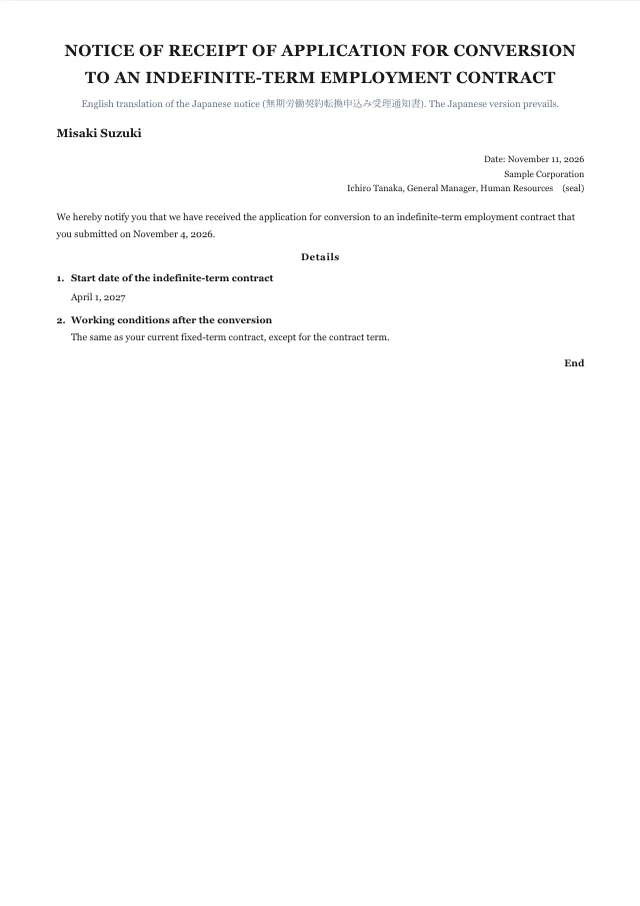
NOTICE OF RECEIPT OF APPLICATION FOR CONVERSION TO AN INDEFINITE-TERM EMPLOYMENT CONTRACT
English translation of the Japanese notice (無期労働契約転換申込み受理通知書). The Japanese version prevails.
Misaki Suzuki
Date: November 11, 2026
Sample Corporation
Ichiro Tanaka, General Manager, Human Resources (seal)
We hereby notify you that we have received the application for conversion to an indefinite-term employment contract that you submitted on November 4, 2026.
Details
Start date of the indefinite-term contractApril 1, 2027
Working conditions after the conversionThe same as your current fixed-term contract, except for the contract term.
PDF, Word, Excel and sample downloads ask for your email address.
Your inputs are processed in your browser, and the PDF is made on your device.
Based on the MHLW reference form (sample application and notice of receipt for conversion to an indefinite-term contract).
Basics
What is muki tenkan? How Japan's 5-year rule works, and who it covers
Key points
Muki tenkan is the rule that turns a fixed-term contract into an indefinite one (a contract with no end date) when the employee applies after their contracts with the same company pass five years in total through renewals (Labor Contract Act, Article 18). The company cannot refuse the application.
The rule began with the amended Labor Contract Act on April 1, 2013. The total is counted from fixed-term contracts that began on or after April 1, 2013. Contract employees, part-time and arubaito workers, and dispatched workers (under their contract with the dispatching agency) are all covered, whatever they are called, as long as they have a fixed-term contract with the same company. Applying is the employee's right; an employee who does not apply stays on a fixed-term contract.
Counting the five years: the contract in which the right arises
The right to apply arises on the first day of the renewed contract that takes the total past five years by its end date. Here is an example for someone who started on April 1, 2021.
By contract length: the contract in which the right arises, the application window and the start of the indefinite contract
Contract length
Contract that creates the right
Application window
Indefinite contract starts
1-year contracts
6th contract (April 1, 2026 to March 31, 2027)
April 1, 2026 to March 31, 2027
April 1, 2027
3-year contracts
2nd contract (April 1, 2024 to March 31, 2027)
April 1, 2024 to March 31, 2027
April 1, 2027
With 3-year contracts, the first renewal takes the total to six years by its end date, so the employee can apply from the fourth year. A single contract is limited to three years in principle (Labor Standards Act, Article 14). Sources: MHLW, Muki Tenkan Rule (labor contract seminar); Labor Contract Act, Article 18(1).
Gaps between contracts (cooling-off)
A gap with no contract between two contracts resets the count when it is long enough: the contracts before the gap no longer count. This is called cooling-off, and the gap needed depends on the total before it.
Total contract term before the gap, and the gap that resets the count
Total term before the gap
Gap that resets the count
1 year or more
6 months or more
2 months or less
1 month or more
Over 2, up to 4 months
2 months or more
Over 4, up to 6 months
3 months or more
Over 6, up to 8 months
4 months or more
Over 8, up to 10 months
5 months or more
Over 10 months (under 1 year)
6 months or more
A gap shorter than the one in the table does not reset the count: the contracts on both sides are added up. Sources: MHLW, Muki Tenkan Portal for Fixed-Term Workers, Q&A; Labor Contract Act, Article 18(2).
How long fixed-term workers have been on contract with their current company
MHLW, 2021 Survey on Fixed-Term Labor Contracts (individual survey)
Over 1 to 3 years
30.7%
Over 3 to 5 years
17.7%
Over 5 to 10 years
17.6%
Over 10 years
20.6%
Workers past five years make up 38.2%, and the Ministry of Health, Labour and Welfare (MHLW) concludes that about 40% of fixed-term workers need a muki tenkan response. The rest are at 1 year or less, or unknown.
Documents
Which documents does muki tenkan use? Application, notice of receipt and labor conditions notice
Besides the application the employee hands in and the notice of receipt the company hands back, muki tenkan also involves the labor conditions notice issued at the renewal that creates the right, and the work rules. Here is what each one does.
The documents used for muki tenkan, who issues them, and their role
Document
From, to
Role
Muki tenkan application
Employee to company
Applies for conversion to an indefinite contract. No form is set by law, and an oral application also counts
Notice of receipt
Company to employee
Confirms the application was received and gives the start date of the indefinite contract
Labor conditions notice (at renewal)
Company to employee
At each renewal that creates the right, states that the employee can apply and the conditions after conversion Labor Standards Act Enforcement Regulations, Article 5
Work rules
Company (shown to all staff)
Set the category of converted employees, their retirement age and the application procedure
The statement at renewal goes in the labor conditions notice or the fixed-term employment contract. The retirement age and category of converted employees go in the work rules.
Who prepares the muki tenkan application?
No form is set by law for the application. A letter the employee writes and a form the company hands out are both valid. The MHLW publishes a reference form (a sample application and notice of receipt), and its model work rules include a clause saying the application is made on a form the company sets separately. Even when the company sets a form, it cannot refuse conversion because the application was made orally. This template follows the wording of the MHLW reference form, and with "Leave the employee's fields blank" on, it prints as a form the company hands to employees.
When to use it
When can an employee apply? The application window and the steps
An employee can apply any day from the first to the last day of the contract that takes the total past five years. The indefinite contract starts the day after the contract in which they applied ends.
When the company states in writing, at the renewal that creates the right, that the employee can apply
When the end of the contract is near and the employee wants to keep working without the worry of non-renewal
After renewing without applying (the employee can also apply during the next contract)
When the company's work rules set an application deadline (an application made after that deadline still counts if it is made by the contract end date)
From checking the total to the first day on the indefinite contract, there are five steps.
Check the total contract term
Add up the contracts that began on or after April 1, 2013, and check that the total passes five years by the end of the current contract. Contracts before a gap of 6 months or more, for example, are not counted.
Write the date, addressee and contract dates
Address it to the company's representative. Write the current contract term and the start date of the indefinite contract (the day after the current contract ends).
Hand it in by the end date and keep a copy
Hand it to HR or a manager, and keep a copy. An oral application also counts, but a written one can be checked later.
The company hands back a notice of receipt
The company cannot refuse, and is deemed to accept the moment the employee applies. The notice of receipt confirms the application and gives the start date of the indefinite contract.
Check the terms after conversion in writing
Check the work rules and working conditions that apply after conversion, in the labor conditions notice or a similar document. Unless other terms are set, everything except the contract term stays the same.
What to write
How to fill in the muki tenkan application: items and a sample
Filling in the muki tenkan application comes down to these seven items, based on the MHLW reference form and the Fukuoka Labor Bureau's filled-in sample. The right-hand column is this template's field.
This template's field
Items on the muki tenkan application, what to write, and the template field
Item
What to write
This templateTemplate field
Title
Muki rodo keiyaku tenkan moshikomisho (application for conversion to an indefinite-term contract), the title on the MHLW reference form, or a shorter in-house title such as muki tenkan moshikomisho
Title
Addressee
The company name and the representative's title and name. The reference form uses the honorific dono
Addressee
Application date
The day it is handed in, up to the end date of the current contract
Employee
Employee
Department and name, contact details (optional), and a seal or signature
Employee
Application sentence
That the total passes five years by the end date, and that the employee applies under Article 18(1) of the Labor Contract Act
Body (fixed)
Current and total contract term
The start and end dates of the current contract, and the start date of the first contract
Contract dates
Start of the indefinite contract
The day after the current contract ends
Contract dates (automatic)
The notice of receipt gives the notice date, the employee's name, the company name with the title and name of the person in charge, and the date the application was submitted (MHLW reference form). This template can also add the start date of the indefinite contract and the conditions after conversion. If the company writes the date received in the box under the application and gives the employee a copy, it records when they applied.
Here is sample wording for the application and the notice of receipt, translated from the MHLW reference form. Use it for an English copy that goes with the Japanese document; the Japanese wording is in the template's Japanese preview.
Application wording (English translation)
As the total term of my fixed-term employment contracts will exceed five years by the last day of my current contract, I hereby apply, under Article 18, Paragraph 1 of the Labor Contract Act, for conversion to an employment contract without a fixed term (an indefinite-term employment contract).
Notice of receipt wording (English translation)
We hereby notify you that we have received the application for conversion to an indefinite-term employment contract that you submitted on November 4, 2026. The indefinite-term contract starts on April 1, 2027.
Muki tenkan application sample and Word template
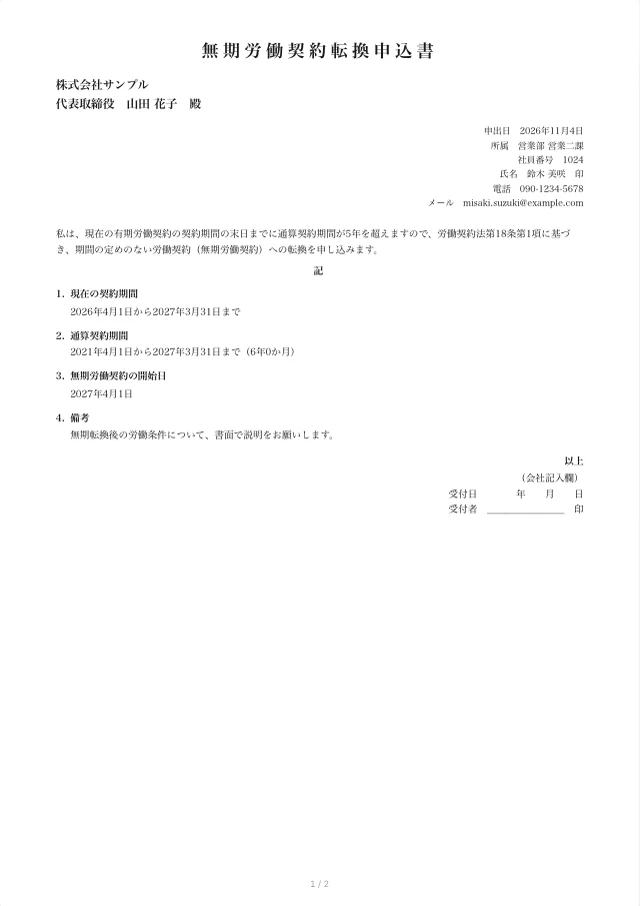
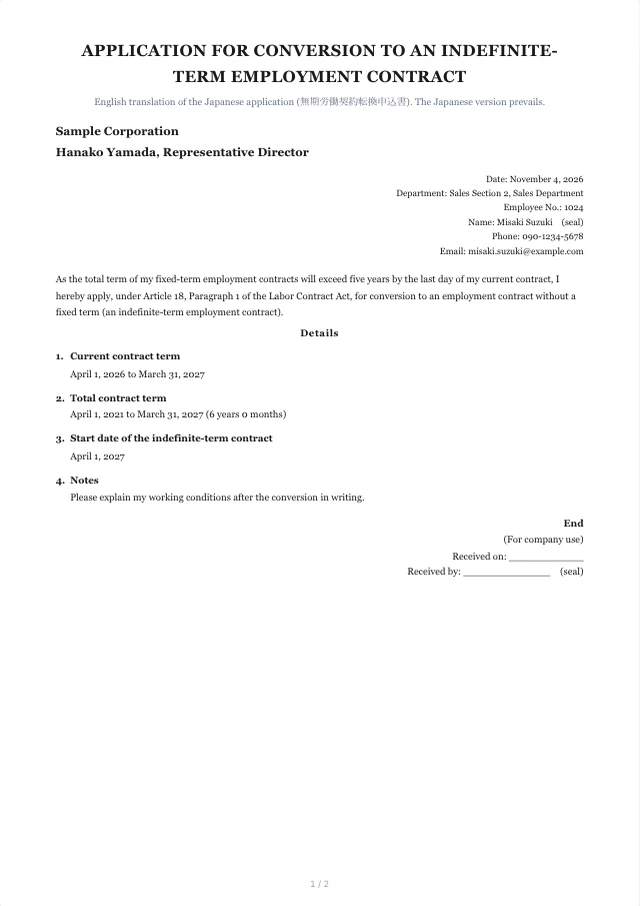
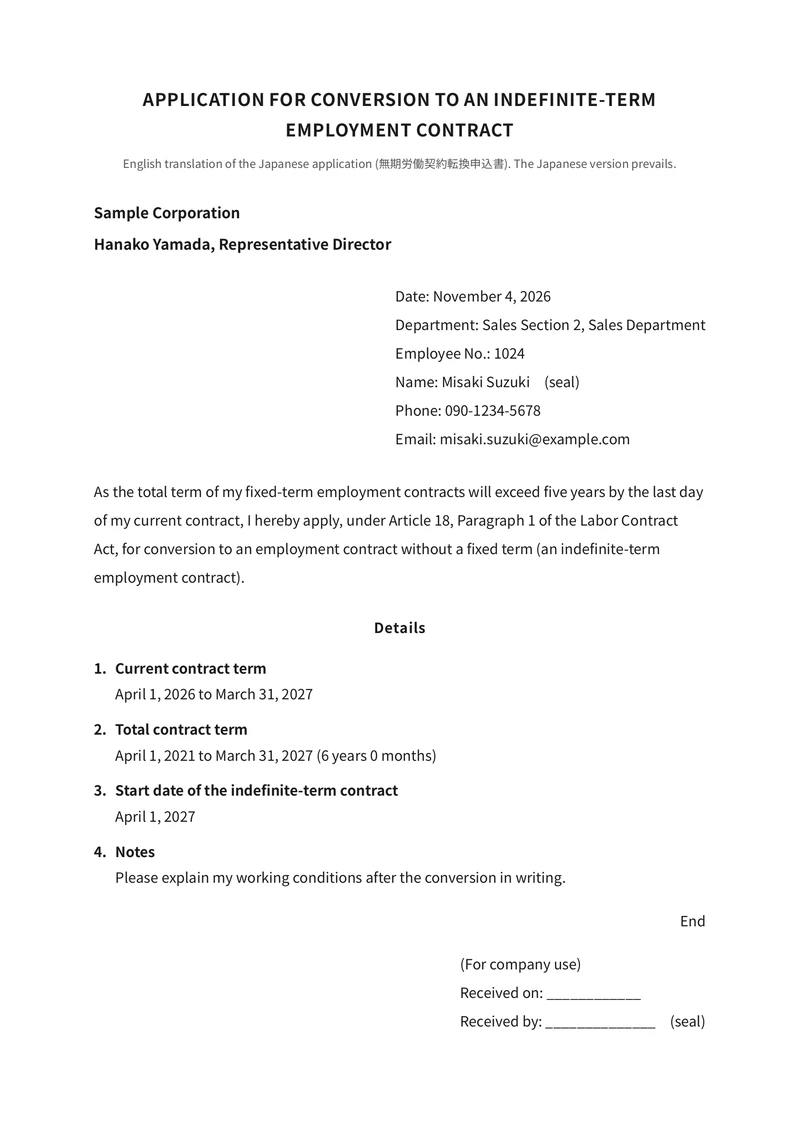
This is a filled-in sample of the application made with the template above: an employee on 1-year contracts, renewed five times to six years in total, applies for conversion from April 1, 2027, and the company's notice of receipt follows on page 2. The sample PDF and the Word template download after you enter your email address. The Word file is a format you complete by replacing the [ ] parts, and you can hand it out as your company's form. If you prefer Excel, enter the names and dates on the Input sheet of the Excel file, and they flow into the printable application and notice of receipt.
Muki tenkan application sample. The current contract term, the total term and the start of the indefinite contract go under Details, with a box for the company (date received, received by) at the bottom. The notice of receipt is on page 2.
The version to hand in is the Japanese one. Switch the template's preview to Japanese, fill in the Japanese version fields in each step, and the same inputs give the Japanese application and notice of receipt, ready to save as PDF. Use the English version to explain the document to an employee who does not read Japanese, or to an overseas head office. The English is a reference translation, and the Japanese version is the one that counts.
After conversion
Working conditions after muki tenkan: pay, retirement age and how it differs from regular employment
Muki tenkan changes only the contract term. Duties, workplace, wages, working hours and the rest stay the same as the last fixed-term contract, unless work rules or an individual agreement set other terms (Labor Contract Act, Article 18(1)).
Does pay go down? What "other terms" means
Unless other terms are set, pay does not change with conversion. "Other terms" means work rules, a collective agreement or an individual contract that set different conditions after conversion. The MHLW says that lowering conditions while the job stays the same is not desirable. Whether the conditions change or not, they are stated in writing at each renewal that creates the right to apply. Other terms can also raise pay when the role takes on the same responsibilities as regular employees.
Retirement age and work rules
Fixed-term contracts have no retirement age, so set one for converted employees in the work rules. Without one, a converted employee never has to retire because of age. The retirement age cannot be under 60 (Act on Stabilization of Employment of Elderly Persons, Article 8), and the rules should also cover someone who converts after reaching it. Employees rehired after retirement do not get the right to apply if the employer has a Type II plan approved by the prefectural labor bureau director.
How it differs from fixed-term and regular employment
Fixed-term, converted and regular employees compared
Item
Fixed-term employee
Converted employee
Regular employee
Contract term
Yes (up to 3 years in principle)
None
None
Working conditions
Set in each contract
Same as before conversion unless other terms are set
Regular employees' work rules
Non-renewal
May end at the end date
None (dismissal needs reasonable grounds)
None (dismissal needs reasonable grounds)
Retirement age
None
Set in the work rules
Set in the work rules
Transfers and scope of duties
As agreed in the contract
Same as before conversion unless other terms are set
As the work rules and contract set
Whether a converted employee becomes a regular employee is the company's decision: conversion alone does not make them one. The renewal clauses for contract employees are in the fixed-term employment contract.
Pros and cons of muki tenkan (company and employee)
Pros, cons and points to watch for the company and the employee
Side
Pros
Cons and points to watch
Employee
No more worry about non-renewal, and a career planned around staying. No consent from the company is needed to apply
Conditions stay the same unless other terms are set, and there is no automatic move to regular-employee treatment
Company
Experienced staff stay longer, with less hiring and training. No more renewal paperwork
Headcount can no longer be adjusted at a contract end. The category and retirement age of converted employees must be set in the work rules
How converted employees feel about their employer now (multiple answers)
MHLW, 2021 Survey on Fixed-Term Labor Contracts (individual survey)
No change (happy with current workload and conditions)
43.6%
Want to keep working longer
41.9%
Want the workload and conditions of regular employees
11.9%
Over 40% of converted employees say they now want to keep working longer. 2.5% say they want to leave or change jobs soon.
If the company talks with the employee about how they will work after conversion before the renewal that creates the right, both the statement at renewal and the notice of receipt are quick to prepare.
Legal basis
Legal background and limits
Muki tenkan is an employee's right under Article 18 of the Labor Contract Act. Before the company receives a muki tenkan application, check these six points, from how the application is handled to dismissal after conversion.
The company cannot refuse (Labor Contract Act, Article 18)
When an employee whose contracts pass five years in total applies, the company is deemed to accept, and an indefinite contract starting the day after the current contract ends is formed at that moment. The law sets no method for applying, so even if the company requires writing, it cannot refuse an oral application on that ground. A deadline in the work rules does not invalidate an application made by the contract end date.
The right cannot be waived in advance
Making an employee give up the right before it arises, for example by making renewal conditional on not applying, is understood to be void as against public policy, since it defeats the purpose of the law (MHLW enforcement notice on the amended Labor Contract Act, August 10, 2012, Kihatsu 0810 No. 2).
Stating the right to apply and the conditions after conversion (from April 2024)
Since April 1, 2024, at each renewal that creates the right, the company states in writing that the employee can apply for conversion and the working conditions after conversion (Labor Standards Act Enforcement Regulations, Article 5). If the employee renews without applying, the statement is repeated at every renewal. The company must also make an effort to explain how it balanced those conditions with regular employees (duties, level of responsibility, whether there are transfers and their scope). The MHLW model labor conditions notice words it like this (English translation).
Model wording (MHLW model notice, English translation)
By applying to the Company during this contract term for an employment contract without a fixed term (an indefinite-term contract), you can convert to indefinite-term employment from the day after the last day of this contract term (date: ____). Changes to the working conditions of this contract in that case: (None / Yes (see attachment))
Non-renewal and renewal caps (Labor Contract Act, Article 19)
Ending contracts before the right arises in order to avoid the rule is considered undesirable in light of the purpose of the Labor Contract Act. Where renewals have made the contract equivalent to an indefinite one, or the employee has reasonable grounds to expect renewal, a non-renewal that lacks objectively reasonable grounds and is not socially acceptable is not allowed (Labor Contract Act, Article 19). Since April 2024, whether there is a renewal cap (a limit on the total term or the number of renewals) and what it is must be stated in writing at each contract and renewal, and adding or shortening a cap later requires explaining the reason in advance.
Exceptions to the rule
Some people fall under an exception: either there are periods with no right to apply, or the right only arises after 10 years. The Type I and Type II exceptions apply only when the company drafts a plan and has it approved by the prefectural labor bureau director.
Fixed-term workers with advanced expertise: no right to apply while on a project that ends within a set period of over five years (up to 10 years; Act on Special Measures for Fixed-Term Employment, Type I plan approval)
Fixed-term workers kept on after retirement age: no right to apply during continued employment after retirement (Type II plan approval). The post-retirement rehire contract can include the exception clause
Researchers and teaching staff at universities and research institutes: the right arises after 10 years (Act on the Activation of Science, Technology and Innovation Creation; Act on Fixed Terms for University Teachers)
Resignation and dismissal after conversion
A converted employee can end the contract two weeks after giving notice (Civil Code, Article 627(1)). Dismissal by the company needs objectively reasonable grounds and must be socially acceptable, and a dismissal without them is void (Labor Contract Act, Article 16). Since the contract can no longer simply end at a set date, set out how converted employees are managed in the work rules.
FAQ
Common questions about muki tenkan
What is muki tenkan?
Muki tenkan is the rule that turns a fixed-term contract into an indefinite one (with no end date) when the employee applies after their contracts with the same company pass five years in total through renewals (Labor Contract Act, Article 18). The company cannot refuse, and the indefinite contract starts the day after the contract in which the employee applied ends.
When did Japan's 5-year rule start?
It started with the amended Labor Contract Act on April 1, 2013. The total is counted from fixed-term contracts that began on or after that date. That is why most people on 1-year contracts first got the right to apply in or after April 2018.
What happens to working conditions after muki tenkan?
Only the contract term changes. Duties, workplace, wages, working hours and the rest stay the same as the last fixed-term contract, unless work rules or an individual agreement set other terms (Labor Contract Act, Article 18(1)). Conversion alone does not make the employee a regular employee, and the retirement age and similar rules are set in the work rules.
Does pay go down after muki tenkan?
Unless other terms are set, pay stays the same as before conversion. The MHLW says that lowering conditions after conversion while the job stays the same is not desirable. Whether the terms change or not, the company states the working conditions after conversion in writing at each renewal that creates the right to apply (Labor Standards Act Enforcement Regulations, Article 5).
What changes with muki tenkan?
The contract no longer ends on a set date, so there is no more worry about non-renewal (the contract simply not being renewed). Pay and duties stay the same unless other terms are set. The company sets up the work rules that apply to converted employees (their category, retirement age, transfers).
Can part-time and arubaito workers convert after five years?
Yes. Contract employees, part-timers, arubaito and dispatched workers are all covered, whatever they are called, once their fixed-term contracts with the same company (for dispatched workers, the dispatching agency) pass five years in total. The right only arises from two or more contracts added together, though, so a single five-year contract does not create it.
By when does the employee have to apply?
Any day from the first to the last day of the fixed-term contract that takes the total past five years. An application made by the end date counts even if the work rules set an earlier deadline. An employee who renews without applying can also apply during the next contract.
Is there an official form for the muki tenkan application?
No form is set by law. The MHLW publishes a reference form (a sample application and notice of receipt for conversion to an indefinite-term contract), and this template follows its wording. An oral application also counts, but handing in a written one and keeping a copy is the safest way to have a record.
Can the company refuse a muki tenkan application?
No. When an employee whose contracts pass five years in total applies, the company is deemed to accept, and an indefinite contract is formed (Labor Contract Act, Article 18(1)). The company cannot refuse because the application was not on its own form or was made orally.
What if the employee does not want to convert?
Applying is the employee's right, not a duty. An employee who does not apply stays on a fixed-term contract, and if the contract is renewed, they can apply during the next one. Making an employee give up the right before it arises, for example by making renewal conditional on not applying, is understood to be void.
What is a no-renewal clause in a fixed-term contract?
A clause that rules out renewal or caps it, such as "no renewal next time" or "renewals up to X years in total". Since April 2024, whether there is a renewal cap and what it is must be stated in writing at each contract and renewal, and adding or shortening a cap later requires explaining the reason in advance. Even with a cap, a non-renewal may not be allowed when the employee has reasonable grounds to expect renewal (Labor Contract Act, Article 19).
Since when must employers state the right to apply for muki tenkan?
Since April 1, 2024. At each renewal that creates the right, the company states in writing that the employee can apply for conversion, and the working conditions after conversion (Labor Standards Act Enforcement Regulations, Article 5). It must also make an effort to explain how it balanced those conditions with regular employees.
Can a converted employee resign?
Yes. Under a contract with no fixed term, the contract ends two weeks after the employee gives notice (Civil Code, Article 627(1)). Check the work rules for a notice period too. Dismissal by the company needs objectively reasonable grounds and must be socially acceptable (Labor Contract Act, Article 16).
Is there a 3-year rule for muki tenkan?
No. The rule is five years in total, and there is no "3-year rule" for conversion. It is often confused with the 3-year limit on a single fixed-term contract (in principle; Labor Standards Act, Article 14) and the 3-year limit on dispatching the same worker to the same unit of a client company (Worker Dispatch Act). Renewing a 3-year contract once takes the total to six years, so the right arises during the renewed contract.
Can the application be made in Japanese and English?
Yes. Switch the template's preview between English and Japanese: the same inputs give the Japanese application, which is the one to hand in, and an English translation, both as PDF. Hand in the Japanese version and attach the English one as a reference translation.
DIY Hiring Kit
Everything You Need To Hire On Your Own
A downloadable hiring framework for small businesses in Japan, with step-by-step guides, spreadsheet ATS, LinkedIn scouting system, interview questions bank, offer letter and employment contracts, and a ton more!
1Dashboard11Checklists8Spreadsheets30Template docs4Weeks of Q&ABilingual
Download every file as Word, Google Docs, Excel or Google Sheets
Founder, SaiyouTeam · HR and recruiting advisor to SMBs in Japan
Former Google recruiter
14 years in recruiting
Emmanuel advises SMBs on HR and recruiting in Japan. Before founding SaiyouTeam, he spent 14 years in talent acquisition, including as a recruiter at Google. Clients often ask him about contract changes such as muki tenkan, so he built this free template. It follows the MHLW reference form and checks the total term and the start date of the indefinite contract as you type.
Whether the right to apply exists depends on the term of each contract since April 1, 2013 and the gaps between them. Check the dates on past contracts before handing in the application.




 14 years in recruiting